Tag: The Buddha

  • Capitalism’s possible impact


    Keynes in an essay had said “his grandchildren’s generation would only work 15 hours a week.” Apparently, that generation is in the workforce now. Are we working <2 working days a week? Far from it. According to some studies, working population of the developed countries are still working at least 34 hours a week (if not 40 hours). Possibly the prediction was incorrect by a generation.

    On a leisure weekend, we were wandering in one of the biggest cities of Latin America last month. It was our first visit to the country. We were talking about the way of living there and possible future for us. I said, in future, we may be working for enjoying what we do, not for earning our living. So, when Keynes said working 15 hours a week, it is possible that rest of the time, people do what they otherwise would want to do – it can be work too. Given a choice I would want to study, read books, wrote blogs 🙂 share my knowledge etc. Some of it I still do though, but over the weekends. Was this the future that Keynes saw as possible? I think yes.
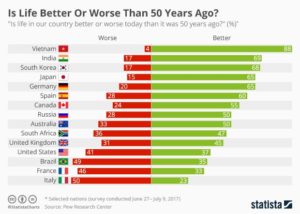
    Uber, Apple and Google are working on autonomous cars. We’ve technology intervention in everything – industrial revolution brought partial automation, technology revolution increasing automation. It is possible that in future organizations will be minting money on robots alone. Hopefully when we reach that state, we will be beyond food, shelter and social standing. In fact that possibly can be one of the reasons for the following outcome of a research – population of developed countries are not that happy. Perhaps our mind has the habit of occupying itself. When there is nothing to be occupied with, either one is unhappy or one can think of bigger purpose in life.

    The statistics can be contested such as – how were these 50 years compared? This discontent and prosperity will surely lead to the questions towards spirituality. When a society is prosperous that is when it starts or tend to move inwards – at times capitalism it is that provides opportunity to dig deeper within [From my previous blog]. I see a lot of people pursuing Buddhism or for that matter meditation in west.

    Besides, when development will lead to unhappiness, the journey of inwards will start. People will ask question – what makes me happy? That is when people will start working for 15 hours a week for wages and rest for self. I see that as an impact of capitalism. When that happens economies would not remain purely capitalistic. There will be change in our approach of economy, it wont remain purely capitalist.

    Image Source – https://twitter.com/nareshnshahani/status/938937338431807488 tweet from – Mr Naresh Shahani.

  • At times capitalism it is!


    CD of Jane Fonda can be more useful for you to learn Yoga – an Indian physical, mental and spiritual practice. When you watch her video you are likely to feel as if she is a native to this art, have you ever thought why? It is not a case of go Yoga alone that many Indians would neither know nor will be able to practice such things well. It is the case with practice of meditation – an eastern method of consciousness – too. Would not you be impressed with many foreigners not only talking seriously about meditation but also practicing meditation religiously and needless to say better than many Indians.

    Have you ever wondered why? What happened that we have relegated such a unique knowledge to either books or only to religious institution? At the same time how the Western world has been taken to these practices with ease and are excelling in it? It would not be surprised that in next 100 years there would be more spiritual readers from the Western world than from India or South East Asia.

    There was a time when India was prosperous. Prosperity makes one question the significance of life, after life and whys of existence. It is unlikely for a hungry stomach to think beyond food. It is difficult for a person in danger to think about higher purpose of life; not impossible but difficult for sure. I remember my professor Dr Anand Saxenasaxena-sir-25dec12 told me –

    गो धन, गज धन, काज धन, सबे रतन धन ख़ान|
    जब आवे संतोष धन, ये सब धुरी समान||

    Go dhan, gaj dhan, kaaj dhan sabe ratan dhan khan
    Jab aave santosh dhan ye sab dhuri saman.

    Meaning:

    It is true that owning cattle, jewels or kingdoms is mine of wealth
    But when you own wealth of contentment (satisfaction) those mines (cattle, jewels etc) of wealth become worthless (like dust)


    I love capitalism because it gives an individual the possibility to be prosperous. Prosperity, at least once, can give a person a chance to raise questions on existence. I believe capitalism and what follows, for example wealth, well-being, abundance etc may make one question – why and how of cycle of life. That is why probably Jane Fonda is a better practitioner of Yoga and many in West are turning towards meditation.

    When a person goes beyond food, shelter and social standing one can think of bigger purpose in life. It has been story of many warriors in India – Mahavir or Buddha. Shashi Throor in one of his famous speech said before Britisher’s arrived in India, India had 23% of the world GDP. That is as much as if not more than current GDP of USA’s proportional GDP to the world. When a society is prosperous that is when it starts or tend to move inwards – at times capitalism it is that provides opportunity to dig deeper within. It seems very counter-intuitive though but that is how the logic of Business to the Buddha; that is how the journey for within may start for the West.

  • Constraints and contradictions


    This blog from business to the Buddha was started when I was completing my MBA. Few of the sessions on economics, marketing, Organizational behavior and supply chain made me realize that there is more common to business, economics, management and spirituality; in particular concepts of Buddhism than what we think. Though I used to feel it since I moved to Mumbai a decade back in 2006. This thought moved into a wordpress blog – business2buddha.wordpress.com because MBA gave me not only a formal education in management but also time to think about the relationship. At that time, I never thought that this choice of writing can be such that I keep on writing for 7 long years. Of course there was a hiatus in 2017 due to some other personal commitments. My thoughts have always been on finding out relationship between business / economics concept to spirituality (in particular Buddhism). The fascination makes me feel that we are on a path of moving from “me” to an “us” society. A society from competition to co-existence, from Business to the Buddha. I wish this comes out to be true.

    Off late I am hearing a lot about “mindfulness”. Some months back Harvard Business Review wrote about it. Initially it made me happy. I was thinking that mainstream is accepting the concept which I had been writing about for some time. Occasionally, I feel that this “mindfulness” thing has become more of a buzzword than a real practice. Hope it does not end up being – six sigma, innovation, analytics and big data type hype. The purpose of mindfulness is for “self”, in effect helping organization and society. Hope mindfulness does not end up like the other buzzword of management jargon; hope people do not end up making it a business and “whats in it for ‘business‘” alone and keep it more practical and individual practice than a corrupt practice of survival of business.

    The contradiction here has been the approach. I have moved from Business to the Buddha. The movement from business to the self and self realization and coexistence. The approach of management jargon seems to be the other way round. Making business out of the mindfulness or possibly trying to get “competitive advantage” or some sort of “benefit” for business from the path.

    I am optimistic about the move from business to the Buddha. In fact when I realized that I might be making a mistake of showing or possibly thinking of a movement from Business to Buddha I bought a domain – www.SaintInSuit.com though I am yet to write on that. I am thinking that I will let people write on the website – their experiences, their relationship between business, management and spirituality. The idea is not to restrict to the Buddha alone. There are other methods, thoughts, concepts and teachings on the path of spirituality that have strong affinity to business. Though I personally can recount more examples on business and spirituality with Buddhism than other religion.

    The concept of Saint In Suit is a thought of middle path, the method that says one can be spiritual without renouncing. One can do business without negatively affecting his/her personal choice of following spirituality. We (predominantly in India) think that there is a constraint between business and spirituality, however we miss out – Saint Kabir was a businessman, so were many others just few examples Gora Kumbhar or even the worst you can think of Kanhopatra was a prostitute. Even the Buddha at a later stage of his life accepted that – one does not necessarily renounce to self-realize.

    There is neither contradiction nor constraint of being a saint yet a businessman. Though, I am worried if people make business of mindfulness specially when it is a showoff than for real change.

    Constraints was a topic for LBC in Sept 2017, as usual I changed the topic a bit and wrote on it well past the week when it was due. You can see what the other writers of the LBC have to say in their respective blogs.  Maria, Ramanna Uncle ji, Ashok and Shackman.

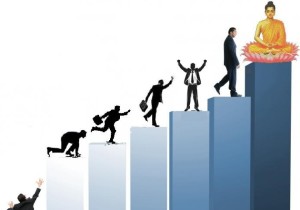
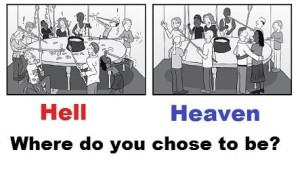
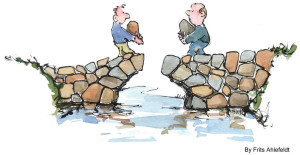
    Image source – first image my creation and second image – Image source – http://www.bravefury.com/six-reasons-men-should-do-yoga/

  • Options, analysis and decisions


    I have been analyzing buying a house vs living on rent and buying a four wheeler vs riding a cab. This is not a new comparison and analysis for me. Most of the time, answers to these two were – buy a house and rent a car or use a cab service.

    How did I arrive at these conclusions? Of course after some calculations and considering options. The question is – what was the measure on which I measured these things to come up with some conclusion? The measure was “utility”. In economics utility means resultant benefit achieved from something (usage or consumption of product or service). When you eat Idly on road side @20 INR and when the same idly plate is served to you in a better place it could by @60 INR. We may argue about taste, hygiene etc of idly from 20INR to 60INR. When one moves from basic utility to additional utilities we measure that in terms of marginal utility. Marginal utility, is the incremental benefit one gets from consumption or usage of an offering.

    We can continue from our situation of buying a four wheeler. The first question one may have is – which car – SUV, Sedan, Hatchback. Once that is decided which company which brand and what amenities such as AC, power window and music system etc. There are obviously many more questions in making a decision. The other option is hiring a local taxi or app based service. After all this analysis – what one gets is drop from point A to point B. At times pain of parking – if it is owned car or self driving. The drop from A to B is utility in this case. Marginal utility is – can you play music of your choice while driving or is the vehicle air conditioned during the trip. In the bargain of ability to play music and air conditioning you need to pay extra. This extra amount vs the additional benefit you get defined marginal utility.

    Many of our life decisions are made emotionally and justified rationally. I analyzed a lot with a decision of buying a house and renting a car. Currently, I live in a rented house and drive a car. How often do we take decision by listening to our heart and mind? Is there a rational justification to our decision? Why do we take such decision? When we have to really take a plunge with faith, we falter. When we have to take a decision with full analysis we do the opposite!

    Give it a thought – Mahavir and Buddha – both were from warrior families and were to be the kings. Why did they renounce everything, how on earth they both might have taken such step? Had they both done enough analysis possibly both had stayed back. I know more about the Buddha so can think of an incident, when he was following extreme austerity such that he could had died of hunger, he decided to eat. In short term his five best friends went away saying he has left the path. But the Buddha was right, austerity and self affliction may not necessarily help. He said to himself, if I die of hunger I wont be able to achieve what I strive for.

    In my analytics practice one of my senior’s Eron Kar used to say – “If you torture data enough it will confess to the story you want it to narrate.” Always it is not right to over analyze, at times leaders need to take a leap of faith and decide.

    Prof Mankad told me once – “Pravin, when you become a leader, sitting in the 76th floor of your corporate office when you have to make a tough choice do one thing. Leave aside all the papers and analysis. Walk toward the window. Take out a coin from your pocket, toss it and you will have the decision.” Dr Mankad continued “Pravin, sometimes you should stop over analyzing.” I need to learn a lot to do that one I have to become that big a decision maker of a company and two stopping the urge to analyze everything, I still analyze a lot!

    Image source – http://novalo.com/flat-fee-self-employed/

  • Hidden potential


    I had inflammation of gums recently and was not able to eat properly. Instead of looking for solution first, I started looking for causes why I had this swelling? Root cause of the same of my eating roasted corn. So, next time onwards I will be careful when eating roasted corn. Currently, I am having backache, all due to wrong postures while working in office seating in office.

    We do not even notice small integral parts of our body such as gums or back until we have a trouble with them. These parts exist and function as per their role in the physiology of our body, yet we are in oblivion of them, until those have some issue – for us those are almost nonexistent until they let us know they exist and have some limits, in my case it was backache and gum’s swelling. I had kept on noticing gums every time I put something in my mouth, back is reminding me of it’s existence until now.

    What is hidden? Hidden – to us human beings – is something that we cannot perceive. The gums and back was something hidden until I had troubles there, it existed physically, I knew it existed but I did not notice it.

    Perceptions are another limitation, our perceptions are limited to our five senses. If something exist beyond these senses we may not know of it’s existence such as noise beyond a certain range.

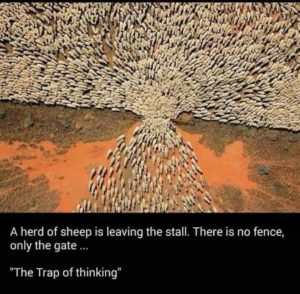
    We cannot see air, it does not mean it does not exist, we know air is there because our sense of touch can feel it – breeze or cold. A seed has a possibility of become a tree, that is it’s hidden potential. We cannot see it manifested and thus we do not believe in it; that is our problem. Our perceptions are actually created by our previous learning. In the image here, there is no gate or fence, it is all in the minds of sheep.

    I have written on it earlier on perceptions and specially here what I learnt from Sai kaka, about our past impressions –
    Sanskar yukt chaitanya jab (संस्कार युक्त चैतन्य जब)
    1. chintan karata hai to usko chitt kahate hai (1. चिंतन करता है तो उसको चित्त कहते है)
    2. manan karata hai to usko man kahate hai (2. मनन करता है तो उसको मन कहते है)
    3. nirnay karata hai to usko buddhi kahate hai (3. निर्णय करता है तो उसको बुद्धि कहते है)
    4. asmita ka bhan karata hai to usko aham kahate hai (4. अस्मिता का भान करता है तो उसको अहं कहते है)
    inme se sansakar nikal jaye to jo bachata hai vo shuddha chaitanya hai (इनमे से संस्कार निकल जाए तो जो बचता है वो शुद्ध चैतन्य है)

    A rough English translation of the same is –

    When a conscious filled with rituals (or say the lessons learnt about ‘way of living’, include religion)

    1. thinks we call it mind (imagination)
    2. contemplate we call it Mind [there is a difference between Chitt and man which I am not able to translate in English]
    3. makes a decision we call it intellect
    4. perceives pride we call it Ego

    Now when the rituals, religion or ‘way of life’ learnt, get out of this conscious mind, what is left is the pure consciousness.

    It means “pure consciousness” is blurred by our different (Sanskara) learning about life. Therefore in some cases religion becomes a problem.

    This is the problem of our perceptions such as we think East is far different from the West. Can we try experimenting – a kid born in Say US should be reared in India and vice versa. Would these kids grow up to behave in similar manner such as US born kid raised in India, would behave like any kid born and raised in US and vice versa? When we talk about East Vs West our perception are based on the “sanskar”, at times those are the hidden potentials.

    Hidden potential was an old LBC topic, I wrote on it today. Loose Bloggers Consortium is where MariaRummuserAshokShackman and I write. You can visit their blogs and read their thoughts on the topic.

    Image source – unknown currently.

  • Education


    I and my wife were rushing to our offices on our two wheeler. This a routine happens daily (include Saturday for her). Actually, this race to office is common place in Mumbai. Many go without interest and many others like us go not only with choice but also to make a difference. Yes, sounds strange – what difference one person can make? But this is how I and my wife take our jobs “very seriously”. This race starts in the morning at about 7:30 AM and ends at about 7:30 PM in evening or later. Now, do not ask – how much difference we have made in our respective companies or our own life. When I ask this question to my self – at times I feel as if we both are running on a treadmill. We are running very fast but are not reaching anywhere on a treadmill.

    This day was no different, we were on our two wheeler, it was not raining. Rain had played a lot of games with us recently. Whenever we were wearing raincoat, it didn’t rain. It was bit sunny and therefore we thought its may not rain today, hopefully by we reach office. Suddenly it started raining and raining like anything, yes this was shocking but happens. So instead of rushing I stopped our vehicle at a bus stop shed and we both wore our raincoat, besides we waited for rain to subdue – it was not very cloudy so we knew it wont rain for long. Ten minutes and it stopped, we started our rush to office again, this time we did not take off our coats.

    In these ten minutes I learnt something interesting – some times, “it is ok to stop in life instead of rushing.” On the contrary it was good to take that break in this particular situation rain stopped.

    When are we going to teach such things to our coming generation? I thought that we teach many things to our children however most of the time, it is for economics returns and not necessarily for living a fulfilling life, just an example – instead of rushing and running just being. An after thought of this question is this – education is a very formal approach, whereas learning is informal. Learning is – stop somewhere instead of rushing; on the contrary education – that is a formal one – makes one assuming rushing to the destination is the solution. Before anyone makes any opinion about my thoughts – I am not trying to undermine education (certificate based formal teaching), it is required to help an individual to be economically better off and help the society take an example of Kashmiri stonepelters – if they get a regular job they wont unnecessarily go out to support terrorists.

    Education was last week’s LBC topic where Maria, Rummuser, AshokShackman and I write weekly. You can visit their blogs and read their thoughts on the topic.

  • Melting pot


    I am sure when we read the title we all will speak about culture and nation. My take apparently is no different. India as a country, culture and in terms of way of life has been a melting pot of thoughts. If we look at Mahabharat time – there were many kingdom fighting from one side or the other in the war. The range goes from present day Afganistan to South East Asia and Kerala.

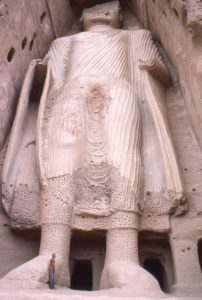
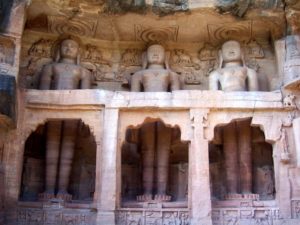
    Afganistan reminds me of Bamiyan Buddha statues. The smaller statue was so big, check photo (sourced from Wikipedia), that a man standing at the foot measures only till the ankles. The statue reminds me of Gwalior fort Jain tirthankar’s statues. No wonder, when I saw them some had disfigured heads.

    The Buddha was basically from Nepal. He came to India for his quest of spirituality. India at that time too, was a confluence of different ways of life. Buddha studied with same master’s who were worshipers of fire, some teachers were of Yoga and Indian philosophies. After learning so many things we was still not self realized. After six years of hardwork, following many different teachings – including fast he was emaciated and almost on the verge of death. That day he was enlightened. Lord Mahavir was his contemporary – he had a different teaching. Both the teachings blended in Indian culture.

    Indian culture basically accepts many different approach of spirituality and religion. The best blend you can see is Bhagvad Geeta. It talks about Bhakti, Gyan, Dhyan and Karma yoga etc. Every chapter in the book is a type of Yoga – yoga means addition. What does a melting pot do – it mixes everything. Right? That is what Yoga is. I have written on Yoga earlier too – including a debate and court case in the US – whether Yoga is Secular or no!

    The question on secularism moves me to another dimension of India. We are secular, and in last couple of years Indian intellectuals (apparently others are equally intellectuals but are considered lesser) have returned awards for lynching of a Muslim Indian citizen. It was a sad incident in the state of Uttar Pradesh during Akhilesh Yadav Government (Samajwadi Party, which apparently is more Muslim centric political party). Recently, another lynching happened – a police officer was killed – muslim Indian citizen – in the state of Jammu & Kashmir, this time state Government is a coalition with BJP (more Hindu tilting political party). Last time the intellectuals returned awards, this time no one came forward! This is all economics of power.

    Economics reminds me of an interesting fact of Indian politics. The best economists – Mr Manmohan Singh and P Chidambaram – came up with farm loan waiver in last decade. When a non economics expert can understand that it is not a solution why a renowned economist takes such a decision – a melting pot you see. The decision was a confluence of politics in economics.

    All the above thoughts are in a melting pot here. My thoughts mostly are  multi-directional – so this blog moves from socialism to capitalism and spirituality to business etc. The melting pot includes few dreams I have – one is here, add to it wish to help Sindhutai Sakpal‘s Orphanage, Art of Living foundation projects and rainwater harvesting in Malwa region of MP. I wrote to one District Magistrate, never received a response, not even from CM’s office – is this a participative government?

    Melting pot was this week’s LBC topic where Maria, Rummuser, Ashok and Shackman write weekly. You can visit their blogs and read their thoughts on the topic.

  • Perceptions and illusions


    Off late, I have – kind of – become forgetful. One of my friends shared someone’s phone number with me, a couple of days later, I bet with him that I ddin’t get that number. We checked Whatsapp, SMS, emails and not to miss address book too. I almost won the bet, thankfully it was not a monetary bet. I still kept on searching – in my “notes” app too I could not find. My friend told me the whole incident and I got a hunch, I think he did share the number! But to my utter surprise I could not find the number anywhere.

    Well, I asked him that number again, he was bit annoyed yet gave me the number. I recalled – he had shared such number once – though I did not remember the whole number. It made me think about what happened in this situation? This incident made me understand that many a times we take things for granted, we tend to ignore many things. When we ignore things we are likely to be bodily at one place and mentally at another – in some fantasy or illusionary world. Isn’t it? The illusion we create through such mental images either become our perception or mend it and thus our limited (or at times incorrect) realities are created. For example – my forgetting my friend’s sharing the number with me as “You didn’t share the number”. If such incidents are not realities how do we know what is reality? In fact I think we need to ask ourselves – what is reality?

    Life is simple – the illusions we assume as reality make it difficult. The fantasy we create are based on our perceptions or our belief of some reality. Our perceptions make our life difficult isn’t it? Let us say – an illusion – “our religion is under threat!” If a religion is one of the biggest in terms of number of followers – what is the threat?

    We are so preoccupied with our own illusionary world that we miss many small things needless to say important or that which are the realities.

    I suggested this topic for LBC, however for last couple of weeks I was not able to write regularly. You can read my fellow bloggers post on this topic at – Ramana uncelji, Shackman and Maria. I am trying to catch up with my backlogs of weekly blogs on spirituality, management and business.

    Related blogNo judgement – its all about perception

  • What would you do in long term?


    In the long run we all are dead – John Maynard Keynes

    I was talking to my boss. He throws interesting questions – what do you think of next disruption? Ok do not talk about bitcoins, healthcare and analytics has already plateaued! Hum! That is a challenge. Wish I knew what is next disruptive business, technology or industry.

    I asked myself, is there lack of cloths that people die of severe cold in winter in India? Is there lack of food on earth that people die of hunger in world? If there is lack of cloths or food, why are our retail stores full with cloths, and food wastage is ~33% or so (National Geographic).

    My mind goes in a very long term when such questions come to mind. I believe in next hundred or hundred and fifty years or may be sooner, we would not need money (currency) or any such thing. This is very surprising for the financial system, businesses or capitalistic mind to believe. Let me elaborate. Have you seen Uber? Has Uber made ownership of car redundant for many people?

    What if our all basic requirements are fulfilled in the same manner – for example, I have some cloths in my wardrobe, I do not wear them all in a day. I wear only one at a time. Why should I have so many cloths? What if we can just select what to wear, wear it and return at some location when we are done! You may ask a question – then how would people earn money or offer services? Uber ride requires cash, card or wallet payment. Let us think of a future – car is driven by machine, cars are run by electricity, electricity is produced automatically by nuclear power and cars are manufactured by machines. No need of a human being for anything. Remember Keynes idea of working 4 days a week or lesser. Actually our capitalistic mind does not approve of this. People must work to earn their living. The best thing is – only capitalistic approach of running for better, more, improved can help us reach the state of future which is imagined here.

    When everything happens automatically, so what would humans do to earn, or say passing time? Can you relate the first part of previous sentence with the nature? Everything happens automatically for animals and they just pass time, they do not need to earn their living. Just think the phrase “Earning your living”! Does not it sound surprising thing, you just live, is not it? You do not need to earn it. I know you might have felt offended when you read automatically and comparing humans with animals. There will be a difference – our evolved sense of self and ability to think. This ability will force us to think about our existence. Our most of the time will be involved in thinking about our existence. This may take some time, when people will get fad-up with their pleasures – perhaps the way Gautam the Buddha got disenchanted. In that world we would not need money, we would not have a lot of possession, yet we will have everything on our finger tips.

    Just look at housing in Tier-1 cities in India. There are many unused inventory kept, most is out of budget for many people to afford. I see a future where whole world will be a rambling place and a type of hotel, where you can stay when you end your day. These houses will be built by machine and thus we would not need to buy or rent them either. Money as a concept will vanish. When you would have whole world at your feet, you would not steal, you would not look for possession. You would be lighter as Mirdad said in ‘The book of Mirdad“Less possessing – less possessed”.

    Here in above paragraphs we spoke about basic needs – cloths, food and shelter. I am sure humans will evolve to self-actualization phase – of Maslow’s need hierarchy – if the above happens (Ok give and take few carnal desires). In the short term, I would want to make that type of world envisioned above. In the longer term, I would want to be self-actualized or say enlightened in this life itself.

    What would you do in long term? was the topic for the week for LBC (Loose Bloggers Consortium). I had suggested this to the group where – Maria, Rummuser and Shackman also write. You can read other LBC authors opinions on their respective links.

  • Business and Humanity


    The visionary thinks beyond his company or his immediate profit. He thinks of the larger good. And, that is what makes him different. There is no place for labor exploitation and harassment of workers in such an enterprise

    I have been thinking about both Business and Humanity repeatedly. The above quote was one that caught my attention. This blog was due in Sept 2014. Yes a lot of things come in mind and thus ideas get spread, and forgotten at times.

    I revisited this title with reference to an interesting news of recent past – Donating the milk of human kindness. This kind of businesses and business ideas impress me a lot. There are a lot of social enterprises that work on the balance between Business and Social good. I have written a couple of blogs on social enterprise earlier. At times it is very difficult to survive in competitive markets with such a cause. There may have been a lot of other companies that probably we (I) might not know and were wound up due to financial crisis. When such closures happen, I start questioning myself again – what is the purpose? Why we work? and many other such leading questions. These points make me wonder many a times, that perhaps when we did not have the concept of money, humans were valued more. With Humans, human values were respected more. With human values, we probably were more caring, just and welcoming.

    The other thoughts going on in my mind were – my recent vacation to Ganpatipule and a video clip of actress Mahira Khan which is going viral of late. In Ganpatipule I visited “Prachin Kokan” a tourist attraction there. It is a place to know about how was Indian social fabric in past, for those who have never lived in Indian village or are kids growing up in tier-1 or tier-2 cities in India it could be a place to know how was our society. Though caste system was depicted there, I could not find a mention to “untouchables” there, so I may be able to write on what was wrong in past – compared to what we learnt in schools. In that museum I could relate to business and humanity working together in historic India – such as a bangle seller would not take money from a baby girl of village. At the time of the girl’s marriage, father of the girl will give this bangle seller gold coin or something. I wonder if we were less ambitious (perhaps driven less by wealth) – as a society – during those times. I could relate this museum and that society to gratitude.

    Gratitude, made me connect to the opinion and viral video clip of Mahira Khan. In this video I felt that if this actress had problem with India she should have refused working here. Though the interviewer is talking more in the clip, but if a person has so much issue with a whole country he or she should just keep oneself away from them isn’t it? This shows a person being opportunistic and thankless. This thought makes me go round to business. The actress is doing business, by acting in Indian movie. Agreed! The question again comes back – can we club or say compromise – “business and humanity” and “business and our self-respect” and “business and our values”?

    Quote – Business Standard article – Buddha at Work

    Disclaimer – author has not seen/visited the website of BabyChakra (referred in the donating the milk of human kindness), nor is related to the company.