Tag: The Buddha

  • Single word sentence that changed me

    It was year 2000, I was doing my Engineering away from home. This session was stressful; I had never failed in any academic exam until that year. I failed in one subject of my engineering. The result was about 5% for that subject for our batch – across the university. There were various discussions on the results in University, colleges and among students. Some toppers or top 10% student have also failed in the exam. Disclaimer: I was not a topper during Engineering. Once, professor who taught, set paper and evaluated the subject had openly said in classroom – “I had passed few students because I knew their parents!” It was a shock to many.

    The above mentioned was kind of first of my academic failure. Though one was inability to make it to IIT, however it was mixed feeling that time, as I had made it to State Pre-Engineering test (with rank). There are shocks and failures that teach you biggest lessons in life than any success.

    Single word sentence that changed me

    With the grievance, I went and spoke with a professor of our department. He was also aware about the whole incident of this particular subject, exam, teacher and batch. I was immature, outspoken and outraged. When you are away from home, no family support and just crossing your teens, you may become very aggressive or meek. The young age also gives you extra bit of adrenaline. With full of anger, I spoke with him– “<a lot of story>. Does the institute want me to ask my parents to come and network with professors? They are also teachers; they too have responsibility of teaching students to make their future. I never failed, had been a bright student academically, who is responsible for this result? How can I secure only 22 marks when my mathematical equation based solution worth 20 marks was correct? Who is responsible for this?” I was venting out like anything!

    He heard me carefully, looked at me patiently, and responded – “Situations!” This one word sentence I don’t know how, made an immense impact on me. Probably, the reason was not that one sentence alone, it was the countenance, the manner, care and concern. It was said with compassion that made the difference. That one word resonated with me for a long time. Perhaps, it is difficult to understand what I am saying, however this interaction left a mark on me.

    Lesson for life

    We get carried away by results, we many a times, consider ourselves something probably we are not. In this particular case – I thought of myself as a failure, though I was not. There were circumstances where someone fail, that does not prove that the person is a failure. It is like seeing a steam of water flowing. You be an observer, water keeps on flowing, as Lao Tzu said – “…grass grows by itself.” Our life situations are like this, most of the times we get carried away, the way I was. We get wet in the stream of water. However, when we become an observer, our perspective and paradigm changes for many things.

    Our problem is that we get carried away by people, situations, results and many things around us. These things make us vulnerable. When we become an observer life changes multifold. My professor’s answer “situation” somehow changed my paradigm of thinking. It was difficult to understand what has changed within at that time, now when I look back I realized that one answer changed me and involuntarily made me an observer, that time I had not practiced any meditation either, that one word somehow moved me towards spirituality.

    I did not apply for revaluation; I had lost faith in the examination system – where a teacher wanted my parents to network, rather than me study or teacher doing his duty diligently. Next semester I passed the subject, which had to happen anyway. The biggest positive for me was I became mindful, spiritual and aware.

  • Happy Dussehra

    We celebrate the festival of Dussehra as win of good over evil. The conflicts were between two different parties – be it Rama and Ravana, Durga and Mahishasura. We are taught these overt conflicts. There is a subtle / covert lesson in these conflicts – the duality of mind. Our contest is with us inside our mind.

    Ravana was very intelligent and capable ruler. As a kid, I watched Ramayana on TV. I used to ask this question to my siblings and parents – “how can a person have 10 heads?” To this I was told, it is symbolic. Ravana was so intelligent that he could have shashtrarth / serious discourse (discussions) with 10 different people simultaneously. Ravana was scholar of Shastras and Vedas, that’s the logic of saying 10 heads etc. Besides all this, Ravana was most respected devotees of Shiva. How can a devotee of the supreme lord be evil?

    Happy Dussehra

    Imagine, a person of such caliber, such profound knowledge and power be known for all the wrong reasons! There are a couple of reasons for that; one is power corrupts and absolute power corrupts absolutely. Further, we need to learn – “with great power comes great responsibilities”. As Uncle Parker says to Peter Parker in the Movie Spiderman.

    When, I look at these historical (for some people mythological) events, I see the easiest way to avoid such conflict is the eight fold path of Buddhism.

    1. Perfect Vision,
    2. Perfected Emotion,
    3. Right speech,
    4. Right action,
    5. Right livelihood,
    6. Right effort,
    7. Right mindfulness, and
    8. Right meditation / Samadhi

    These are the virtues that can be explained to our generation in different manner for example – right livelihood for the Buddha was dependent on begging. In current generation I believe everyone should be self-dependent for livelihood. When some scholars say Right resolve (in the above list it is replaced with emotion), they explain it as life of a hermit giving up the world. When the Buddha attained enlightened I remember reading in some text he said, “It is not necessary to leave the world, one can be enlightened being a family person”. He propounded the Middle path for the same.

    The real flight or contest is within, we can be the best in anything – as Ravana was. However, what matters is how we remained centered to be good. So, if we start taking these eight fold path doctrine in context of our generation, we can be as intelligent as Ravana and as good as Rama. The choice is always ours. This Dussehra I wish we all learn to fight our internal conflicts and Good wins over the evil within.

    Image source – Amar Ujala

  • Cost of poor quality

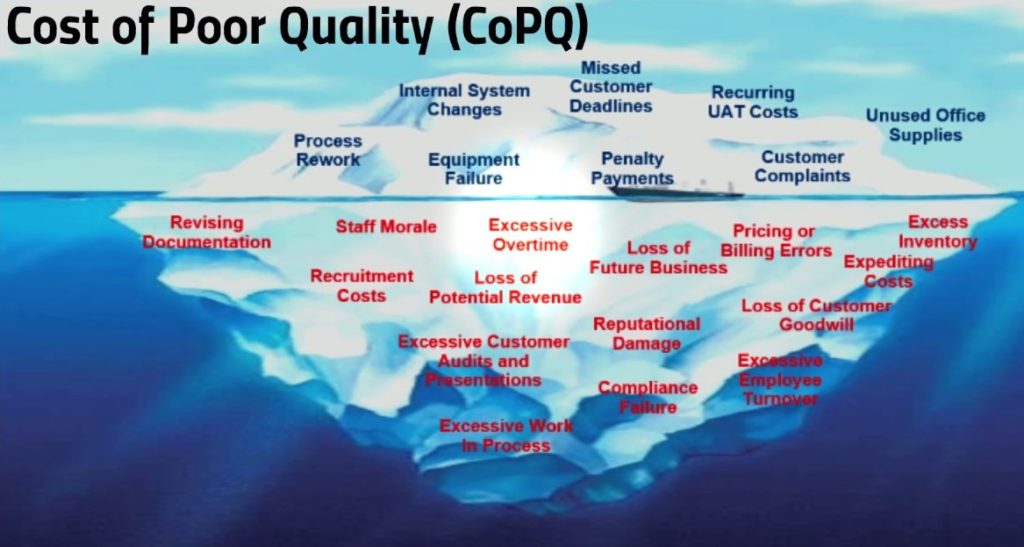
    Cost of poor quality (CoPQ)

    In operations improvement, Cost of poor quality is a common management term. Sum total of all the costs that are generated due to defective material produced by a system is CoPQ. There are various costs defined in management systems for this. You can read more about CoPQ at iSixSigma.

    A naive example

    cost-of-poor-quality

    Since, management example for CoPQ can be complicated by jargon. So, I am taking liberty of making it very layman with few variations in explanation. The context is very India-centric here. There is lot of corruption in road construction projects in Indian cities. Almost every year during rain (otherwise too at some places), these roads are full with potholes. Some people say – you need to search road within the potholes. Why go to any other city – Mumbai is a living example of the same. These roads result in – untoward events (possible serious accidents), high cost of vehicle maintenance and repairs, poor vehicle mileage and at times backache to the travelers even with good quality shock-absorbers of the vehicle.

    The evident cost, in case of Mumbai roads alone, is repairing same patch of road in single season at least 3 times.

    Example of CoPQ In life

    Terrorists – they are an example of CoPQ to society, they waste their life as well as killing other people. Say one of the person’s killed is an educated, married person with a child in his 30s. Death of this person is a loss to the Society, a talent who added to the GDP. The loss to the GDP is for about 20+ years the person could do. Family and child lost a support system. This loss of support could eventually result in inability to blossom and become a better contributor to the society. Society can be better off if a terrorist commits suicide without causing any other damage. Though it is a loss again to the society that a person is dead without adding any value to the society, however it is better than the trouble that person could be to the world.

    Depression of an individual is CoPQ for self and society. The society is losing time and skills of this depressed person. Actually, interdependent co-arising plays an important role in our society. CoPQ can be derived from interdependent co-arising too. If we understand the concept of interdependent co-arising society can reduce terrorists and depression patience.

    How to reduce CoPQ for society?

    When I was thinking about what we humans ban do to reduce the cost, I came back to the same old point – meditation, spirituality and teachings of Buddha and Jain Thirthankars. Both Jainism and Buddhism emphasis on concepts such as non-violence, non-stealing, fidelity etc. Corruption is a type of stealing and terrorism is violence. If one gives proper heed to the virtues, roads will be of good quality and if one meditates regularly his quality of live will improve multi-fold. In essence, practicing these principles the Cost of poor quality can be reduced drastically.

    Image source – Cost of Poor Quality – pt4 youtube video

  • Businessman Buddha

    I was extrapolating to get into a mind. The mind of a person – who left everything and went to the Himalayas. What changed for him, how his mind responded to the alone-ness. What was going on in there – in the mind? Why he left the society and went to the hills? What conspired? How he changed there? Would he be the same changed person when – in case – he comes back to the society?

    Middle-Path

    Can one have the same mindset of a hermit of Himalaya, in the concrete jungles? Can one balance being a hermit in the concrete jungle? Is it true that people find peace of mind in Himalayas? What is different there and here in the worldly city?

    My recent experience of Art of living‘s Anand Utsav course has given me few more questions and dimensions. Last week I wrote about listening to the tik-tik of wall clock. My wife entered the room switched on the fan, I missed the tik-tik. This is what happens with us in our daily highly demanding and at times stressful professional life. We miss very many things in the noises of becoming someone, owning valuable things, money, designation etc.

    The long and short of all this is balancing the life with awareness and becoming a saint in a professional life. Do we really need to be a monk to be spiritual? Most of us are running to be someone or to achieve something. There is no problem in having ambition and goals; the point is ,it make one restless. Why to be restless and anxious? Is not it a possibility that a person can be centred and yet ambitious? Is not it a possibility of a person being spiritual, professional and successful? These questions have become easier for me to have a perspective after the Anand Utsav course. I would certainly repeat more courses of Art of living.

    Just-be

    One can follow the middle path of being an enlightened master without leaving everything. One can be an enlightened master without leaving family. I see future enlightened masters will be successful professionals. These future generation enlightened master would / may not even talk about high flying esoteric spirituality. They will do their work as any worldly person does. These masters will not leave everything for the Himalayas, they may not sell their Ferrari. I think that is what is the lesson of the Buddha – Middle path. I think that is why current generation enlightened master’s are bringing spirituality to masses and to the day to day life.

    As Osho said long back, many of the masters will be like the Zorba. Zorba the Buddha (Osho’s book) – “… Zobra is Love and Buddha is Awareness… when you are Zorba the Buddha, you have attained the greatest height that is possible in existence…”

    Image source of monk https://www.theguardian.com/technology/2011/apr/17/untangling-web-aleks-krotoski-religion

  • Buddha Purnima

    This Buddha Purnima, I thought that I should share a full moon meditation that you can practice instead of reading any content on my blog. Please do spare 20 odd minutes to experience a meditation. The Buddha Purnima day is very special, it is said that Buddha was born, enlightened and passed-away on this very day.

    Wish you a very Happy Buddha Purnima day.

    “Full moon meditation is very well known. The moon is also very connected to spiritual practices. You can say that these meditations are more compelling.” – Sri Sri Ravi Shankar

    This buddha Purnima, I wish everyone grows the qualities of compassion, peace, kindness and love.

    Do read a brief about Full Moon Meditation here.

  • Unifying heart, mind and actions

    At times after office, I take my daughter – Adviti – for a walk. It was such usual day when after office I took her to the nearby market area where there were seats to sit and gaze the moving vehicles leisurely. She enjoys watching buses, whenever I see her look at bus or point at moving buses I start singing a nursery rhyme – “Wheels on the bus go round and round…”. Recently, this outing taught me – once again – how can one unify heart, mind, and action together.

    She is generally very observant – as with any infant – she also gets completely engrossed in the observation. This one day, I rediscovered and realized a very cliché known fact. She was sitting on a bench, watching the buses and enjoying the sight. After a while, an old man came and sat. A decent looking, in his mid-60s or early 70s, an old man who was new to both of us was sitting next to us. Adviti started feeling uncomfortable and started crying. I told her, see Advi he is like Aba (dadaji). She is too young to understand it. She kept feeling uncomfortable for some time. I tried diverting her attention and again showing her moving buses and singing the rhyme. The old gentleman too tried talking to her and pacifying her but to no avail.

    After a while when it was a bit irritating to the nearby people, I took Adviti to another bench. When we sat at new nearby she repeatedly looked at the gentleman intermittently. However, this time around I could divert her attention to the original purpose of our visit – leisure visit to the market, looking around vehicles and causal amusement.

    When she was happily looking at vehicles and had forgotten the incident, I revisited the event in my mind. Until she was focused she was completely engrossed in the activity. The moment she got a distraction she lost all her fun and joying. This happens with us also a lot of times. We get distracted with some or the other thing. It impacts our productivity in the office our personal life when we start looking at others rather than concentrating on what we do and enjoy doing. Small incidents teach us a lot.

    Earlier I had written on focus. I had put a point in that blog – “Distractions are felt if you are not centered”. The corollary is equally correct – If one is distracted it is difficult to be centered. I always feel that the solution for this is meditation and spirituality. Meditation helps improve awareness which eventually makes it easy to bring together the heart, mind and action together.

  • Me too in Buddha’s life

    In recent days #MeToo has been talk of the town in India. I do not intend to hurt sentiments of the affected girls. In fact in my social circles whenever such discussions came I supported the girl’s story. Yet, when I am writing this post, I know there has to be a balanced approach, when I vehemently supported them there were always questions – why now? why so late? etc etc. So, here is a story that happens in the life of The Buddha.

    During the time of the Buddha, there was a similar incident. Though, I am not trying to justify or deny harassment cases in of Me Too as fake or if the cases / stories are coming out to malign people unnecessarily. In fact, the Bollywood is notorious for such incidents (casting couch) etc, however, someone has spoken openly about it after a long time. In fact, there were cases of journalists (read Vinod Dua) and when a Tehlka founder-editor (read Tarun Tejpal) was accused by a girl – of the age of his daughter – about molestation. Long and short journalism is not sacred either. In fact in the recent times the way journalism is getting exposed – be it Radia tapes or AugustaWestland news for cash cases – is shaking faith in print / other media itself.

    There was a CD that came in public for a very short duration wherein a very prominent politician had sex in his parliament (a sacred place for democracy in India) building room. The reason for the quid pro quo was to become a judge in a high-court in India. The woman lawyer compromised for becoming a judge. Off late a news is making rounds that Chief Justice of India (CJI) harassed his staffer some time. Another politician – died recently – was dragged in court for DNA test to prove he is the biological father of an adult – recently that son of the politician died.

    In essence many systems where power plays a key role are not clean – be it limelight based Bollywood or fancy journalism or being a politician or judiciary. In another such power system is spirituality and religion, a bishop in an Indian church is accused of raping nuns. The result? Nuns are in question not the bishop! Even though the nuns have come out in open! This is not just one case in isolation, there were many such harassment cases, only few were / are reported.

    As the case is with Churches, the power center in olden days in India used to be the spiritual teachers. The Buddha was also accused of raping a women. What happened there may not be the case in general with above mentioned cases of recent times. Let me narrate this story from the book – Old Path White clouds.

    Story from Old path white clouds

    During the time of the Buddha, his teachings were becoming powerful. There was a big challenge to the establishment of that time. So some people conspired to falsely accuse the Buddha of sleeping with a woman and making her pregnant. They found an attractive, young woman and told her that the Buddha had caused a rapid decline in the faith of their ancestors by luring many young men to become his disciples. Anxious to protect her faith, she agreed to the plan.

    Every day she went to Jetavana dressed in a beautiful sari and carrying a fresh bouquet of flowers. She did not arrive in time for the Dharma talks, but waited outside the Dharma hall as people left to return home. At first, whenever anyone asked her where she was going or what she was doing, she only smiled. After several days, she answered coyly, “I’m going where I’m going.” After several weeks of such vague comments, she began to answer, “I’m going to visit Monk Gautama.” And finally, she was heard to exclaim, “Sleeping at Jetavana is delightful!”

    Such words burned the ears of many people. Some laypeople began to feel doubts and suspicions, but no one said anything. One day, when she came to one of the Buddha’s Dharma talks. Her belly was noticeably round. In the middle of the Buddha’s discourse, she stood up and loudly said, “Teacher Gautama! You speak eloquently about the Dharma. You are held in high esteem. But you care nothing for this poor woman made pregnant by you. The child I carry is your own. Are you going to take responsibility for your own child?”

    A wave of shock passed through the community. Everyone looked up at the Buddha. The Buddha only smiled calmly and replied, “Miss, only you and I can know whether or not your claims are true.”

    The Buddha’s calm smile made this woman feel uneasy, but she retorted, “That’s right, only you and I know whether my claims are true.”

    The community could no longer suppress their astonishment. Several people stood up in anger, the woman suddenly felt afraid the people would beat her. She looked for a way to escape, but in her panic, she ran into a post and stumbled. As she strained to stand back up, a large round block of wood fell from where it was tied onto her abdomen, and landed on her foot. She cried out in pain and grabbed her crushed toes. Her stomach was now perfectly flat.

    A sigh of relief rose from the crowd. Several people began laughing and others derided the woman. Bhikkhunis stood up and gently assisted this woman out of the hall. When the two women were gone, the Buddha resumed his Dharma talk as if nothing had happened.

    Summary

    The life in current times is not that easy to prove innocence or guilt. Court cases are long drawn and at times the one with influence wins. Many girls / women will be facing defamation suits in the battle of right vs wrong. Many cases may be correct however the point is – how to prove the allegations?

    The intentions of this post is not to support or oppose the accused or complainant. Because there may be prima-facie the cases such as Megha Sharma where girl seems to be the culprit.

    The point is every generation faces such moral bankruptcy. Some end up on the side of one gender some on the other. This is an opportunity to sensitize everyone that what is inappropriate in discussions, the same must be avoided in actions too.

    It is incorrect to ask woman to hide from head to toe, not go out alone, how to dress or they invite rape if wear small cloths! We must teach the boys to respect girl. I believe that only spirituality and practices taught by Indic religion Buddhism, Hinduism and Jainism can help our societies. In particular Brahmacharya (celibacy), Aparigraha (non-possession).

  • I want to be the winner

    Couple of weeks back, I was reading a psychology based assessment and relevant review of the same. In the review, I found one particular pointer – “I want to be the winner”. I read it, then re-read it. This stuck me and I paused.

    Winning in corporate battle or academics

    I have always been a very competitive person. However, this time when I was reading this statement it looked too complicated to define a person. So I re-read the statement – “I want to be THE WINNER”. Yes it is always a wish to be a winner, but THE WINNER! This drifted me from the overall review and psychology stuff to a general social issue.

    Are we really making youngsters competitive or we are pushing them to be a “CUTTHROAT”. Just read the word again – cut throat. In another words it means kill!

    So, the psychology questionnaire and its review had my attention even more. What defines a person as most likely or least likely for “I want to be the winner”. If someone is reading it in a passing reference, it will be just a statement, however if you look that statement in a social, personal, academic or professional context this statement may be very fatal.

    This can be fatal when we think everyone wants to be the winner. Our education system makes us compete at times when it is not required! I have written on this reference earlier – the problem of top 5%. Why top 5%? Because I was never in top position in academics :). When I look back at myself 20 years when I was in 12th, I realize that what kind of damage I might have done to the class in which I studied. Now, when I look back I feel most of the times, it is about collective growth rather than me over you. After reading about interdependent co-arising I have always believed in collective growth. Even the economy cannot survive if only some people grow – bad precedent is trickling down economy, that is a mirage.

    I believe, life is like a team sport, take an example Football. When you play, you play with a team on your side, you are competing to score a goal, it is not likely that a football team goalkeeper will score, but if the team wins, the goalkeeper naturally is one of the winners.

    There is no problem in being a winner, wanting to be a winner, however “THE WINNER”?

  • Adviti and perspective change


    Adviti is growing up, she has started turning and every now and then she turns. When feeding her, she turns that makes putting food in mouth difficult. It was surprising initially to feed her used to be irritating that she is turning in no time. Once, I was talking to a relative, she said – Adviti will keep on doing it because it provides her a different perspective to the world. As an infant, how good and easy for them to change perspective – make it exactly 180 degree and enjoy. How difficult for us to change our perspective?

    This change in perspective gave me an opportunity to question my own opinions. So, first was marriage in particular caste. The other apparent Indian customs such as – girls parents to not step in her home once girl is married! Yes that I have heard in conservative families. I don’t know how much is it followed now. So, when I badgered Lingayat community for disrespectful behavior on marriage issues, today I try to look at another perspective.

    perspectiveOne of the possible reason for people looking at their own community or professional background could be that a girl grown up in similar environment may find it easy to settle in new family with similar customs or work requirements. If a farmer marries a goldsmith’s daughter would not it be very difficult for her to get accustomed to the new way of living?

    Second, when society used to say not to go to girl’s home after her marriage, the possible reason could be – avoiding conflicts. Indian soap opera’s show it often. Additionally, olden days, it used to be a wish that girl is married in a family of economically higher standing. So, possible that girl or her parents should not feel uncomfortable, or should not be named for their out of place demeanor by the boy’s family. My small mind could think of only these possible reasons.

    Lastly, eastern religion – all have concept of rebirth and karma. Personally, I not only follow but also believe in these concepts. A different paradigm from these seemingly good concept is here. If you tell a student that you’re not good at mathematics because in last life time you moneylender and did mischievous calculations to let the borrowers keep on paying you unnecessarily, that is a bad perspective on the concept.

    There are many wars, fights and arguments due to perspectives. Be it capitalism vs socialism, one religion vs the other or political biases. We can be passionate about our perspective yet should be compassionate to listen to others view too. Otherwise there will always be wars, fights and arguments.

    Adviti is teaching me a lot of things with her growing up. The recent one is changing perspective and looking at the other side, even if it seems incorrect prima-facie. This is a difficult task, I am trying to learn though, she changes her perspective by 180 degree easily at this age. Are we as adults going to learn something from our next generation?

    Image source – https://commons.wikimedia.org/wiki/File:Point_of_view_bias.jpg

  • Work, games and spirituality


    It was a pleasant evening of  summer vacation in 1996. We were playing cricket as usual. We were about 15-16 boys and kids of our colony. Few of us were in teens, me and my friend used to lead and divide team and lead them to play against each other. My friend – an all-rounder – was a very sincere, serious and fully dedicated to the tasks given and therefore respected by all friends alike. I knew his this nature because we were together in NCC too. This event happened 20+ years back. Yet I remember the day, because it taught me about work, games and spirituality. Though it took me 20+ years to learn the lesson.

    That day in the very first match of 6 overs, we’re all out at 8 runs score. This was the first match for evening, my team discussed to lose this match and we will play next better. We’d given up even before beginning our bowling. I took the first over, and bowled slow delivery to my friend. He understood our thought process, instead of playing the ball, he caught the ball and threw it at me angrily. He said – if you want to play, play seriously! If you dont, either I or my team wont continue playing with you guys. Go back bowl like you would otherwise!

    Actually it hurt my ego. I felt humiliated and realized that they too deserve a fair play. So, this time around – knowing that we are going to lose – I bowled the best I could. In first over we took 4 wickets and gave away 2-3 runs. Our team size used to be 7-8 mostly. So, we realized we are in the game! But the problem was – my friend was still on the crease and we had weak alternative bowlers. We’d no chance, I gave the ball to my bowler and went to field at boundary (long on).

    I don’t know what was going on in my friends mind, whether it was his overconfidence or desperation to finish the game quickly he hit a big shot. I ran like mad to catch and jumped to catch the ball, bruised myself but my friend was out. This was the moment – similar to Sachin Tendulkar’s wicket in 90’s for Australia – we realized even with 8 runs score and 29 balls spare, we can win. It was just a matter of few more balls and we won.

    The lesson

    I learnt a lesson when I was reprimanded to immense humiliation. Though I could comprehend the learning only now when I read an interpretation of Bhagavad Gita Chapter 4, shloka 22 by Sri Sri Ravi Shankar (Guruji). A friend of mine from The art of living shared this interpretation with me. I am sharing a select part of the message which can help identify inference.

    यदृच्छालाभसन्तुष्टो द्वन्द्वातीतो विमत्सर: |

    सम: सिद्धावसिद्धौ च कृत्वापि न निबध्यते || 4.22||

    yadṛichchhā-lābha-santuṣhṭo dvandvātīto vimatsaraḥ

    samaḥ siddhāvasiddhau cakṛitvāpi na nibadhyate (4.22)

    “Being free of jealousy, having that equanimity of mind, Arjuna, do your job!”

    …When you don’t think whether you will succeed or not, you will be able to give your hundred percent. Often it is the result which makes you not give your hundred percent… If you know you are going to lose, then you will not be sincere about playing the game... When you don’t worry whether you win or lose, or you don’t even consider its effect, you give your hundred percent, that is really playing, that is a real game.

    “It is the same with work. Work has to be like a game.”

    A yogi considers even his work as a game, so be a yogi. Yogi means ‘one who does things in perfection.’ Every little thing he does will be perfect because he has that equanimity of mind. Only when you consider your work as a game, can you ever be detached about whether it is going to be successful or not. It doesn’t matter anyway.

    My friend taught me the above lesson – I learnt and understood that lesson recently.