Tag: The Buddha

  • Permanent happiness – Favorite Season


    My Favorite Season will be a season or a moment when everyone finds out his / her purpose in life. My favorite season is the one when we achieve Permanent Happiness.

    How often have you seen dragging yourself going from one thing to the other, from one place to the other and doing it because you “have” to do it. You do things because those are either social obligation or because these are required for survival. How many times – many of us – do things because you “want” to do it.

    A time when everyone of us is doing what he/she wants to do we hopefully will see more constructive world. A world where if it rains it would be the best thing that can happen, if it is chilling winter it would be good and summers would also be enjoyable. Thankfully, I have witnessed almost every harsh season – almost flooding rains, harsh summers and for a short time, almost 0 degree winters. Even with these seasons, I could not find my favorite season, because when it was summer I was waiting for rains or winter, during rainy days I waited for sun to show up and so on. If we are not satisfied inside we cannot be happy. May be permanent happiness is a mirage!

    It has been a quest for some years for me to identify the purpose of my life. After my MBA, there was a mail in my mail box – Manager Marketing for a liquor brand.

    I asked one of my professor’s – “Sir I received this mail, should I give it a try?” happiness

    He in return asked me – “do you feel excited about it?”

    I said – “Sir I am a teetotaler, I do not encourage people drinking.”

    He said – “Don’t even apply there. This job does not sound aligned to your personality. I am not saying you cannot do good work in this organization, but even if you do awesome in this role, you would end up losing yourself on your principles. It would make you dissatisfied in life.”

    His point was – identify what you “want” to do, not what you “have” to do. There may be situations when answers are not straightforward – I want to do marketing. The job is for marketing. You will have to be more specific in that case – “Ok, not marketing of tobacco or liquor”.

    Once I had been offered a similar situation. There are three businesses, online gambling, jewelry ecommerce and some other if you had money where would you invest? I selected jewelry ecommerce even though on all calculations I could find online gambling offers the biggest opportunity in terms of RoI (Returns on Investment). The person asked me why? I said I would not want to compromise on my principles, I do not encourage gambling and therefore even if it offers me better returns I would not consider this business.

    If all of us can make rational decision on what we enjoy doing our works wont remain works, they would become hobbies. That time would be the best time for our society – that would be the best season to live on earth. Is not it? Otherwise – permanent happiness is a mirage!

    This week’s topic for LBC was “My Favourite Season” suggested by Ramana uncleji. As usual I twisted it as per my choice – what I want to write instead of what I have to write. 🙂 You can read other blogs of other Loose Bloggers Consortium members at Ramana Uncleji, Shackman and Lin.

    Image source – http://www.picserver.org/images/highway/phrases/happiness.jpg

  • Interdependence and insurance


    As it had been for last 10 years, this February also, I abhorred writing a fat cheque to my insurance company. I hated the agent who had sold me those policies and almost made a fool out of me. Yes I always felt that he duped / robbed me by selling these policies and just for the sake of saving taxes I had to pay so much as premium. I never wanted to learn from my MBA class of financial accounting on managing risks.

    Social SupportNot just that, I have received N number of calls from so called WHO, which asks for funding heart, eye, kidney etc surgery of a baby boy or a girl. These calls have always been met with a cold no, or suggesting that I have assisted in other such causes or “I am a DND registered customer why are you calling me?” These calls sound spurious so there are interesting crowd funding support system such as – Watsi, Ketto Milaap etc.

    Recently, one of my family member had to be admitted to hospital and undergo a surgery. Thankfully, this person was covered under insurance. I realized the value of insurance. I revisited the concepts of insurance. Insurance is distribution and transfer of risk. In our case, we had been paying premium for last couple of years (during this time it looks as if the amount is gone in vain). Eventually, we needed this risk manager to take charge.

    What insurance companies do is pooling and redistributing of risks. It sounds very weird. What pooling of risk means is going to many people covering them under insurance at a premium by charging some money. This premium amount is invested in different investment instruments. Whenever someone amoungst the insured faces the risk (under which the insured is covered), insurance company pays the amount as per their terms – this is called as redistribution.

    I am healthy, so for me it is a “cost” I know I wont fall sick and I am also sure that I wont die sooner, so why pay this premium and get covered for something that is not going to happen to me? This is the point young people ask themselves. But you never know when you need such assistance. There are circumstances when you may need such help. I drive safe, what is the guarantee the other person wont jump signal and bang my vehicle?

    I am not trying to sell any insurance. I am here to explain a very interesting concept that we all do support each other when we buy an insurance. If I do not and would not need that money, I am sure someone else in the pool is going to be benefited by the money which I have helped create – interdependence!

    This concept of interdependence is not new to me or to Indian philosophical system. The Buddha talked about it as one of the lessons – Interdependent co-arising. In fact when I was reading about insurance I came across this (source Insurance Regulatory Development Authority India) –

    In India, insurance has a deep-rooted history. It finds mention in the writings of Manu (Manusmrithi), Yagnavalkya (Dharmasastra) and Kautilya (Arthasastra). The writings talk in terms of pooling of resources that could be re-distributed in times of calamities such as fire, floods, epidemics and famine. This was probably a pre-cursor to modern day insurance. Ancient Indian history has preserved the earliest traces of insurance in the form of marine trade loans and carriers’ contracts.

    Is not it an interesting thing? That we support each other even without knowing and help ourselves too. The challenge comes when insurance companies reject your claim and money and greed becomes primary focus instead of helping someone in need even after covered under insurance. This blog post is already very long, so I hope reader will understand the challenges in this industry and greed seeping in the system.

    Image source – http://excusercise.org/social_support.htm

  • Dalits in India, Dividing work, birth or none?


    Perhaps in middle school (6th to 8th), we learnt a lesson on why crows are our best friends and what we can learn from them. They eat dead animals and therefore keep our surrounding clean. We need to learn from them that whenever they see something to eat they always invite their fellow crows and all of them eat it together – what camaraderie, isnt it? But alas! as we grow we forget these small things we learnt as kids.

    Perhaps Krishna knew it all, he suggested Draupadi (Panchali) to reject Karna and thus Panchali said – Karna is a son of lower caste and I wont accept him as my husband. This – for my readers who have not heard of Mahabharat or know the context – was an India where girl (if not all, at least daughters of Kings), had the freedom to decide who she wants to marry. This was called Swayamvar – or a competition – where husband was selected by his capabilities by the girl. This kind of Swayamvars are recorded in history – be it Rama or Prithviraj Chauhan (12 century AD). Compare it with arrange marriage system of say two generations back when such decision was not that easy to offer to girl. This was an India where even if Krishna (God in human form as per Indian scriptures) was alive, abilities of Karna was proved secondary than caste (family’s profession).

    We have heard many such incidents in Indian history when a untouchable became center of discussion – be it Shabari who fed Rama only sweet berries by tasting those first. Here untouchable was first tasting the fruit and than offering it to Rama. Or be it a story of Eklavya. He approached Dronacharya (Drona) who refused him, later asked him to chop off his thumb to offer it as fee of teaching. Or the story of Sunita during time of the Buddha.

    I dislike the concept of caste system of India to the core. Slowly I moved away from the ritualistic religion to spiritual part of religion. I read parts of Bhagavad Geeta too. When I read Chapter 4 verse 13 of the Geeta I interpreted it in my own way, thank god at least Hinduism offers differing with the pandits; I can have my owns interpretation of the scriptures (ref recent controversy of Irrfan Khan).

    (Sanskrit) चातुर्वर्ण्यं मया सृष्टं गुणकर्मविभागशः । Sunita “Lord, I do not dare come closer. I am an untouchable.”
    तस्य कर्तारमपि मां विद्धयकर्तारमव्ययम्‌ ॥

    (Transliteration) catur-varnyam maya srstam, guna-karma-vibhagasah
    tasya kartaram api mam, viddhy akartaram avyayam

    I infer this as follows – “I created four sub-division of society based on work and attribute. Even after doing this I am above and beyond this division.” Remember Krishna does not say that the division is based on birth, it is based on work and attribute of work.

    Listen to other language translation here, I cannot say it this translation reflects my opinion.

    In whatever ways Indian society has misinterpreted the concept completely. This whole caste system implementation has gone awry. I believe the concept could have been, teach kids and when they grow up their abilities will put them to different works and thus their work in society will be divided in four sub-divisions! Even if this sounds justification of the caste system, I still dislike the caste system. Everyone must have his/her fair opportunity to learn and try what and how one wants to work in the society. I hope the capitalistic economics and current open access to opportunities will offer an evolved society. Currently it is just a hope, as we read the news about atrocities against Dalits. It has been close to 70 years, but if we still see these news in media either there is something wrong with our society or media is giving coverage to it only now!

    Just fresh graduate from college and I’d just joined my first job, where I was selected through campus interview. I resigned within few weeks stating I’d have done this work after my 10th, if I were to do it. My brother taught me at that time – “no work is bad, low or menial. Do not look at your resignation from your first job as an ego issue. Accept it ‘you would not have enjoyed doing it.‘ If you want to start a company, it is upto you, if you want to study further, be into R&D be it. Even if you are gardening, be the best of the gardener you could be. Do it to the best of your abilities, no work is low or menial and never forget this lesson.

    I could relate to his lesson in many sense, be it a crow’s nature to clean our surrounding inadvertently or our society having different people performing different acts, we have to balance and accept that everyone does what best he/she can do for the society. There may be instances when one’s abilities are not utilized (as was in my first job); at that time he/she has to decide to move on and do what makes more sense to him/her. In today’s world when a person makes competitive strategy – he/she is Kshtriya (warrior clan in Indian caste system). When the same person presents his concept or shares his knowledge he/she is Brahaman (Pundit, teacher clan in Indian caste system). As a startup CEO (Chief Everything from dusting room to meeting clients to executing tasks) when one cleans his desk, prepares tea, drives somewhere or designs product/service he/she is Shudra or Vaishya (lower caste or businessman clan in Indian caste system). In current social and economic setup we cannot rely on the definition of works of previous times. We need to either define things in newer manner or perhaps just get rid of the division itself.

    There may have been roads paved with good intentions (by dividing work & caste system), but could not have lead to heaven at least. We started dividing society not on work but on birth. We decided one work is better than the other – but this is be good.

  • Millennials and the future


    Old days our ancestors used to communicate using sign language. Historians have found out wall painting in many civilizations and have discussed about usage of sign languages. We humans evolved, grew and became intelligent so started speaking, reading and writing when languages were born. Or perhaps the signs were difficult to remember over a period of time, thus language was born. We have evolved. With time, a lot of developments have happened. Now we communicate across the globe.

    Development happens in cycles, so now after so much of development we have again started speaking in sign language. We call this sign language – smiley. Many a times one has to refer to the ‘dictionary’ to understand what is the meaning of that smiley. Specially that is the case with older generation (I am a part of that). Millennials are different species – well that is how media, marketeer and many people think. Millennials understand these sign language with ease. Though as per definition I should be part of millennials but I dont understand the sign language.

    Many studies state that Millennials are different compared to the older counterparts. I am of the opinion that every generation is more evolved compared to previous one. Generation of my parents were busy settling down. My generation is little adventurous, millennials are freer, more connected and apparently they have more concerns for society.

    There are many studies on Millennials, because they are going to be the biggest spender & biggest target audience for marketeers. Some studies say that Millennials are more concerned about environment, more connected, driven by sharing, more inclined towards social justice & balance and are more spiritual than religious One study. Now organizations also care for CSR, however shallow that could be. Hopefully this will be true one day – let them fake CSR until they make it. I am sure millennials will make this transition sincere with time.

    When I read about millennials I thought in another direction. Sheer size of this generation is making us note these characteristics. Of course these are key traits of this generation, but still the sheer volume is making us notice this. There must have been people in previous generation who had similar thoughts but the numbers, perhaps the ability to measure was less at that time. There are very contrary analysis also done – Millennials less spiritual and less religious too, Millennials less religious but more spiritual either these are really contrary findings or it has been the norm for generations; earlier it was not measured now it is.

    Yuga – Sadhguru. Isha Yoga

    According to Indian philosophy, the generations evolve, this happens in a cyclic fashion. Yes perhaps therefore we are moving towards spirituality now. I came across an interesting video by Sadhguru on this same thought, the video is not available now but the article is, read it here.

    If I try to connect the dots of what Sadhguru said and that of characteristics displayed by the millennials, we are likely to see a more interconnected society and more compassion and empathetic time to come. Wish my this prediction comes out to be true and terrorism stops, not by guns perhaps by the power of interdependence.

    This was last weeks title for LBC, unfortunately I could not write last week as I had two sessions on IPR – one for faculty development and one for startups those two sessions took precedence over my weekly commitments. So I missed writing. Read other’s who write on LBC here – Rummuser, Shackman.

  • Meditation


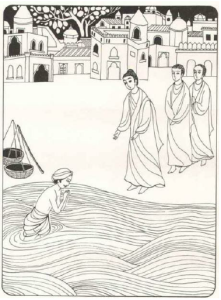
    As always Buddha was walking with a few of his followers from one town to the other. En route they crossed a small rivulet. All the Bhikkus and the Buddha crossed the water body. After crossing some distance from the rivulet the Buddha told one of his disciples “I am thirsty, can you get me some water for me?”

    The disciple responded, we just crossed a rivulet a while back I will bring water from there.Meditation

    Since the group had just crossed the rivulet, the water had become very muddy and turbid.

    The disciple thought “How can I give this muddy water to Buddha to drink?”

    The disciple came back and told Buddha “The water in there is very muddy. I don’t think it is fit to drink. There must be another water body nearby I shall fetch water from there”

    The Buddha told the disciple to go back to the same place but this time around wait for some time. The disciple went back, and found that the water was still muddy, but as the Buddha had suggested to him to wait, he waited for some time.

    After some time, the disciple found the mud had settled down, and the water was clean. He collected some water in a pot and brought it to Buddha.

    Buddha looked at the water, and then he looked up at the disciple and said “See what you did to make the water clean. You let it be and the mud settled down on its own and you have clear water.”

    Meditation is not “doing” it is happening / being; it is effortless.

    I heard this story in my Art of Living course way back in 2004.

  • LBC – Peace Of Mind


    When I read the topic for Loose Bloggers Consortium, the very first thing came to my mind was this video from Kung Fu Panda 2. The other thought was that I have written a lot of blogs related to peace of mind earlier.

    The conclusion of every blog post is that peace of mind comes from within and not outside. For example –

    In the blog Peace of Mind – I started of thinking peace of mind comes from owning something or being at peace is independent of owning anything? I reasoned out that peace of mind is not in achieving something in life. However, peace of mind is being at peace with our mind in the present. Because the more we think more we complicate life – life is, simple!

    In another blog Arrived… where? though peace of mind was not straightforward point of discussion, but something related was discussed. My brother in law asked me a very simple question – ‘what is home?’ ‘what is school?’ How do you define home/school etc” In that same discussion the conclusion was – home relates more to a feeling – comfort, peace.

    In one more blog Dichotomy on happiness the question I ask was – happiness requires fulfillment of the CONDITIONS we create for being happy or it is a feeling irrespective of what happens in our life/to us? These conditions, to me, are never ending… as it happens to the squirrel in Ice Age-Trilogy and to Chaipau in Salaam Bombay“. Dichotomy of happiness is you decide on what you enjoy doing or you remain happy irrespective of the situation you are in….

    In all these thoughts, the real peace of mind was understood when I first saw Dadaji (Dada Gavande), here is a tribute blog to Dadaji. “When I saw him for the first time, and later as well, I was completely awe stuck, everything, thought and feeling vanished. So much of serenity was flowing off his face that I had nothing to talk or ask.” If you want to experience such peace of mind, you either have to meet an enlightened master or be enlightened yourself.

    There were about 10 or more blogs in which peace of mind was touched upon. For more of my thoughts on peace of mind, read What are you searching for? where really the question is to you. In another blog Is religion another organized crime? the point is have religion lost their meaning? In the blog Money what is it? I tried to create another fictitious currency. In another blog Fish will fly in its next birth how my sister tried pacifying her daughter whose fish had just died.

    You can read all the blogs searched with “Peace of Mind” as searched term here

    This topic for LBC was suggested by Ramana uncleji. You can read other blogs of other Loose Bloggers Consortium members at Ramana Uncleji, Shackman and Lin.

  • Distinctions


    prayer of frogI have been reading one or the other story of Father Anthony De Mello’s books – The Prayer Of The Frog Vol. I and Prayer of The Frog Vol. II and share the same here occasionally. The books have small and very interesting stories. One of the story I read was on a balancing act is here –

    …..or distinctions.

    A man was doing his Ph. D in philosophy. His wife realized how seriously he was taking his studies only on the day she said to him, “Why is it you love me so much?”

    Quick as a shot he replied, “When you say ‘so much’ are you referring to intensity, depth, frequency, quality or duration?”

    By dissecting her petals no one ever gathered in the beauty of the rose.

    At times you just need to live and not analyze your life – a big, very big lesson for me (perhaps many professionals) to learn.

  • App dipo bhava


    I was fearing writing this blog last week, however I could not resist myself. Actually I feel I am too small to write on this big personality.

    Last week India celebrated 125th birth anniversary of Dr B R Ambedkar. I have immense respect for Baba Saheb, as he is called. He was (I would say ‘is’ even till today) one of the most educated politicians India ever had. He was a lawyer, the chief architect of Indian constitution, an economist and a social reformer. If someone can boast about a PhD he/she can talk about only one big University unlike Baba Saheb – Columbia & London School of Economics. Well, many politicians may call themselves as lawyers & social reformers, however there is a huge difference between Baba and these so called reformers of our time or for that matter lawyer.

    On social reforms, how many Indian politicians can say that they have moved generations on a specific path – path we may question though. How many Indian politicians can say that they have offered opportunities to the generations for growth and equality – the opportunity we may question though. None of any other Indian politician could do and has done – just name any Ms Mayavati! Mr Nitish Kumar! or a leader from Maharashtra Ramdas Athavale! No, no one can be even named with Dr Ambedkar.

    We, in Mumbai, celebrated Baba Saheb’s birthday last week with a lot of pomp. Some areas (I know of Chembur) people made huge rangoli in many others there were temporary gates made, in many other areas hoardings were pasted with wishes on 125th anniversary of Baba Saheb. However, there was a question in mind when I was seeing the celebration in Mumbai. What message Dr B R Ambedkar would give to these people?

    Actually, this celebration is nothing new for me as an Indian. We in India have the habit, or you may call it reverence in refined words, that we eulogize such personality. It has happened with Shirdi ke Sai Baba, Mahatma Gandhi et al you just name any. The question to ask is – what have we learnt from them? What would be just one message they want to give us?

    Coming back to Baba Saheb, I was wondering isn’t it more political than spiritual or social to celebrate the birthday? The problem with any established practice is – even if the person is reborn those who have made something a practice / a ritual would not accept this reborn person’s teachings. They would rebuke him/her. Be it Jesus, Mohammad or Baba Saheb.

    I love Baba Saheb for many reasons some listed above; his choosing Buddhism too is a reason because I believe Buddhism gives a person the right to question, questioning self, questioning established rules and concepts. But, has the community learnt anything about Buddhism from the social revolution Baba Saheb tried to bring to the community? Many converted to Buddhism, but what about inculcating the basic tenets of Buddhism? I asked one of my friends – Buddha never preached harming animals, why do you eat non-veg, forget meditation, forget eight-fold path, answer the basic thing? Nope you have not learnt practicing being vegetarian – which is a practice done at least twice a day. Have you heard of meditation? Nope. What are the steps of eight-fold path?

    I am confident that had Baba saheb be alive today – he would have made only one statement for the masses – Appa dipo bhava “Be a light unto yourself”. Forget these rituals forget these political stands. Your growth is in your hands. Why not use the money spent on putting hoardings for some other constructive work, say scholarship for a student?

    A last word – Even if you do not want to learn being a light to yourself follow the path of Baba Saheb consider education seriously and try to be like him, how many would take this idea seriously?

  • Inclusive growth, How?


    There is income inequality. Agree? If no check this – IMF Publication

    …increasing the income share of the poor and the middle class actually increases growth while a rising income share of the top 20 percent results in lower growth—that is, when the rich get richer, benefits do not trickle down…

    If businesses want to earn good profits in long term; businesses need to improve purchasing power of poor. Why? When people will have enough money to buy products/services, then only profits will increase at a better rate. Isn’t it? The simple explanation to this is – once poorer population gets resources (buying power) market size for companies increase multiple times. The increase would not be for one company but for every company in the market. One example of that could be involvement in CSR activity wherein poor can get good basic facilities and opportunities to earn. Once the poor can earn, they can spend too! Of course a caution here is – CSR is not charity, it should not become charity where it may lose its meaning.

    If this logic is clear – shouldn’t business be investing in making people prosperous? Once we do this we would solve a big problem – poverty. Hopefully, we will be able to not only grow the businesses but also grow every strata of society. Isn’t it? This is interdependent co-arising.

    Let me share a store, a very old & cliche, but I think that can drive home the point.

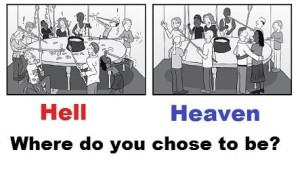
    Heaven HellLong ago a person wanted to see how heaven and hell were. An angle obliged and granted the wish. Person was blindfold and was sent to hell first.

    When the blindfold was removed, person was standing at the entrance to a great dining hall, full of round tables piled high with delicious foods of all kinds.

    The person noticed that, people seated around those round tables but their bodies were thin, and faces gaunt and creased with frustration. Each person sitting on dinning table held a spoon though their arms had no elbows and the spoons were four feet long. These people could reach the food on those platters, but could not get the food back to their mouths.

    Next the person was sent to the heaven. In the heaven the entrance to the dining hall was big, it too had round tables with piles of lavish feast as hell had. Here too people did not have elbows in arms and they were holding long spoons about same length as the hell. The person noticed that the people in heaven were plump and happy, the dinning hall was full of joy and laughter. Situation in both – Heaven and Hell were similar, however there was difference in the milieu, the reason?

    The difference between heaven and hell was – the people in heaven were using those long spoons to feed others so effectively everyone was full, plump & happy.

    Source of the story is AnomalyBeta and LinkedIn

    So, if we take the concept of interdependent co-arising as the core of growth, capitalism or communism or any economic structure we follow we will surely have inclusive growth. The catch here will be – value of money will decline, and exclusivity (as marketing or demand / supply concepts of economics) will play in different fashion. In whatever case at least the basic necessities hopefully be fulfilled.

    Other blogs on inequality – The Price of InequalityNot so trickling down!, Economics concepts and equality and Has the time for this idea come? and Inclusive growth

  • Kanhaiya to Mallya why lessons from Buddha Prevail!


    Recently India saw two very poles apart events and both can make us learn – the Middle Path of the Buddha. One incident was of JNU – ultra leftist & anti establishment – and the other was bank NPAs (one example of Vijay Mallya) – ultra rightist & Crony Capitalistic. I did not write anti-national as those who read news or biased towards one side would find my opinion biased even before reading the post fully, so ‘anti-establishment’ was the word used.

    The backdrop of Javaharlal Nehru University row is this – students union of JNU requested for a cultural event. Well, for those who do not know JNU is a University in Capital city of India. JNU students union is a leftist union. This event turned sloganeering against India. The slogans – besides anti India – included supporting terrorist who (in rarest of rare capital punishment in India) was hung during previous Govt. The previous Govt was run by the  parties currently in opposition – including left front. In twists of the whole drama a hero emerged named Kanhaiya Kumar. When I searched and heard one Professor of JNU, I came to know more about left front. They seem to support the whole drama where slogans were raised against India. This support goes deep down in the intellectual class sitting in news channel studios in Delhi.

    Domestic helpThough anti-establishment word sounds weird because where was the class of Kanhaiya Kumar for last 10 years? Where were they when there were a lot of corruption cases? Suddenly that class is demanding Azadi (freedom), well freedom from whom and what? If you demand freedom from poverty – work! Isn’t it a better solution? Azadi from toot-phoot (breakup) – better you do not do it, isn’t it? Currently who is involved in toot-phoot (look at parts of India where Maoists are active & killing). Azadi from terrorism – better you support or join security forces isn’t it? Why were student’s slogan in support of Afzal Guru (a terrorist)? Azadi from Manuwad & Brahmanwad (it is related to caste system of India) – I too am against caste system. Would it be better to do something at a grass-root level instead of sloganeering ‘against India’? Azadi from suit boot (economically better off) – isn’t it good if you do any of the other things listed above you would get in suit boot? Perhaps someone else will raise voice against you! But does it mean you and the other economically better off should leave everything and become poor in support of you to have Azadi from suit boot? The logic of communism is at question here – to bring affluence or wealth to less privileged is a better approach rather than making everyone equally poor to bring equality. Isn’t it? Read about Aarti Amma here these people should learn from her.

    Indian Big Corporations debtOn the other hand there is another class in India – capitalists. They are those who either mend rules or get rules created to favor themselves. According to some reports the amount of debt big corporate houses in India have goes in lacs of crores (of trillion INR). The example of top 10 debtors is below in image. These corporate houses are those who keep close relations with the law-makers (political parties – either in opposition or in power). So, these debtors enjoy the debt money lavishly. Once they kind of run out of money, they get debt restructured (happens to big companies only). There is a fancy word for that – Corporate Debt Restructuring. One such example in India is Dr Vijay Mallya of Kingfisher Airline. We’ve heard of his lavish birthday bashes and Calendars; he owes 7000 cr (70 Billion INR) to banks. His airline is defunct and he recently fled; banks has declared him willful defaulter a couple of months back.

    So in recent times, India has seen extremes of both the sides – failure of overly capitalistic system where crores of rupees are usurped by organizations without remorse and there are overly leftist those who want to overthrow the establishment itself. We have seen an example of USSR failing and we have seen repeated recession / bankruptcy. These examples teach us same the lessons again and again. There is a middle path that we need to follow, No left or no right. There has to be a balance.

    The solution? Once again it is the eight-fold path –

    1. Perfect Vision,
    2. Perfected Emotion,
    3. Right speech,
    4. Right action,
    5. Right livelihood,
    6. Right effort,
    7. Right mindfulness, and
    8. Right meditation

    All of these have to come from within, outside perspective will contaminate these. Meditation is a one single solution, it may provide each one of us from Kanhaiya to Mallya ‘tranquility’ that will help reduce the fascination to revolt or predilection to cheat. Because if we start following this eight-fold paths we would realize – ‘we all are connected’, ‘we all are interdependent‘ and if we want Azadi, this azadi would be from whom? If we want to cheat the banks, it is in turn cheating with someone who is a family of ours.