Tag: Prof Harkant Mankad

  • Why not define smaller things?


    Last month I met Prof Mankad. I always think whenever I meet him I should record our conversation. He is indeed a library of knowledge in himself. We discussed about our education system besides many other things (blogs written last weeks) Purpose of education and Showjumping. Dr Mankad told me – “one of the real problems with our daily life is our weird definitions e.g. success. We define success as owning that BMW. Until we get that BMW we don’t feel content. Thus, we avoid being satisfied, we do not live a fulfilling life. Though as an individual we can, but the weird definition makes us estranged from many small things.”

    Vada Pav
    Vada Pav

    He further shared an experience. One of his friends landed in India from the US (at about 12:00 AM or 2:00 AM). Next day 6:00 AM he was at Prof Mankad’s home, and asked to just accompany him. They drew to Karjat had some special Vadapav of that place and drove back to Mumbai.

    Well, all this made me question few very basic things we generally overlook. We do not think much about basics of life, but still have some preconceived notion about those things. As Dr Mankad shared example of success, another example is beauty. I watched this video in my MBA Marketing class. Our definition of beauty is weird watch this <2 min ad of Dove, to understand how our perceptions are defined; at times created. Many girls want to be fair, those who have curly hair want straight and vice versa!

    How often have we thought on these seemingly simple, stupid, strange yet serious questions. What is the meaning of Success (for me or you)? Does our definition of success change over time? what is the purpose of life? Why are we studying (at least when in college)? How will I/you know when I/you reach the target (a 100,000 INR or 10,00,00,000 INR), the goal is always a moving one! What is the benchmark? I think we need to just pause at times, and think how we want to shape our life, what is important for ourselves at least that instance, isn’t it? I think that is what enlightened masters call “living in present”

    Related – 1. Why are you doing what are you doing? 2. What more you need? 3. Entanglement of a langot 4. Race – never ending

    Race – never ending
    Why are you doing what are you doing?
    Why are you doing what are you doing?

  • Why do we educate our kids?


    Rat raceWhen I visited my sister last time, I asked her this question – What is the purpose of education? She is a teacher, she was the best person to ask this question.

    I felt pity on my nieces, so I asked this question. My nieces (one just 4.5 years other 10 years) go to school even in April! I went there to spend some time with them and they went to schools! This is their age to try new things – painting, playing different sports, learning some music. Let them find what they enjoy doing rather than forcing them to sit in the classroom in the summers.

    My sister’s answer reminded me of Prof Mankad’s Macroeconomics class of my MBA. His exams used to be unique (not disclosing it though). His reasoning for such unique exam was- Information is accessible now a days; I want you to think, I want you to cultivate abilities to connect the dots of various subject matters you come across and develop ability to make decisions, opinion and inferences. These theories should not be crammed. You can make these graphs / search them any day / any time while you work. Practice of using these theories in making your opinions etc is what I want you to develop.

    Surprisingly, many Google search terms “Exam paper of Professor Mankad” and “Exam paper of Prof Boman Moradian” have ended up on my blog post. Here I never wrote about what they ask in their exams. I feel strange some students search such things also!

    So my sister – who teaches Science – answered – “I want students to see things for themselves, to experimeReady to Racent; science is something which will help them develop analytical skills”. My sister and Prof Mankas’s answers were not what I see the approach of marketing any school – B-School to Medical School to the Public school for K-12 levels. Our B-Schools & Tech-Schools talk about post education Salaries as benchmark for success! In fact, IVY league guys went to jails because of bigger crimes e.g. insider trading; and if not in jails they caused more troubles to an average human being than a pickpocket who also goes to jail for small crimes for troubling one average human being at a time.
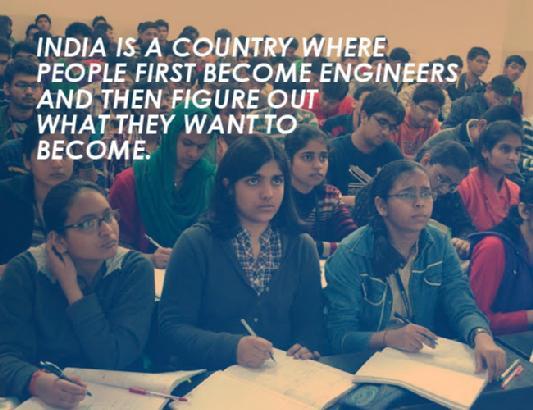
    Why should we educate kids? Don’t you think that the purpose of education be set first. At least we have been doing this for executing businesses well. At least ask the kid what he/she wants to do – after a certain age – instead of making everyone an Engineers or Doctor?

    Related blogs – Showjumping, Race – never ending, Entanglement of an undergarment, Neeraj in Kabir’s style

    Image source – Alka Arya’s article http://hillpost.in/2012/04/revised-rate-race/44257/

    Here is what I found on LinkedIn – Engineers in India

  • Moral markets!


    Do markets have morals? When I read Mr Rajeev Mantri’s article “The morality of markets” (Link) in the Livemint, I asked this simple question to myself.

    Various things came to my mind – i. financial meltdown(s) there are numerous examples of past; namesake recent one in 2008 ii. real estate bubble (again namesake – Mumbai, I have read of similar bubble in China) iii. stock market speculations (working on scrips – I think in India markets traders call it scrip चलाना) iv. crony capitalism*. All these thought made me think the title of the article itself is an oxymoron.

    I am not against free market economy, I am neither a leftist or socialist. When it comes to economics (and politics) I prefer to take the middle path. Just to give you a perspective on why I am not completely agreeing to the point of view of Mr Mantri, watch the following video (reference – my Oct 2013 blog – The Price of Inequality) –

    [youtube=http://www.youtube.com/watch?v=QPKKQnijnsM]

    Capitalism has its own’s problems, and morality is questioned more often in those economies – be it environmental damages, besides few points I raised above. I believe we should not assume development that happened in the US/Europe as the only way to grow and to prosperity. In fact, we have written records of prosperous India even before anyone knew of USA. We have history of Utopia – Ram rajya. How was it achieved? Do not you think we should try to study that as well? There are more ways than the Left and Right approach we take.

    Coming back to the article of Mr Mantri – he concludes with India having billions of dreams. I do not doubt but here my difference with our own culture comes as a stumbling block. I do not appreciate the Caste divide and therefore disagree with Mr Mantri there – there seems not to be many diverse dreams. For ages we stifled dreams by asking kids to follow a craft or business of his family caste system of old days. These things are bringing me to some circular logic – where I suggest to study old Indian economics and refute social Caste system. What is circular logic? Listen to this song you would understand – (apologies those who dont understand Hindi, it is in Hindi) –

    [youtube=https://www.youtube.com/watch?v=mchDikR-AAw]

    paisa kamane ke liye fir paisa chahiye.

    Paisa kamane ke liye fir paisa chahiye – Golmaal hai bhai sab golmaal hai…

    An English translation of this song in some future blog.

    Note – * Crony Capitalism – “Gas wars” a recent book in controversies is in my reading list.

  • Showjumping


    It was a Monday morning I woke up at 6:00 AM, got ready for office. Call it Monday blues for others but for me Monday’s are s different type of race. Race to get to the main road, catch a cab (cabbies dont want to go short distance ~6 KM <60 INR), board a local train to Andheri station run from there too to catch an Auto or Bus; where there is already a big line! Seriously, at times I feel “life is a race” (reminds me of a dialog in movie 3 idiots), no one knows race for what and where! The story does not end here. Whenever I cross NALCO (a stop for buses in Andheri East area), I see kids walking to school. One thought comes to my mind – these kids too have their office! That office is called school.

    At least till 8th standard, I don’t remember if I had gone to school, after exams for 1 full month of April month. My niece, she is not even 5 years finished her LKG in March; goes to her office (e.g. school) at 8:00 AM in April Month – yes she is in UKG now – she has got promoted! In our offices too we have a system of promotion (at least examination in March-April) isn’t it?

    This does not seem to me as education – we are making machines. My sister teaches in a school – I asked her what is the purpose of education? Why are you a teacher? Her response was unconventional. She said I want to make the kids expand their horizons. I added do you think schooling is doing it right? She had a mixed response.

    I feel forcing kids to school is not education, it can at best be schooling. Here please think of “Schooling” – as a verb! Such as training a horse for Showjumping!


  • Special situation needs special solution


    Crisis unites, for how long? I was thinking about Quantitative Easing of Fed in the US. While thinking undoubtedly read G20 communique of 2009 e.g. London Summit here. A prologue about this communique. In 2008, US financial market collapsed. This resulted in domino effect across geographies. Every country, its financial system and thus citizen of the country were adversely affected. Do not ask me – what happened to those who were responsible for this collapse? Many of them made huge money and (almost) vanished! as – according to the books – they earned legitimately. Coming back to the point – otherwise a competitive world became a co-operative world. The mindset changed like this –

    “…We will conduct all our economic policies cooperatively and responsibly with regard to the impact on other countries and will refrain from competitive…” (source – London Summit communique para 12).

    I am forced to think – do we need crisis to unite the world and people?

    The thought is in the mind because now, when things seem to be fine with the US economy or may be just because US Fed wants to reduce burden on its balance sheet they came up with a solution of QE and rest of the world feels US is renaging the agreement/communique.

    I assume, we may go in another set of moderate crisis in coming time, we have not come out of the crisis completely. However, perhaps, this time world would have lesser belief on Govts, financial system and the cooperation as agreed by the leaders, economists and Financial Organizations.

    The trust deficit we live in – or we will live in – requires special measure. A special situation demand a special solution. Since, I am more of an spiritual person I feel the solution is moving towards spirituality. This can be done two ways – bringing spiritual lessons in corporate life or making corporate values resonate, implemented and executed spiritual life. Signing a document does not solve problem in long term – we are seeing that happen through tapering of quantitative easing by USA.

    Disclaimer – Author doesn’t intent to criticize QE, author is of the opinion of looking at the basics of the problem – Greed. Author has written few blogs on Greed earlier here.

  • The Price of Inequality


    I have read Dr Joseph Stiglitz. He is a Nobel prize awarded economist. The book I read first was Globalization and its discontents and recently I started reading The price of Inequality.

    I realized that Dr Stiglitz may not be the so called capitalist economist, he is capitalist but with a touch of a Just and relatively Equal society. So, when I started reading “The price of Inequality” I started wondering what kind of wealth difference exist in the US. Since, I have never been to the US so the picture of the USA I have always created is – no poverty, everyone having enough and more to not only survive but also a lavish life, a home with front garden, a car parking (of course too), wonderful interiors of the home etc. This picture is largely because of the Movies we watch – on a lighter note Hollywood is responsible for that ;).

    Well, while reading the book, I came across a video on Facebook (watch below).

    [youtube=http://www.youtube.com/watch?v=QPKKQnijnsM]

    Though, some may argue this video is shared for more socialistic reform e.g. healthcare reform, but that is not the point of contention for me. Watch Margin Call to understand the point of view of the bosses of the investment banks – well to sum up “They do not care! Everything will be fine in sometime.”

    My perspective is not a fight on any economic approach e.g. socialism Vs Capitalism, I favor inclusive growth and I believe for achieving that we need to follow a middle path wherein a mixed approach be used.

    Read my previous blogs related to the book – Globalization and its discontents

    Blogs here

  • Inclusive growth


    We’ve seen that socialism had it’s problem, capitalism is no less culprit. I’ve been thinking about both together and have written about it. Regularly I asked this questions of how to two of my MBA professors – Prof Harkant Mankad and Prof Arun Ramanathan. Prof Ramanathan suggested me to read functioning of Nordic countries – heavy tax but less social security. Once I shared this logic –

    Socialism & CapitalismIf we look at both simultaneously we see some good and some not so good practices. Socialism had social benefit at center but execution sucked. On the other hand capitalism has profit at center and execution is better, and also capitalism largely never considered social good as one of the concerns.

    The very bird-eye-view (yes MBAs use this kind of jargon) solution could be – What is we bring social benefit and profit together at center and use execution efficiencies of capitalism around? The profit does not necessarily become – extracting whatever available consumer surplus is there with consumer. Take an example of social entrepreneurship, that is one good approach. Here, I do not intend to say every business should be like that. Also, yesterday I tweeted and updated on LinkedIn – If you want to be social entrepreneur, remember funder of social enterprise has impact in mind+heart & investing in head, so impact weighs higher! those kind of initiative can help in inclusive growth.

    I see that PPP – Public Private Partnership – can also be great boon for inclusive growth. However, greed has created more problem in the Indian context than giving us Inclusive Growth.

    Take an example of MNREGA, it has been failing, benefits are not reaching where they should. How can political parties be kept away from execution? Politicians asking for bribe in such cases is nothing but extortion. How about giving the executioner tax benefits to get involved in it and ask for accountability? Audit Done periodically by people (an independent body monitoring). The people affected and benefited can vote for continuation or stopping that company from involvement. So this can be kind of election on performance of NREGA.

    What I think is – people want a respectable life and not bread thrown at them condescendingly. Inclusive growth is possible when we think more like a combination of socialistic -capitalistic society.

    This way we’d be capitalist but in a socialist manner where besides profit, social uplifting would be a core of philosophy and growth.

  • Interdependent co-arising – macro-economics example


    I hae written on Interdependent co-arising (older blogs at the link) earlier.  The concept simply means – we are all dependent on each other.

    Those who want to know the concept in layman term follow this blog – interdependent co-arising example of a farmer.

    Definintion of interdependent co-arising is below with a macro-economics example. In late 90’s the East Asian countries faced a very serious economic challenge of decades. The financial system came down like a house of cards. Dr Joseph Stiglitz – Economics Nobel Prize winner of 2001 – shares the concept of interdependent co-arising (dooming in otherwords) in his book  – “Globalization and its discontent“. On Page 106-107 he invariably – and inadvertently perhaps – explains what is interdependent co-arising. Hope economists would understand this lesson, if not from the Buddha then from Dr Stiglitz.

    Beggar-Thyself Policies

    Of all the mistakes the IMF committed as the East Asian crisis spread from one conuntry to another in 1997 and 1998, one of the hardest to fathom was the Fund’s failure to recognize the important interactions amont the policeis pursued in the different countries. Contractionary policies in one country not only deepened that country’s economy but had adverse effects on its neighbors. By continuing to advocate contractionary policies the IMF exacerbated the contagion, the spread of the downturn from one country to the next. As each country weakened, it reduced its imports from its neighbors, thereby pulling its neighbors down.

    The beggar-thy-neighbor policies of the 1930s are generally thought to have played an important role in the spread of the Great Depression. Each country hit by a downturn bolster its own economy by cutting back on exports and thus shifting consumer demands to its own products.A country would cut back on export by imposing tariffs and by making competitive devaluation of its currency, which made its own goods cheaper and others countries’ more expensive. Howeer, as each country cut back on imports it suceeded in “exporting” the economic downturn to its neighbors. Hence the term bagger-thy-neighbor.

    Solution to all these economic, social, personal, spiritual or other problems?

    Its interdependent co-arising itself. We all need to help each other grow – grow the pie and share it well, if not equally!

  • Segment of one & inclusive growth


    What are we? We are a society, made of communities, families and individuals. We are talking about growth on global scale. At times we are talking more about “saving” the world from financial melt down. I sometimes think – who has created it at the first place? That is for some other day though.

    When we see growth we talk on aggregate level – GDP of the country, GDP growth rate, reserve, unemployment rate etc. Have we ever thought that these numbers are “aggregate level” number for example – if I put my one hand in boiling water and another at minus thirty degrees [100+ (-30)], average temperature of my body is 35 degrees. But does that mean I am fine? No my one hand is burnt and other is numb. That is the reality of aggregate level measures.

    How do we resolve such inconsistencies? Let us start measuring things in terms of segments. As they call it in Marketing, Segmentation. On a very deeper level as segment of one. “Segment of one” means handling each individual as an individual (and not as any generic segment). Though is more of marketing and in my professional experience analytics gyan (which is not purpose of this blog) so I would come back to the point.

    Segment of oneIf we do that Marketing stuff of Segment (segment of one) in society and eventually to the individuals. We would realize that “inclusive growth” is only possible when we take growth stories to communities, at smaller level say villages, communities, to each family to each individual. I see that as the solution to a better reflection of growth. I better measure would emerge from there, upliftment of each individual.

    Writing this, I feel as if I’m a politicians, speak and no action! How to do that is the question. A very idealistic solution – what if we’ve unemployment benefits for everyone also encourage everyone to do what he/she wants to do – until found success, unemployment benefits would help these people. Word of caution – there may be free-riders one has to fix that challenge. Take an example of Venture Capitalists and Funders. They do the same but at a later stage – say when I found my calling, started working and kind of see a revenue model. This is truly a very impractical and idealistic solution, but can we build on this to devise a practical and applicable solution from it?

    Image source – http://www.dmnews.com/marketing-to-a-customer-segment-of-one/article/262747/

  • 33 – Understanding change and change in understanding


    33 Understanding change and change in understanding is a book by Richard Saul Wurman. You know TED conferences? He created that. I want to write a lot of blogs (perhaps one for each page from the book).

    Professor Mankad gave this book to me, when I requested him for opinions on few of my blogs. The book is very interesting, I will read it again before giving back to him. Today I am referring to a chapter of the book – I am a zoo episode.

    The protagonist is astound at the arrogance of man. The author writes – “… they are just so proud of themselves in all their various religious books, the Bible, the Koran, the Book of the Dead, the Bhagavad Gita and many, many more.

    In every one of these tomes it was man this man that man, and besides the fact that it was men and women, the arrogance of thinking of ourselves as a single species just amazed the Commissioner…”

    “Bacteria, the Commissioner knew, subdivide and reproduce, in effect multiplying by division. The human body… …has many trillions of cells and 90% are bacteria!…”

    “I am a zoo, the commissioner said, Because that is what I am. It would be only religious arrogance to see myself as a single species.”

    I wonder if the author wanted to say zoo in terms of our thoughts too. We have so many so diverse thought that we are a zoo and a jungle within our mind too.

    We are much more than what we think we are. I was recently talking to my father and he suggested – “we are made of various tissues, tissues are made of cells and molecules and atoms and particles. Now each particle is in effect an energy packet. So we eventually are indestructible in that sense.”

    What we need to remember is – understanding the change helps in change in understanding!