Tag: Prof Harkant Mankad

  • Pandemic – why companies should choose to spend

    Coronavirus pandemic is a global phenomenon, as of now 160 countries out of 193 recognized countries are affected. Many countries are in lockdown. All the developed countries are affected, therefore, the economy worldwide is severely affected. In this trying time, the whole world needs Keynesian economics. In nutshell, the concept says – “Increase government expenditures and lower taxes to stimulate demand and pull the global economy out of the depression.” Here I am going to discuss my opinion on why companies should choose to spend and continue working on their ongoing plus upcoming projects.

    http://business2buddha.com/2013/11/24/keynes/

    Keynesian economics considers or provides guidelines to the Governments. You can check India approves 1.70 lakh Crore package for poor, $2 trillion package US Congress has approved recently. Apparently, this is the biggest package US or for that matter, any government has approved. Government spending is only one part. I am of the opinion that every industry must seriously consider not only spending but also sustaining employees. Short term “shareholder value” can wait for better long terms sustenance. I know this sounds counter-intuitive – special when all companies are losing revenues due to lockdown, expecting retaining employees and to sustain a business. Surely this will impact the survival of many firms, projections and revenue targets of almost every company and shareholder returns. Let me give you some basic reasoning for my opinion of private firms too should continue their investment and how can it help bring the economy on wheels again.

    coronavirus-hospitality-industry-impacted

    Due to Coronavirus few industries are directly affected, namely; Airline, Hospitality and discretionary expense items e.g. beauty or apparel. People are going to spend on their basic necessities for the next few weeks or who knows months. The impacts revenue and therefore growth-related projects of these industries. Let us take an example as an explanation.

    Example

    An apparel company wanted to increase its footprints in a new region. That would require – finding retail space, employees for the store, furniture/store interiors design, products to put in the shelf and technology e.g. internet, hardware, POS and marketing to bring shoppers in-store. Due to the impact of a pandemic the apparel company will delay all these. The domino effect will be on – real estate, prospective employees, interior designers, producers (who produce for the apparel company in terms of aggregate demand), internet service provider, IT company planning to provide hardware and software and the marketing activation agency that was supposed to engage in the project – right from printing flyers. Why I brought flyers? Because this and interior decorators have many unskilled laborer working for them. The result – the domino engulfs many part-time workers. When these part-time workers do not have money they will have an impact on purchasing many other things. A self-fulfilling prophecy – read more about self-fulfilling prophecy here.

    At this time, what should private businesses do? At whatever negotiated discounts – they must continue their projects be it starting footprints in new regions as given in the above example. The companies must continue their spending because sooner or later things will fall in place. People will start consuming and the economy will be on track again. If spending is done as usual – the economy will come on its feet faster than it other would. Therefore I am suggesting that after the lockdown due to pandemic – why companies should choose to spend.

    Summary

    I fell in love with research of McKinsey and company, “Grow Fast or Die Slow” sustaining growth in technology companies. Paraphrase of this research is –

    1. Growth matters more than margin or cost structure
    2. No correlation between cost structure and growth rate

    Net-net one cannot cost cut to grow the business. Business growth requires “growth”. This is why I suggest that companies should choose to spend. Cost rationalization is important, questions are the discretion, putting costs in the right perspective and strategic decisions on these investments. This is the time when project costs will be more rational compared to a booming economy. At this tough time, many companies will look at cost reduction – what leadership across the globe must know is that – this is the time to look at a big picture and work towards completing the unfinished projects, starting the planned projects and reopen the businesses as usual after lockdown. Why? Because sooner we start spending on our planned projects, sooner economy will be back on track and most importantly we will be able to reach our projections, targets, and shareholder value.

    The concept of interdependent co-arising perfectly fits this conclusion. When we keep our investments on, the fund will be available to others to either spend or pay as salary. This spending results in moving the circle of growth.

    Related newsCognizant to offer extra 25% of base salary

  • How to get out of the comfort zone?

    Last week I wrote the biggest lesson that I learnt with Professor Tomas Lopez. Simple summary of the lesson, we’re conditioned to think in certain manner. It cause more trouble to our daily situation then anything else. I was fortunate to have been reminded of this problem of mine (our mind) by Professor Mankad too – read here. Professor Lopez put me out of my comfort zone many a times. Getting out of comfort zone is very important if you want to earn some pearls in life.

    Here is a short story of loss, that one must avoid in life. This story is from the book – Prayers of the frog Volume 1 and Volume 2. An awesome book with short stories and life lessons.

    Awareness

    An oyster saw a loose pearl that had fallen into the crevice of a rock on the ocean bed. After great effort she managed to retrieve the pearl and place it just beside her on a leaf.

    She knew that humans searched for pearls and thought, “This pearl will tempt them, so they will take it and let me be.”

    When a pearl diver showed up, however, his eyes were conditioned to look for oysters and not for pearls resting on leaves.

    So he grabbed the oyster which did not happen to have a pearl and allowed the real pearl to roll back into the crevice in the rock.

    From the book – Prayers of the frog V1

    The author concludes – You know exactly where to look. That is the reason why you fail to find God.

    prayer-of-the-frog

    It happens with all of us, we look for happiness in something other than what we have in hand. This is where we end up being unhappy. Many a times we know the answer to – “When will I be happy?” Yet we miss the path to the goal. In fact, when we achieve the goal; our goal post has already changed. This is the problem of our mind, we are never calm, even before we reach somewhere we find the next destination. Here the destination can be as easy as the next venue for dinner or as ambitious as next company, job, or car. What we need to change is our way of thinking.

    Our life experience and circumstances programs us to become a certain individual over time. Be it the diver of the above story, or me or you. We must ask a question to ourselves – are we ready to get out of our comfort zone?

    How to get out of the comfort zone?

    Our comfort zone is the worst enemy of our possibilities. As was the case with the Digger. I think we can get out of comfort zone by some of the ways such as

    1. Getting into tough spots with choice – life is a trouble… only death is not I was put in those situations by Prof Lopez
    2. Awareness in actions, if you had read my blog on conditioned mind, you would understand the context
    3. Get out of your ego, do something that does not conform to your definition of YOU. Read how Mumbai brushed my ego
    4. Learn from past experience (slingshot example), yet try things without getting bogged down by your past experiences
    5. Remember our perceptions create our reality, do not limit yourself with those limited perceptions of yours
    6. Keep things simple as ABC – story from Prayers of the frog
    7. Think and know, you are nothing in front of the creation, why limit yourself, why feel low, embarrassed even before trying?

    The Buddha also went beyond his comfort zone to be enlightened. In fact he had put his everything on the gamble. Let me know which one you can relate to? Or what you think is even better method of getting out of comfort zone, it would interesting to learn.

  • Guru poornima


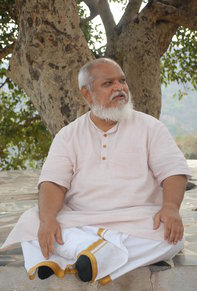
    I have had privilege of meeting at least three enlightened masters in my life (until now), mentors and coaches. Some of the mentors may be enlightened masters and I am not aware about those. However, rest three I am sure – Sai Kaka, Dada ji and Guruji. It is difficult to have very close day-to-day meeting with the enlightened masters. The mentors have a special place they guide, encourage, handhold, and challenge, I have been fortunate that I have a long list of mentors.

    I received a wonderful story on whatsapp “Importance of Guru” or mentor or coach in life.  Without much ado here is this wonderful story on Guru Poornima.

    ——————

    Once upon a time, a cow went out to graze in the jungle. Suddenly, she noticed a lion racing towards her. She turned and fled, fearing that at any moment the lion would sink his claws into her. The cow desperately looked for someplace to escape and at last, saw a shallow pond. Barely evading the lion’s reach, she jumped into the pond, and in the heat of the chase, the lion blindly leaped after her.

    Sai KakaTo the surprise of them both, the pond was extremely shallow yet filled with deep recesses of mud. After toppling over each other, the cow and the lion found themselves a short distance apart, stuck in the mud up to their necks. Both had their heads above water but were unable to free themselves no matter how much they writhDada Gavanded.

    The lion repeatedly snarled at the cow and roared, “I am going to enjoy the sound of crunching your bones between my teeth!”

    He thrashed about in fury but soon became fretful as he found no prospect of escape.

    The cow thoughtfully laughed as the lion struggled to free himself and asked him, “Do you have a master?”

    The lion disdainfully replied, “I am the king of the jungle. Why do you ask me if I have a master? I myself am the master!”

    The cow said, “You may be the king of the jungle, but here all your power has failed to save your life.”

    “And what about you?” Retorted the lion. “You are going to die here in this mud too!”’

    The cow smiled mildly and said, “No, I am not.”

    “If even I, the king of the jungle cannot free myself from this mud”, snapped the lion, “Then how can you, an ordinary cow?”

    The cow gently replied, “I cannot free myself from this mud, but my master can. When the sun sets and he finds me absent at home, he will come looking for me. Once he finds me, he will raise me up and escort me home sweet home.”

    The lion fell silent and coldly glared at the cow.

    Soon enough, the sunset and the cow’s master arrived. He immediately recognized the plight she was in and lifted her to safety. As they walked home, the cow and the master both felt renewed gratitude for one another and pitied the lion they both would have been happy to save if only the lion had allowed them.

    The cow represents a surrendered heart, the lion represents an egoistic mind, and the master represents the Guru. The mud represents the world, and the chase represents the struggle for existence therein.

    —————————————–

    Its good to be independent and not rely on anyone. But don’t take it to an extreme, you always need a partner/coach/mentor who will be always on the lookout for you.

    Having them does not mean you are weak, it’s just that you can be stronger with their help.

  • Trust, PNBFraud and Cryptocurrency


    It was a monthly routine of some of my friends of our engineering days that can explain one Professor Mankad’s statement – “Money is what is accepted as money”. Some of my friends, used to be penniless for last one week to ten days every month. Possibly it is a common phenomenon of current generation students. So for about last ten days these friends of ours used to borrow from us. A couple of times I gave, returns used to be few and far between. I and few other “venture capitalists” stopped lending these friends. In these trying times, the borrower friends came up with an idea – whenever the received a cheque (rarely demand draft) – from home it used to take three or more days to realize those – they used to borrow against it.

    Let me try to explain it with example, say Neerav got a cheque of INR 2500 from home, he will show that and borrow money (say INR 1000) from Yogesh and possibly INR 1500 from Pravin and another INR 1000 from Prateek. Now Neerav has borrowed INR 3500 against a cheque of 2500. All of the lenders used to be under an impression that within next five days or so we will get our money back as Neerav has got INR 2500. We used to accept that cheque as guarantee of timely return. “We” accepted cheque in “Neerav’s name” as a money. Thankfully none of the Neerav’s defaulted on our outstanding.

    We have been living in a very nicely woven cobweb of currency and economy for at least last two centuries. Currency and thus “money” is the biggest fraud happening around us. Be the gold standard (relatively better method of “value”) to fiat currency. What is money? The question Professor Mankad asked us in our MBA class about 8 years back is still very relevant and I have been revisiting it time and again. When he asked such question, we started answering coin, currency notes etc etc. His one line response was – “Money is what is accepted as money”. Yes that is true, money is what is accepted as money, as we used to accept cheque without known Neerav has kind of pleaded same cheque to 5 different lenders!

    Bitcoin logoEarlier, I wrote on trust as a foundation – Currency for the future. QUOTE from there Let us flip the coin and say “Trust” is the currency. What would happen? Those who have hoards of currency may be the most bankrupt people on the earth. Perhaps, a business of trading of trust would start (Bomday Trust Exchange or National Trust Exchange). Would the world be a different place then when currency would be mutual trust (well not necessarily Mutual such as DLF and Robert Vadra. UNQUOTE. This I wrote in 2012, at that time Cryptocurrency (example bitcoin) was not commonplace – well even I did not know about it. I had a different measure and calculation for the currency – money what is it?
    However, lesser than the intangible concept of Trust that I thought, we have a better believable system evolving these days – cryptocurrency. If we keep on seeing the meltdown of 2008, NPA frauds of India and many other such scams from the politicians and their accomplice etc. we will soon accept the bitcoin or other such more reliable systems for transactions. Crypto is putting pressure because administrations and regulatory authorities will lose control on the economy. With the control also they are not making any good; at least if we see India – a former FM and his son facing trial but our system is unable to conclude the trial or many scammers settling out of India.

    I am bit hopeful on blockchain, it is more reliable (difficult to fudge) and open as against the lenders like Punjab National Bank who can decide on their fancy on the money of other depositors. Blockchain is the way for not only currencies but for many other things including contracts and agreements. Hopefully then we will have a more balanced society and “trust” as digital money. Only fear is these “connected” bureaucrats, politicians and their page 3 friends, clique will first get their ill gotten money put in these digital currencies and probably try to make it murky too.

    Disclaimer – story of engineering days is authentic, names of my friends are changed, I didn’t have any batchmate in Engineering named Nirav.

  • Capitalism’s possible impact


    Keynes in an essay had said “his grandchildren’s generation would only work 15 hours a week.” Apparently, that generation is in the workforce now. Are we working <2 working days a week? Far from it. According to some studies, working population of the developed countries are still working at least 34 hours a week (if not 40 hours). Possibly the prediction was incorrect by a generation.

    On a leisure weekend, we were wandering in one of the biggest cities of Latin America last month. It was our first visit to the country. We were talking about the way of living there and possible future for us. I said, in future, we may be working for enjoying what we do, not for earning our living. So, when Keynes said working 15 hours a week, it is possible that rest of the time, people do what they otherwise would want to do – it can be work too. Given a choice I would want to study, read books, wrote blogs 🙂 share my knowledge etc. Some of it I still do though, but over the weekends. Was this the future that Keynes saw as possible? I think yes.

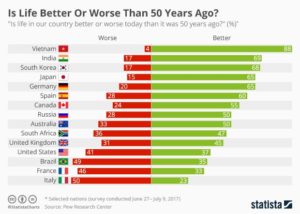
    Uber, Apple and Google are working on autonomous cars. We’ve technology intervention in everything – industrial revolution brought partial automation, technology revolution increasing automation. It is possible that in future organizations will be minting money on robots alone. Hopefully when we reach that state, we will be beyond food, shelter and social standing. In fact that possibly can be one of the reasons for the following outcome of a research – population of developed countries are not that happy. Perhaps our mind has the habit of occupying itself. When there is nothing to be occupied with, either one is unhappy or one can think of bigger purpose in life.

    The statistics can be contested such as – how were these 50 years compared? This discontent and prosperity will surely lead to the questions towards spirituality. When a society is prosperous that is when it starts or tend to move inwards – at times capitalism it is that provides opportunity to dig deeper within [From my previous blog]. I see a lot of people pursuing Buddhism or for that matter meditation in west.

    Besides, when development will lead to unhappiness, the journey of inwards will start. People will ask question – what makes me happy? That is when people will start working for 15 hours a week for wages and rest for self. I see that as an impact of capitalism. When that happens economies would not remain purely capitalistic. There will be change in our approach of economy, it wont remain purely capitalist.

    Image Source – https://twitter.com/nareshnshahani/status/938937338431807488 tweet from – Mr Naresh Shahani.

  • Options, analysis and decisions


    I have been analyzing buying a house vs living on rent and buying a four wheeler vs riding a cab. This is not a new comparison and analysis for me. Most of the time, answers to these two were – buy a house and rent a car or use a cab service.

    How did I arrive at these conclusions? Of course after some calculations and considering options. The question is – what was the measure on which I measured these things to come up with some conclusion? The measure was “utility”. In economics utility means resultant benefit achieved from something (usage or consumption of product or service). When you eat Idly on road side @20 INR and when the same idly plate is served to you in a better place it could by @60 INR. We may argue about taste, hygiene etc of idly from 20INR to 60INR. When one moves from basic utility to additional utilities we measure that in terms of marginal utility. Marginal utility, is the incremental benefit one gets from consumption or usage of an offering.

    We can continue from our situation of buying a four wheeler. The first question one may have is – which car – SUV, Sedan, Hatchback. Once that is decided which company which brand and what amenities such as AC, power window and music system etc. There are obviously many more questions in making a decision. The other option is hiring a local taxi or app based service. After all this analysis – what one gets is drop from point A to point B. At times pain of parking – if it is owned car or self driving. The drop from A to B is utility in this case. Marginal utility is – can you play music of your choice while driving or is the vehicle air conditioned during the trip. In the bargain of ability to play music and air conditioning you need to pay extra. This extra amount vs the additional benefit you get defined marginal utility.

    Many of our life decisions are made emotionally and justified rationally. I analyzed a lot with a decision of buying a house and renting a car. Currently, I live in a rented house and drive a car. How often do we take decision by listening to our heart and mind? Is there a rational justification to our decision? Why do we take such decision? When we have to really take a plunge with faith, we falter. When we have to take a decision with full analysis we do the opposite!

    Give it a thought – Mahavir and Buddha – both were from warrior families and were to be the kings. Why did they renounce everything, how on earth they both might have taken such step? Had they both done enough analysis possibly both had stayed back. I know more about the Buddha so can think of an incident, when he was following extreme austerity such that he could had died of hunger, he decided to eat. In short term his five best friends went away saying he has left the path. But the Buddha was right, austerity and self affliction may not necessarily help. He said to himself, if I die of hunger I wont be able to achieve what I strive for.

    In my analytics practice one of my senior’s Eron Kar used to say – “If you torture data enough it will confess to the story you want it to narrate.” Always it is not right to over analyze, at times leaders need to take a leap of faith and decide.

    Prof Mankad told me once – “Pravin, when you become a leader, sitting in the 76th floor of your corporate office when you have to make a tough choice do one thing. Leave aside all the papers and analysis. Walk toward the window. Take out a coin from your pocket, toss it and you will have the decision.” Dr Mankad continued “Pravin, sometimes you should stop over analyzing.” I need to learn a lot to do that one I have to become that big a decision maker of a company and two stopping the urge to analyze everything, I still analyze a lot!

    Image source – http://novalo.com/flat-fee-self-employed/

  • My Favorite Fictional Character


    Have you ever thought about fiction and reality? Fiction is something untrue, made-up or imaginary. How can I say that the Buddha or Krishna or Jesus was someone who actually walked the face of earth. Is it a possibility that these were imagination of someone? This thought puts me to another thought, what if I myself am is some imagination and a reality is somewhere, something else.

    Have you ever had a dream, Neo, that you were so sure was real? What if you were unable to wake from that dream? How would you know the difference between the dream world and the real world? Morpheus The Matrix

    What makes something real? Is it because I think, see, feel (perhaps smell or hear) and my mind makes me feel that this is something real because I can sense it? Or something is real because it exist without someone’s ability to sense it or no. Take an example of light – we cannot see light beyond a certain frequency range. Does it make the light non-existent?

    These questions remind me of a very interesting movie – The Matrix.

    “…The Matrix is everywhere. It is all around us. Even now, in this very room. You can see it when you look out your window or when you turn on your television. You can feel it when you go to work… when you go to church… when you pay your taxes. It is the world that has been pulled over your eyes to blind you from the truth…”

    I have had a couple of Morpheus in my life to teach me. I have written about almost everyone on this blog. I would want to be Morpheus too, for someone or few in future. I love the character of Morpheus from The Matrix the most. Morpheus is a believer, he courageous. The best part is, the kind of confidence Morpheus has in Neo, it makes me feel that I want to be Neo too. Laurence Fishburne played the role so well that I keep on watching his teachings (dialogs) whenever I feel I should. There are a lot of learnings in those dialogs – “Do not think you are, KNOW you are.” I have written on the movie (red pill) earlier too. I was so fascinated with the movie that I used to tell people that I am fine being a spot-boy for the movie – alas I am in India :(. The movie is so philosophical and spiritual to me that I repeatedly watch it.

    Instead of me talking (writing), I would want to share some videos of the movie (Youtube), not sure about the copyright permissions there.

    I see many of my teachers in Morpheus – they are indeed my Favorite (they are real) human beings, this blog post is dedicated to all of them. This was the title of this weeks Friday Loose Bloggers Consortium. Con You can read other LBC bloggers thoughts here – Rummuser and Shackman.

  • Has the time for this idea come?


    When I wrote Problem of top 5% blog I was little too concerned due to various reasons. One was, I – being a centralist – am not a good judge of the situation in completely capitalistic societies. Second was – I myself was at the center of the example. How can I judge myself. I may get biased was the very obvious possibility. I shared the draft with Prof Mankad, again various reasons. He knows me, he has lived in the US for many years, he is an economist etc. His response was –

    QUOTE# – The solution lies with top 5/10%. Regulators – teachers, principals – also bank on 10% and would not want to do anything to hurt them. (Refer to a very long article in Huffington* Post yesterday -26th Sept 2014 – on ‘culture’ at FED NY to ignore the trespasses of Goldman’s.)
    With current socioeconomic yardsticks of success, it will take time for the 10% to shed their arrogance. The society may attempt to generate a social consciousness to move away emphasis (not d-emphasise) top 10 %. Can we start with admissions to prime colleges? Take an honest, mathematically random system of selection of say 50 from top 500? Such a system would retain the academic standard and defuse the arrogance of top 50 and perhaps reduce the commercial exploitative practices of coaching classes.
    Same practice may be chosen in recruitment of employees. (And perhaps in selection of brides!) [that “bride” part a “late cut” – as Prof Mankad calls it 🙂 – on me]
    This would be revolutionary. Who will start the revolution? UNQUOTE


    So the possible solutions Prof Mankad suggested starts from the top. Top 5% or 10% need to shred their arrogance (read Problem of top 5% a figurative real life example of representing our society, economy and even schools).

    An interesting case happened recently in India. A Gujarat based Jeweler – Savji bhai – has gifted generously to his employees this Diwali. Apparently he is a standard 4th dropout! Mahatma Gandhi used to say what Prof Mankad suggested in his opinion – “…the wealth of the owners is distributed among the workers and when this situation is arrived at, only then would India grow in real terms…”

    According to reports Savji Bhai has given Diwali gifts based on a loyalty program, so even though he did not study typical “Employee Engagement” and “Loyalty Marketing” or any other jargon of an MBA. Additional interesting this is – he supports pilgrimage of his employees families, has made stadium in Surat.

    Just to conclude – Mahatma Gandhi said wealth distribution as the way for Swaraj, Top 5% are hoarding the wealth (reference Dr Joseph Stiglitz) and even Govts are afraid of top 5% so we have a creative solution which Savjibhai experimented with recently. Has the time for this idea come? Wish we see Business and the Buddha co-exist positively to make this world a better place to live and be enlightened.

    NDTV interview (I am yet to watch it though)

    Savjibhai in a brief speech (Gujarati) 2012 – when not many people knew him.


    Note –

    # The blog Problem of top 5% was published on 11th Oct, draft created was on 26-27th Sept. Prof Mankad shared his opinion on 27th Sept.

    * I read Huffington Post article which Dr Mankad referred, however currently not able to get that link, so here is related link – http://www.propublica.org/article/carmen-segarras-secret-recordings-from-inside-new-york-fed

  • Did Keynes fail in Japan?


    It all started in 1990s when Japan took the step to deflate its economy – Yen devaluation, lower interest rate, money supply etc. The effect is observed till today and in fact we may get into another slowdown in 2015-16. Actually, that’s what is the fear. Some experts are forcing Euro-zone not to make the same mistake Japan made in 1990s. If one sees debt of the developed countries one may be forced to conclude – we are sitting around next slowdown. Take Japan – about 250% debt to GDP ratio! Surprising right? Nope, situation is not better in US either, USA is also at 100% debt to GDP. Many are already blaming Quantitative Easing for the next likely downfall.

    I happened to read a news last month on Keynes failing Japanese economy. Well, I agree with the concept of Keynesian economics; you may even call me anti-capitalistic – though I am not. I am more in the league of following the middle path. May be Japanese have become too devoted of Keynes’ concept – so I started questioning myself on many fronts i. Is Keynesian economics the problem? ii. Did Japan over do it? iii. How things work around here? Etc These questions may be comforting to those who are against the Keynesian economic theory.

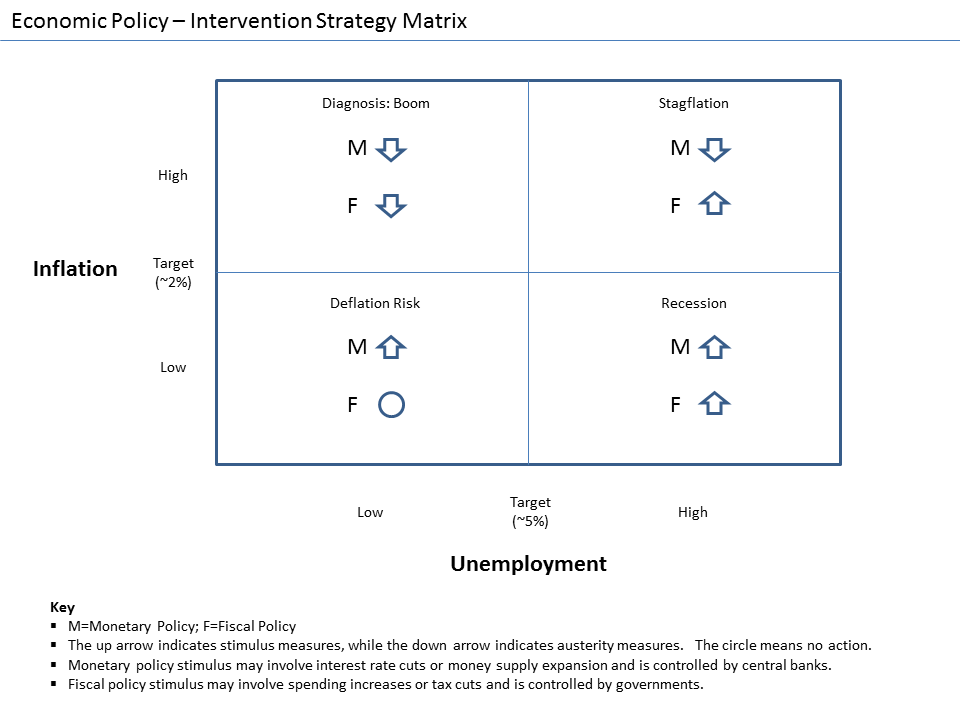
    Economic_Policy_-_Intervention_Strategy_MatrixSince, Keynesian economics had worked in relatively less connected world of 1930s I dismissed the question 1 for future blog. Japan’s overdoing it and how the system works were somewhat related questions. So, that question became central in my very tiny analysis.

    The question I had was – how does Govt issue bonds and how does it get circulated in the market? Well, that is done through the banks and the bankers. Aha! did I hear bankers? Those bankers who went to the President (USA) and said – “we would buy Jet for our executives?” Ok! If those who still blame Keynes, would you ask with each slow down who makes the most money? Is not it the same – bankers? At least the Govt is putting money in the system in the hopes that this method will work to keep the economy afloat. I was checking Wikipedia article on Economy of Japan. An external states that – Japan possesses 13.7% of the world’s private financial assets (the second largest in the world) at an estimated $14.6 trillion [2010 data]. This data states that – Keynesian economics is doing more services to the Capitalism than otherwise!

    [Tweet “Japan has 13.7% of the world’s private financial assets! #Keynesian #economics does more service to #Capitalism than otherwise”]

    Who is playing with the hopes and cheating the system? I am little too critical when I say “cheat” because some people are in the profession of making investment decision and those decision at times counter intuitively work against the basic premise (hope) on which at the first place Govt had put money in the system. I think a solution for the problem of Japan or for that matter world economy (likely next economic burst) lies in answer to the question(s) – who has actually hoarded the money? How to make amend for this workaround of Keynesian method of boosting economy?

    I asked Prof Mankad about his opinion on Japan. He shared this – “One of the real reasons for Japanese stagnation through the last decade of twentieth century had little to with Japanese policy. It was caused by two important external forces viz., depreciation of dollar (and hence default appreciation of Yen) and rise of ‘low cost’ China which deprived Japan of its traditional export markets. The fault of Japanese policy makers was absence of policy response to the changing situation and rise of China.”

    So there is seemingly an emotional explanation [which questions the other side] from my side. There is another more analytical, logical and thoughtful explanation from Prof Mankad. Whichever you want to ponder upon – Keynes did not seem to have failed Japan.

    Yet at the same time, every generation needs a revised look at things & our generation too! Keynesian Economics was successful when the world was not that connect, now QE of USA is invested in India/China which did not happen in 1930s.

    Image source – http://upload.wikimedia.org/wikipedia/en/a/a7/Economic_Policy_-_Intervention_Strategy_Matrix.png

  • Faith


    “Gamblers are the biggest believers!” Prof Mankad told this to me. He asked “who do you think are the biggest believers? They have faith, next time… if not this time one more time, next time fortune will be mine. They believe that one next time; they have faith.”

    When I heard this, I promised Professor Mankad that I’ll learn the games played in gambling. This is seemingly contrary to what we have heard – gambling is not a good thing! On the other hand gamblers can be the biggest believers in the world! I wonder if there is a God he must be sitting in some casino and helping someone make fortune! Isn’t it?

    I had been thinking of writing a blog on our that small piece of chat, and I received this small story – modified a bit.

    FaithBar

    There was a town; often visited by many traders and nearby villagers during the weeks for all sorts of trade. In that town there was a church, but no bars. A person saw an opportunity seeing many visitor in town but bar. Hoping that after a tiring day people would come and just chill in the bar; so quenching thrust with booze was huge business case! However, this person could find a place only opposite the lone church of the town! He started his business there.

    Church

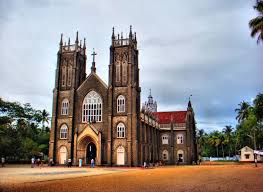
    People from all walks of life visited his bar, not only after a tiring day in the market but also after their prayers and other casual visits to the Church. Earlier only Church used to a common meeting place for town dwellers as well as for villagers from far and wide. Now the bar had taken over. The church was a serious matter and bars were for fun and frolic. Even for heart broken people it was a place to forget the pains. The heart broken had route as – message to Gods in the church with emotional stories, after the painful saga go to the Bar for comforting oneself. The church authorities were pained with this challenge from a competitor just under the nose. They prayed daily against the bar. As fate could have it, the prayers were heard sooner rather than later – the bar was struck by lightning and caught fire.

    Bar owner sued the church for the cause, as an action by their prayer. The church authorities denied all responsibility!

    So, the judge commented – “…its difficult to decide the case because here we have a bar owner who believes in the power of prayer and an entire church that doesn’t believe in it.!!!”

    At times you find somethings at the most unexpected place!

    Disclaimer & sources – The author does not intend to hurt any sentiments, and does not question the authority of the churches [he has his STRONG opinions though]. The author does not want to claim any Intellectual Property Rights – Copyright – to the story [even though he has modified the story].

    Images [used for purpose of representation only] source

    Church – http://upload.wikimedia.org/wikipedia/commons/f/fa/St._Andrew%27s_Forane_Church_of_Arthunkal.jpg

    Bar – http://i1.ytimg.com/vi/NfRrEUz62Lw/hqdefault.jpg