Tag: Prof Harkant Mankad

  • Do what is right in perpetuity


    The class was nostalgic, remembering the last couple of days of sessions of Operations Management with Prof Moradian. Today we were attending his last session of Operations Management. We all enjoyed each session, the quick wits and learnt a lot. We were attending his last session and thus all that was coming to an end for Operations Management.

    That session was very special, I could still hear his one statement very clearly that – “…in your career whenever you have to take any decision, always do what is right for your company in long term…”.

    When I recollect those words from Prof Moradian – “… do what is (make decisions which are) right for the company in perpetuity…” that makes a lot of sense to me. That one statement made me speak couple of tough truths in my career, but it feels good when you consider big picture vis-a-vis to your personal interests.

    An organizations need to learn the art of balancing between the short term sustainability and the long term growth OR short term profit and long term uncertainty. In current economic scenario short term sustainability seems the way to survive, let alone long term growth or profit for that matter. Message seems clear to me – Do what is right for the company in perpetuity.

    Actually this statement equally applies to each individual in life too – we should do whatever is right for us and others – IN PERPETUITY.

    Related blogs –

    Balancing Act – Professor Mankad shared this story of Balancing act with me earlier.

    Fruit will arrive in its season

  • Fiscal Cliff – TRIZ solution


    Fiscal cliff? What’s that?

    I asked Professor Mankad (Sir). He explained it to me in detail. I loved learning that big picture from him. I must admire President Obama for the way he has put in his plan. Everyone in US Admin knows that “We are in trouble”. But how to get your idea win, should be learnt from Obama & Team.

    When Sir explained whole thing with immense patience, I thought about what could be the solution. Sir also suggested that  what are the possibilities and what could be the likely future? I felt – we are (going to be) in deep trouble. Sir suggested that this trouble could be even deeper, longer and disappointing than the 2008 melt down.

    I’m scared. For all such troubles I always look at the other side as solutions. OTHER SIDE here means socialistic approach to solving capitalistic problem. I smsed Sir – could “Sanjha Chulha*” be the solution? It would help provide few  jobs for people in Sanjha Chulha and reduce expenditure of unemployed on food. When that happens, Govt can reduce expenditure of unemployment benefits.
    *Sanjha Chulha means community kitchen.

    The other approach I thought was using TRIZ. Actually that is what Govt must be doing (without the jargon of TRIZ). Before discussing the solution framework, a brief on Fiscal Cliff (Details – About link and Wiki link).

    Fiscal Cliff – is a deep impact due in the budget of Govt. Because as per “Bush tax cut” (of 2003) the taxes would increase at the same time Govt has to reduce spendings e.g. unemployment benefits offered for 99 weeks would reduce to 52 weeks, defense budget reduce by say 50% etc. All of this would result in recession in the USA. The challenge for Govt is – how to control it? Fiscal Cliff is also a function of debt reaching a ceiling % of GDP.

    In TRIZ there is a solution type for such issues. That is named as physical contradiction, which means you want something and you dont want that at the same time. You want Tax cut and you dont want that. You want reduced expenditure but you dont want that.

    Simple solution is – “increase ceiling debt as % of GDP”. Other solution would be, TRIZ offers solution by separation principle.

    1. Separate tax collection based on condition. This is tried arguement is on tax ceiling (Obama says 400k, Congress says 1M).
    2. Separate tax collection based on organization vs individuals. In TRIZ it is kind of separation of parts Vs the whole.
    3. Separate tax collection on time. This separation could be coupled with solution 1.

    1. Separate spends based on condition. spend ceiling on spends of different types
    2. Separate spends based on community vs individuals. Healthcare Vs unemployment benefits
    3. Separate spends on time. Delay spends which could be avoided.

    For testing all these ideas a very simple mathematical model and “goal-seek” of Microsoft Excel can be used. (Though its not that simple – but who wants to complicate things? Objective is to simplify life) politicians/consultants like complexity, who can leverage it.

    Relevant news Euro debt reaching 90%

    Separation principle

    Related blogs –

    1. Double dip

    2. Euro is it dead

    3. Need of the hour
  • Conflict of interest


    Disclaimer – Author himself is an MBA in Marketing (has been and is in the business of – kind of – selling dreams) and has worked as operations management consultant (has been and was/is/has been facing the challenges faced by operations department)

    I was comparing ourselves as an organization. I am an organization in myself, so are you and Ms Y. I was wondering about the departments Marketing and Operations. Marketing is selling dreams and Operations is capabilities. What I dream to be, could be the job of marketing department and what my capabilities are is the reality of operations.

    There is nothing wrong in dreaming, in fact it is good. At the same time knowing the capabilities is also important, that would help us realize the true potential and opportunities of improvements. Though, how often we dream then review our current potential and then think of building future capabilities to achieve potential? That’s where I think Marketing and Operations Department lock horns.

    An incident reminded me of a lecture of Prof Moradian, long term Vs short term and conflict between Marketing and Operations departments. I started seeing more reasons for conflicts between Marketing department and Operations Department.

    Marketing and Operations lock horns with each others. Because generally Marketing team communicates moon, Sales team sells the idea of “reaching the moon as a reality” to prospect and Operations finds it difficult to do that. Why? Because Operations had the capabilities and was supposed to put the prospect in the sky (not necessarily on moon). Thus, challenges faced by operations and promises made by marketing are different.

    The second issue is Marketing and Sales team lives on quarter on quarter (Q-o-Q). They have to show the revenue which is the goal for any organization. On the contrary Operations team cannot take decision for one quarter. For example – operations may not say we need infrastructure for one quarter and not in other quarter and thus make huge investment in one quarter and sell those equipment back in next.

    A branding expert told us that marketing managers (brand manager) want to start new brand building exercise (to gain in short term for writing on their resume – ‘I started this initiative’) and move to next level. New manager comes he/she too does the same. Short term gains are there for the marketing manager; yet for long term the brand is diluted perhaps no one knows what would the brand stand for in future.

    This was/is the case of 2008 melt down. Decisions were made on short term with one phrase in each agreement – “systemic risk”. BFSI industry created various certificates (CDR) etc to sell junk to make big buck in short term. Dreams were sold without real fundamentals. In other words, operations did not have the capabilities of generating the kind of returns promised – with a rider of systemic risk – to prospects.

    This is what is conflict of interest for us as individuals – our dreams Vs our realities. The same is true with Organizations – their marketing Vs operations. This is also true for us as economy – our dreams Vs the reality of systemic risk and capacity of economy to fulfill the dreams.

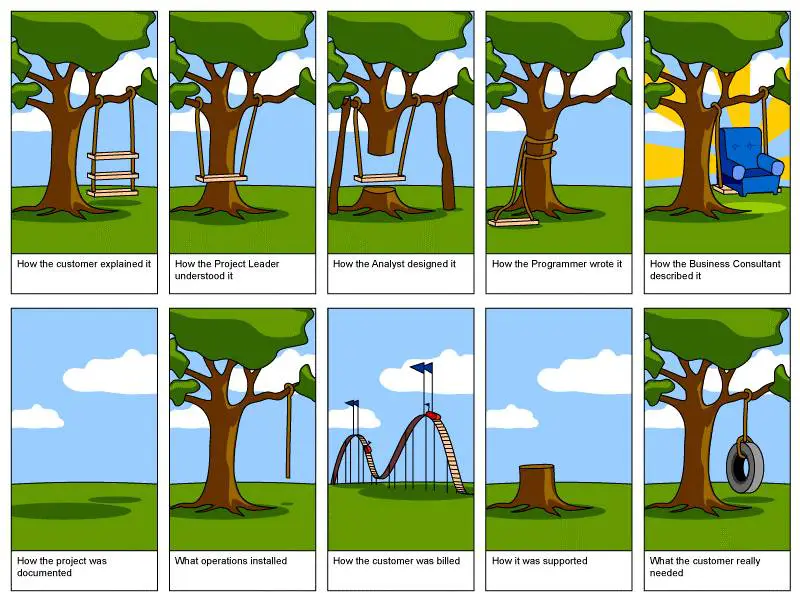
    Image source – http://www.cravingtech.com/blog/wp-content/uploads/2007/11/project.jpg

  • Measuring growth


    I had been asking myself a very naive question. How do we measure growth? Well the answers is not “the GDP” etc. What if I sell things very expensive? GDP might grow, right? So, I zeroed down to interest rate as one vehicle to measure growth.

    Well, let me be more fairer in providing one more reason for taking debt as a metric. I had been wondering about 2008 crisis and the fancy word – Corporate Debt Restructuring. When we look at these and other special purpose instruments we would realize that humans try to fool themselves or fool others. Therefore I considered  Debt as one metric to measure growth. I noticed Kingfisher drowning  recently – I mean the airline in India. We all have witnessed crisis of 2008. In the enthusiasm and to show fat books banks start providing loans to people; once a person is not able to repay the debt banks auction those properties. These two big cases and the housing bubble, all these things are examples of our assumption based “Growth” of economy. Here we assumed growth is represented by the ability of people/organizations to take loan. Interest rate of loans would become a representative of metric of growth.

    We all are in this mess of economic slowdown because of the concept of debt. The ability of big, smart and mighty people and organizations to restructure these debts. When I was doing a course on Independent Directors with Institute of Directors I was wondering in one session – “What if  we don’t have this concept of Debt?” In Islamic banking there is no concept of debt. We may say that Islamic banking has a more refined concept (debt), it is called as profit sharing.

    I am not a scholar of Islamic Banking and therefore whatever I am writing here is with reference to what I was told by one of my colleague and friend (Abdullah Pijvi). He too suggested to me that he is speaking from his experience (he had taken some loan) and therefore he knows that there is no straightforward concept of Debt/loan. It was interesting to know that concept however I had a question in my mind – if Islamic banks don’t have the concept of debt how do they grow? And I started defining metric of growth as – debt and interest rate!

    Related blogs – Where is growth?, What else you need? and Abundance of scarcity

    Disclaimer – 1. In this blog technicalities of economics were not considered very seriously. So readers are warned to do their research in formulating their arguments for/against such thoughts. 2. More thoughts on Islamic banking in future blogs

  • Currency for the future?


    In his class, Prof Mankad asked us “what is money?” He answered – “Money is what is accepted as money”. Very apt definition. Here I am taking small freedom to change it a bit. I am changing the word “accepted” to “trusted”. Of course trust is a very heavy word. We have built a concept “of money” on trust. The question is where is trust? On a lighter note – There was a time when banks did not trust each other (recession of 2008). I have heard this idiom – “put your mouth where the money is.” Should money be replaced with “trust”.

    I was watching 3 idiots last Sunday and thought that kids like Rancho (character played by Amir Khan) – who could solve problems of class 10th while studying in class 6th – are not that rare in India. You go to Super 30 in Bihar, or any institute in Kota (Aakash, Bansal etc) you would encounter many such kids. Then what happens? Why don’t we see such extraordinary kids as stars of tomorrow? Because in future all these kids realize that the only measurement stick (metric) this world has is – Money! See the video of Staffi Graph – how much money do you have? Well, I am not blaming Staffi for that. This is just a representative video of our society. The measurement of success is how much money do you have? Not how did you get it. Also, the measurement is not how satisfied or happy you are?

    [youtube=http://www.youtube.com/watch?v=PlA_hL3NyyU]

    When these extraordinary kids get out of college, are paid enough and more so that they do “what the company wants them to do”, not what they would want to do. Most of them choose to accept that offer because measurement metric for the society is – Money.

    Let us flip the coin and say “Trust” is the currency. What would happen? Those who have hoards of currency may be the most bankrupt people on the earth. Perhaps, a business of trading of trust would start (Bomday Trust Exchange or National Trust Exchange). Would the world be a different place then when currency would be mutual trust (well not necessarily Mutual such as DLF and Robert Vadra ;))

    The day I started writing this blog I also had a brief discussion with Mr Shreekant Shiralkar and he was of the opinion – Money becomes immaterial after a certain time, what you do, what satisfaction you get from work and the trust you build is important. When he said Trust his thoughts were different compared to what I am presenting here. However, what I feel is the currency for future should be trust you build, the good you do to the society and how satisfied and happy you are.

  • Where is growth?


    The mobile was ringing, suddenly phone was picked and the statement – wait! Mumbai Indians needs only 5 runs to win in last 6 balls. I said ok Sir I will call you in five minutes. The turmoil of thoughts continued in my mind. What am I thinking, what are the questions in my mind, so many things how do I connect all these dots etc. Mumbai Indians eventually won, Prof Mankad informed me in next five minutes.

    We started talking – the market is steady, if not bull than not bear too. Indian Prime minister and Finance minister both are making statement that “We are going to grow at 6.9% if not at 8%”. Still, there is some uncomfortable feeling. I told Prof Mankad, “Sir I am not convinced. Further to it I said – news is Facebook is licensing the AOL patents – owned by Microsoft now – for close to 550 million. Next thing which I forgot to ask him was – news of bribing in Mexico by senior executive of Wal-Mart. Wal-Mart was running behind growth – sometimes in 90’s – and got in this trouble recently when the case was surfaced. I further added that Italy and Spain are showing -ve growth (to be precise signs of recession), where is growth?

    As always these questions were simple to answer for Prof Mankad. What he said very closely resembled to my thinking of inclusive growth. He said – hold your horses, the questions are right, this growth is notional and specific to IT and finance industry, largely to few services industries so to speak. The questions are pertinent, sir said. If I remember correctly he also informed me that Italy not only Spain has declared recession, French election would surely put more light on the already tough Euro crisis. Sarkozy is likely to lose, and then there are more elections coming up in Europe e.g. Germany etc. Political parties in Holland have agreed on austerity measures. Growth would happen and thus recession would be arrested only once we see growth in all the industries otherwise we are in a bad shape. It is not possible to say that we are growing at so and so rate when only one or two industries are showing signs of growth.

    This reminded me of my most loved theory of the Buddha – Interdependent Co-arising. I have written on this often and the current situation shows us yet once again that we are all connected, nothing can be isolated and growth is a collection of small growth in each industry. Each industry is a building block for the overall movement of the engine of economy world across (with few riders). No China can survive without US or Europe, no India or Philippines can grow its service industry until there is overall growth in the demand of service industry in developed nations.

    Where is growth? There would be growth when we all learn that we need to think about each other and help each other grow – we are all interdependent and we would successfully grow only when we grow together.

  • Leadership and education


    Election results of couple of Indian states are out and largely there are clear mandates in all states. So, there are not many permutations and combinations happening for forming governments. I was wondering about the elections, results and post results – five years. The long term thoughts (five years after results) were hampered by a news of rabble rousing activities in UP. Does the confidence of victory create so much defiance that people do not mind taking law in their hands or crossing the limits?

    This question lets me ask myself – what do we need? Politicians or leaders? Are politicians really leaders? I was thinking about this and on LinkedIn I read a question. IF YOU HAVE GOOD STRATEGY, DO YOU STILL NEED A LEADER?

    Can a good strategy create a leader or leaders can create effective strategies? My answer is leaders can create effective strategies. Also, I heard someone say – An army of sheep led by a lion are more to be feared than an army of lions led by a sheep.

    I was talking to Prof Ramanathan, he told me “…Pravin I see there is a lack of leadership at various levels, be it corporate or others…”

    The fact of the matter is the crisis is wide spread are we creating leaders? Are we creating excel, power point and ivory tower experts of solutions? When I read the book – I have a dream I realized that there are people who took initiatives, who rolled their sleeves and got down to work. There may be many more not covered in the book, yet how many of us have become leaders after studying at Ivy league?

    Recently, I met Prof Mankad, we discussed Greek crisis and the visible solutions to it. He made a good observation on the economic power of China that made me think – having and managing power requires a sense of responsibility and ability to be fair. This ability requires courage and confidence to say – ‘yes I erred’ when one did commit mistake. Does our education teach kids to have these qualities?

  • Individually smart, collectively dumb!


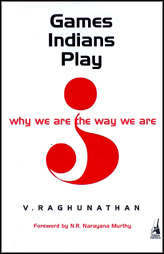
    Book Games Indians Play cover
    Games Indians Play
    Have you read Games Indians Play! by Dr Raghunathan? Very interesting book with pertinent examples of issues we face, many a times overlook and are facing worldwide. In that book he says – “We are individually very smart but collectively dumb”. I think we are collectively dumb and therefore we are in the economy-related mess we have created.

    I did not know that I would be referring to my new year blog so early in this year. Newspapers of 3-Feb-2012 made me do so. The news was about the 2G scam which had been under scrutiny for a long time now. In my opinion the verdict clearly stated that power corrupts and it gives you confidence that you can get away with murders too (many such cases pending in India)!

    I thought hard – really very hard – to find a solution. I think I will go back to TRIZ (theory of Inventive Problem Solving) to decide conflicts and resolving them. Until I find a one size fit all ‘man made’ solution, I could think of only one possibility. This solution is self restraint, and owning responsibility to make sure we are morally correct.

    This word ‘Moral’ reminds me of my economics and business ethics class of MBA where we discussed moral hazards with Prof Mankad and Prof Arun Ramanathan. I was reading this article on Moral hazards at Wharton. The article talks about authorities and new stringent rules. This regulatory authority will tomorrow need another (other set of rules) and so on and so forth. How long will we create such authorities? Moral hazards would end very easily when each one takes responsibility and become accountable for his/her action. This accountability has to come on each level and for all the actions. The problem lies with a reality that – ‘We are individually very smart but collectively dumb’. This ‘being individually smart’ begets moral hazard. The solution for this problem is one’s own self. Take responsibility own it and be accountable. Perhaps initially we (as individual) will fail but collectively we will start succeeding.

    I am hopeful that once we start from ourselves (individually), each one of us would be able to avoid situations where we would talk about Newspapers of 3-Feb-12 (2G Scam), other scams and the bad shape of world economy. Hoping that we would save our energy to concentrate on something constructive.

  • Welcoming’12, Seasons of ’11 and accountability


    For some new year is getting new fancy, even more exposing table calendar and flaunting that. For some it is a continuum of the life – life as usual. For some it is a time to celebrate. I think this is the occasion when we should ask ourselves what happened last year and what should be improved? In 2011 I asked myself -” would I support places such as Barasti in Dubai?” I felt that Barasti is a place which supports racism and I decided against going there.

    When it comes to the year 2012, some time back there was a rumour about the year 2012. Hollywood made a movie – 2012. That movies speaking about this year as a question of existence, right? Well, why start the year with that question. Or we can start thinking about existence and ask questions to ourselves. Look at the 2011, what we did not see? We saw Arab Spring, Summer of India/USA and Winter of Europe. Let me elaborate –

    Arab Spring – I was in middle East during the time when Egypt, Bahrain, Yemen and other such uprising were in news. I wrote in 2011 about Arab uprising – Power Corrupts. Yes, it does and had been in question for Middle East in 2012.

    Summer of Europe – Have you not noticed that the production in China, industrial growth figures of India and other developing nations were not positive lately? The likely reason for that is slow or negative growth of developed nations e.g. USA and Europe. Euro zone saw a unique problem this summer of 2011 when countries were likely to default on their loan payment! I asked a question to myself Euro is it dead? and in May 2011 asked my Teacher of economics – Professor Mankad is Euro dead? We saw the turmoil of Euro for couple of months. Lately, I read on Reuters that “the Euro is not an experiment…” ECB executive said that. On a lighter note – “as if it was supposed to be an experiment until now”. Personally, I am in favor of the kind of economic zone Euro has created. However there are problems with accountability which needs very strong measure.

    Winter of India and USA – Euro zone crisis did not end and we saw another people’s movement – the Lokpal movement in India and Occupy Wall Street in USA. In brief Lokpal bill is to curb corruption and bringing high and mighty beurocrates and politicians under the ambit of LAW. Strange a democratic country India talking as if it is an autocratic country where KING/QUEEN (beurocrates – include lower and upper – and politicians) is above the law. On the other hand citizen of USA were questioning ‘the top 1% holding maximum wealth‘. Why not Investment Bankers take responsibility for not only creating toxic assets but also burning those assets which eventually ruined the economy – of the whole world.

    Well what do you make out of these seasons of 2011. If I look back and take a macro perspective – all these big events of 2011 were Questions on “accountability”. Let us begin the new year with taking responsibility of our actions and working towards a peaceful (Middle East), moral (India) and equitable (Europe and USA) world.

  • Money – what is it?


    This was a very candid question Prof Mankads asked once – ‘What is money?’ and he answered – ‘Money is what is accepted a money.’ True, money is what is accepted as money. Humanity needed some tangible measure so we deviced various forms of money at various time. For example at the time of barter system ‘everything’ was weighted against the other. So everything was acceptable in trade as money. Then came matels and now paper and plastic money (credit cards).

    I started thinking if we needed something tangible as money what if we made something like Camay (soap) a currency? If some other things be made money what would happen? Take an example of age – everyone would gradually get money. Fun or being funny – comadians would have maximum money in the world. Seriousness – patients in extremely intencive care units. Trust – Indian politicians or politicians in general would stand nowhere. Spirituality – the spiritual masters would be at the top, one I know is Sri Sri Ravi Shankar.

    Now if we ask ourselves – who is rich? The simple answer is one who has ‘more’ money. ‘More’ is contextual (adjective). Now, if we take money as fun, being happy or being funny. How many of us are rich today? Kids in school are competing, people are jealous or many of us have only instant gratification and long term sorrow. Not many of us are rich! Has money made anyone happier?

    Assume Trust be the currency. How many have earned it? Yes trust is hard earned currency, right? Bankers have lost their trust of 100+ years (see the occupy wall street movement), politicians have lost it. Citizen vote because they think someone will improve the systems. On the contrary we all still remember Jesus, the Buddha and other Masters. Plato, Aristotle and Chanakya. We named unit of force on the name of Newton we say Da Vinci was genius. Were they ‘RICH’ in terms of hoarded money? So, what if we measure richness on different factors now and in future. See this engineer mind thinks of formulae (which is not correct, yet I am writing it) –
    Richness = [{(money + Happiness)*Trust/greediness}^(1/greediness)]*(peace of mind)*spirituality
    and other important stuff
    Range of the variables
    0 > Money, Happiness and Trust > 1
    Greediness > 1 upto infinite
    peace of mind and spirituality> 1
    ^ stands for raise to the power

    I think everyone of us has to identify what we want from our life and that one or few things would be The thing(s) which would make each one of us Rich (not necessarily Money). Of course, this richness should not come at the expense of others or harming others.