Tag: osho

  • Spirituality and Science

    Mahavir – the Jain Tirthankar – was traveling – walking – for his rainy season retreat (Chaumasa). As is the case with any enlightened master in India, Mahavir too had followers traveling with him. One of his followers – named Gaushalak – was mischievous and wanted to have Proof of his enlightenment.
    While they were crossing a rivulet. Gaushalak asked Mahavir, do you see that plant? Mahavir responded in the affirmative. He further asked Mahavir, would this plant grow into a tree? You know all, you can see the future, and you are enlightened can you please confirm this?

    It is said that enlightened people can talk to even the non-living, or in other words, they can understand beyond the perceived too. In fact, someone told me that in Indian Ayurveda, Rishi’s came to know about some of the herbs when they asked the plant for a cure.

    So, Mahavir reached to the plant, apparently, he asked the plant would you grow into a tree? The plant responded to Mahavir in a Yes. Only Mahavir was at the consciousness level to hear the plant, none of the others. He continued his walk and responded in another affirmative to this follower.

    As this follower wanted to test Mahavir, he went to the plant, pulled it off the ground, and threw it aside. Further, he said – I have removed the plant; I am proving you wrong right now itself. Mahavir continued his walk.

    The rain retreat was over. Mahavir and his followers walked back, cross the same rivulet. Mahavir pointed to a plant and told Gaushalak – do you see the plant? This is the same one, it has not only found another ground but also grown within the past few months. Gaushalak was ashamed of his deeds and doubting the master.

    If I related this story to us as professionals, it is the will to cross the hurdles and blossom in adversities when you have been uprooted.

    My experience

    What makes enlightened masters different than the others? They have a consciousness level of super-consciousness. Super-consciousness can be defined as omniscient, omnipresent, and omnipotent. It may sound a bit off from the spirituality where God is not a matter of discussion. The Buddha did not answer the question of the existence of God. Consciousness has a higher level that is beyond the manifested world.

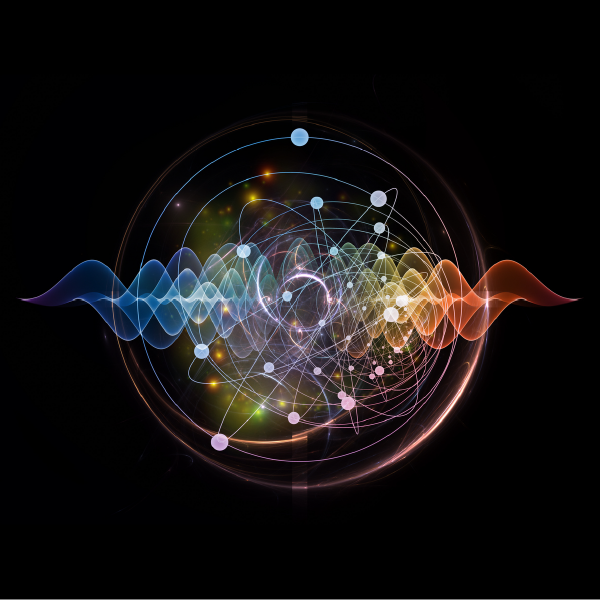
    I attended a meditation silence retreat of the art of living foundation during the new year’s weekend. It was a wonderful experience. It helped me to understand and experience some unique things. Many experiences cannot be expressed in words. However, the concept of spirituality connected to present-day physics (quantum mechanics) was very easy to grasp and experience. We are all wave functions. Hinduism states that we are made of five elements – Earth, Air, Water, Fire, and Space. Space is omnipresent. All the other elements according to the Mass Energy equation of Einstein are interchangeable to mass (I would call it manifestation) to energy and vice versa.

    The Indian sages have achieved multiple manifestations and changes of form. Read Autobiography of a yogi or At the 11th hour for some examples. Basically, we believe in things that we can comprehend or think are possible. We call things as miracles that are incomprehensible or beyond our perception “as possible”. Slowly science and spirituality seem to be merging. Now our experience can connect the dots to scientific proofs. Slowly our perception of miracle, manifest and unmanifest will be even more blur.

    Two miracles

    In a place named Agar Malwa in MP, there is a Samadhi of Swami Jaynarayan Ji Upadhyay. He was a lawyer and a meditation practitioner. It is an incident of July 1931. Once he was in deep meditation (Samadhi) and missed attending the final hearing of one of his clients. When he came out of meditation, he ran to the court. There he came to know that his final arguments were unbeatable, and his client is acquitted. He was physically in meditation at a temple and there he was in the court too. He knew he missed the session. People say that after hearing this about himself, he left everything and became a monk. Recently, in the same city a law college started and it is named after him.

    Similarly, there is another incident of Guru Nanak dev’s manifestation. It is said that when Guru Nanak dev Ji died, His mortal remains turned into flowers. There was a dispute about his last rites. His Muslim followers wanted to bury, Hindu and Sikh devotees wanted to cremate the remains. Guru Nanak dev Ji avoided this dispute by suggesting the followers bring flowers and keep the same on either side of his. Whichever side’s flowers remain fresh, that sect’s custom should be followed with mortal remains. After his death, only flowers remained, the body could not be found. It is documented as well.

    Spirituality and science

    Some things are beyond comprehension – at least as of now. However, those things can be possible. Science is able to provide an explanation for some, during and after the silence meditation retreat course, I could connect some dots relate to some experiences. Earlier I used to dismiss such stories as fiction. Now, I feel that there is something unexplained for science – call it the ether or Space element – that can be experienced with deeper meditations.

    The point I want to drive home is, we are spiritual beings in physical forms. The idea is not to discuss miracles but the possibilities. Finally, each one is a wave function condensed into a manifestation. In some cases those who are evolved can make change manifestation too. Probably, the self-realization spirituality talks about is the realization and experience of the wave function – that is the omniscient, omnipresent, and omnipotent.

    Image source – https://letstalkscience.ca/educational-resources/stem-in-context/introduction-quantum-mechanics
  • Driving in India


    Many activities in India can be related to spirituality take for instance driving. It is a very spiritual experience. I have had the privilege of driving on Indian roads – streets and highways, metro to small cities and even two wheeler and four wheeler. I have used choicest of the words while driving. This experience also includes bicycle and how can I ignore walking? This idea of connecting spirituality and driving (plus walking) stuck to me when one of my friend’s was hit by a two wheeler rider breaking his wrist and handset.

    In two ways spirituality is manifested when you drive in India, one when you are stuck in traffic you have two options. Option one you are at the verge of meditation, or the complete opposite curse self or Google maps left right and center for selecting the route or abusing people who caused (not following lanes, jumping signals etc) the traffic. Option number one is better any day. I can vouch for this specially in traffic of Mumbai.

    The other way of manifestation of spirituality is when you are riding a two wheeler, specially in a tier 2 city. The two wheeler riders in tier 2 cities drive such that you have to take care of yourself. The thought processes of these riders are like this – “I’ve to take care of myself, hell with others, they will take care of themselves”. You have to be very careful because anybody can pop from any side. When my friend’s wrist was hurt badly and mobile screen broken I could not resist but think about all these. The rider it seems was practicing riding meditating (like walking meditation) while driving went away in thin air, without stopping and apologizing.

    You have to be selfish to drive in tier 2 city because a two wheeler rider will take care of himself you take care of your vehicle rest of the other people around you are Maya, signals are for mortals you are self realized parabramh (the non destructible God).

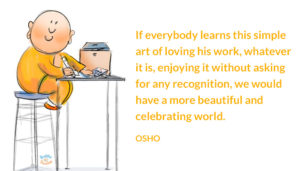
    This “selfishness” reminded me of the above short comment from Osho – the other way of connecting spirituality to Indian traffic conditions. What is your take? Can driving in India be a spiritual experience?


  • Hidden potential


    I had inflammation of gums recently and was not able to eat properly. Instead of looking for solution first, I started looking for causes why I had this swelling? Root cause of the same of my eating roasted corn. So, next time onwards I will be careful when eating roasted corn. Currently, I am having backache, all due to wrong postures while working in office seating in office.

    We do not even notice small integral parts of our body such as gums or back until we have a trouble with them. These parts exist and function as per their role in the physiology of our body, yet we are in oblivion of them, until those have some issue – for us those are almost nonexistent until they let us know they exist and have some limits, in my case it was backache and gum’s swelling. I had kept on noticing gums every time I put something in my mouth, back is reminding me of it’s existence until now.

    What is hidden? Hidden – to us human beings – is something that we cannot perceive. The gums and back was something hidden until I had troubles there, it existed physically, I knew it existed but I did not notice it.

    Perceptions are another limitation, our perceptions are limited to our five senses. If something exist beyond these senses we may not know of it’s existence such as noise beyond a certain range.

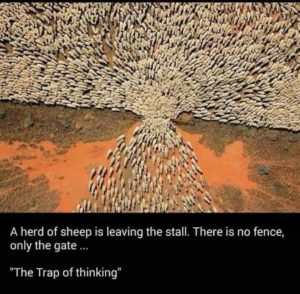
    We cannot see air, it does not mean it does not exist, we know air is there because our sense of touch can feel it – breeze or cold. A seed has a possibility of become a tree, that is it’s hidden potential. We cannot see it manifested and thus we do not believe in it; that is our problem. Our perceptions are actually created by our previous learning. In the image here, there is no gate or fence, it is all in the minds of sheep.

    I have written on it earlier on perceptions and specially here what I learnt from Sai kaka, about our past impressions –
    Sanskar yukt chaitanya jab (संस्कार युक्त चैतन्य जब)
    1. chintan karata hai to usko chitt kahate hai (1. चिंतन करता है तो उसको चित्त कहते है)
    2. manan karata hai to usko man kahate hai (2. मनन करता है तो उसको मन कहते है)
    3. nirnay karata hai to usko buddhi kahate hai (3. निर्णय करता है तो उसको बुद्धि कहते है)
    4. asmita ka bhan karata hai to usko aham kahate hai (4. अस्मिता का भान करता है तो उसको अहं कहते है)
    inme se sansakar nikal jaye to jo bachata hai vo shuddha chaitanya hai (इनमे से संस्कार निकल जाए तो जो बचता है वो शुद्ध चैतन्य है)

    A rough English translation of the same is –

    When a conscious filled with rituals (or say the lessons learnt about ‘way of living’, include religion)

    1. thinks we call it mind (imagination)
    2. contemplate we call it Mind [there is a difference between Chitt and man which I am not able to translate in English]
    3. makes a decision we call it intellect
    4. perceives pride we call it Ego

    Now when the rituals, religion or ‘way of life’ learnt, get out of this conscious mind, what is left is the pure consciousness.

    It means “pure consciousness” is blurred by our different (Sanskara) learning about life. Therefore in some cases religion becomes a problem.

    This is the problem of our perceptions such as we think East is far different from the West. Can we try experimenting – a kid born in Say US should be reared in India and vice versa. Would these kids grow up to behave in similar manner such as US born kid raised in India, would behave like any kid born and raised in US and vice versa? When we talk about East Vs West our perception are based on the “sanskar”, at times those are the hidden potentials.

    Hidden potential was an old LBC topic, I wrote on it today. Loose Bloggers Consortium is where MariaRummuserAshokShackman and I write. You can visit their blogs and read their thoughts on the topic.

    Image source – unknown currently.

  • Are You Enjoying What You Are Doing?


    I have been writing on Business to the Buddha for 6+ years, 325 or so blogs now. If you have read my previous posts and at times the title, you might have wondered, why such title? One reason you can read it on this link, and other is to look for a way how we can have a more inclusive, economically better and psychologically calmer society? The question of this post – “Are you enjoying what you are doing?” is directed towards that economics and psychological thought.

    What all do we do except our daily chores such as eating, sleeping etc? In those activities there are some mandatory activities and some forced and other times hobbies there are always choices and challenges. Some things we do not like doing yet we have to do, some times we like doing something but we have to postpone those. This is where many people think of such question.

    Long back precisely in Oct 2011, I drafted a blog “Do what you love doing”. Somehow I never completed that article, parts of that are produced below –

    …On this point, I had contention recently in a professional set-up. I also believe that if one does what he/she enjoys doing lot of issues of his/her life could be solved. Take an example – in Mumbai average a person travels 2 1/2 hours per day, works for about 9-10 hours, sleeps say 7 1/2 hours and whatever time is left she/he either stays with family, goes to social gathering or does domestic works. If more than 1/2 time daily goes in office related activities, why not someone do something which is relevant to the interest of the individual? This choice of ‘doing something which is of interest’ has to be a mature and personal decision of a person…

    This was with reference to a reward program in a company. My point of view was very opposite of what many other employees of that company believed in- though the management was appreciative of my opinion. I understood later why employee-employer relations are the way they are in many companies. My observation is – in many cases, beyond money there is a drive that makes a person get up in morning at go to a job. Until one reaches that level of awareness, person looks forward to the last day of month when salary will be credited. If someone has passion and purpose one finds time, energy and resources to do that activity. When this happens a person truly enjoys what he/she is doing.

    This small point what Osho said – “If everybody learns this simple art of loving his work, whatever it is, enjoying it without asking for any recognition, we would have a more beautiful and celebrating world.” is very valid. If we would either start loving what we do, or we start doing what we love our economy and Human Development Index both will fare better.

    I raised this question to some of my email & blog friends, from that discussion the question became topic of Loose Bloggers Consortium. You can read thoughts of other two writers – Rummuser uncleji here and Shackman uncleji here.

    Image source – http://oshoinsight.com/tag/enjoy/

  • My Favorite Fictional Character


    Have you ever thought about fiction and reality? Fiction is something untrue, made-up or imaginary. How can I say that the Buddha or Krishna or Jesus was someone who actually walked the face of earth. Is it a possibility that these were imagination of someone? This thought puts me to another thought, what if I myself am is some imagination and a reality is somewhere, something else.

    Have you ever had a dream, Neo, that you were so sure was real? What if you were unable to wake from that dream? How would you know the difference between the dream world and the real world? Morpheus The Matrix

    What makes something real? Is it because I think, see, feel (perhaps smell or hear) and my mind makes me feel that this is something real because I can sense it? Or something is real because it exist without someone’s ability to sense it or no. Take an example of light – we cannot see light beyond a certain frequency range. Does it make the light non-existent?

    These questions remind me of a very interesting movie – The Matrix.

    “…The Matrix is everywhere. It is all around us. Even now, in this very room. You can see it when you look out your window or when you turn on your television. You can feel it when you go to work… when you go to church… when you pay your taxes. It is the world that has been pulled over your eyes to blind you from the truth…”

    I have had a couple of Morpheus in my life to teach me. I have written about almost everyone on this blog. I would want to be Morpheus too, for someone or few in future. I love the character of Morpheus from The Matrix the most. Morpheus is a believer, he courageous. The best part is, the kind of confidence Morpheus has in Neo, it makes me feel that I want to be Neo too. Laurence Fishburne played the role so well that I keep on watching his teachings (dialogs) whenever I feel I should. There are a lot of learnings in those dialogs – “Do not think you are, KNOW you are.” I have written on the movie (red pill) earlier too. I was so fascinated with the movie that I used to tell people that I am fine being a spot-boy for the movie – alas I am in India :(. The movie is so philosophical and spiritual to me that I repeatedly watch it.

    Instead of me talking (writing), I would want to share some videos of the movie (Youtube), not sure about the copyright permissions there.

    I see many of my teachers in Morpheus – they are indeed my Favorite (they are real) human beings, this blog post is dedicated to all of them. This was the title of this weeks Friday Loose Bloggers Consortium. Con You can read other LBC bloggers thoughts here – Rummuser and Shackman.

  • How can I be liberated?


    The business of “I” is unique. We think that it relates to “me” but that the catch-22 situation. Whenever, I say this word “I” it reminds me of two consecutive chapters of The book of Mirdad. Mirdad is unique as his book, On one page he says – don’t use the word “I” it is forbidden word on the Noah’s ark; on the very next page he says “I” is the most creative word” (it is source and center of all things).

    When we say “I” it is largely the Ego talking, whereas when Mirdad says “I” (the creative word) it is the source of and frobuddhapixabaym the creator of the world. The question is – “Is ego ‘purpose of existence’ or a problem?

    Here is what The Buddha told Sariputta on the same.

    ————————-

    Sariputta came to Buddha.

    He asked Buddha, “How can I be liberated?

    Buddha said, “Do not come to me, go elsewhere – because I cannot liberate you, I can only liberate you from this ‘you’.”

    Buddha said further, “‘I’ is never liberated. One is liberated from the ‘I’. So if you are looking for your liberation, go somewhere else. But yes, if you want liberation from yourself, you have come to the right place. I will make you free from yourself. So do not ask how you will be liberated. You will not survive in your liberation. You should ask how to be free from this ‘I’ – how to be liberated from this ‘I’.”

    ————————-

    Liberated from what? If the “I” is dropped, the question ends, isn’t it!

    We can at most get attached to the actions we do, not the results. That is why I write about myself – “I’m passionate about my work and actions and empathetically careful, attached and committed to them.” Experts (read Lord Krishna) suggests do not even get attached to the actions! That is difficult, just imagine how difficult it is to detach from the “I”.

    Source – Osho, Finger Pointing To The Moon, Image source – Pixabay

  • Left and right


    What I could infer from “Left and right” (as the topic was) or say left, right and center is “all over the places, not organized”.

    If someone is in complete disarry e.g. left and right, what that person needs is meditation. Watch this video on Meditation by Osho. What this video suggests – I would say in one word – is “Awareness”.

    If one’s mind is also going left and right, one must be aware of the disarray, confusion. “I am aware that I am confused.” Sounds funny. However, I think with the deep clarity and awareness of the confusion and acceptance of that confusion one may get some solution.

    This topic was suggested by gaelikaa, for the weekly Friday Loose Bloggers Consortium where currently nine of us write on the same topic every Friday.  I hope that you enjoyed my contribution to that effort.  The eight other bloggers who write regula”rly are, in alphabetical order,  AshokgaelikaaLin, Maxi, Padmum, Rummuser,  Shackman and The Old Fossil. Do drop in on their blogs and see what their take is on this week’s topic. Since some of them may post late, or not at all this week, do give some allowance for that too! – See more at: http://business2buddha.com/#sthash.VWAxQjus.dpuf

  • Kashmiri Saint – Lalla


    I was listening to Osho’s discourse and in one discourse he was referring to a Kashmiri woman Saint – Lalleshwari. I was impressed with the first verse I read from her. Thought to share it here for many others to read –

    Whatever work I did became worship of the Lord;Lalla
    Whatever word I uttered became a prayer;
    Whatever this body of mine experienced became
    the sadhana of Saiva Tantra
    illumining my path to Parmasiva. -138

    So wonderful, profound meaningful and to the point. I plan to read more of her writings.

    Read this – The Hindu Article – Mystic insights

    Image source – Poet Seers

  • Entanglement of a langot (undergarment)


    I heard/read a story when I was a kid, I think in some Osho discourse or book. Well, I have been thinking about writing this for a long time, but I didn’t remember the whole story so I called my gateway of last resort (Ramana Rajgopaul uncleji – he blogs here). “Gateway of last resort” is a Computer Networks term, when every other link fails send data packets to gateway of last resort, is how any router is configured.

    Actually, he is very different person – you (I mean, I) can speak with him on any subject matter (from Sex to Super-consciousness). He guides with different points of views and references (he speaks great sanskrit, speaks Shlokas of different scriptures and mind you – he is an MBA from IIMA OK!). By the way he is 70 year young; young because when I talk to him I feel as if I am an old man, he is full of life as young as a 15 year old can be. Coming back to the story…

    Entanglement

    There was a saint, ascetic. He used to live outside of a village as used to happen in old day India. He owned only 2 langots (Nappies, or undergarments), nothing else. One he used to wear while other is washed. As any Indian saint could be – he was fed by villagers. Once, one of his langot was nibbled by a mouse. So villagers gave him cat to shoo away mouse/mice. In some days our saint realized that he needed to take care of the cat and to feed her he needs something. Villagers gave him a cow for feeding milk to the cat.

    Well, now he needed someone to take care of his cow, he hired someone to take care. The story goes something like this – this hired person needed monthly salary so saint started teaching as well. Slowly, this saint – an ascetic – becomes a family man. This langot converts an ascetic to a family man…

    This is how (may be not because of your undergarment) all worldly entanglements are woven around our life.

    Life is like this, we try to do something and end up doing something else. May be to take care of a langot (business, family, self) your whole focus changes. So, take care of your purpose otherwise you would be entangled such that you would run around in paraphernalia than the focus.

    Oh yes, this story reminded me of Novel by Herman Hesse – Siddharth. Ramana uncleji has also written a story on similar lines here.

    Related blogs –

    What more you need?

    Why are you doing what are you doing?

    Race – never ending

  • Lesson from the Twitter…


    Twitter is a funny thing, at times, It teaches you some lessons unintentionally. This is what happened to me which made me think – am I writing what I feel is my opinion or I am writing what makes others feel good about my opinions? For a mere mortals – like I am – this question is of existence on twitter. So here comes my thoughts on survival on twitter.

    I wrote last month The Master is the Servant’s Servant. I remember reading this in the Book of Mirdad. Recently, I revisited this line – Master is the servant’s servant and vice versa. In this “virtually socially connected world” There is a new paradigm to looking at this saying of Mirdad.

    During Diwali, I purged my list of people I am following on Twitter. I unfollowed whom I thought I should not follow now. Similarly I looked at the list of people who are following me. I realized, that there was a time when I had more than 250 follower e.g. more than 250 people following me and getting my tweets on their timelines. Slowly this number had declined. Many people did what I did to few during Diwali ‘cleaning’! They simply “Unfollowed” me. So, I was wondering, how come I reached 250+ followers? I tweeted about 1. political opinions, 2. my view on economics 3. spirituality and 4. Business e.g. Intellectual Property Rights, Innovation, Startups, Entrepreneurship & VC/PE deals, Analytics, Big Data etc.

    Actually, many people followed when I tweeted what “sounded” good to their ears. Me being me – later on – I might have written something against those thoughts or something irrelevant to those followers – the simply went. No regrets – actually, that growing number gives you a false sense of pride – believe me it feels like that initially. I realized that ok – writing this or that makes people follow you. Should I start writing in this or that manner? I was getting in the trap of being salves of those few people who wanted to hear what suited most to them. Well, that was what making me servant (of others opinion) and them the master (of my owns opinion).

    So, it is a kind of question of one’s existence. cogito Ergo Sum (I think therefore I exist) or my thoughts echo with thoughts of the People therefore I exist (at least on twitter).

    Anyways the reality is – we are all interdependent and therefore the definition of salve and master is incorrect in itself.

    Disclaimer – I do not intend to demean those 1. who followed me, 2. later unfollowed me, 3. still following me 4. whom I follow, 5. I unfollowed and 6. I am still following etc on Twitter.