Tag: meditation

  • Cost of poor quality

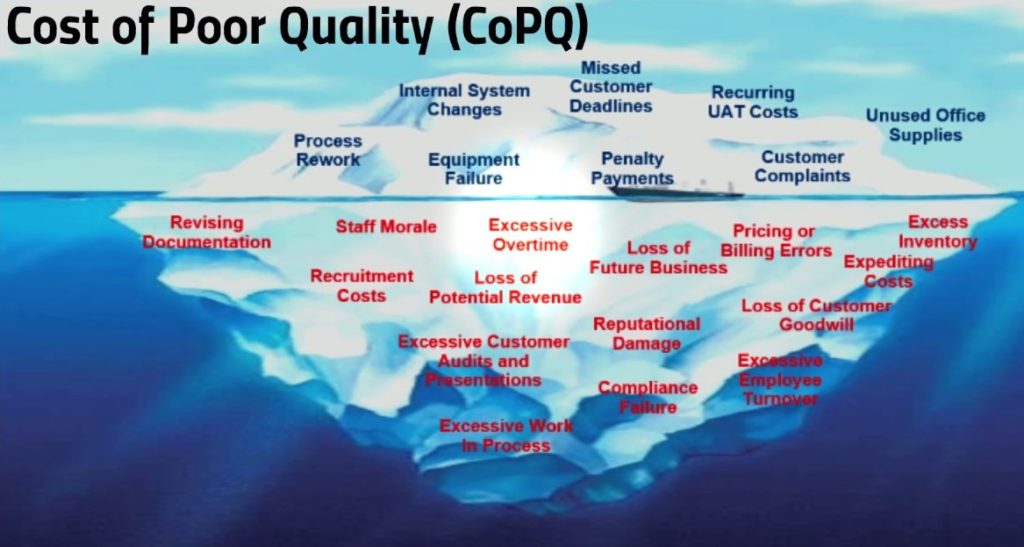
    Cost of poor quality (CoPQ)

    In operations improvement, Cost of poor quality is a common management term. Sum total of all the costs that are generated due to defective material produced by a system is CoPQ. There are various costs defined in management systems for this. You can read more about CoPQ at iSixSigma.

    A naive example
    cost-of-poor-quality

    Since, management example for CoPQ can be complicated by jargon. So, I am taking liberty of making it very layman with few variations in explanation. The context is very India-centric here. There is lot of corruption in road construction projects in Indian cities. Almost every year during rain (otherwise too at some places), these roads are full with potholes. Some people say – you need to search road within the potholes. Why go to any other city – Mumbai is a living example of the same. These roads result in – untoward events (possible serious accidents), high cost of vehicle maintenance and repairs, poor vehicle mileage and at times backache to the travelers even with good quality shock-absorbers of the vehicle.

    The evident cost, in case of Mumbai roads alone, is repairing same patch of road in single season at least 3 times.

    Example of CoPQ In life

    Terrorists – they are an example of CoPQ to society, they waste their life as well as killing other people. Say one of the person’s killed is an educated, married person with a child in his 30s. Death of this person is a loss to the Society, a talent who added to the GDP. The loss to the GDP is for about 20+ years the person could do. Family and child lost a support system. This loss of support could eventually result in inability to blossom and become a better contributor to the society. Society can be better off if a terrorist commits suicide without causing any other damage. Though it is a loss again to the society that a person is dead without adding any value to the society, however it is better than the trouble that person could be to the world.

    Depression of an individual is CoPQ for self and society. The society is losing time and skills of this depressed person. Actually, interdependent co-arising plays an important role in our society. CoPQ can be derived from interdependent co-arising too. If we understand the concept of interdependent co-arising society can reduce terrorists and depression patience.

    How to reduce CoPQ for society?

    When I was thinking about what we humans ban do to reduce the cost, I came back to the same old point – meditation, spirituality and teachings of Buddha and Jain Thirthankars. Both Jainism and Buddhism emphasis on concepts such as non-violence, non-stealing, fidelity etc. Corruption is a type of stealing and terrorism is violence. If one gives proper heed to the virtues, roads will be of good quality and if one meditates regularly his quality of live will improve multi-fold. In essence, practicing these principles the Cost of poor quality can be reduced drastically.

    Image source – Cost of Poor Quality – pt4 youtube video

  • Unifying heart, mind and actions

    At times after office, I take my daughter – Adviti – for a walk. It was such usual day when after office I took her to the nearby market area where there were seats to sit and gaze the moving vehicles leisurely. She enjoys watching buses, whenever I see her look at bus or point at moving buses I start singing a nursery rhyme – “Wheels on the bus go round and round…”. Recently, this outing taught me – once again – how can one unify heart, mind, and action together.

    She is generally very observant – as with any infant – she also gets completely engrossed in the observation. This one day, I rediscovered and realized a very cliché known fact. She was sitting on a bench, watching the buses and enjoying the sight. After a while, an old man came and sat. A decent looking, in his mid-60s or early 70s, an old man who was new to both of us was sitting next to us. Adviti started feeling uncomfortable and started crying. I told her, see Advi he is like Aba (dadaji). She is too young to understand it. She kept feeling uncomfortable for some time. I tried diverting her attention and again showing her moving buses and singing the rhyme. The old gentleman too tried talking to her and pacifying her but to no avail.

    After a while when it was a bit irritating to the nearby people, I took Adviti to another bench. When we sat at new nearby she repeatedly looked at the gentleman intermittently. However, this time around I could divert her attention to the original purpose of our visit – leisure visit to the market, looking around vehicles and causal amusement.

    When she was happily looking at vehicles and had forgotten the incident, I revisited the event in my mind. Until she was focused she was completely engrossed in the activity. The moment she got a distraction she lost all her fun and joying. This happens with us also a lot of times. We get distracted with some or the other thing. It impacts our productivity in the office our personal life when we start looking at others rather than concentrating on what we do and enjoy doing. Small incidents teach us a lot.

    Earlier I had written on focus. I had put a point in that blog – “Distractions are felt if you are not centered”. The corollary is equally correct – If one is distracted it is difficult to be centered. I always feel that the solution for this is meditation and spirituality. Meditation helps improve awareness which eventually makes it easy to bring together the heart, mind and action together.

  • Intentions


    Once upon a time, there was a woodcutter, Ram. He was hardworking and had been doing woodcutting as a ancestral (family) profession. He was in this business for good about two decades. Ram’s daily schedule was to wake up in morning, get ready and go to the jungle to bring wood for selling in the village market as a fuel. His experience in all these twenty years were mixed, some days he found good wood and buyers with least heckling, other days neither of these.

    In old days in India, seeing a saint meditating was a common siting, specially outskirts of town or in jungles. One day a saint arrived in the jungle where Ram used to go for cutting wood. This saint started meditating at an open space under a tree. A couple of days passed, he was in meditation.

    Ram happened to cross this place and noticed the saint. Ram kept on cross this area daily for want of good quality wood. He noticed this saint meditating everyday. Ram was extremely impressed with the radiance of this unknown saint. The steady, unfazed and peaceful demeanor used to make Ram’s day calm, monetarily rewarding and merrier. When you’re around enlightened masters, your life changes for good, somehow things start falling in place.

    One day, Ram felt that he must help the saint by keeping some food for him. It will help the saint continue practice without wasting his time on searching for food. So he brought honey from nearby apiary, without disturb the beehive much thus avoiding disturbance in the area. Once honey was available, he kept this honey and water near the saint and left for the day.

    Saint was in deep meditation, completely unaware of the number of days passed by or someone keeping food for him. How long can you keep ants away from sweet? Ants came soon and rather than being a help; honey became a nightmare. Same evening some mischievous people also crossed this place. These people threw sugarcane sticks at the saint with full intentions to disturb his meditation. Thankfully instead of hitting the saint, these sticks fell nearby. Now, these ants got diverted to the sugarcane stick!

    One must look at the intentions behind actions, it is not always the case that someone throwing a stone at you, he/she is likely to hurt you. Someone’s good intentions may be deterrent whereas bad intentions can be a boon.

    Have you heard that one must not help caterpillar in it’s metamorphosis to a butterfly or should not break an egg to take chicken out? Good intentions but harmful outcome. Similarly –

    [Tweet “Take the stones people throw at you and use them to build a monument. Quote Robin Sharma”]

    It happens occasionally that your colleagues help you. If this assistance does not make you learn, possibly the long term outcome is harmful to you. On the contrary if your colleague does not help you; may be it is good for you because you will learn harder way with mistakes. These mistakes can teach you many ways not to do something, or how to do other new things. Isn’t it? Perspective!

    Bad things may not happen to good people. If you feel something is bad in your life, possibly you need to involve yourself in more of good work. My sister – Preeti – told me this story recently, I liked it and so I put it here.

    Image source – http://tathaastu.com (via Google search)

  • Driving in India


    Many activities in India can be related to spirituality take for instance driving. It is a very spiritual experience. I have had the privilege of driving on Indian roads – streets and highways, metro to small cities and even two wheeler and four wheeler. I have used choicest of the words while driving. This experience also includes bicycle and how can I ignore walking? This idea of connecting spirituality and driving (plus walking) stuck to me when one of my friend’s was hit by a two wheeler rider breaking his wrist and handset.

    In two ways spirituality is manifested when you drive in India, one when you are stuck in traffic you have two options. Option one you are at the verge of meditation, or the complete opposite curse self or Google maps left right and center for selecting the route or abusing people who caused (not following lanes, jumping signals etc) the traffic. Option number one is better any day. I can vouch for this specially in traffic of Mumbai.

    The other way of manifestation of spirituality is when you are riding a two wheeler, specially in a tier 2 city. The two wheeler riders in tier 2 cities drive such that you have to take care of yourself. The thought processes of these riders are like this – “I’ve to take care of myself, hell with others, they will take care of themselves”. You have to be very careful because anybody can pop from any side. When my friend’s wrist was hurt badly and mobile screen broken I could not resist but think about all these. The rider it seems was practicing riding meditating (like walking meditation) while driving went away in thin air, without stopping and apologizing.

    You have to be selfish to drive in tier 2 city because a two wheeler rider will take care of himself you take care of your vehicle rest of the other people around you are Maya, signals are for mortals you are self realized parabramh (the non destructible God).

    This “selfishness” reminded me of the above short comment from Osho – the other way of connecting spirituality to Indian traffic conditions. What is your take? Can driving in India be a spiritual experience?


  • At times capitalism it is!


    CD of Jane Fonda can be more useful for you to learn Yoga – an Indian physical, mental and spiritual practice. When you watch her video you are likely to feel as if she is a native to this art, have you ever thought why? It is not a case of go Yoga alone that many Indians would neither know nor will be able to practice such things well. It is the case with practice of meditation – an eastern method of consciousness – too. Would not you be impressed with many foreigners not only talking seriously about meditation but also practicing meditation religiously and needless to say better than many Indians.

    Have you ever wondered why? What happened that we have relegated such a unique knowledge to either books or only to religious institution? At the same time how the Western world has been taken to these practices with ease and are excelling in it? It would not be surprised that in next 100 years there would be more spiritual readers from the Western world than from India or South East Asia.

    There was a time when India was prosperous. Prosperity makes one question the significance of life, after life and whys of existence. It is unlikely for a hungry stomach to think beyond food. It is difficult for a person in danger to think about higher purpose of life; not impossible but difficult for sure. I remember my professor Dr Anand Saxenasaxena-sir-25dec12 told me –

    गो धन, गज धन, काज धन, सबे रतन धन ख़ान|
    जब आवे संतोष धन, ये सब धुरी समान||

    Go dhan, gaj dhan, kaaj dhan sabe ratan dhan khan
    Jab aave santosh dhan ye sab dhuri saman.

    Meaning:

    It is true that owning cattle, jewels or kingdoms is mine of wealth
    But when you own wealth of contentment (satisfaction) those mines (cattle, jewels etc) of wealth become worthless (like dust)


    I love capitalism because it gives an individual the possibility to be prosperous. Prosperity, at least once, can give a person a chance to raise questions on existence. I believe capitalism and what follows, for example wealth, well-being, abundance etc may make one question – why and how of cycle of life. That is why probably Jane Fonda is a better practitioner of Yoga and many in West are turning towards meditation.

    When a person goes beyond food, shelter and social standing one can think of bigger purpose in life. It has been story of many warriors in India – Mahavir or Buddha. Shashi Throor in one of his famous speech said before Britisher’s arrived in India, India had 23% of the world GDP. That is as much as if not more than current GDP of USA’s proportional GDP to the world. When a society is prosperous that is when it starts or tend to move inwards – at times capitalism it is that provides opportunity to dig deeper within. It seems very counter-intuitive though but that is how the logic of Business to the Buddha; that is how the journey for within may start for the West.

  • Constraints and contradictions


    This blog from business to the Buddha was started when I was completing my MBA. Few of the sessions on economics, marketing, Organizational behavior and supply chain made me realize that there is more common to business, economics, management and spirituality; in particular concepts of Buddhism than what we think. Though I used to feel it since I moved to Mumbai a decade back in 2006. This thought moved into a wordpress blog – business2buddha.wordpress.com because MBA gave me not only a formal education in management but also time to think about the relationship. At that time, I never thought that this choice of writing can be such that I keep on writing for 7 long years. Of course there was a hiatus in 2017 due to some other personal commitments. My thoughts have always been on finding out relationship between business / economics concept to spirituality (in particular Buddhism). The fascination makes me feel that we are on a path of moving from “me” to an “us” society. A society from competition to co-existence, from Business to the Buddha. I wish this comes out to be true.

    Off late I am hearing a lot about “mindfulness”. Some months back Harvard Business Review wrote about it. Initially it made me happy. I was thinking that mainstream is accepting the concept which I had been writing about for some time. Occasionally, I feel that this “mindfulness” thing has become more of a buzzword than a real practice. Hope it does not end up being – six sigma, innovation, analytics and big data type hype. The purpose of mindfulness is for “self”, in effect helping organization and society. Hope mindfulness does not end up like the other buzzword of management jargon; hope people do not end up making it a business and “whats in it for ‘business‘” alone and keep it more practical and individual practice than a corrupt practice of survival of business.

    The contradiction here has been the approach. I have moved from Business to the Buddha. The movement from business to the self and self realization and coexistence. The approach of management jargon seems to be the other way round. Making business out of the mindfulness or possibly trying to get “competitive advantage” or some sort of “benefit” for business from the path.

    I am optimistic about the move from business to the Buddha. In fact when I realized that I might be making a mistake of showing or possibly thinking of a movement from Business to Buddha I bought a domain – www.SaintInSuit.com though I am yet to write on that. I am thinking that I will let people write on the website – their experiences, their relationship between business, management and spirituality. The idea is not to restrict to the Buddha alone. There are other methods, thoughts, concepts and teachings on the path of spirituality that have strong affinity to business. Though I personally can recount more examples on business and spirituality with Buddhism than other religion.

    The concept of Saint In Suit is a thought of middle path, the method that says one can be spiritual without renouncing. One can do business without negatively affecting his/her personal choice of following spirituality. We (predominantly in India) think that there is a constraint between business and spirituality, however we miss out – Saint Kabir was a businessman, so were many others just few examples Gora Kumbhar or even the worst you can think of Kanhopatra was a prostitute. Even the Buddha at a later stage of his life accepted that – one does not necessarily renounce to self-realize.

    There is neither contradiction nor constraint of being a saint yet a businessman. Though, I am worried if people make business of mindfulness specially when it is a showoff than for real change.

    Constraints was a topic for LBC in Sept 2017, as usual I changed the topic a bit and wrote on it well past the week when it was due. You can see what the other writers of the LBC have to say in their respective blogs.  Maria, Ramanna Uncle ji, Ashok and Shackman.

    Image source – first image my creation and second image – Image source – http://www.bravefury.com/six-reasons-men-should-do-yoga/

  • Lady’s Finger Recipe


    Nope, this post is not about how to make, it is inspired by a grandma making Lady’s Finger.

    When I was in schools, my brother once told me for the subject of history that I did not like – “You have to study it irrespective of your choice. Our system is such that to graduate to the next grade you have to pass each subject, even if you don’t like or enjoy one subject. So better be sincere for the subject, forget scoring well in that at least get passing grades.” After that he added – “Do not think too much about liking or disliking the subject just give it some time to sink in. Just study it do not be feverish about it.”

    This was a good start for some of the things I did not like. It does not mean I enjoyed taking every subject sincerely. I never enjoyed History as a subject, until I had to pass the subject upto grade 10 (include English language upto 12th). Reading anything on history later on was interesting though. There was no pressure to “passing” the subject anymore, no need to remember anything. This point made me somewhat more sincere to “what I did” and somewhat in learning rather than the grades. Well, it still does not mean that I became a great student – I was just an above average student. After all these exercises, I learnt one thing – put some efforts, dedicate time and energy to what one is doing. Sincerity and dedication were two takeaway words from there. The lesson is on and off with me.

    My wife is always interested in cooking new stuff. She keeps on learning new dishes and experiment with those. Recently, she was watching ‘Lady’s Finger Recipe’. Out of curious I too started watching the video with her. To my utter surprise, the cook was not working in a high profile kitchen. It was some open space, not on a good quality burner, but on a chulha, an open air temporarily made fireplace. The first glance made me even more curious. I started watching the recipe. What made me stuck to the video was the dedication of the cook.

    I and my wife spoke to each other – wow! She is so content, no pressure of running to office after cooking food and packing it in tiffins. No pressure of cooking, dinner, washing utensils and sleeping to get ready for the next day either. She looks so peaceful making this. This kind of devotedness one needs to be happy in life, isnt it? No worries of getting passing grades and dislike for doing what you are doing.

    This kind of work ethics remind me of meditation. Work does not remain work, it becomes a prayer.

    Isn’t there a lot of learn from grandma in this small 8 min video?

    Related blogs – Truth is something you really do.


  • Meditation


    As always Buddha was walking with a few of his followers from one town to the other. En route they crossed a small rivulet. All the Bhikkus and the Buddha crossed the water body. After crossing some distance from the rivulet the Buddha told one of his disciples “I am thirsty, can you get me some water for me?”

    The disciple responded, we just crossed a rivulet a while back I will bring water from there.Meditation

    Since the group had just crossed the rivulet, the water had become very muddy and turbid.

    The disciple thought “How can I give this muddy water to Buddha to drink?”

    The disciple came back and told Buddha “The water in there is very muddy. I don’t think it is fit to drink. There must be another water body nearby I shall fetch water from there”

    The Buddha told the disciple to go back to the same place but this time around wait for some time. The disciple went back, and found that the water was still muddy, but as the Buddha had suggested to him to wait, he waited for some time.

    After some time, the disciple found the mud had settled down, and the water was clean. He collected some water in a pot and brought it to Buddha.

    Buddha looked at the water, and then he looked up at the disciple and said “See what you did to make the water clean. You let it be and the mud settled down on its own and you have clear water.”

    Meditation is not “doing” it is happening / being; it is effortless.

    I heard this story in my Art of Living course way back in 2004.

  • LBC – Peace Of Mind


    When I read the topic for Loose Bloggers Consortium, the very first thing came to my mind was this video from Kung Fu Panda 2. The other thought was that I have written a lot of blogs related to peace of mind earlier.

    The conclusion of every blog post is that peace of mind comes from within and not outside. For example –

    In the blog Peace of Mind – I started of thinking peace of mind comes from owning something or being at peace is independent of owning anything? I reasoned out that peace of mind is not in achieving something in life. However, peace of mind is being at peace with our mind in the present. Because the more we think more we complicate life – life is, simple!

    In another blog Arrived… where? though peace of mind was not straightforward point of discussion, but something related was discussed. My brother in law asked me a very simple question – ‘what is home?’ ‘what is school?’ How do you define home/school etc” In that same discussion the conclusion was – home relates more to a feeling – comfort, peace.

    In one more blog Dichotomy on happiness the question I ask was – happiness requires fulfillment of the CONDITIONS we create for being happy or it is a feeling irrespective of what happens in our life/to us? These conditions, to me, are never ending… as it happens to the squirrel in Ice Age-Trilogy and to Chaipau in Salaam Bombay“. Dichotomy of happiness is you decide on what you enjoy doing or you remain happy irrespective of the situation you are in….

    In all these thoughts, the real peace of mind was understood when I first saw Dadaji (Dada Gavande), here is a tribute blog to Dadaji. “When I saw him for the first time, and later as well, I was completely awe stuck, everything, thought and feeling vanished. So much of serenity was flowing off his face that I had nothing to talk or ask.” If you want to experience such peace of mind, you either have to meet an enlightened master or be enlightened yourself.

    There were about 10 or more blogs in which peace of mind was touched upon. For more of my thoughts on peace of mind, read What are you searching for? where really the question is to you. In another blog Is religion another organized crime? the point is have religion lost their meaning? In the blog Money what is it? I tried to create another fictitious currency. In another blog Fish will fly in its next birth how my sister tried pacifying her daughter whose fish had just died.

    You can read all the blogs searched with “Peace of Mind” as searched term here

    This topic for LBC was suggested by Ramana uncleji. You can read other blogs of other Loose Bloggers Consortium members at Ramana Uncleji, Shackman and Lin.

  • Monk with mobiles!


    Can mobile phones / smart phones make us more spiritual? I asked myself this when I another question stuck my mind – has my ‘attention span’ reduced? This ‘attention span’ question is intriguing. What is the problem of attention span? Well, we lose interest in things happened yesterday. We may just ‘move on’ from any significant hSadhuappening one hour back. The lack of attention span is blamed to the technology and in some cases to the smart mobile phones.

    Before digging this topic further, attention span means – “the length of time for which a person is able to concentrate on a particular activity or subject (without being distracted)”. So in one way it is a problem that we lack concentration. What if we flip the coin and say that is a good thing – why not live in the present.

    A case in point of the same is US presidential election. What I read in news is – whatever frivolous news comes in the forefront, becomes obsolete within few hours. The word ‘frivolous’ in previous sentence is calculated and selective because of the most talked about candidate in election. It is interesting that this ephemeral nature of the news or short attention span can be observed in twitter trends. Any breaking news stuff becomes “what was that?” after few hours. No one seems to care about any ethical question, event or comment. In no time we have a new entertainment (breaking news). The problem is such that grave questions are buried due to short attention span.

    An example in Indian context – ‘Corruption’ was a huge point of discussion three years back. A political party came into existence due to the same. Apparently this party is not willing to take case of corruption seriously now – be it case against former CM of Delhi, CWG, talking about prominent political family or the political party or any other cases of corruption raised by the people associated with this new political party.

    This seems to be true that technology has put us into a situation when we lose interest in everything happening around us in no time. I’m sure in future the duration of lose of interest will be few seconds – sooner or later. Since technology is growing at fast pace, ‘later’ is likely to happen soon, who knows?

    Well does not it mean we – humans – will become more meditative? Because in meditation our effort is to be in present moment. Since, meditation is not ‘doing’ therefore will technology make us so helpless or so efficient that we will effortlessly be in the present moment?

    Effectively, mobiles or the problem of attention span is a two way sword, isn’t it? It is upto us to maximize the utility from it. Would we or the next generation be monk with mobiles?

    Image source – unknown old Google search.