Tag: Capitalism

  • Data as a narrative

    I listen to even the data driven opinions with a pinch of salt now. I did it unwillingly and learnt it one can present data to please bosses even if the findings are unfavorable. It happened with a client of ours. They’d invested about 8 Cr rupee in their Above The Line (ATL) marketing. We used to do offer data analytics solution to them. So, we were told measure the impact. We found out, there was almost no impact – statistically, even if you take p-values and seasonality and market condition etc etc. The 8 Cr had gone in drain. However, we’d to help our manager at client’s office “look smart”. We’d to make a presentation that look and feel sound, statistically such that the branding efforts have had a positive impact. We somehow did it, against my wish. I quit the organization soon after, due to various reasons.

    Actually we had conveniently changed the goalpost for the client. Our clients objective of the ATL was generating investments, however the presentation of the data was done completely for branding. All the communication for the ATL was regarding “invest with us”. The presentation was not about the impact of that in terms of call to action “investment” as such. Human being are smart, we create our own narrative from what we see, hear and observe.

    You-see-what-you-want-to-see

    So, one must take data and findings with open eyes and willingness and honesty to question. I’ve been favoring capitalism over socialism (or some sort of communism), the data suggests that capitalism is somewhat better than socialism. We have many examples – South America going through the upheaval North America is better off, USSR broke down, India moved to more open economy after 1993. Mass production or mass anything is great for economy of scale and businesses. I happened to stumble upon the episode of “Last week tonight” by John Oliver on Amazon or warehouses. John Oliver presents concepts interestingly. He adds humor with numbers and in 20 minutes drive home his point and makes you accept the conclusion.

    After watching this episode of Last week tonight, I thought of writing on this. However, as I said, I have started taking data with pinch of salt. I asked myself, are these the only few stories about work condition at Amazon? Why other such stories not coming out? Should one get to see other perspective instead of believing only one side? I came across similar thought published in NYT, so I made up my mind to type it down. My opinion still stays – the quantum can be more or less, presentation may make the statistic look appalling.

    The NYT article touches what John Oliver is talking about in his show – work conditions at Amazon. In fact Amazon is forcing competitors to match its standards, which affects lives of employees. I wonder if we really need that toilet paper at lightening fast speed, as John Oliver talked about in his show. Are we sure we want such competitive and capitalistic world? I wish no. Mass production results in unwelcome competition and possible corrupt practices example – using fertilizers for farm produce affecting the soil quality or destroying work life balance of employees for quality of service that may not be the demand of customer.

    I’d not envisioned capitalism of this kind to win over socialism – where there is no trickling down as expected by economists however not happening on ground as recently economists found out. If we do not improve our capitalist approach to be more inclusive we will surely pay a huge price of inequality – as Prof Joseph Stiglitz had pointed out in his book by same name.

    We need a world that is more balanced, the competition of capitalism can eat into mental peace of individual. Socialism as we know it, tries to make everyone equally poor that bad too, we need balance – the middle path. Few months back when I visited a village, I saw how Modi govt’s socialistic approach of govt worked. I see promise in such approach where there is a balance – in Govt trying to balance socialistic giving and encouraging competitiveness. Though currently, according to data the economy of India is not doing that great. Also some time back GDP calculation method was changed. Should we trust data that can be manipulated to suit narrative? Before trusting anything, should not we ask questions on validity of data and representative-ness of the same?

    Image source – https://www.skepticink.com/

  • Gaming the system

    A couple of weeks back I wrote about problems with Socialism and probably how it can be improved with lesser gaming of the system. It is not that capitalism does not allow gaming the system, in fact there is immense lobbying that happens which is no less than corrupting the system. A few examples are – unsubstantiated loans to corporate houses (ICICI bank gave to Videocon group), Kingfisher Airlines and Jet Airways playing their own lobbying tactics to either get better slots / airports or getting competition out of the system.

    The point is, in capitalism too many wrongful act are done at higher level too besides on personal level. Which is basically a case in Socialism too. The advantage in capitalism is everyone is trying to be rich whereas in socialism mostly the government control most of it. In many of these high level and individual level we tend to look at our own’s benefit over the collective good of the society. Effectively, we are individually smart and collectively dumb.

    The technology enhancements are helping people game system can be done at various levels. A couple of days back I came across this small video on Twitter. In China, insurance companies offer discounts in the premiums of health insurance if a person is physically active. So, people have devised “a solution” to look fit. The point here is not to stay fit, but to let the insurance company believe you are fit. This step counter does the trick.

    The above system is not only for fooling insurance companies but also to fool oneself. It defeats the purpose of having step counter, healthy life style and own’s health at large. Besides loss to the companies it is a bigger loss to individual – you only get on life to live.

    Net net I would emphasis – you only get on life to live – live truthfully, why game the system? If you look at recent Indian businessmen’s examples be it Naresh Goyal of Jet airways, Vijay Mallya of Kingfisher airlines or Mehul Chowksi and Nirav Modi of Gitanjali group; by the way there are many more in the list; what is the result? Whole banking system and many consumers are at the receiving end. Why game the system – live life truthfully, isn’t it?

  • Entrepreneurship and interdependent co-arising

    Over time, I have been analyzing socialism and capitalism from the lense of spiritual professional. Mostly, people think combination of words “spiritual” and “professional” sound as an oxymoron. No it is not. A spiritual person can be more thoughtful, it is not necessary that a spiritual approach only suits in Himalayas. On a lighter note – I do not intend to state that I am thoughtful. My looking at socialism and capitalism has also come from practically looking at people be it Aarti Amma or Shaku bai.

    Well, slowly I have made a centrist approach, though leaning right. At least capitalism gives everyone an opportunity to become rich, understand the futility of being ultra rich and become a philanthropist. We can argue till cows come home about the eyewash of this philanthropy in many cases. There are many of these new gen millionaires in India, they are doing their bit of philanthropy in a different manner. They are helping other startups with funding or advice.

    In last more than a decade, India probably has seen many young, competitive, hungry for more and problem solver millionaire. The list is long from Bansals of Flipkart, Ritesh Agarwal of Oyo, Vijay Sharma of PayTm, Byju Raveendran of Byju’s to others. The best part is, the list is very long. This kind of opportunity was less likely in India before 1990’s. This new entrepreneurial energy and problem solving for Indian and global context lets me lean to the right.

    If we take examples of Sarla or Kishore, there is surely a better way of making everyone work towards becoming self dependent. This opportunity is better offered by capitalism – as much good as you can make good for yourself and society you can be better off and in return you are helping the society too. In a way capitalism gives you an opportunity to be more practical in implementing interdependent co-arising. If you are solving a pressing problem you will get buyers, you make buyers life easy, they will pay you.

    Now, I see entrepreneurship also from an spiritual perspective. I believe that there will be someway and someone who will help Aarti Amma and Shaku Bai to grow beyond their limited means. Though when I look at socialism and capitalism I still emphasis, socialistic approach is needed in some cases such as healthcare, education and food safety. Here too a Public Private Partnership is fine. At one time or the other interdependent co-arising will work for Aarti Amma and Shaku Bai too with some entrepreneur helping them and make a financially viable business solution.

  • Socialism the right way

    Recently I wrote on why socialism fails? The article may sound a complete no-no to socialism. I believe any concept is inherently not flawed. The flaw is mostly in the execution – be it capitalism, socialism or any other “-ism. So, what can possibly be socialism the right way? I am sure many would know Venezuela going through hyperinflation and complete chaos – that is one gift that socialism may give you.

    In economics many of the rules are written in some assumption or concept like – “everything else being constant…” the concept will work like this or like that. For an example – demand curve or supply curve. These curves are belied by the prices in some cases such as – price of oil or price of diamond.

    Similar is the case of assumption in the underlying concept of socialism. The assumption is – no one will try to game the system. If I take the same example of Sarla or Kishore of the previous blog any Sarla or Kishore with average intelligence will stop working or will try to get a certificate that proves (s)he is the bottom 20% of Indian population to get the benefits of NYAY scheme announced by the Congress Party in its election manifesto.

    In India, Amitabh Bachchan got a certificate of being a farmer long back. So, it is not difficult for people to get a certificate to the race to the bottom. Though, off late Mr Bachchan has paid off loans of many farmers in UP. The way a farmer’s certificate was easy to obtain for Mr Bachchan it is easy to get a BPL certificate too. What the scheme Nyay is most likely trying to do is – make youth and many Indians lazy or to game the system. This is how Socialism fails.

    There is another example of similar scheme running in India – MGNREGA. I have heard of cases where there is immense corruption in this scheme. People are getting part of the allocated fund per person just for signing a document (rest goes to the chain of officials). Thus, the unskilled people for whom it was an employment guarantee, get money for free. If one wants to get the same work done by someone, the wages asked are higher. It results in increase in inflation.

    With schemes like MGNREGA or Nyay, does not the leaders of the political parties implying that they do not have any idea for – 1. how to create more jobs (run the economy) and 2. how to increase skill level of the citizens so that citizen can do something for themselves rather than depending on others. It looks like these politicians have not heard the idiom – “Teach a man to fish and you feed him for life”. By the way, MGNREGA was started by one of the most renowned economists of the world!

    If I recall 2009 farm loan waiver of Manmohan Government – again a Congress government – more socialistic in its letter and spirit that did not augur well to our economy. The impact of that according to Bank of America Merrill Lynch the farm loan waiver will cost 2% to the GDP of India by 2019. At times educated economists try to fix a problem at the wrong place. Possibly the Modi Government GDP numbers could have been 2% higher!

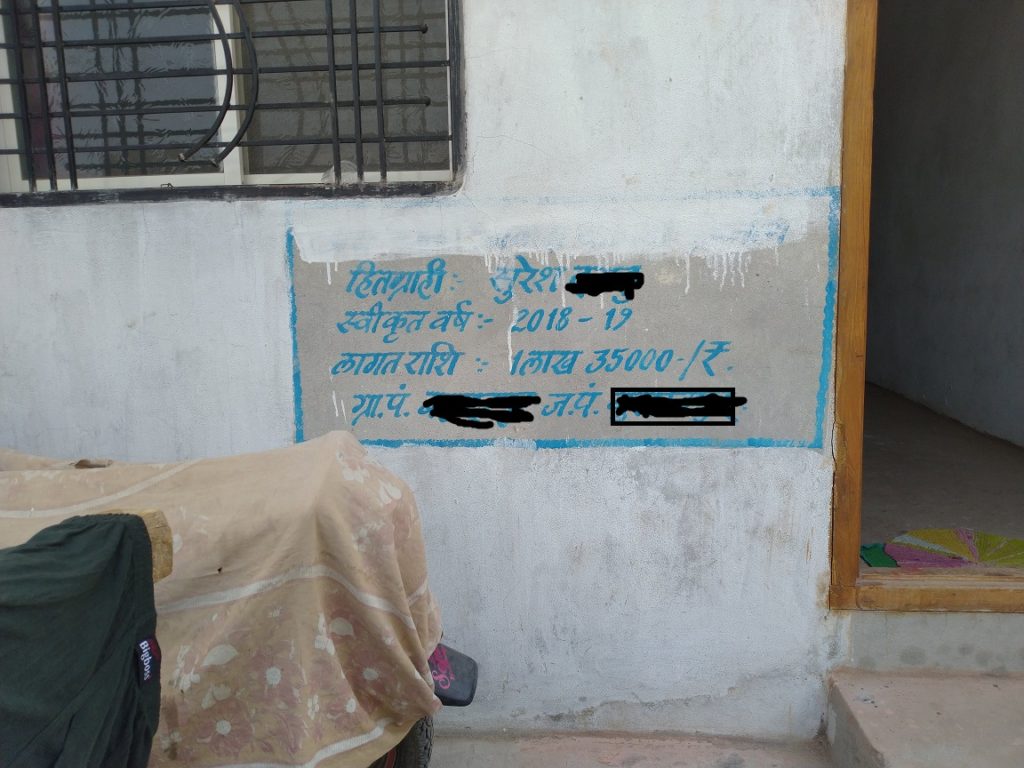
    No doubt the basic principles of the right to food, shelter, water, education, and healthcare is considered given in today’s capitalistic economies and countries – example Obama care in the USA or Ayushman Bharat Health Scheme in India. There is a universal education program running in India Education for all (Sarva Shiksha Abhiyan). When I started looking at quick implementations of government’s schemes such as Pradhan Mantri Awas Yojana I feel current Indian Prime Minister Narendra Modi is more socialistic than the Socialists / Marxists in India. In fact, recently I went to a village (about 500 KM from Mumbai), and I first hand saw – took some photos too shown here – the scheme being used by the villagers effectively.

    However, good the intentions to keep everyone at an equal level, humans do not seem to have found a way for equality. Possibly in the ant world, socialism is practically depicted to a better extent. Why USSR failed and communism of China is not worth appreciating, why Venezuela failed? Because there is no incentive to work or there is no ownership (common ownership) involved. Further, the move from capitalism to socialism follows communism as a midway stop. Communism gives power to the few, who – like any other human being – would not want to relinquish their power? The result – communism does not seem to end ever.

    Socialism (to some extent any -ism) can only work if we create a different scale for all of us – human beings. A different scale for success, survival, and growth. Many times greed and wish to control – people, things and systems – makes way and thus the Marx intermediary (read communism) from capitalism to socialism remains never-ending. Why can not we have a good execution, social good, and profit together? We can have it, provided we look at some new scale to measure ourselves.

    If any form of socialism needs to survive it has to be a middle path – a mix of different approach to economics, policy making and system. A system where we reward work, we provide essentials at appropriate cost or subsidy or for free and let people benefit from their work. At the same time, all the world political, social, economic and cultural systems must include teaching spiritual practices, trust and fairness – example is concepts of Jainism – Ahinsa (non-violence), Asteya (non stealing), Aparigraha (non-attachment) and concepts of Buddhism – meditation, interdependent co-arising. These concepts are essentially from different philosophy of Hinduism.

  • Start the new year by giving


    Capitalism has specially fascinated me in recent past. The fascination had been such that I have believed that capitalism is an approach where we realize futility of running behind all the comforts and all the need hierarchies. If there are other economic models too that help you approach this realization, than capitalism seems to work faster. My feeling had been that the possibility of realizing that need hierarchy under a socialistic and other type of economic systems is lower compared to capitalism. This impression is based on visits to certain cities of developed – mostly – capitalistic economies.

    My opinions may be incorrect, as repeatedly pointed out in comments by Ramana uncleji. I am still analyzing why I may be incorrect in the sense that capitalism a better approach to move towards spirituality compared to other systems.

    Image result for donateOne recent incident helped me evaluate my premise bit more. I was collecting donations for an NGO – DSY. The plan was to collect about 1 lac Indian rupee within 5 days before 25th Dec. Some unexpected mail, call and chats resulted in donations. I was confident of other close friends to donate – they did not! It was utter surprise to me. I am not asking money for myself, I am giving financial details of the organization and I am also showing the work the organization has done, yet the closest of my friends are uncomfortable to donate. Impact of two of the projects are below –
    Some of my friends are MBAs and others are Engineers working in respectable organizations. They are well to do, yet they were unwilling to donate. What was the problem with them to even commit INR 1000 or say INR 5000? In fact I told a few of them if you donate INR 5000 or more you will get tax deduction under section 80G of Income tax too. The question I had in my mind was – if someone can spend few thousands on New Year eve, cannot someone commit that much or lesser for someone else? The money can help a farmer stay alive, not commit suicide or a tribal child study. Why so? Have we become so callous? Are we less compassionate in the influence of capitalism?

    Answer to the question and my recent analysis was – in many cases today’s capitalism is a constant feeling of “having less” and “willingness to have more”. I’ve been writing about this desire for more, constant running behind many things in past. I felt that it’ll get subdued over period of time under capitalism. Prosperity will help a person view futility of this constant race to get more. Because over a period of time an individual will start questioning own’s running – why? What more? Resulting in realizing futility of this rat race sooner rather than later.

    Abundance possibly is based on our sense that “I already have things in abundant supply”. Possibly, we’ll have some different economic model in future, not exactly capitalism; where contentment will be primary and give will be preferred over feeling of paucity depravity and wanting for more.

    Last not the least – I’ve extended my targets to 2 lac. By 31st March 2018 you can donate at https://www.dsyindia.org/login.php. Once you donate please share the acknowledgement with me so that I know how far I’m from my targets.

    Start the new year by giving. Wish you a Very Happy New Year. I hope few of you will think of donating besides wonderful celebration of the coming year.

    Image source – http://mike-ward.net/donate/

    Related blogs – Education, Chicken in the “poultry farm of economy”, Race – never ending, What more you need?, When will we stop?, Swasthay – dwelling in oneself, Money worth earning, A cup of tea

  • Capitalism’s possible impact


    Keynes in an essay had said “his grandchildren’s generation would only work 15 hours a week.” Apparently, that generation is in the workforce now. Are we working <2 working days a week? Far from it. According to some studies, working population of the developed countries are still working at least 34 hours a week (if not 40 hours). Possibly the prediction was incorrect by a generation.

    On a leisure weekend, we were wandering in one of the biggest cities of Latin America last month. It was our first visit to the country. We were talking about the way of living there and possible future for us. I said, in future, we may be working for enjoying what we do, not for earning our living. So, when Keynes said working 15 hours a week, it is possible that rest of the time, people do what they otherwise would want to do – it can be work too. Given a choice I would want to study, read books, wrote blogs 🙂 share my knowledge etc. Some of it I still do though, but over the weekends. Was this the future that Keynes saw as possible? I think yes.

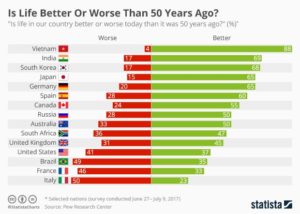
    Uber, Apple and Google are working on autonomous cars. We’ve technology intervention in everything – industrial revolution brought partial automation, technology revolution increasing automation. It is possible that in future organizations will be minting money on robots alone. Hopefully when we reach that state, we will be beyond food, shelter and social standing. In fact that possibly can be one of the reasons for the following outcome of a research – population of developed countries are not that happy. Perhaps our mind has the habit of occupying itself. When there is nothing to be occupied with, either one is unhappy or one can think of bigger purpose in life.

    The statistics can be contested such as – how were these 50 years compared? This discontent and prosperity will surely lead to the questions towards spirituality. When a society is prosperous that is when it starts or tend to move inwards – at times capitalism it is that provides opportunity to dig deeper within [From my previous blog]. I see a lot of people pursuing Buddhism or for that matter meditation in west.

    Besides, when development will lead to unhappiness, the journey of inwards will start. People will ask question – what makes me happy? That is when people will start working for 15 hours a week for wages and rest for self. I see that as an impact of capitalism. When that happens economies would not remain purely capitalistic. There will be change in our approach of economy, it wont remain purely capitalist.

    Image Source – https://twitter.com/nareshnshahani/status/938937338431807488 tweet from – Mr Naresh Shahani.

  • At times capitalism it is!


    CD of Jane Fonda can be more useful for you to learn Yoga – an Indian physical, mental and spiritual practice. When you watch her video you are likely to feel as if she is a native to this art, have you ever thought why? It is not a case of go Yoga alone that many Indians would neither know nor will be able to practice such things well. It is the case with practice of meditation – an eastern method of consciousness – too. Would not you be impressed with many foreigners not only talking seriously about meditation but also practicing meditation religiously and needless to say better than many Indians.

    Have you ever wondered why? What happened that we have relegated such a unique knowledge to either books or only to religious institution? At the same time how the Western world has been taken to these practices with ease and are excelling in it? It would not be surprised that in next 100 years there would be more spiritual readers from the Western world than from India or South East Asia.

    There was a time when India was prosperous. Prosperity makes one question the significance of life, after life and whys of existence. It is unlikely for a hungry stomach to think beyond food. It is difficult for a person in danger to think about higher purpose of life; not impossible but difficult for sure. I remember my professor Dr Anand Saxenasaxena-sir-25dec12 told me –

    गो धन, गज धन, काज धन, सबे रतन धन ख़ान|
    जब आवे संतोष धन, ये सब धुरी समान||

    Go dhan, gaj dhan, kaaj dhan sabe ratan dhan khan
    Jab aave santosh dhan ye sab dhuri saman.

    Meaning:

    It is true that owning cattle, jewels or kingdoms is mine of wealth
    But when you own wealth of contentment (satisfaction) those mines (cattle, jewels etc) of wealth become worthless (like dust)


    I love capitalism because it gives an individual the possibility to be prosperous. Prosperity, at least once, can give a person a chance to raise questions on existence. I believe capitalism and what follows, for example wealth, well-being, abundance etc may make one question – why and how of cycle of life. That is why probably Jane Fonda is a better practitioner of Yoga and many in West are turning towards meditation.

    When a person goes beyond food, shelter and social standing one can think of bigger purpose in life. It has been story of many warriors in India – Mahavir or Buddha. Shashi Throor in one of his famous speech said before Britisher’s arrived in India, India had 23% of the world GDP. That is as much as if not more than current GDP of USA’s proportional GDP to the world. When a society is prosperous that is when it starts or tend to move inwards – at times capitalism it is that provides opportunity to dig deeper within. It seems very counter-intuitive though but that is how the logic of Business to the Buddha; that is how the journey for within may start for the West.

  • What would you do in long term?


    In the long run we all are dead – John Maynard Keynes

    I was talking to my boss. He throws interesting questions – what do you think of next disruption? Ok do not talk about bitcoins, healthcare and analytics has already plateaued! Hum! That is a challenge. Wish I knew what is next disruptive business, technology or industry.

    I asked myself, is there lack of cloths that people die of severe cold in winter in India? Is there lack of food on earth that people die of hunger in world? If there is lack of cloths or food, why are our retail stores full with cloths, and food wastage is ~33% or so (National Geographic).

    My mind goes in a very long term when such questions come to mind. I believe in next hundred or hundred and fifty years or may be sooner, we would not need money (currency) or any such thing. This is very surprising for the financial system, businesses or capitalistic mind to believe. Let me elaborate. Have you seen Uber? Has Uber made ownership of car redundant for many people?

    What if our all basic requirements are fulfilled in the same manner – for example, I have some cloths in my wardrobe, I do not wear them all in a day. I wear only one at a time. Why should I have so many cloths? What if we can just select what to wear, wear it and return at some location when we are done! You may ask a question – then how would people earn money or offer services? Uber ride requires cash, card or wallet payment. Let us think of a future – car is driven by machine, cars are run by electricity, electricity is produced automatically by nuclear power and cars are manufactured by machines. No need of a human being for anything. Remember Keynes idea of working 4 days a week or lesser. Actually our capitalistic mind does not approve of this. People must work to earn their living. The best thing is – only capitalistic approach of running for better, more, improved can help us reach the state of future which is imagined here.

    When everything happens automatically, so what would humans do to earn, or say passing time? Can you relate the first part of previous sentence with the nature? Everything happens automatically for animals and they just pass time, they do not need to earn their living. Just think the phrase “Earning your living”! Does not it sound surprising thing, you just live, is not it? You do not need to earn it. I know you might have felt offended when you read automatically and comparing humans with animals. There will be a difference – our evolved sense of self and ability to think. This ability will force us to think about our existence. Our most of the time will be involved in thinking about our existence. This may take some time, when people will get fad-up with their pleasures – perhaps the way Gautam the Buddha got disenchanted. In that world we would not need money, we would not have a lot of possession, yet we will have everything on our finger tips.

    Just look at housing in Tier-1 cities in India. There are many unused inventory kept, most is out of budget for many people to afford. I see a future where whole world will be a rambling place and a type of hotel, where you can stay when you end your day. These houses will be built by machine and thus we would not need to buy or rent them either. Money as a concept will vanish. When you would have whole world at your feet, you would not steal, you would not look for possession. You would be lighter as Mirdad said in ‘The book of Mirdad“Less possessing – less possessed”.

    Here in above paragraphs we spoke about basic needs – cloths, food and shelter. I am sure humans will evolve to self-actualization phase – of Maslow’s need hierarchy – if the above happens (Ok give and take few carnal desires). In the short term, I would want to make that type of world envisioned above. In the longer term, I would want to be self-actualized or say enlightened in this life itself.

    What would you do in long term? was the topic for the week for LBC (Loose Bloggers Consortium). I had suggested this to the group where – Maria, Rummuser and Shackman also write. You can read other LBC authors opinions on their respective links.

  • Business and Humanity


    The visionary thinks beyond his company or his immediate profit. He thinks of the larger good. And, that is what makes him different. There is no place for labor exploitation and harassment of workers in such an enterprise

    I have been thinking about both Business and Humanity repeatedly. The above quote was one that caught my attention. This blog was due in Sept 2014. Yes a lot of things come in mind and thus ideas get spread, and forgotten at times.

    I revisited this title with reference to an interesting news of recent past – Donating the milk of human kindness. This kind of businesses and business ideas impress me a lot. There are a lot of social enterprises that work on the balance between Business and Social good. I have written a couple of blogs on social enterprise earlier. At times it is very difficult to survive in competitive markets with such a cause. There may have been a lot of other companies that probably we (I) might not know and were wound up due to financial crisis. When such closures happen, I start questioning myself again – what is the purpose? Why we work? and many other such leading questions. These points make me wonder many a times, that perhaps when we did not have the concept of money, humans were valued more. With Humans, human values were respected more. With human values, we probably were more caring, just and welcoming.

    The other thoughts going on in my mind were – my recent vacation to Ganpatipule and a video clip of actress Mahira Khan which is going viral of late. In Ganpatipule I visited “Prachin Kokan” a tourist attraction there. It is a place to know about how was Indian social fabric in past, for those who have never lived in Indian village or are kids growing up in tier-1 or tier-2 cities in India it could be a place to know how was our society. Though caste system was depicted there, I could not find a mention to “untouchables” there, so I may be able to write on what was wrong in past – compared to what we learnt in schools. In that museum I could relate to business and humanity working together in historic India – such as a bangle seller would not take money from a baby girl of village. At the time of the girl’s marriage, father of the girl will give this bangle seller gold coin or something. I wonder if we were less ambitious (perhaps driven less by wealth) – as a society – during those times. I could relate this museum and that society to gratitude.

    Gratitude, made me connect to the opinion and viral video clip of Mahira Khan. In this video I felt that if this actress had problem with India she should have refused working here. Though the interviewer is talking more in the clip, but if a person has so much issue with a whole country he or she should just keep oneself away from them isn’t it? This shows a person being opportunistic and thankless. This thought makes me go round to business. The actress is doing business, by acting in Indian movie. Agreed! The question again comes back – can we club or say compromise – “business and humanity” and “business and our self-respect” and “business and our values”?

    Quote – Business Standard article – Buddha at Work

    Disclaimer – author has not seen/visited the website of BabyChakra (referred in the donating the milk of human kindness), nor is related to the company.

  • Dalits in India, Dividing work, birth or none?


    Perhaps in middle school (6th to 8th), we learnt a lesson on why crows are our best friends and what we can learn from them. They eat dead animals and therefore keep our surrounding clean. We need to learn from them that whenever they see something to eat they always invite their fellow crows and all of them eat it together – what camaraderie, isnt it? But alas! as we grow we forget these small things we learnt as kids.

    Perhaps Krishna knew it all, he suggested Draupadi (Panchali) to reject Karna and thus Panchali said – Karna is a son of lower caste and I wont accept him as my husband. This – for my readers who have not heard of Mahabharat or know the context – was an India where girl (if not all, at least daughters of Kings), had the freedom to decide who she wants to marry. This was called Swayamvar – or a competition – where husband was selected by his capabilities by the girl. This kind of Swayamvars are recorded in history – be it Rama or Prithviraj Chauhan (12 century AD). Compare it with arrange marriage system of say two generations back when such decision was not that easy to offer to girl. This was an India where even if Krishna (God in human form as per Indian scriptures) was alive, abilities of Karna was proved secondary than caste (family’s profession).

    We have heard many such incidents in Indian history when a untouchable became center of discussion – be it Shabari who fed Rama only sweet berries by tasting those first. Here untouchable was first tasting the fruit and than offering it to Rama. Or be it a story of Eklavya. He approached Dronacharya (Drona) who refused him, later asked him to chop off his thumb to offer it as fee of teaching. Or the story of Sunita during time of the Buddha.

    I dislike the concept of caste system of India to the core. Slowly I moved away from the ritualistic religion to spiritual part of religion. I read parts of Bhagavad Geeta too. When I read Chapter 4 verse 13 of the Geeta I interpreted it in my own way, thank god at least Hinduism offers differing with the pandits; I can have my owns interpretation of the scriptures (ref recent controversy of Irrfan Khan).

    (Sanskrit) चातुर्वर्ण्यं मया सृष्टं गुणकर्मविभागशः । Sunita “Lord, I do not dare come closer. I am an untouchable.”
    तस्य कर्तारमपि मां विद्धयकर्तारमव्ययम्‌ ॥

    (Transliteration) catur-varnyam maya srstam, guna-karma-vibhagasah
    tasya kartaram api mam, viddhy akartaram avyayam

    I infer this as follows – “I created four sub-division of society based on work and attribute. Even after doing this I am above and beyond this division.” Remember Krishna does not say that the division is based on birth, it is based on work and attribute of work.

    Listen to other language translation here, I cannot say it this translation reflects my opinion.

    In whatever ways Indian society has misinterpreted the concept completely. This whole caste system implementation has gone awry. I believe the concept could have been, teach kids and when they grow up their abilities will put them to different works and thus their work in society will be divided in four sub-divisions! Even if this sounds justification of the caste system, I still dislike the caste system. Everyone must have his/her fair opportunity to learn and try what and how one wants to work in the society. I hope the capitalistic economics and current open access to opportunities will offer an evolved society. Currently it is just a hope, as we read the news about atrocities against Dalits. It has been close to 70 years, but if we still see these news in media either there is something wrong with our society or media is giving coverage to it only now!

    Just fresh graduate from college and I’d just joined my first job, where I was selected through campus interview. I resigned within few weeks stating I’d have done this work after my 10th, if I were to do it. My brother taught me at that time – “no work is bad, low or menial. Do not look at your resignation from your first job as an ego issue. Accept it ‘you would not have enjoyed doing it.‘ If you want to start a company, it is upto you, if you want to study further, be into R&D be it. Even if you are gardening, be the best of the gardener you could be. Do it to the best of your abilities, no work is low or menial and never forget this lesson.

    I could relate to his lesson in many sense, be it a crow’s nature to clean our surrounding inadvertently or our society having different people performing different acts, we have to balance and accept that everyone does what best he/she can do for the society. There may be instances when one’s abilities are not utilized (as was in my first job); at that time he/she has to decide to move on and do what makes more sense to him/her. In today’s world when a person makes competitive strategy – he/she is Kshtriya (warrior clan in Indian caste system). When the same person presents his concept or shares his knowledge he/she is Brahaman (Pundit, teacher clan in Indian caste system). As a startup CEO (Chief Everything from dusting room to meeting clients to executing tasks) when one cleans his desk, prepares tea, drives somewhere or designs product/service he/she is Shudra or Vaishya (lower caste or businessman clan in Indian caste system). In current social and economic setup we cannot rely on the definition of works of previous times. We need to either define things in newer manner or perhaps just get rid of the division itself.

    There may have been roads paved with good intentions (by dividing work & caste system), but could not have lead to heaven at least. We started dividing society not on work but on birth. We decided one work is better than the other – but this is be good.