Category: Buddha

  • When the Buddha dies, the schools are born


    I wrote earlier about the business of religion, recently found an interesting story on the same and thought to share it here. This story is from a book – ‘The prayer of the Frog’ by Father Anthony de Mello, S.J.. This book has very interesting stories on religion, spirituality and human relations etc. The story I am referring here is from ‘The prayer of the Frog – Volume 1, Page 95, Part – Religion

    The resurrected philosopher
    An ancient philosopher, dead for many centuries, was told that his teachings were being misrepresented by his representatives. Being a compassionate and truth-loving individual, he managed, after much effort, to get the grace to come back to earth for a few days.

    It took him several days to convince his successors of his identity. Once that was established, they promptly lost all interest in what he had to say and begged him to disclose to them the secret of coming back to life from the grave.

    It was only after considerable exertion that he finally convinced them that there was no way he could impart this secret to them and that it was infinitely more important for the good of humanity that they restore his teaching to its original purity.

    A futile task! What they said to him was “Don’t you see that what is important is not what you taught but our interpretation of what you taught? After all, you are only a bird of passage whereas we reside here permanently.”

    When the Buddha dies, the schools are born.
    ***
    These small stories are so interesting that I would refer to them again in future.

    When I say business to the Buddha, I mean teachings applied in real life (including Businesses) and not interpreted/misinterpreted by someone (priest) for the common public.

  • Ego


    Two men in a room, room is in an apartment, apartment is in a building
    Building is in a locality, locality is in a city, city is in a state
    State is in a Nation, Nation is in a continent, continent is on The Earth
    The Earth is in a solar system, solar system is in the galaxy
    The Galaxy is in the Milky way…

    We are so small still we create TWO WORLDs in a single room!

    Me on the top of the world
    ‘Me’ on the top of the world

    When I was in school, I read this poem in Hindi in my course. It is very meaningful and important story of our life. We are nothing if we follow the trace suggested by the poet. Yet, we create our own world and cause problems in our surroundings, our near and dears life and life of our colleagues. All this for what – to manage, boost and nurture our Ego. If the ego goes beyond our near & dear and colleagues, it goes to kill people in the name of our belief system. Majority of the wars fought in the world are because of Ego.

    Alexander the great – why “the great” because he conquered the world – with sword! Cold war – why? To prove WE are better than YOU. MY country is superior than YOURs. This applies to the recent attacks in cities of Afghanistan, social unrest in the Middle East (suppressed ego of citizen and suppressing ego of the respective rulers) and Nuclear ambitions of Iran and North Korea. We see political, religious, cultural and regional problems because of Ego.

    At the same time, I am of the opinion that ego is not a problem, the manifestation of the same is a problem. Self respect becomes ego when it crosses a certain line. I see many solutions to this, one is when we start looking at ourselves through the lenses of the poet who wrote the above lines. We are tiny small creatures and there are many things beyond I and MY GROUP. For some, ‘I’ and ‘My group’ becomes purpose of existence. Second solution I see is through the eyes of Mirdad. Other is through the peaceful methods e.g. meditation suggested by spiritual masters.

    What say you – is ego ‘purpose of existence’ or a problem?

    Related blog based on The book of MirdadForbidden word

  • Leadership and education


    Election results of couple of Indian states are out and largely there are clear mandates in all states. So, there are not many permutations and combinations happening for forming governments. I was wondering about the elections, results and post results – five years. The long term thoughts (five years after results) were hampered by a news of rabble rousing activities in UP. Does the confidence of victory create so much defiance that people do not mind taking law in their hands or crossing the limits?

    This question lets me ask myself – what do we need? Politicians or leaders? Are politicians really leaders? I was thinking about this and on LinkedIn I read a question. IF YOU HAVE GOOD STRATEGY, DO YOU STILL NEED A LEADER?

    Can a good strategy create a leader or leaders can create effective strategies? My answer is leaders can create effective strategies. Also, I heard someone say – An army of sheep led by a lion are more to be feared than an army of lions led by a sheep.

    I was talking to Prof Ramanathan, he told me “…Pravin I see there is a lack of leadership at various levels, be it corporate or others…”

    The fact of the matter is the crisis is wide spread are we creating leaders? Are we creating excel, power point and ivory tower experts of solutions? When I read the book – I have a dream I realized that there are people who took initiatives, who rolled their sleeves and got down to work. There may be many more not covered in the book, yet how many of us have become leaders after studying at Ivy league?

    Recently, I met Prof Mankad, we discussed Greek crisis and the visible solutions to it. He made a good observation on the economic power of China that made me think – having and managing power requires a sense of responsibility and ability to be fair. This ability requires courage and confidence to say – ‘yes I erred’ when one did commit mistake. Does our education teach kids to have these qualities?

  • Interdependent co-arising – a farmer’s example


    Recently Dr Raghunathan shared a link of his interview with Wharton with me We are individually very smart but collectively dumb. The very first paragraph of the interview has an example of a farmer. A farmer whose corn won top awards year after year. When a reporter asked about the secret of his success, the farmer attributed it to the fact that he shared his corn with his neighbors. Why, the reporter wondered, would the farmer want to share his seed when those neighbors also competed with him for the prize? The farmer’s reply was, “The wind picks up pollen from the ripening corn and swirls it from field to field. If my neighbors grew inferior corn, cross-pollination would steadily degrade the quality of my corn. If I am to grow good corn, I must help my neighbors do the same.”

    I am writing time and again on interdependent co-arising and how it applies to businesses, I think this small story on BUSINESS – a winning business – states a lot about ‘interdependent co-arising’. This example applies beyond India, the long term gain for world economy would be working on the concepts of interdependent co-arising.

    Related blogs on interdependent co-arising

  • Individually smart, collectively dumb!


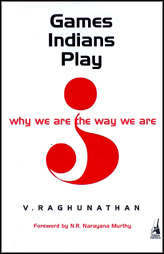
    Book Games Indians Play cover
    Games Indians Play
    Have you read Games Indians Play! by Dr Raghunathan? Very interesting book with pertinent examples of issues we face, many a times overlook and are facing worldwide. In that book he says – “We are individually very smart but collectively dumb”. I think we are collectively dumb and therefore we are in the economy-related mess we have created.

    I did not know that I would be referring to my new year blog so early in this year. Newspapers of 3-Feb-2012 made me do so. The news was about the 2G scam which had been under scrutiny for a long time now. In my opinion the verdict clearly stated that power corrupts and it gives you confidence that you can get away with murders too (many such cases pending in India)!

    I thought hard – really very hard – to find a solution. I think I will go back to TRIZ (theory of Inventive Problem Solving) to decide conflicts and resolving them. Until I find a one size fit all ‘man made’ solution, I could think of only one possibility. This solution is self restraint, and owning responsibility to make sure we are morally correct.

    This word ‘Moral’ reminds me of my economics and business ethics class of MBA where we discussed moral hazards with Prof Mankad and Prof Arun Ramanathan. I was reading this article on Moral hazards at Wharton. The article talks about authorities and new stringent rules. This regulatory authority will tomorrow need another (other set of rules) and so on and so forth. How long will we create such authorities? Moral hazards would end very easily when each one takes responsibility and become accountable for his/her action. This accountability has to come on each level and for all the actions. The problem lies with a reality that – ‘We are individually very smart but collectively dumb’. This ‘being individually smart’ begets moral hazard. The solution for this problem is one’s own self. Take responsibility own it and be accountable. Perhaps initially we (as individual) will fail but collectively we will start succeeding.

    I am hopeful that once we start from ourselves (individually), each one of us would be able to avoid situations where we would talk about Newspapers of 3-Feb-12 (2G Scam), other scams and the bad shape of world economy. Hoping that we would save our energy to concentrate on something constructive.

  • Perhaps, eyes are forever!


    Have you had eye sight related issue? I recently had a very strange one. I observed – at occasions – faces of people elongated. It was strange and I started thinking what if I lose my eyes? Well, I wont die! only eyes would be lost. I am not the eyes, eyes are part of me. I went one step further, what happens when we die? We lose eyes, ears e.g. all five senses. But does it mean that if we lose the senses we would be dead? What dies when a person dies? I wonder when I say MY eyes, MY this and MY that. Who is this MY? Who am I? Does this ‘My’ e.g. possession, end when we die? Are we just body or there is something beyond body?

    Well, that seems too complicated. I rushed to an specialist. Thankfully, there seems to be no apparent problem, I am under observation though. I informed I have filled eye donation form, what happens in such cases, how does eye donation work? He said cornea is used in eye donation. So even if I have specks there is no big issue. That was good feedback, if you have not filled eye donation form do it, because you can help someone even after your death. Perhaps! eyes are forever!

  • I have a dream!


    Related blog – Why this title?
    Have you read the book – “I have a dream” by Rashmi Bansal? One of my friends gave me this book and said – ‘it might change your life, read it.’ It is on social entrepreneurship. I am reading the book nowadays, and found ‘author’s note’ very interesting, I am putting the note here.

    QUOTE
    There are two kinds of people in the world. Those who think, and those who feel. The ‘thinkers’ see a child begging on the street and say to themselves ‘that’s not my problem.’ Those who feel, however, will give that child something, if not a coin, at least a moment of compassion. Thinkers believe the world is a neat place, with boundaries. ‘My house’, ‘My family’, ‘My community’, ‘My welfare’ that’s where there the boundary ends.

    But those who feel see the entire world as One. Beggar and bourgeois, sinner and saint. We are all interconnected in ways we cannot understand. And Hence, in serving another, we are only serving ourselves.

    For too long now we – the ‘middle class’ of India – have chosen to be thinkers. We have deadened our hearts and our minds to the poor, the hungry and the homeless and the hopeless. Because that problem is really not ‘ours’.

    And the small minority who feels, it’s doing the best it can. But it is never enough! I see now, a new breed of people. Thinking-feeling individuals who look a problem in the eye and declare war. These people think like entrepreneurs but feels and work for the cause of society. And hence, they are ‘social entrepreneurs’. These are people like you and me, not Mother Teresa. They are using the principles of business, to create a better world. A world where profit does not equal greed. Where people come together for a greater common cause. A world where ‘I’ does not mean crushing ‘them’. Because the bank balance you have here on earth will remain, when you depart. Your Karma you carry forward.

    So no matter what your problem in life is, spare a moment for someone else.

    Spread love, laughter and goodwill.

    The more you give, the more you will get back.
    UNQUOTE

    I see a connection between teachings of the Buddha, these entrepreneurs and what Rashmi is saying – i) greater common cause ii) a world where profit is not equal to greed iii) we are all interconnected and iv) we are ONE world.

    I too have a dream – to see all of us – business men/women – as compassionate and thinking in the lines we – as a single world. This for sure would ensure peace, harmony and economically stable world.

  • Welcoming’12, Seasons of ’11 and accountability


    For some new year is getting new fancy, even more exposing table calendar and flaunting that. For some it is a continuum of the life – life as usual. For some it is a time to celebrate. I think this is the occasion when we should ask ourselves what happened last year and what should be improved? In 2011 I asked myself -” would I support places such as Barasti in Dubai?” I felt that Barasti is a place which supports racism and I decided against going there.

    When it comes to the year 2012, some time back there was a rumour about the year 2012. Hollywood made a movie – 2012. That movies speaking about this year as a question of existence, right? Well, why start the year with that question. Or we can start thinking about existence and ask questions to ourselves. Look at the 2011, what we did not see? We saw Arab Spring, Summer of India/USA and Winter of Europe. Let me elaborate –

    Arab Spring – I was in middle East during the time when Egypt, Bahrain, Yemen and other such uprising were in news. I wrote in 2011 about Arab uprising – Power Corrupts. Yes, it does and had been in question for Middle East in 2012.

    Summer of Europe – Have you not noticed that the production in China, industrial growth figures of India and other developing nations were not positive lately? The likely reason for that is slow or negative growth of developed nations e.g. USA and Europe. Euro zone saw a unique problem this summer of 2011 when countries were likely to default on their loan payment! I asked a question to myself Euro is it dead? and in May 2011 asked my Teacher of economics – Professor Mankad is Euro dead? We saw the turmoil of Euro for couple of months. Lately, I read on Reuters that “the Euro is not an experiment…” ECB executive said that. On a lighter note – “as if it was supposed to be an experiment until now”. Personally, I am in favor of the kind of economic zone Euro has created. However there are problems with accountability which needs very strong measure.

    Winter of India and USA – Euro zone crisis did not end and we saw another people’s movement – the Lokpal movement in India and Occupy Wall Street in USA. In brief Lokpal bill is to curb corruption and bringing high and mighty beurocrates and politicians under the ambit of LAW. Strange a democratic country India talking as if it is an autocratic country where KING/QUEEN (beurocrates – include lower and upper – and politicians) is above the law. On the other hand citizen of USA were questioning ‘the top 1% holding maximum wealth‘. Why not Investment Bankers take responsibility for not only creating toxic assets but also burning those assets which eventually ruined the economy – of the whole world.

    Well what do you make out of these seasons of 2011. If I look back and take a macro perspective – all these big events of 2011 were Questions on “accountability”. Let us begin the new year with taking responsibility of our actions and working towards a peaceful (Middle East), moral (India) and equitable (Europe and USA) world.

  • Durgasakha – an organization


    Last week I went on trekking with an organization named Durgasakha. First thing first – thank you to my friends Abhishek Ranjan Jha and Santosh Jagtap to pull me and registering me for the same and thanks to the Durgasakha team. It was a great experience and a good outing after long work hours and weeks. Beyond a break from work, why I enjoyed this trek is also the reason of why I am writing this blog.

    Tringlewadi Igatpuri

    I liked this organization, thanks to Abhi, Subodh and Nene Kaka who informed about the mission of this organization during the trek. Durgasakha is a Hindi/Mararthi word which means – Friends of forts. The organization came into existence as a group who were trekking enthusiasts. Slowly these guys realized that few group visit these forts and litter here and there. So, one thought – to keep forts clean (source of water and temples on the fort) whenever they visit there – came in mind. Plantation and finding history of the place etc. Well, initially any person may think that it is a good thought and perhaps every trekking group would want to do that. This organization goes beyond it.

    This group took another initiative, to help underprivileged yet bright kids, question was how? This initial thought was materialized on two levels, one to distribute used cloths etc – I will come on the ETC in some time – to the interior areas of Maharashtra. The ETC part was – people are moving from CRT TVs to LED/LCD TVs so if those old TVs can be distributed to schools of the interior areas with educational CD and CD players that would help learning of these kids. A fact was, this group – currently – does not take any cash donations in general from anyone, any profit from the trekking events go to sustaining these activities of helping the villagers. Is not it interesting? These people are no ‘corporate bigwig’, these guys are like many of us, who are working in Mumbai struggling in trains on daily basis, for example.

    One other friend of mine – Nitin Chandorkar – was with me on the trek. He suggested “I am of the opinion that we should not just give them facilities but also make them self reliant” (give a man a fish and you feed him for a day, you teach him how to fish and you feed him for life). A very good thought, to our surprise the group – Durgasakha – has already started and done that too. Few Namkins we took on trek were from similar organization they are trying to nurture.

    After this trek I was thinking to write about this experience. I was wondering one does not need to be politician or very rich to do something for the society. What is needed is – preparation of heart and mind or desire to do something. I remember few lines of a Hindi Song – …’Mushkil nahi hai kuchh bhi, agar thhan lijiye’ मुश्किल नहीं है कुछ भी अगर ठान लीजिये. Nothing is difficult if you are committed!

  • The world is imperfect!


    When I was in my teens, I wanted to change a lot of things. The political system, the education system and even the social system of India. This was furthered by the program – the Big Fight of Rajdeep Sirdesai. Once my father told me – “world will remain the same, it was same at the time of the Buddha (people pelted stones on him, conspired against him), it was same at the time of Kabir. Jesus was crucified, Mira poisoned and so was Osho. The world still, is the same and would remain the same. Why do you want to change the world? Look at yourself and why do not you think of changing yourself.”

    My father is right the world is the same and will remain the same. The need of the hour is to change oneself, because everything starts with ‘I’ and surprisingly everything ends with ‘I’ (earlier blog on Forbidden word). Is not it an irony? I did not understand the deeper level of my fathers message for a long long time. Many ‘I” create the world, and each single ‘I’, has its own definition of ‘perfect’. Interestingly, the definition of perfect keeps on changing and therefore, the single definition of a perfect does not remain intact within the mind of ‘I’. This starts one conflict then the other and so on. The conflicts are -at least – as many as the ‘I’ in the world.

    The world is imperfect, the world will remain imperfect or perhaps we – as individuals – are not attuned to accept it and live with it. Effectively, perhaps we – as individuals – are not perfect. I think this is why we suffer and perhaps this is where the Buddha started on the four noble truth – there is suffering, there is cause of suffering, there is a solution and lastly ‘the path’. I believe, the suffering is not because of the world, but because we see things as we want to see and when something does not work according to our logic we feel the world is imperfect.

    Related blog based on The book of MirdadEgo and Forbidden word