Category: Buddha

  • Red pill


    These dialogs of the Movie Matrix are very dear to me. The Matrix in Hindi was translated as Mayajaal. Maya means illusion. When this movie was released I was doing my Engineering and by chance I was learning about control systems, Artificial Intelligence (AI) and Computer Networks. I along with one of my friends Vijayant Thakur did extensive work on the same.

    When I watched that movie, I could relate to so many things of my education that I started thinking that one day I will make my own AI based matrix :). Finally, I did my major project thesis on AI. Besides the technical aspects of the movie, it touched me on a spiritual levels too. Though I did not and (feel do not) understand spirituality much, I could feel some very strange relation between technology and spirituality. I thought to put the blog on Matrix because of the following few sentences of another beloved book of mine – Living with the Himalayan Masters by Swami Rama (page 62).

    “… My master said that avidya means individual ignorance while maya is both individual and cosmic illusion. Ma means ‘no’ and ya means ‘that’. That which is not self-existent yet appears to exist, like mirage, is called maya. Then he explained another school fo philosophy which maintains that maya is universal illusion and also the mother of the universe…”

    In the movie The Matrix the same happens – a universal illusion is created which makes people feel that it is the year 1999.

    The dialogs which I am sure many people know and admire (hats off to the screenplay and dialog writers).

    “Don’t think you are KNOW you are!” – and very interestingly this statement of Morpheus is contrary to Greek philosophy – Cogito Ergo Sum!. That is where difference between philosophies of East and West comes alive.

    “Com’on don’t TRY to hit me and HIT me.” Do not TRY, DO it.
    “The body cannot live without the mind.”
    “I’m trying to free your mind, Neo. But I can only show you the door. You’re the one that has to walk through it.

    I used to tell my friends if given a chance to work in that movie, I would want to play the role of Morpheus rather than Neo. I enjoyed watching the movie, it relates to us on different levels and specially to us in professional and spiritual life. For example –

    [Conditions applied] One should do what one is passionate about (believes in) – Neo takes ‘red pill’ to know about the Matrix. [As long as one is not hurting the others privacy and not killing other – read terrorism].

    …Take a ‘red pill’ and see how deep the rabbit hole goes…

  • Business of religion!*


    The first message we heard in the class of Brand Management of Professor Ram Kumar, was “It is an eco-system…”. An entangled, closely knit or perhaps confusingly mingled ‘Eco-system’. Econ-system of brands, products, product variants (variants are very confusing, no doubt) and bombardment of marketing messages (communication). Here everyone wants to say that our product is the best using different channels and different language. Hum! it sounds very common, right? So common that we overlook it.

    In another class of Marketing we were asked which is the oldest business in the world, still running successfully? I (when I say ‘I’, literally I) responded ‘religion’. Every religious institution says our religion is better (perhaps the best) than others and is the only path for salvation. Walmart, Google, Microsoft, Facebook, Tata or Reliance might exist, or not, for 1000 years but for sure we will (and had) many religion for 1000’s of years and we will have them in future too. Why? Because – religious institution sells itself on emotions. Even without learning any Marketing concept, religious institutions learnt that emotions should be hit directly to let people decide emotionally and justify rationally.

    Let us talk about the channels they use. It is similar to what we learn in distribution channel or managing supply chain. ‘Retail store’ of Religion or distribution channels are found everywhere, and finances? Well there is no limit to it (find it for yourself – a recent News in an Indian Newspaper The Hindu or Google search for $ with any major religion of the world…). Every religion has a source of income this source of income germinates from the EMOTION we talked earlier about. Yet there is a lot to learn from religious institutions, learning the administration, Marketing and distribution channel and much more, is not that true?

    Personally, I am a strong believer that religion plays an important role in building and binding society. Religion is a path wherein you have to follow the traffic rules. If you do not follow the rules you are likely to meet with an accident. What is the question of saying rules of left hand drive better than right hand drive? The rules are there to avoid accidents and make the journey safer and easier. When I say ‘firm believer’ I mean the rules taught by the religion, and not the comparison of one to the other.

    Well, not only for business but also for being righteous person we can learn a lot from religion!

    * Conditioned applied – Thoughts presented here are my own and learnt from different sources, I do not intend to hurt any sentiment or question any religion.

  • When will we stop?


    I watched this movie – Salaam Bombay! directed by Meera Nayar (1988). This movie was nominated for Oscars as Indian entry. A sad movie with only one good thing – a character ‘Baba’ dies, receiving the fruits of his deeds.

    The end of the movie seemed very artistic, philosophical and thought provoking to me. The hero – Chaipau or Krishna – is back to square one. Khali haath aaya tha aur khali hath hi hai. (in Hindi) He comes to Mumbai (Bombay of that time) empty hands and is empty hands in the end too. He has a beyblade (or torque) in his hand. That toy to me was the vicious circle of life.

    The protagonist has to collect INR 500 for his elder brother for a damaged bike. Circumstances happen such that he could never save that much. It seemed similar to me as the Ice Age 1 2 3 squirrel on which I wrote earlier in the blog Cogito Ergo Sum meaning “I think, therefore, I Exist”. The squirrel is behind the corn and our protagonist is for collecting INR 500. A sad truth – we are always running behind something. When the Buddha told to Angulimala – “I stopped long back, when will you stop?” Angulimala – a hardened criminal – stopped.

    Our INR 500 will never be saved and the corn will always elude us… When will we stop?

  • Blind men and the elephant


    I read this story in a book. A father once gave his son a telescope. One day the boy was using the telescope, he was little disappointed with the performance, he went to his father and said “father it is useless, I can see better without it. Everything is too small.” Father smiled, the boy was looking from the wrong side, he was not getting the BIG PICTURE at all. The boy had a narrow outlook through the glass. The father turned the little telescope around.

    The father had widened the son’s outlook. The boy grew up and improved the primitive telescope and with it discovered the moons of Jupiter, the rings of Saturn and the Mountains on our moon. The boy was Galileo.

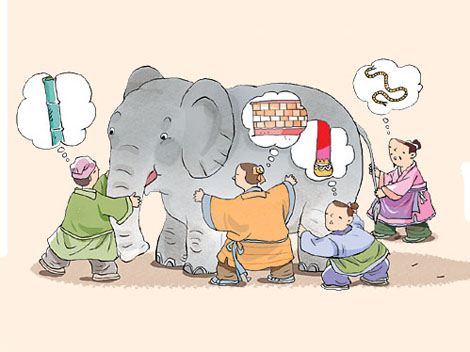
    What is important is seeing things in proper perspective and we must widen our outlook. So it is generally about the perspective, outlook and the way we look at things on which I wrote earlier. Similarly, there is a story about blind men and the Elephant. I took it from Wikipedia for the blog, however this story is very famous in India and we learnt this as kids. The story goes like this…


    A king has the blind men of the capital brought to the palace, where an elephant is brought in and they are asked to describe it.”When the blind men had each felt a part of the elephant, the king went to each of them and said to each: ‘Well, blind man, have you seen the elephant? Tell me, what sort of thing is an elephant?” The men assert the elephant is either like a pot (the blind man who felt the elephants’ head), a winnowing basket (ear), a plowshare (tusk), a plow (trunk), a granary (body), a pillar (foot), a mortar (back), a pestle (tail) or a brush (tip of the tail).

    I searched for books on blind men and the Elephant and found out that there are many books with this title for professionals are –
    Blind Men And The Elephant : Demystifying The Global It Services Industry
    The Blind Men And The Elephant: Mastering Project Work and
    on spirituality The Elephant And The Blind Men, Finding The Oneness Of God And Man you can check these books if you want to read them.

    Image source – http://history.cultural-china.com/en/38History960.html

  • The Machine that Changed the World


    I read this book recently “The Machine that Changed the World“. It is indeed a good book every businessman should read it. “The business is run on trust” or “the business will be run on trust”. When we hear this statement it seems odd, however it is true Trust is the factor. I wrote often about ‘interdependent co-arising‘ (Blog 1, Blog 2 and Blog 3). When I read this book I realized that it is practiced in Japan for many years. Toyota has substantial equity share in its suppliers and the suppliers of suppliers. This is a complete mesh of cross-locking equity structure. They trust each other decide a profit margins rather than hiding the cost structures. According to the book “…This system has replaced the vicious circle of MISTRUST into VIRTUOUS circle of COOPERATION…”.

    The cross linking equity structure goes to a deeper level and different competitors also own each others share. This shareholding pattern is to help each other raise funds. Reference to this is – “The Machine that Changed the World” page 194 perhaps it is edition 1.

    What I found interesting (page 151 of the book I think first edition) – when the volume of demand changes and assembler gives notice to the supplier and in case the volume (demand forecast) fluctuates “…The assembler will work with the supplier to look for other business…”. This is not only interesting but also a surprising and welcoming effort to build trust. One more thing I found very impressive and useful – “…we (suppliers) work without safety net, so we cannot afford to off the high wire…” and thus suppliers maintain the quality not only for their own sake but also for the assemblers.

    The other interesting fact is not just production but also product development is done in cooperation. We hear “crowd-sourcing” as a means for innovation however, a crude system has been used by Toyota for years now. New product development at Toyota involves the suppliers and major work of NPD is done by the suppliers.

    One more interesting factor I realized while reading the book. When we say “one customer at a time” and “managing customer relation in Marketing”, this concept was far more ingrained in the Lean system of sales even in 60s. So beyond Operations the Lean system has been a pioneer in Marketing and Sales too.

    Still after praising the book I am of the opinion that there would be some method which will change the game even further. The question to ask is when and how (which I contemplated earlier)?

  • Cogito ergo sum


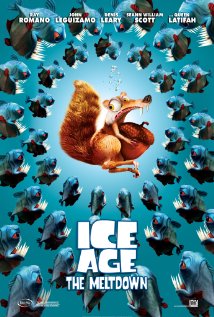
    I always wonder about these things… what is the difference between we human beings and animals? They are also living being, then what is the difference? This thought comes again and again in my mind. Recently when I was watching the movie Ice Age 2: The Meltdown. The thought again came in my mind – whats the difference? Most interesting part is – the protagonists in the movie are animals.

    Whenever I watch that movie, one character pops out – “on the face” – often and it reminds me of us – the human beings. It is the squirrel – Scrat. In every screen it is fighting for its corn – similar to our life. The corn represents our jobs, loved ones and issues faced regularly etc etc and alas! the list never ends. And secondly, the fight and the run never ends!

    Cogito, Ergo Sum is a philosophical statement by Descartes, meaning – I think, therefore I exist. Yes the proof of ‘my existence’ is that at least I am thinking that whether I exist or not, right? And the question of my existence is not just about existence; it is deeper, why are we doing what are we doing? And even further it goes to why do we exist? Because perhaps even without thinking of existence animals exist, right? And here the logic fails, I have heard saints saying – life does not listen to your logic. There has to be some reason of us having a more developed brain which gives us the capabilities to think about our existence and the question – why we exist? It is similar to phophobia – fear of phobia, existence of the question of existence :).

    Whatever the case is – I think, therefore I exist! And we all exist like the Scrat in the mids of the fish (e.g. ourselves, our friends and enemies) trying to save our corn e.g. ourselves, job, loved one etc etc.

    Image source – www.imdb.com

  • Book review


    Few years back I read books written by Dr Brian Weiss. Dr Weiss is a psychotherapist, had published papers in journals and was teaching in a University. During late 70s and early 80s his life changed complete, when he was treating one of her clients. The first book of Dr Weiss I read was based on this patients treatment, title of the book is – Many lives many masters. It is a good book, about Past lifes and past life regression methods. After reading the third book – Only love is real, I wrote the following review on . In total I read four books of Dr Weiss
    1. Many Lives Many Masters,
    2. Same Soul Many Bodies,
    3. Only Loves Is Real and
    4. Messages From The Masters exactly in the same order.

    I am of the opinion that everyone should read at least Many lives many masters and Only love is real. One point, when you read the books please do not think of your ideology or what you have been taught since childhood, just read the book. The review is below.

    You believe in past life or not… you can learn from this book, sometimes you can read it as a novel. But believe me you will not only love reading it but will understand the depth of the phenomenon called “LIFE”.

    I am more of a spiritual but not religious, still after reading the book I felt the depth of the teachings of the Buddha and Hindu-ism. Please do not go to the dogmatic belief of any religion when you are reading this review.

    It would be good if you read Same soul many bodies (its almost the Buddha teachings in chapters), when I read that I felt that Buddhas teachings are retold. I would say read “Only love is real” and do not ask me more, but I would say read it and understand the meaning deep meanings.. we are not just this life we are all eternal be happy… be loving.

    On the contrary is Ashtavakra Geeta. So do not get confused, do read at least Many lives many masters and Only love is real. When I read those books the books were expensive, I think they are relatively economical now through online.

  • You cannot drive car looking at the rear view mirror


    I was watching a movie “Do Aankhen barah haath”, a very old Hindi movie directed by V Shantaram and also the lead role played by him. Since it is a very old movie acting is melodramatic, could be questioned and people can find many faults too, however as I wrote earlier in one of the blogs “Lost in translation” what is more important message or the presentation? So, you can watch the movie for the message.

    I related the movie to a part of the Buddha’s life. Many of us must have heard the story of Angulimala, a bandit. However, how many know the story of him before he became Angulimala and after the meeting with the Buddha?

    Angulimala was a bandit, killer of people just to get their fingers and make a garland. Yes thats what is known about him. The real name of Angulimala was “Ahinsak” or “Ahimsak“, a Sanskrit/Pali word meaning “nonviolent”. The pre Angulimala view about Ahinsak is on the link. What happened to him after he met the Buddha? When he met the Buddha, he became a Bhikku.

    The following part is from the book Blog – Old path white clouds (Book – Old Path White Clouds). Soon after he became a Bhikku he died, how? As a Bhikku he went to the same village where he killed people for making the garland of fingers. People attacked him to take the revenge, not noticing that he is a Bhikku, completely changed person now and he is not even reacting to the attack. The message of the attack reached the Buddha, he rushed to the place. Severely wounded, Angulimala, died in the laps of the Buddha.

    Similar situation arrives in the movie “Do Aankhen barah haath”, I could relate those sequences to the story of Angulimala.

    My Engineering college professor Dr Anand Swaroop Saxena told me way back (in 2001 some time) – “inherently people are not flawed, situation drive people to react in the way they react.” Dr Saxena taught me a great deal, I worked with him on my undergraduate project (published in a national journal :)). He always intrigued me with his simple, profound and ruminating words. For one question he said “…situations are responsible.”. Later I met a Sant Sai Kaka, he too said almost the same thing with more details and profundity. The reaction part comes from the prior experience (sanskar) one had in life. These statements changed the paradigm for my thinking. Yet it is the responsibility of the person to control oneself not to be driven by the situation/sansakar/prior experience.

    Two points to make here – 1. inherently people are not flawed, situation drive people to react in the way they react and 2. past experiences are the milestone you have left behind while you drive to a destination. You cannot drive car looking at the rear view mirror – is not it right!

  • Porters five forces


    Three or four years back when I was reading the book – Blog – Old path white clouds (Book – Old Path White Clouds), I started looking at businesses with a changed mindset. In India, there are small stalls on roadside. The stalls could be tea stall, paratha stall, idly dosa stall, Sandwich or others. What I observed was, at many places these stalls were near each other e.g. tea stall near the sandwich stall or the idly stall. This is so common that we overlook such arrangements of shops.

    What is the reason of them being next to each other? The reason is roughly 50% of the buyer of sandwich would buy a cup of tea or the other way round some people buying tea would order for a paratha. These offerings are seemingly different for the stall owners, they are selling a refreshing drink or a breakfast however, from the point of view of a customer it is a wholesome offering – tea with paratha/sandwich.

    Well the point I am trying to make with the example is one and the same. In terms of business Prof Mohan Sawhney (of Northwestern University) says ‘Metamarket’ and in Buddhism they called it interdependent co-arising.

    Representation of porters five forces
    In organized retail, there are two parties catering to the end customers. One the manufacturer and the other retailer. Here too, we would see the collaboration or the dependence of one on the other. If I relate the concept of interdependent co-arising further with the very basic management lessons – Porters Five Forces – we would observe few things. Earlier the manufacturers had power (suppliers power) and now the retailers are gaining power (buyers power), and this cat and mouse game would continue. This power would shift to the ultimate buyer – the customer – perhaps it will happen in the future.

    How can the forces be balanced? Well, when we look in the basics we would learn. The idea in any game theory based dilemma (Prisoners dilemma) is that when each one starts co-operating everyone wins. That would apply in long term. Net net – we would have to be on the basics – the concept of interdependent co-arising.

    Image source – http://www.smartcode.com/

  • A cup of tea


    I see at this cup of tea kept upon my table. Oh yes this cup is full of tea :)… I have to consume it… I have heard a tagline (Cafe Coffee Day an Indian Coffee chain) – “a lot can happen over coffee”. Let me replace Coffee with Tea.

    ‘A cup of tea’, it actually relates to many industries. The packaging industry, the cup/disposable cup manufacturing, tea company, tea farm, sugar (if added), Milk, Energy (utilized in making tea as well as manufacturing/processing other parts). Energy goes to a different tangent again – how produced, how transmitted etc. So this simple cup of tea kept on my table makes me think about so many things. Wait let me drink it, it is getting cold and horses of my mind are running unnecessarily. Whatever is the case this cup of tea has made me think of ‘interdependent co-arising’.

    ‘Interdependent co-arising’ is a concept in Buddhism. This concept states – everything in the world is dependent on other thing and things evolve together. [This is my understanding of the concept…]

    If we extend this concept to business – observe the value chain of any business. The cup of tea I was thinking about is a perfect example of Interdependent co-arising. I read a concept proposed by Prof Mohan Sawhney (of Northwestern University) – ‘metamarket’. Metamarket is a cluster of complementary product. The complementary product actually belong to diverse set of industries. This goes again to the cup of tea and a very basic as well as vital concept for each one of us to understand – interdependent co-arising.