Category: Buddha

  • Money – what is it?


    This was a very candid question Prof Mankads asked once – ‘What is money?’ and he answered – ‘Money is what is accepted a money.’ True, money is what is accepted as money. Humanity needed some tangible measure so we deviced various forms of money at various time. For example at the time of barter system ‘everything’ was weighted against the other. So everything was acceptable in trade as money. Then came matels and now paper and plastic money (credit cards).

    I started thinking if we needed something tangible as money what if we made something like Camay (soap) a currency? If some other things be made money what would happen? Take an example of age – everyone would gradually get money. Fun or being funny – comadians would have maximum money in the world. Seriousness – patients in extremely intencive care units. Trust – Indian politicians or politicians in general would stand nowhere. Spirituality – the spiritual masters would be at the top, one I know is Sri Sri Ravi Shankar.

    Now if we ask ourselves – who is rich? The simple answer is one who has ‘more’ money. ‘More’ is contextual (adjective). Now, if we take money as fun, being happy or being funny. How many of us are rich today? Kids in school are competing, people are jealous or many of us have only instant gratification and long term sorrow. Not many of us are rich! Has money made anyone happier?

    Assume Trust be the currency. How many have earned it? Yes trust is hard earned currency, right? Bankers have lost their trust of 100+ years (see the occupy wall street movement), politicians have lost it. Citizen vote because they think someone will improve the systems. On the contrary we all still remember Jesus, the Buddha and other Masters. Plato, Aristotle and Chanakya. We named unit of force on the name of Newton we say Da Vinci was genius. Were they ‘RICH’ in terms of hoarded money? So, what if we measure richness on different factors now and in future. See this engineer mind thinks of formulae (which is not correct, yet I am writing it) –
    Richness = [{(money + Happiness)*Trust/greediness}^(1/greediness)]*(peace of mind)*spirituality
    and other important stuff
    Range of the variables
    0 > Money, Happiness and Trust > 1
    Greediness > 1 upto infinite
    peace of mind and spirituality> 1
    ^ stands for raise to the power

    I think everyone of us has to identify what we want from our life and that one or few things would be The thing(s) which would make each one of us Rich (not necessarily Money). Of course, this richness should not come at the expense of others or harming others.
  • We – “the Societies…”


    I read a book on the Buddha – Old Path White Clouds. Really, the path is very old. We are still struggling after many centuries. The book starts with a young Bhikku – Svasti a buffalo tending boy. The Buddha had tried hard to bridge the gap pervading in society at that time. During the time of Mahabharat (even before the Buddha) Karna had to face it (as son of a charioteer, check Wiki). I am talking about the societies we have formed. We are divided by race, religion, nationality, region, caste and sub-castes. Therefore we are not a society we are ‘societies’.

    I read two news items and thought to write about them. Though personally I feel religious belief is a personal matter and therefore no ‘group’ should interfere with beliefs of individuals. However, we have made religious belief system an organization which now has become a business as well as tool to discriminate. Anyways, the first news item was – First whiff of justice for Gujarat riot victims and the second was – Dalits enter Madurai temple after two long decades. In northern part of India people feel that southern states are far less discriminating, is that true? This news item shows different picture.

    At the time of the Buddha there was only four divisions of Indian society (as only Hinduism existed). Now we have many religion, languages, states, castes and sub-castes. The task of bridging gaps has become difficult in our times. Take an example of one belief system of India. The concept of this system was ‘a casteless society’, within 1000 years of its existence there are about 16 different sub-caste in this single belief system! The number is alarming because old Hindu system has only 4 castes (of course 4 are then sub divided) and this example less than 1000 year old has 4 time more sub divisions. I have heard Islam has 70+ sects, Buddhism has at least 3, Christianity has a few. Phew! how long will we divide as well as fight the so called holy wars?

    If we see at a macro level – we are divided in nation we live in, language we speak, color of skin, economic status for that matter brand of car we use. I am sure no spiritual master had meant to use his/her teachings as a tool to discriminate. We are humans and is not that enough to thrive, survive and grow physically, mentally and spiritually? ‘The path’ is really very old, we are still not able to understand it. We are ‘societies’ and we do discriminate, why?

    Related blog – Business of religion!

  • Theory of constraints


    Prof Moradian taught us concept of the Theory of Constraint. He also suggested us to read a book by Eliyahu Goldratt – The Goal. In the novel, protagonist is struggling with the operational inefficiencies of his plant and therefore facing a constant fear of management decision to close the plant.

    Well, what is this theory of constraints (ToC)? In brief ToC states that “A chain is no stronger than its weakest link”. I was thinking that this concept is applicable to our society too. We are evolving, we are constantly developing some thing or the other, society is a sort of factory. And the concept of the ToC applies equally to our life. Look at it this way if rich becomes richer the poorer would become weaker link of the society. Have you heard that during recession crime rate increases? This is ToC for our society. Lately, lot of demonstrations are happening across world by the title Occupy Wall Street. This is where I think that ToC can be applied in the society.

    I thought about interdependent co-arising and the Theory of Constraints in conjunction. My understanding of interdependent co-arising is that – we are all dependent on each other and for growth of each individual other has to necessarily grows. In other words, if society wants to evolve, everyone in the society has to evolve. The weakest link of the society may hamper the growth of society in total. Here I see a solution to the constraint, perhaps a socialistic one. We as a society have to help each other to grow (strengthen the weakest link), otherwise we would see increasing “Occupy Wall Street” kind of movements or increasing crime rates in future.

    I shared these thoughts with Prof Moradian and he said the idea is good why don’t you think about throughput and operating expenses and develop this concept of ToC in society further? This made me dig deeper. It is said that ‘a stitch in time saves nine’. If we rewind to 2008, after months of searching for alternatives Mr Barnanke, Mr Paulson and others had to bail-out banks of USA. Why not we start doing something now and for future. I see the operating expenses of this approach as deferred expense of brand building (building society) exercise for future. The throughput of the exercise would be availability of competitive, capable and intelligent work force for companies. These capable people would be the spenders of tomorrow – moving the wheel of consumerism forward – effectively, the solution may not be as socialistic as I think.

    Related blog – Ideate – save the sinking ship

  • Forbidden Word


    I was thinking about few things and somehow it boiled down to one of my previous blog – Life is… Simple. I was thinking – when ‘I’ (Ego) would not remain many of our problems would end. Because physical problems happen to the body; bigger problems occurs because those problems germinate from our mind, right? Life is simple, we complicate it. When “I” think, “I” create a world with “my thoughts” and that world would always be imperfect. There would always be disconnect between the world created in mind and the world mind sees. Either the mind should create similar world, accept the world as it is or mind should cease to exist.

    I remembered The Book Of Mirdad when I thought about “I”. This book is very well written. The first chapter of the “Book of Mirdad” speaks about the Forbidden Word – ‘I’.

    The settings of the book are as follows – i. location Noahs ark and ii. out of many things – using the word “I” is forbidden according to the rules set by Noah centuries ago. The book of Mirdad starts with two chapters on “I”. Quoting from the book –

    …Your eyes are veiled with far too many veils. Each thing you look upon is but a veil.
    Your lips are sealed with far too many seals. Each word you utter forth is but a seal…

    In my understanding – we see what we want to see (a rope looks like a snake) and we hear what we want to hear. All because the interpretation is done by none other than our Mind. Further, Mirdad says –

    …The eye can veil, but cannot pierce the veils.
    The lip can seal, but cannot break the seals…

    The book is profound because in the very next chapter, Mirdad makes a completely opposite statement which is completely opposite to the decree of Noah (about using the forbidden word – “I”). On one page he says – avoid using the word “I” in your speech because this is not true on the very next page it says “I” is a “creative word” (it is source and center of all things). The rider here is – “…say forthwith in your heart ’ God be my refuge from the woes of I and be my guide unto the bliss of I’…”

    Effectively, when we say “I” it is largely the Ego talking, whereas when Mirdad says “I” (the creative word) it is the source of and from the creator of the world… Stop using “I”, harping and harnessing “the ego” and when you do that – “life is – Simple”.

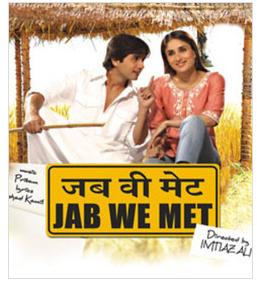
  • Why I like Jab we Met


    I recently re-watched the movie – Jab We Met. I enjoy watching this movie and specially the characters. One a bubbly, lovely and risk (risk without any calculation) taking girl who lives in present. And the boy who learns a lot from her.

    This girl is (I am not talking about Kareena Kapoor, I am talking about the character played by her) is like a child, who does not know, does not want to think and does not care for tomorrow. She “lives in the present” as the Art of Living teaches. She believes in love and lives life for the love. Love is very close to a path of spirituality in Indian philosophy – Bhakti (Devotion). When she says – “…pyar me kuch sahi galat nahi hota” (there is nothing right or wrong in love), it reminds me of the divine love people have talked about in Bhakti marg (the path of devotion). As the song of this movie says – “Ye ishq haye baithe bhithai jannat dikhaye…” (when in love a person is in heaven without any desire, longing or work). I believe heaven is here and now. The way we live we define “what is heaven?”

    On the other hand, we have a boy whose girlfriend is marrying someone else. I define love in different ways – the love of Bhakti gives freedom to the loved one, whereas the love we show, talk and depict (in movies and largely assume in our life) is largely a jail or for that matter only lust. The reason for calling it jail is – when a person becomes possessive for the loved one, the person may not like few things about the other (for example talking to someone – specially the opposite sex). Or at times asking the loved one not to do A or B or C, this condition is not freedom, perhaps it is not love at all – it is a jail, am I right?.

    The best part is learning of the boy. He learns and starts loving his work too. This is the other premise in which I strongly believe. One should do what he/she enjoys doing, then work does not stay a burden. Lastly, the song which I like the most is – ‘…Na hai ye pana, no khona hi hai…’ (it is neither owning nor losing). This song largely states that love is not possession, love is being in a state of mind where you are free, happy and do things which you feel are right (of course not harming anyone).

  • …there is a new beginning!


    I was reading – Living with the Himalayan Masters by Swami Rama and came across an interesting analogy which I am sharing here.

    “…A candle light is extinguished by the breeze very easily, but if that light is protected and allowed to catch the forest, it will grow into a forest fire. Then the breeze helps that fire instead of extinguishing it. Similarly, when an aspirant, with the help of discipline, protects the flame of desire burning within, it grows more and more. Then all the adversities instead of becoming obstructions, in fact, start becoming means. The obstacles which are supposed to obstruct the path of self realization are not really obstacles. Our weaknesses and the values we impose on the objects of the world create these obstacles for us. Attachment is one of the strongest obstacles created by us…”

    End result changes when context changes. A breeze may extinguish or support fire. I read few lines long time ago –

    …पेड़ थे मजबुत वो जड़ से उखड कर गिर गये (stronger trees have been uprooted)
    और पौधो ने किया है आंधियो का सामना … (however, saplings/plants have faced storms)

    Here definition of strength becomes a weakness. Strength of a tree is being tall and ability to withstand forceful blow. However, this strength becomes a weakness in case of a storms. Here we need to think – the context defines many things, at times changes the approach to the decision making also. I remember my Professor of MBA – Prof Lopez – we used to have animated discussions on various things because context used to differ. He always suggested that there are no ready made solutions – one size does not necessarily fit all…

    With reference to the economic problem I may say that there are many issues. Initially, it was love for the ‘Free Market Economy’ (with respect to the above para – ‘attachment’) by the policy makers of USA, and later the other extreme (protectionism) is one of the issues. We may say that – ‘…any time world economy may crumble’. However, when I change the context I think the time has come to move on to a more inclusive world – Vasudhev Kutumbakam (in one way “not protectionist”). I am of the opinion that we need to think of each one of us as a unit. The solution is there, provided we move from ‘I’, ‘Me’ and ‘You’ to ‘Us’. The changed context will show us new possibilities – I think there is a new beginning. … Destruction sometimes has value!

  • Syādvāda – The Doctrine of Postulation


    I had written about this earlier, however thought to revisit the same again. What is the meaning of system when it is not solving the required purpose? Let us take the same example again from my previous post Lost in translation. What is the meaning of grammar (System) if the language (Following the system) is not able to communicate the message using the grammer?

    To make my point further clear, let me take recent developments in India. In case of Anna Hazare, the Government was shouting about the SYSTEM in place, “THE SUPREME PARLIAMENTARY PROCESS” and therefore was not relenting to the rightful issue of sentiments of the common man of India. What is the use of such process which is not listening to the voices of people, and we call it DEMOCRACY! At the same time, Supreme court of India has kept death sentences (ruled in favor of High Court) for Killer of Mr Rajiv Gandhi and Afzal Guru (involved in parliament attack of 2003), let me repeat – Supreme Court of India. Yet for many years they are in jails of India. Now, the system of respecting the Supreme Court is not followed. What kind of SYSTEMS we are talking about?

    A man/woman – actually killer in some sense – is in jail not receiving the fruits of his/her crime, why because we can do away with some systems selectively to suit our benefits. At the same time a man (Anna) – who is fighting for a cause – is given rule-book and all sorts of stories of systems, stating what he is doing is not in favor of democracy. What nonsense! Are not these systems making us handicap rather than helping us? Is the system making us feel – in India, you can get away with murders too?

    Reiterating this from my earlier blog – …I am not arguing against systems. I am just trying to say that one has to answer the question – why at first place we designed systems?

    1. to facilitate operations of society (in case of religion, culture and laws)
    2. to facilitate operations of work (in case of businesses).

    Inputs from Prof Mankad on need of system –
    3. to facilitate understanding of the present and formulating vision for the future (in case of education)
    4. to facilitate orderly day to day living for people, ensure fairness in dealings, security and openness (in case of governance, transparency and judiciousness). At times, systems are inadequate too.

    And therefore my stand is no spiritual teacher advocated “create a religion in my name” …and do business on the same. They just showed the path, I recall Mahavir (one of the messengers of Jainism) used ‘Syādvāda’. What I understand about ‘Syādvāda’* is – this is true and that is also true. Everything is based on relativity. Systems are correct if they solve the basic purpose, if they do not – better to change them. Everything of 12th century (or Before Christ) may not be relevant today better abolish some of them, right? So, relevance is important and thus the doctrine of postulation… systems are correct but in context, be it democracy of India. Mahavir said that 500 years BC (Before Christ), we are still not listening/learning, are we?

    More on Syādvāda in future blogs.

    *Note – it is purely my understanding and please do your research for references

  • Dichotomy on happiness…


    “There are some things money cannot buy…” I am not talking about Master Card! Generally speaking, I was thinking that there are many things money cannot buy. In fact, the Buddha left his whole empire! He too knew there are “somethings money cannot buy”. This is where I had two minds, and thought to share these thoughts and request for feedbacks.

    The first and foremost thing money cannot buy is LOVE, you are a better judge for this. Other important thing is happiness, in a spiritual context ‘bliss’.

    Sometime back I decided to leave a very lucrative offer the reason was I knew at my heart of my heart, I would not want to do this work and would not enjoy the work. The other option was – nothing! So, it was a tough decision to leave something (something immensely rewarding) for nothing. Recently, I met one of my friends (he knew my previous decision) his first and repeated question to me was – ‘Are you happy?’ And all the time my answer was – ‘YES, are not you happy with what you are doing?’ His response was with many riders – “yes for ‘X’ I am happy, but because of ‘Y’ I have some issues, you know this and you know that and this is what and whatever whatever etc”.

    I thought we take so many decisions “for” or “because of” some or the other things e.g. money. We tend to give drivers seat to our ‘mind’ for making criteria and decision too, while a rear seat to our ‘heart’. Relationship, emotions, all these relate to heart and we largely overlook these while making decision. However, being human we are driven largely by emotions and therefore there has to be a balance between rationality and emotion in decision making too.

    Then came the second perspective – if one wants to be happy no one can stop him/her from being happy. Happiness is a very personal matter. Two persons in similar circumstances could have different feelings (one ecstatic and other wretched). Peace of mind cannot be bought in the market, it has to be felt. If it has to be felt, why cannot one be peaceful while doing whatever he/she is doing? … So the dichotomy is – do we make decision based on few factors and that is the reason for us to be happy or we are happy because we want to be happy and irrespective of the decision we make or irrespective of what happens in our life.

    The question to ask is – happiness requires fulfillment of the CONDITIONS we create for being happy or it is a feeling irrespective of what happens in our life/to us? These conditions, to me, are never ending… as it happens to the squirrel in Ice Age-Trilogy and to Chaipau in Salaam Bombay“. Dichotomy of happiness is you decide on what you enjoy doing or you remain happy irrespective of the situation you are in….

    Related blogs – Cause…, the Middle Path, No judgement its all about perception and Balancing Act, When will we stop?

  • The book of Mirdad


    “Interestingly philosophical and strangely confusing”, profound and spiritual.

    I have read the book twice, once in English and second time in Hindi recently. When I read The book of Mirdad I had a strange feeling both the times, I either get into profound silence or an eternal turmoil of thoughts. I try to comprehend and I try to fathom the depth of the book. I believe I can write a lot on, about, around and in relation to the book. However, with my limited knowledge and depth of many things, this blog is sharing the following from the book of Mirdad –

    ‘Less possessing – less possessed.
    More possessing – more possessed.
    More possessed – less accessed.
    Less possessed – more accessed.’

    In Hindi it is –

    कम परिगृह – कम बंधन।
    अधिक परिगृह – अधिक बंधन।
    अधिक बंधन – कम मोल।
    कम बंधन – अधिक मोल।

    I liked many parts and I would love to share those at occasion in future blogs. You can buy and read a Hindi translation of the same book at throw-away price from Radha Swami Satsang Beas or the English version at The Book Of Mirdad

  • The Middle Path


    I was thinking about the change happening around us on a daily basis. On a lighter side – roads of Mumbai with so many potholes. Well, on a serious note the economic situation in USA, changing thought process of middle class Indian etc etc. Keeping so many thought aside and together what I was thinking to write is about the middle path suggested by the Buddha.

    I believe the challenge economies are facing and have faced are because of their lopsided strong stance. USSR failed (various reasons) one reason was strong rooted socialism. USA is facing great challenges one reason – blind faith in capitalism. I see the good part of Indian economy is balance between socialism and capitalism e.g. public private partnership. The message I see is – there has to be a balance. The balance is needed on various fronts such as the one I suggested earlier e.g. controlled aggression in earlier blog on Balancing Act.

    When I think about following the middle path, I see many avenues for the same in our daily life, in our profession. Think of emotion and logic there has to be a balance. If one is too passionate about something, it may turn into obsession which may be harmful. There is a thin line difference between being a Courageous person and being a foolhardy. Balance between work and life. There are various personality type that need balancing.

    Further, I thought about Prof Lopez and my class of Marketing and his advise to me. I realized – what is required is an accountability when any Marketing activity is pursued. I heard someone saying that Marketing is a bottomless pit. Now – and in the future – there would be a great demand and pressure on Marketing departments for controlling the expenses and achieving the results e.g. Return On Marketing Investments (ROMI). This would require a balance between Marketing analytics and creativity. Message should be conveyed creatively yet keeping the returns expected and doing a first hand analytical research on the ROMI.

    Net net, we have to follow or learn to follow the middle path – economies, Governments, businesses, society and individuals. Isn’t it?

    Related blogs – Irony! Balancing Act and Cause…