Category: Buddha

  • Swasthay – dwelling in oneself


    “You have to move on from the posts, you dont hang around it – I was a post you have to move on now.” When Prof Lopez told me this in our last meeting at Dubai, I felt bad. He further added – “Once you pass standard 1st you move on to the 2nd and so on, right Pravin?” I had to complete my MBA and move on to a job an so on and so forth.  Slowly I moved on. Yet, recently I was going through the content of my MBA and came across some photos, class works etc and fallen back in time to relish my moment of that time. One of my friends commented on Facebbok – Movee oooooooooooonnnnnnnnnnnn! Instead of moving on, I remembered the last sentence Prof Lopez told me – “Pravin, you have to move on.” I had created this blog title – Move on… on Dec 1st 2010 and came back in the drafts to complete it now.

    The other reason to complete this blog was my recent meeting with Mr Ramana Rajgopaul my blogger friend and uncleji, he blogs at www.rummuser.com. He is reading a book – How Much Is Enough?: Money and the Good Life and we discussed economics and greediness  etc. Really the question is right. How much is enough? We think of buying a small apartment, when we own one, we think of bigger one and then a bungalow, villa, a farm house do we stop there? No! then we need something more a big car or something else. Where is the end? Take an example of corruption in India, what these politicians do not have? They have all they might need, but no! They want more.

    This “move on” is literally turning into running, running behind something, at time running away from the real problem. We have so many gadgets and even though we are connected with so many unknown people through social media, we dont know the neighbor. I personally felt that I spend more time on internet compared to talking with people. In bus I am on the net, in train I am on the net, at home I am on the net! So, are we facing our problems (personal or social) or we are just avoiding and moving on, running from one thing to the other just to save ourselves from facing those problems?

    When Angulimala met the Buddha. Angulimala screamed at the Buddha to stop because he wanted to cut fingers of the Buddha. The Buddha turned and told Angulimala that he, the Buddha, had already stopped. He had stopped killing and harming and now it was time for him, Angulimala, to stop.

    Now is the turn for us to stop. When I say we should stop it means a strange stop – our mind should stop running, time and space would move, our mind should be at peace, quiet. That is the definition of Swasthay (swa + sthith) – dwelling in one’s own self.

    Related blogs

    You cannot drive car looking at the rear view mirror

    When will we stop? (on the movie Salam Bombay)

    Dichotomy on happiness…

  • A tribute to Dadaji


    Dada Gavand

    It was a rainy day in June 2007 when I took a train to Thane. I did not know anything about how to reach Yeoor. Android phones were not around so I had to find my way. Being new to Mumbai I just asked people on different places and reached Yeoor. This was not the right time for me to meet him. Someone there told me that he does not meet people now, he is very old and he is taking rest. So I came back. Next time I went with my Sister in Sept 2007 early morning, we sat outside and waited, to our surprise he opened the door himself.

    When I saw him for the first time, and later as well, I was completely awe stuck, everything, thought and feeling vanished. So much of serenity was flowing off his face that I had nothing to talk or ask. It was a meeting of a life time. In my first meeting I only sat in open space, my sister talked with Dadaji. While sitting I had strange feeling (perhaps that is meditation), I can not explain that but there was a lot of light around me (though my eyes were close for about half an hour). Then someone (later I got to know him as Rajuji from Parel) came, I opened my eyes. He gestured to keep quiet and pointed at ground. I followed his instruction and looked – there was a snake. Without hurting anyone of us it went. In my first meeting generally I didn’t speak much but had a great experience.

    I met him later with my parents and with my art of living teacher. always I had seen the tranquility on his face and I just could say that a lot of peace was permeated through him, I don’t know how else can I explain his existence. He passed away a couple of months back so I thought to offer him a tribute on his birth anniversary 4th September.

    His site and his message to us is available on this site. I read a few of his books the books are below.

    1. Intelligence beyond thought

    2. Beyond The Mind

    3. Towards the Unknown: The Journey Into New-Dimensional Consciousness

    4. Intuitive Intelligence: A Play: Within and Without

  • Collective Materialism – likely future of economy!


    I have written about socialistic capitalism or capitalistic socialism. When I say that I simply mean that we would move our economies and businesses in a direction where there would be a balance. It would be a kind of middle path where enterprise would exist at the same time there would be a concern for the society and social development. Take an example of corporate social responsibility (CSR), however the word CSR would become more of a practice than a statement in annaul reports. The reason for the same would be – we are all connected. If I do not earn how would bank generate savings? If banks do not generate saving how would they offer loan and so on. In terms of Buddhism it is similar to interdependent coarising.

    In more sophesticated words the tripple bottomline would be the corporate mantra in future enterprise. I thought of an example which could be the model for this concept of triple bottomline. I happen to read corporate philosophy of Sahara India Parivar – “Collective Materialism”. This company is very interesting and different – it calls itself a family and everyone is a worker first. According the the website of the company the philosophy of collective materialism is as follows –

    “In any human relationship, it becomes imperative to take into consideration the materialistic aspect of life – we do so but by giving it second priority.

    The first priority is given to emotional aspect and with perfect blending of materialism with emotionalism results in continuous collective growth for collective sharing and caring, that gives an impetus to our philosophy.”

    On a lighter note collective materialism is not what Government of India doing – filling pockets of few select few (so it is collective and materialism both) Sahara shree – Subrato Roy – deservers the credit for this philosophy.

    Related blogs

    The middle path

    Balancing act

    Cause…

  • What difference will it make?


    I recently got involved with a project with the Art of Living. The project is based on the upliftment of residents of Dharavi. So, I just happened to visit the website of Dharavi School of the Art of Living. When I read this story on the site, I thought that this I would share on my blog.  Here is the story….

    The story of Starfish

    A small boy was walking along a beach with his grandfather. Every now and then he would pick up a starfish strewn on the beach and throw it back into the ocean.

    His grandfather watched for some time and then impatiently said, “Son, what are you doing? There are so many starfish. What difference will it make?”

    The small boy picked up one more starfish, looked at it, and throwing it back into the ocean said to his grandfather, “It makes a difference to this one! This one will live.”

    Often we are saddened, overwhelmed and paralyzed by the enormity of a task. But like the small boy, each one of us can make a difference to someone.

    The website concludes –

    The children of Dharavi are much like the starfish: strewn aside by circumstance and society. You can bring them back into the mainstream. Give them an education delivered with affection. They too can make a difference to this world. Wouldn’t you like to give them a chance? To know more about the school  Click here. To contribute to the school Click here!

    Source – http://www.dharavischool.org/the_starfish_story.html

  • Peace of mind


    I was wondering, peace of mind comes from owning something or being at peace is independent of owning anything? I was under and impression that peace of mind comes from achieving one’s goals for example owning a car. However, achieving one goal results in creation of another goal and so that may not be the answer. If we extend the example of owning a car as goal one, next goal could be owning a bigger or perhaps a personal jet.

    Another thought was peace of mind comes from doing what you enjoy doing, however after some time that doing something may become a routine and so on. So the series of question and answer was not ending with a specific answer. Recently, I came across a site and a possible solution. Why am I calling it a “possible solution” because mind accepts the solution however, practicing and living that solution would take some time.

    According to that site the Buddha concluded that everything in this physical world is marked by three characteristics – the Dharma Seals. These three characteristics of conditioned existence are Anatman, Anitva and Dukkha.

    According to those Dharma SealAnatman is the concept of self. The Buddha emphasised on the changing character of the soul. Anitva means that nothing is constant. All the things, feelings and experiences are inconsistent and impermanent. There is no such thing that lasts forever.  When we fail to grasp the first two conditions truly, we suffer and that suffering is known as Dukkha. We always crave for permanent satisfaction (in my thought process peace of mind), but forget that everything changes, not even satisfaction last forever.

    So, I concluded that peace of mind is not in achieving something in life. However, peace of mind is being at peace with our mind in the present. Because the more we think more we complicate life – life is, simple!

    Source of Dharma Seals – http://www.buddhist-tourism.com

  • “Social Strategy” – a step in the future!


    A couple of days back I was on Facebook. Yes it happens when you are too occupied with work and commitments are such that you are socially cut-off – even if you do not want to. I checked Facebook update of one of my friends – Nishant Jain, a Supply Chain specialist with HCL – “Outsourcing is dead. Co-sourcing is the only way to go” by Vineet Nayar. This comment of Mr Nayar and subsequently sharing the statement by Nishant makes an statement that we are going to grow together, there is no other way out! I wrote on this earlier – Collaboration in logistics… What we call competition or what we see as “servicing clients” is actually helping client perform their duty better and there needs to be more ‘open-ness’ and involvement in what service/product we are offering. I started writing my blogs with the same concept (Refer – Why this title?).

    …“When Ferrari and Honda run on the racing track competing for the first spot, they are not eying at the first spot, they are racing to offer best product to their customers.” The Buddha’s teaching on ‘Dependent co-arising’ teaches me this. “Each one of us is a rung of a ladder to the other and vice versa, hence for self development and moving higher up, one’s ladder should be strong enough, even one’s competitors.” I believe this will be the extension of P&G’s present approach of Connect & Develop in future; working on various fronts with the competitors such as IPR – strategically innovating – besides others…

    I requested Nishant that would it be fine if I refer you in the blog? He is kind enough to say yes. Around the same time, when I was drafting this blog I happened to read an article in McKinsey Quarterly – The social side of strategy.  This article, Nishant’s facebook update and my owns earlier blog connected all the dots. I could see the relationship between Business and the Buddha in another dimension yet again.

    According to the McKinsey article companies are trying their hands on social strategy. Further it states that such strategy planning efforts would be more inclusive, action oriented, detailed and of course measurable. The other advantage of such efforts would be enthusiasm people would have; it would provide ownership to the execution. The reason for these strategic initiatives to be far more measurable is that these would increase accountability. Everyone in the organization would review progress of each initiative resulting in improved quality.

    Effectively, we are moving toward a more inclusive society and more inclusive organizations. Caution – the idea of open strategy or social strategy is to provide a platform to the organization for brainstorming, yet the whole idea is not yet completely evolved. So, companies need to open up slowly in some regards such as intellectual property.

    As Indian philosophy states – Vasudhev Kutumbakam (one-world family), I sincerely hope to see that happening.

    I would continue this in future blogs, too. Until then thank you for reading.

  • Inner revolution


    Recently heard that UK has declared recession, Spain and Italy has done so earlier, Greece has once voted against the austerity measures and Sarkozy is no more French president – which is a dent on austerity measures of Eurozone. This is the story of Euro! USA employment numbers are not that encouraging, employment should be about 250,000/month however last time I noted it was 150,000 or so. China showed reduced production and Indian GDP is down.

    The picture looks gloomy, however have you seen importance of stars during full moon?  No! The importance and glitter of stars is prominent during darkest of nights. I believe this tough economic time is hinting of such nights when we would realize the importance of small things which impact us in big way. Take an example corruption! Take an example Greed! Though it seems a lesson on moral science but what else we are saying when we talk about the “Moral Hazard” as the biggest reason of recession and financial turmoil! In Indian context we need to work on reducing corruption (byproduct of greed) which is the biggest moral hazard here. In Europe and US Greed is the problem.

    I asked myself – are we going to see a revolution in the world? This revolution I believe would be on a tangent – it would not only happen in the society, not only by the society but also it would happen on the self! We have seen societies changing, cultures evolving  however these changes die down slowly and moral hazard starts again.

    Guruji

    I was attending an Art of Living (with Guruji :)) session today and the idea of ‘inner revolution’ stuck to me at that time. This makes a perfect sense – if everyone becomes righteous, we would not need to change the society, it would change itself.

    We need to get ready for inner revolution and help change the world for better today and tomorrow! Remember this would start from each one of us.

  • Pocahontas – “Colors Of The Wind”


    I heard these lyrics and liked it, specially few lines, thought to share it on my blog. Though, I do not want to take beauty of  lyrics yet cannot stop myself  from writing

    “…And we are all connected to each other” – this relates to interdependent co-arising

    “…Come roll in all the riches all around you” – I felt it often, that (at least in metro cities) we are so much bogged into  our daily commitment that we don’t even look up in the evening at these beautiful constellation of stars. We are running behind the ‘riches’ of pockets and losing on the wonders around us

    [youtube=http://www.youtube.com/watch?v=HvvZ1TEQRB8]!

    You think I’m an ignorant savage
    And you’ve been so many places
    I guess it must be so
    But still I cannot see
    If the savage one is me
    How can there be so much that you don’t know?
    You don’t know …

    You think you own whatever land you land on
    The Earth is just a dead thing you can claim
    But I know every rock and tree and creature
    Has a life, has a spirit, has a name

    You think the only people who are people
    Are the people who look and think like you
    But if you walk the footsteps of a stranger
    You’ll learn things you never knew you never knew

    Have you ever heard the wolf cry to the blue corn moon
    Or asked the grinning bobcat why he grinned?
    Can you sing with all the voices of the mountains?
    Can you paint with all the colors of the wind?
    Can you paint with all the colors of the wind?

    Come run the hidden pine trails of the forest
    Come taste the sunsweet berries of the Earth
    Come roll in all the riches all around you
    And for once, never wonder what they’re worth

    The rainstorm and the river are my brothers
    The heron and the otter are my friends
    And we are all connected to each other
    In a circle, in a hoop that never ends

    How high will the sycamore grow?
    If you cut it down, then you’ll never know
    And you’ll never hear the wolf cry to the blue corn moon

    For whether we are white or copper skinned
    We need to sing with all the voices of the mountains
    We need to paint with all the colors of the wind

    You can own the Earth and still
    All you’ll own is Earth until
    You can paint with all the colors of the wind

    Source – http://www.stlyrics.com/lyrics/classicdisney/colorsofthewind.htm#.T70bBkXzsZw

  • Bhavachakra – the wheel of life


    On this buddha Poornima (Sunday 6th May), came across detailed explanation of Bhavchakra. I thought to share it on blog.

    Life seriously is a wheel, is not it? For individuals – Wheel of emotions, wheels of personal development and wheels of social interactions. For organizations and society too this wheel goes on – growth, development and destruction. Check any Indian Soap of prime time, you would come to know what we are surrounded with. It is up to us to learn about this wheel and help ourselves to get out of this – app dipo bhava (be a light unto yourself).

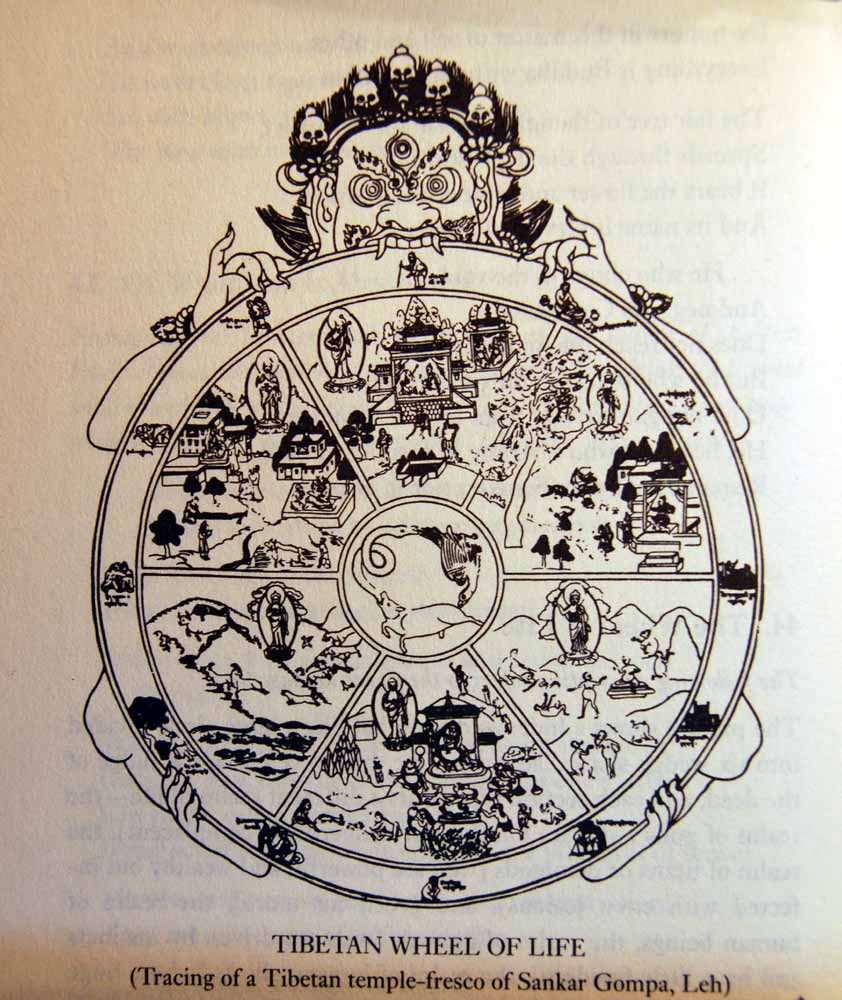
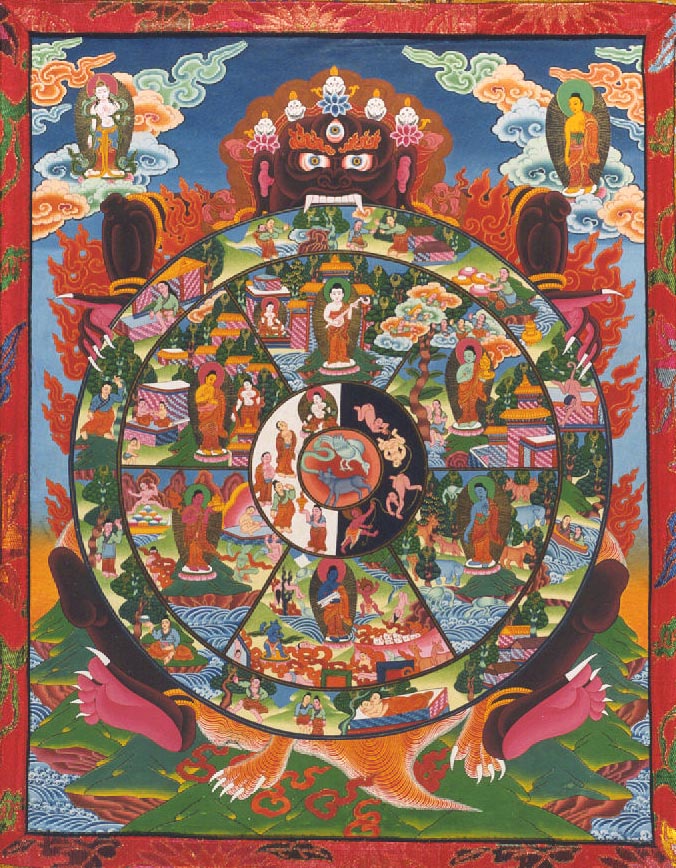
    The following content as well as image on bhavachakra is from this link, which explains it well.

    Bhavacakra or Wheel of Becoming/Wheel of Life is a form of a mandala or tanka (painted wall hanging), used primarily in Tibetan Buddhism.  The painting of a tanka is itself a form of mediation.  Its meaning is very complex, and can be read to represent at least three different realms of manifested effects ofkarmic actions.  It can be read as a diagram for the six different kinds of existence into which one may be born into during the middle rounds of samsara.  It can be read as symbolizing each of the different realms of human existence, lived out by certain kinds of people according to their karmic fortunes of personality type and socioeconomic status.  Or it can be read as a description of situations or states of consciousness that everybody passes through again and again in the course of a single day.

    Its iconographic meaning is correspondingly complex as well.

    In the background are varied Buddhist symbols, such as the moon, clouds in shape of swastika, and always a representation of at least one Buddha orBodhisattva, seen attempting to help sentient beings to find their way to Nirvana.

    The wheel is held by the jaws, hands and feet of the demon, Yama, the judge of the dead, who turns the wheel.  Yama represents the ignorance that comes from greed and “selfhood,” that keeps the wheel of suffering turning.

    The outer rim of the wheel is divided into twelve sections, called the Twelve Interdependent Causes and Effects – 1. ignorance, 2. volitional action or conditioning, 3. consciousness, 4. name and form, 5. six sensory organs (eye, ear, nose, tongue, body and mind), 6. contact or touch, 7. sensation, 8. desire, craving, thirst, 9. grasping, 10. becoming or existence, 11. birth, and 12. decay and death.

    The areas between the six spokes represent the six forms of unenlightened existence.

    There are six wedged-shaped sections, with each representing a different realm of life –

    1. realm of the Gods – Devas (who are blissful but dangerously complacent; always at the top of the wheel)

    2. the realm of the titans, demigods and fighting demons – Asuras (lowest rank of gods, who are powerful and wealthy but infected with envy, jealously, and greed for more; always in the upper half of the wheel)

    3. the realm of “human beings” (always in the upper half of the wheel)

    4. the realm of “animals” (sentient beings, less intellectually advanced than humans, driven by instincts and have little freedom, but can still experience suffering and project karma; always in the bottom half of the wheel; inclusive of birds, fish, and even a worm)

    5. the realm of “hungry ghosts” – Pretas (whose huge bellies but pinpoint mouths and eyes suggest insatiable craving; always in the bottom half of the wheel)

    6. the realm of “hell beings” (who are consumed with relentless rage; always at the bottom of the wheel; beings brought to hell for  past karma, but beings who can escape it through good deeds and reincarnation).

    At the center or hub of the circle is a smaller circle containing the Three Poisons, within a rim of binary demarcation of black and white. The black section represents the Dark Path on which sentient beings are moving downward to the hellish realms. The white section represents the Path of Bliss on which beings are moving upward to the Godly realms. The Three Poisons are personified as a rooster or fowl, a pig or boar, and a snake, chasing one another around and around. They symbolize the forces that keep people caught up in the samsaric round of existence: the rooster stands for greed, the pig for ignorance or delusion, and the snake for hatred.

    The wheel can thus hold distinct meanings, each speaking to different sensibilities.

  • Where is growth?


    The mobile was ringing, suddenly phone was picked and the statement – wait! Mumbai Indians needs only 5 runs to win in last 6 balls. I said ok Sir I will call you in five minutes. The turmoil of thoughts continued in my mind. What am I thinking, what are the questions in my mind, so many things how do I connect all these dots etc. Mumbai Indians eventually won, Prof Mankad informed me in next five minutes.

    We started talking – the market is steady, if not bull than not bear too. Indian Prime minister and Finance minister both are making statement that “We are going to grow at 6.9% if not at 8%”. Still, there is some uncomfortable feeling. I told Prof Mankad, “Sir I am not convinced. Further to it I said – news is Facebook is licensing the AOL patents – owned by Microsoft now – for close to 550 million. Next thing which I forgot to ask him was – news of bribing in Mexico by senior executive of Wal-Mart. Wal-Mart was running behind growth – sometimes in 90’s – and got in this trouble recently when the case was surfaced. I further added that Italy and Spain are showing -ve growth (to be precise signs of recession), where is growth?

    As always these questions were simple to answer for Prof Mankad. What he said very closely resembled to my thinking of inclusive growth. He said – hold your horses, the questions are right, this growth is notional and specific to IT and finance industry, largely to few services industries so to speak. The questions are pertinent, sir said. If I remember correctly he also informed me that Italy not only Spain has declared recession, French election would surely put more light on the already tough Euro crisis. Sarkozy is likely to lose, and then there are more elections coming up in Europe e.g. Germany etc. Political parties in Holland have agreed on austerity measures. Growth would happen and thus recession would be arrested only once we see growth in all the industries otherwise we are in a bad shape. It is not possible to say that we are growing at so and so rate when only one or two industries are showing signs of growth.

    This reminded me of my most loved theory of the Buddha – Interdependent Co-arising. I have written on this often and the current situation shows us yet once again that we are all connected, nothing can be isolated and growth is a collection of small growth in each industry. Each industry is a building block for the overall movement of the engine of economy world across (with few riders). No China can survive without US or Europe, no India or Philippines can grow its service industry until there is overall growth in the demand of service industry in developed nations.

    Where is growth? There would be growth when we all learn that we need to think about each other and help each other grow – we are all interdependent and we would successfully grow only when we grow together.