Category: Buddha

  • Generation running behind Technology


    Over the weekend I was talking to Rummuser uncleji. We were talking about many things one was – “uncleji you dont call me, its only me who calls you!”. So he said “Pravin  I am a generation old and for me internet, mobile etc are new age things and not necessary to communicate.” In fact he told me that he even receives inland letters from some of his friends. What? thats history right? But yes  STILL that is also a mode of communication.

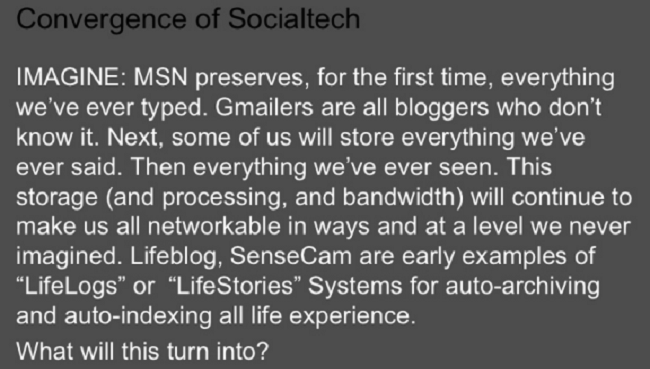
    I happened to read the following, copied as image some time back (source unknown now). I was thinking that it is true, my father must be thinking, this is too much what these guys and the kids do. This is complex and where all would this technological running around go and end?

    Convergence of Social Tech
    Convergence of Social Tech

    The question I asked myself was is it generation, running behind the technology? That is Latest things and fashion introduced and the young one’s running behind them. Or is it Generation running behind, technology? That is generations left behind the technology evolution and just trying to catch up or sit and relax. Older people who use technology as and when required.

    Perhaps 30 years from now I would think the same manner. Technology would be even more evolved and kids of that generation would find it cool, ok and obvious. At times those kids would think – how our forefathers survived without such gadgets?
    I think if my father is thinking something about technology and how far would it go? He is right, there seems to be no end. Step back and ask yourself – do you need a tweeter or a facebook to have a “Social Network” or to be “socially connected”? Do you think you need a mobile to Communicate? Do you think you need a TV or movie for Entertainment? I dont intend to say that we dont need many things; the question is how much is needed? and when is it needed?

    World would keep on evolving but there would be something that wont change and time and again a few people would think about it. Should we just stop and look within now? Is not it enough of running around?


  • Interdependent co-arising – macro-economics example


    I hae written on Interdependent co-arising (older blogs at the link) earlier.  The concept simply means – we are all dependent on each other.

    Those who want to know the concept in layman term follow this blog – interdependent co-arising example of a farmer.

    Definintion of interdependent co-arising is below with a macro-economics example. In late 90’s the East Asian countries faced a very serious economic challenge of decades. The financial system came down like a house of cards. Dr Joseph Stiglitz – Economics Nobel Prize winner of 2001 – shares the concept of interdependent co-arising (dooming in otherwords) in his book  – “Globalization and its discontent“. On Page 106-107 he invariably – and inadvertently perhaps – explains what is interdependent co-arising. Hope economists would understand this lesson, if not from the Buddha then from Dr Stiglitz.

    Beggar-Thyself Policies

    Of all the mistakes the IMF committed as the East Asian crisis spread from one conuntry to another in 1997 and 1998, one of the hardest to fathom was the Fund’s failure to recognize the important interactions amont the policeis pursued in the different countries. Contractionary policies in one country not only deepened that country’s economy but had adverse effects on its neighbors. By continuing to advocate contractionary policies the IMF exacerbated the contagion, the spread of the downturn from one country to the next. As each country weakened, it reduced its imports from its neighbors, thereby pulling its neighbors down.

    The beggar-thy-neighbor policies of the 1930s are generally thought to have played an important role in the spread of the Great Depression. Each country hit by a downturn bolster its own economy by cutting back on exports and thus shifting consumer demands to its own products.A country would cut back on export by imposing tariffs and by making competitive devaluation of its currency, which made its own goods cheaper and others countries’ more expensive. Howeer, as each country cut back on imports it suceeded in “exporting” the economic downturn to its neighbors. Hence the term bagger-thy-neighbor.

    Solution to all these economic, social, personal, spiritual or other problems?

    Its interdependent co-arising itself. We all need to help each other grow – grow the pie and share it well, if not equally!

  • Border-less world


    Let us imagine, a border-less world. A world where

    Source - http://praditaastarina.files.wordpress.com/2011/08/170580815_bbdabc8038.jpg
    Border-less world

    1. people can move from one place to the other without Visas
    2. goods and services can be bought and sold without import/export duties
    3. education is free (at least basic education)
    4. people would be free to do what they want to do (not taking law in their hand though)

    I believe both the leading economic “-isms” and many spiritual/religious “-isms” have been trying to do that for years.

    The economic “-ism” are capitalism and socialism. Socialists want this by making a world a single big society where everyone is working for the society. Capitalists are trying to do it through Washington Consensus and IMF. Until now the results have been failure. Russia failed, China becoming a capitalist USA (being protectionist) walking on the way to become more socialistic. Seems There could be a middle path where both these -isms are together.

    Religious groups “-ism” are Christianity, Islam, Buddhism, Hinduism etc. Christianity wants the world to be Christan, Islam talks about Universal brotherhood. I am not sure about the other two asking people to convert to their religion though. However, Hinduism talks about Vasidhev Kutumbakam. Vasidhev Kutumbakam means one world family. But the idea all over the world is unity and unifying the world in different ways.

    All this is failing because – the ulterior motives are money or fan following (I mean increasing number of followers of the religion).  Since both they ways seem not working, what if we turn to something else, no politician, no economist and no religious group to lead. People leading the people’s movement!

    Take the following case – Social media for social service, crowd sourcing based funding (crowd funding) and initiatives such as Janlokpal (India), Occupy Wall Street (USA), Jasmin revolution (Tunisia) and Tahrir square (Egypt) etc. If people are empowered yet are asked not to encroach on others freedom. What if we really become an educated world, without politics, without divisions, without borders.

    This may happen if we remove ego and greed from our society!

    Image Source – http://praditaastarina.files.wordpress.com/2011/08/170580815_bbdabc8038.jpg (Apologies for delayed update, it was updated in the image description but not visible on view)

  • Segment of one & inclusive growth


    What are we? We are a society, made of communities, families and individuals. We are talking about growth on global scale. At times we are talking more about “saving” the world from financial melt down. I sometimes think – who has created it at the first place? That is for some other day though.

    When we see growth we talk on aggregate level – GDP of the country, GDP growth rate, reserve, unemployment rate etc. Have we ever thought that these numbers are “aggregate level” number for example – if I put my one hand in boiling water and another at minus thirty degrees [100+ (-30)], average temperature of my body is 35 degrees. But does that mean I am fine? No my one hand is burnt and other is numb. That is the reality of aggregate level measures.

    How do we resolve such inconsistencies? Let us start measuring things in terms of segments. As they call it in Marketing, Segmentation. On a very deeper level as segment of one. “Segment of one” means handling each individual as an individual (and not as any generic segment). Though is more of marketing and in my professional experience analytics gyan (which is not purpose of this blog) so I would come back to the point.

    Segment of oneIf we do that Marketing stuff of Segment (segment of one) in society and eventually to the individuals. We would realize that “inclusive growth” is only possible when we take growth stories to communities, at smaller level say villages, communities, to each family to each individual. I see that as the solution to a better reflection of growth. I better measure would emerge from there, upliftment of each individual.

    Writing this, I feel as if I’m a politicians, speak and no action! How to do that is the question. A very idealistic solution – what if we’ve unemployment benefits for everyone also encourage everyone to do what he/she wants to do – until found success, unemployment benefits would help these people. Word of caution – there may be free-riders one has to fix that challenge. Take an example of Venture Capitalists and Funders. They do the same but at a later stage – say when I found my calling, started working and kind of see a revenue model. This is truly a very impractical and idealistic solution, but can we build on this to devise a practical and applicable solution from it?

    Image source – http://www.dmnews.com/marketing-to-a-customer-segment-of-one/article/262747/

  • Wealth and Wisdom


    Wealth is the abundance of valuable resources or material possessions. Wealth in itself is of no value, someone owning it gives “it” some “value”.  Similarly Wisdom (Hinduism) is considered a state of mind and soul where a person achieves salvation. Again here salvation is achieved by “someone”. So salvation may not be anything in itself, right? Once you achieve it there is no “self”, that is another side of it though.

    The definition of wealth (or for being wealthy) in my opinion is – when you have no more desire to earn more possession – when you have complete disinterest for money – you are wealthy. Because there is no end to earning. There may be a possibility that you are the wealthiest person on earth in the list of Forbes. You may not be interested to say “enough is enough!” I don’t need more money.

    http://media-cache-ec3.pinterest.com/originals/af/fa/97/affa97f31778a0e75cb506d1e38f0f95.jpg

    According to me one is wealthy – if one decides doing things because he/she enjoys doing the work and therefore does his/her work just for the hack of it. Say if I go to office with a motive of Salary at the end of the month, I am not wealthy. But if I do the same work because I enjoy doing it, feel self-satisfied and content. so the salary is not the desire but the fulfillment I achieve makes me wealthy. The later becomes reality with wisdom.

    What if wealth and wisdom meet? The age old approach of the west (wealth) meets the even older approach for life of the east (wisdom). I do not think the world would remain the same, this world would become wealthy and wise. Largely we would stop running for growth, to bailout countries and to make more money. This would be the world where the Business would meet the Buddha and people would do their work as their duty rather than compulsion.

    Definition source – Wikipedia

    Image source – Pinterest

  • 33 – Understanding change and change in understanding


    33 Understanding change and change in understanding is a book by Richard Saul Wurman. You know TED conferences? He created that. I want to write a lot of blogs (perhaps one for each page from the book).

    Professor Mankad gave this book to me, when I requested him for opinions on few of my blogs. The book is very interesting, I will read it again before giving back to him. Today I am referring to a chapter of the book – I am a zoo episode.

    The protagonist is astound at the arrogance of man. The author writes – “… they are just so proud of themselves in all their various religious books, the Bible, the Koran, the Book of the Dead, the Bhagavad Gita and many, many more.

    In every one of these tomes it was man this man that man, and besides the fact that it was men and women, the arrogance of thinking of ourselves as a single species just amazed the Commissioner…”

    “Bacteria, the Commissioner knew, subdivide and reproduce, in effect multiplying by division. The human body… …has many trillions of cells and 90% are bacteria!…”

    “I am a zoo, the commissioner said, Because that is what I am. It would be only religious arrogance to see myself as a single species.”

    I wonder if the author wanted to say zoo in terms of our thoughts too. We have so many so diverse thought that we are a zoo and a jungle within our mind too.

    We are much more than what we think we are. I was recently talking to my father and he suggested – “we are made of various tissues, tissues are made of cells and molecules and atoms and particles. Now each particle is in effect an energy packet. So we eventually are indestructible in that sense.”

    What we need to remember is – understanding the change helps in change in understanding!

  • MBA is not about Money, Blazer, Arrogance


    Recently one of my friends – Krishna Kranthi has written a novel – “MBA is not about Money, Blazer, Arrogance“. Generally I don’t read fiction but the title of the novel made me read it. It is an interesting read and good authorship for a first time novelist. I liked it so much that I almost completed it in single reading. Many MBA students feel the same as the protagonist in “MBA is not… “. Only a few not only think but also write about it. Yet only a few not only write but also live the lessons learnt through this soul search, Krishna is one. Take an example – whatever small profit earned through the sell of the novel would go to an NGO. A very noble cause – who and how many think and act like that?

    In the novel, the protagonist asks pertinent questions. The protagonist – somewhat confused and a lot more explorer – is trying to search for the real purpose of the MBA. If I take the freedom to extend the realm – searching for the real purpose of life! The book is very good read for all students (not just MBAs) – it may help them find the objective for doing what they are doing?

    When I am writing this, I am reading “Globalization and its discontents” by Prof Joseph Stiglitz. I see through these books and connect the two things. I realized that there are more things beyond the ivory towers of AC rooms and excel sheets of calculations (as we MBAs are generally absorbed in). That something is – the drought stricken Marathwada Maharashtra (read Mumbai mirror Sunday 17th feb 13) etc. There is hope, there is opportunity for all of us to think beyond our own small goals. The opportunity to do something good for the society as a whole.

    —-
    There are two kinds of people. The Preservative and the Transformer. The Preservatives are trying to protect the status-quo, while the Transformers are trying to do something new update / innovate / improve and do something worth for self and society.

    I see a transformer in Krishna a different fellow who is different from the preservators. Who has asked few core questions for education (MBA). I think readers can find their own selves in the protagonist of novel and do some soul searching while reading the novel.

  • Illusion of control


    I was watching Kung Fu Panda. In one discussion Master Shi Fu and Master Oogway are talking. Watch the video below Illusion of control

    [youtube=http://www.youtube.com/watch?v=Li9wgw0a2QI]

    This video is interesting, it talks about the “illusion’ of control we’ve in our mind. Actually, for a couple of months I’ve been thinking – am I controlling my life? Am I in control of the project I have in my hand? I remembered my MBA days – at times, I used to be authoritative with my group (confession, I may be wrong though). I remember Ashar (he blogs here) and I discussing about being on top of the deadlines. Ashar is very diligent, committed and punctual guy, I always enjoyed working with him in a team.

    So I always tried to be on top my deadlines, work etc. At occasion this control of being on top of deadlines and control of everything related to me seemed an illusion. This began with few questions and few things I slowly connected later.

    As a kid I had heard about Jaora in MP (there is a tomb of a Sufi saint there), had heard about possession and the other world. Recently, I came to know about Meera Datar Dargah and witness firsthand what we watch in movies (e.g. Vidya Balan in Bhool Bhulaiya). This is called possession (demonic possession), and under this influence a person loses his control on him/her self. When I saw that I asked myself – are we in control in our life? Lately, I got to know about Hazarat Gazali’s Dargah near RC Church. At the Dargah I met Taufik bhai, a very simple, devoted and pious person. Though I want to talk to him but he is generally very busy. Does something else (the other world) dictate us? The question remained – are we in control in our life?

    Next thing that made me think about control was astrology. One of my friends father is an astrologer – he predicted about Harshvardhan Navathe would win in KBC (Ref old Mid-Day news). Do stars dictate us? So the question remains – are we in control?

    I was getting puzzled, kept on doing my work and thinking also. One night, just out of the blue, I started watching Kung Fu Panda. I have watched this movie many a times so forwarded stuff I didn’t want to see again. Suddenly I reached the part of the movie where Master Oogway talks about ‘Illusion of control’. I stopped there, switched off computer and slept (it was already 1:20AM next day I had office). Somehow, I thought that I got a direction for answer, if not answer. I somehow could connect the dialog of Master Oogway of illusion of control to the Geeta (Karmanye Vadhikaraste…)

    कर्मणयेवाधिकारस्ते मा फलेषु कदाचन।
    मा कर्मफलहेतुर्भूर्मा ते सङ्गोऽस्त्वकर्मणि।   2.47 – more on this by another blogger here

    My inference was this -1.  forget about control, 2. even the illusion of control and 3. do you work! Well 4. forget about the result too.

    There have been some connections made but few dots have opened Pandora’s box because we have many questions on – possession, astrology etc.

    Disclaimer – Author only knows about paranormal activities, demonic possession or astrology, but is no way an expert to provide inputs etc.

  • The dog and the fox


    Assume (as few may not believe in rebirth) that someone died as a Jew and born again as a Muslim. The soul has only did one thing – changed sides from one HATE group to the other. Remember Jews and Muslims have conflict in Palestine, I am not an expert on international politics so please do not take these statements as expert opinions – concentrate on the moral.

    Please understand – I do not intended to hurt any particular religion or ideology, it was just a story which I read and liked the message – We have enough religion to hate but not enough to love.

    Just to make my point, here is some related story. This is a story I read today (on my old blog account), liked it so here is the story as a blog. The story is from a book titled “The Prayer of the Frog” volume I, By Father Anthony de Mello publisher Gujarat Sahitya Prakash, Post Box 70, Anand-388 001. India.

    We really have so many Beliefs to hate or create identity but rear for love – ‘unconditional love’, or sometime Humanity. We have a lot of things (and religions) – shouldn’t we have little Humanity in us!

    The dog and the fox

    A hunter sent his dog after something that moved behind the trees. It chased out a fox and corralled it into a position where the hunter could shoot it.

    The dying fox said to the hound “were you never told that the fox is brother to the dog?”

    “I was, indeed,” said the dog. “But that’s for idealists and fools. For the practical-minded, brotherhood is created by identity of interest.”

    Said the Christian to the Buddhist: “We could be brothers, really. But that’s for idealists and fools. For the practical-minded, brotherhood is created by identity of beliefs.”

    Most people, alas, have enough religion to hate but not enough to love.

    I used to blog in 2006 also. This blog is from that blog post. Though I did not continue blogging there (at that time the interface was not that evolved for me).

  • Ted Talk – Bob Thurman: We can be Buddhas


    This is a TED talk I heard yesterday. Thanks to my mobile and TED app found this video. This is a very interesting & small talk by Bob Thurman. I felt to have the transcript too so have searched and pasted it below.

    [ted id=130]

    And I feel like this whole evening has been sort of amazing to me, I feel it’s sort of like the Vimalakirti Sutra, an ancient work from ancient India, in which the Buddha appears at the beginning and a whole bunch of people come to see him from the biggest city in the area, Vaisali, and to bring some jeweled parasols to make offering to him. All the young people, actually, from the city — the old fogeys don’t come, because they’re mad at Buddha, because when he came to their city he accepted, he always accepts the first invitation that comes to him from whoever it is, and the local geisha, a movie star sort of person, raced the elders of the city in a chariot and invited him first.

    So he was hanging out with the movie star, and of course they were all grumbling, “He’s supposed to be religious and all this, what’s he doing over there at Amrapali’s house with all his 500 monks,” and so on. They were all grumbling, and they boycotted him, they wouldn’t go listen to him. But the young people all came. And they brought this kind of a jeweled parasol, and they put it on the ground. And as soon as they had laid all these, all their big stack of these jeweled parasols that they used to carry in ancient India, he performed a kind of special effect which made it into a giant planetarium, the wonder of the universe. Everyone looked in that and they saw in there the total interconnectedness of all life in all universes.

    And of course in the Buddhist cosmos there are millions and billions of planets with human life on it, and enlightened beings can see the life on all the other planets — so they don’t, when they look out and they see those lights that you showed in the sky, they don’t just see sort of pieces of matter burning or rocks or flames or gases exploding, they actually see landscapes and human beings and gods and dragons and serpent beings and goddesses and things like that.

    The made that special effect at the beginning to get people to think about interconnection and interconnectedness and how everything in life was totally interconnected.

    And then Leilei (I know his other name) told us about interconnection and about how we’re all totally interconnected here and how we’ve all known each other, and of course in the Buddhist universe we’ve already done this already billions of times in many many lifetimes in the past. And I didn’t give the talk always…, YOU did, and we had to watch you, and so forth.

    And we’re all still trying to, I guess we’re all trying to become TEDsters, if that’s a modern form of enlightenment. I guess so. Because in a way, if TEDster relates to all the interconnectedness of all the computers and everything, it’s the forging of a mass awareness, of where everybody can really know everything that’s going on everywhere in the planet.

    And therefore it will become intolerable — what compassion is, is where it will become intolerable for us, totally intolerable that we sit here in comfort and in pleasure and enjoying the life of the mind or whatever it is, and there are people who are absolutely riddled with disease and they cannot have a bite of food and they have no place or they’re being brutalized by some terrible person and so forth, it just becomes intolerable.

    With all of us knowing everything, we’re kind of forced by technology to become Buddhas or something, to become enlightened.

    And of course, we all will be deeply disappointed when we do.

    Because we think that, because we are kind of tired of what we do, a little bit tired, we do suffer, we do enjoy our misery in a certain way, we distract ourselves from our misery by running around somewhere, but basically we all have this common misery that we are stuck inside our skins and everyone else is out there.

    And occasionally we get together with another person stuck in their skin and the two of us enjoy each other, and each of us tried to get out of our own, and ultimately it fails of course and we’re back into this thing.

    Because our egocentric perception — from the Buddha’s point of view, misperception — is that all we are is what is inside our skin. And it’s inside and outside, Self and Other, and Other is all very different. And everyone here is unfortunately carrying that habitual perception, a little bit, right?

    You know, someone sitting next to you in a seat , that’s okay because you’re in a theater, but if you were sitting on a park bench and someone came up and sat that close to you, you’d freak out. “What do they want from me?” Like, “Who’s that?” And so you wouldn’t sit that close to another person because of your notion that it’s you versus the universe — that’s all Buddha discovered.

    Because that cosmic basic idea that it is us all alone, each of us, and everyone else is different, then that puts us in an impossible situation, doesn’t it? Who is it who’s going to get enough attention from the world, who’s going to get enough out of the world, who’s not going to be overrun by an infinite number of other beings — if you’re different from all the other beings?

    So where compassion comes is where you surprisingly discover you lose yourself in some way, through art, through meditation, through understanding, through knowledge actually, knowing that you have no such boundary, knowing your interconnectedness with other beings. You can experience yourself as the other beings when you see through the delusion of being separated from them.

    When you do that, you’re forced to feel what they feel. Luckily, they say — I still am not sure — but, luckily, they say that when you reach that point, because some people have said in the Buddhist literature, they say “Ooh, who would really want to be compassionate, how awful! I’m so miserable on my own, my head is aching, my bones are aching, I go from birth to death, I’m never satisfied, I never have enough, even I’m a billionaire I never have enough, I need a hundred billion, so I’m like that, imagine if I had to feel even a hundred other people’s suffering. It would be terrible.”

    But apparently, this is a strange paradox of life, when you’re no longer locked in yourself, and as the wisdom, or the intelligence, or the scientific knowledge of the nature of the world, that enables you to let your mind spread out, and empathize, and enhance the basic human ability of empathizing, and realizing that you are the other being, somehow by that opening, you can see the deeper nature of life, and you can, you get away from this terrible iron circle of I, me, me, mine, like the Beatles used to sing.

    You know, we really learned everything in the ’60s. Too bad nobody ever woke up to it, and they’ve been trying to suppress it since then. I me me mine, it’s like a perfect song, that song. A perfect teaching.

    But when we’re relieved from that, we somehow then become interested in all the other beings. And we feel ourselves differently. It’s totally strange, it’s totally strange.

    The Dalai Lama always likes to say, he says that when you give birth in your mind to the idea of compassion, it’s because you realize that you yourself and your pains and pleasures are finally too small a theater for your intelligence, it’s really too boring whether you feel like this or like that, or what, you know — and the more you focus on how you feel, by the way, the worse it gets. Like, even when you’re having a good time, when is the good time over? The good time is over when you think, How good is it? and then it’s never good enough.

    I love that Leilei said that the way of helping those who are suffering badly on the physical plane or on other planes is having a good time, doing it by having a good time.

    I think the Dalai Lama should have heard that, I wish he’d been there to hear that. He once told me, he looked kind of sad, he worries very much about the haves and have-nots, he looked a little sad because he said, Well, a hundred years ago, they went and took everything away from the haves. You k now, the big communist revolutions, Russia and China and so forth, they took it all away by violence, saying they were going to give it to everyone, and then they were even worse. They didn’t help at all.

    So what could possibly change this terrible gap that has opened up in the world today?

    And so then, ah, he looks at me.

    So I said, Well, you know, you’re all in this yourself. You teach: it’s generosity. Was all I could think of. What is virtue.

    But of course, … I think the key to saving the world, the key to compassion is that, it is more fun. It should be done by fun. Generosity is more fun, that’s the key.

    Everybody has the wrong idea — they think Buddha was so boring, and they’re so surprised when they meet Dalai Lama and he’s fairly jolly

    Even though his people are being genocided, and believe me he feels every blow on every old nun’s head, in every Chinese prison, he feels it. He feels the way they are harvesting yaks nowadays, I won’t even say what they do. But he feels it.

    And yet he’s very jolly, he’s extremely jolly.

    Because, because when you open up like that, then you can’t just, what good does it do to add being miserable with others’ misery? You have to find some vision where you see how hopeful it is, how it can be changed.

    Look at that beautiful thing Chiho showed us, she scared us with the lava man, she scaaared us with the lava man is coming, then the tsunami is coming, but then finally there was flowers, and trees, and it was very beautiful. It’s really lovely.

    So, compassion means to feel the feelings of others, and the human being actually IS compassion. (The human being is almost out of time.)

    The human being IS compassion because what is our brain for? Now, Jim’s brain is memorizing the almanac. But he could memorize all the needs of all the beings that he is, he will, he did. He could memorize all kinds of fantastic things to help many beings. And he would have tremendous fun doing that.

    So the first person who gets happy, when you stop focusing on the self-centered situation of “how happy am I?” where you’re always dissatisfied as Mick Jagger told us — you never get any satisfaction that way — so then you decide, “Well, I’m sick of myself, I’m going to think of how other people can be happy. I’m going to get up in the morning and think, ‘What can I do for even one other person, even a dog, my dog, my cat, my pet, my butterfly.’” And the first person who gets happy when you do that, you don’t do anything for anybody else, but YOU get happier, you yourself, because suddenly your whole perception broadens, and you suddenly see the whole world and all of the people in it. And you realize that this — being with all these people — is the flower garden that Chiho showed us.

    It is Nirvana