Tag: the book of Mirdad

  • Gyani in professional life

    The Bhagvad Geeta defines who is a gyani (sage) as follows – “One who remains unattached under all conditions, and is neither delighted by good fortune nor dejected by tribulation, he is a sage with perfect knowledge.” It is very difficult to implement in life. The practical approach for trying is – “Pandemic has happened, we are in lockdown. This is our current reality. We cannot change it, isn’t it? What we can do now is detach ourselves from this reality and look at what can we do as a professional and as a person.” If we approach situations in this manner we can be Gyani in professional life – a saint in suit. Here is a very small example with me how I failed in it recently and learnt a lesson.

    My recent experience

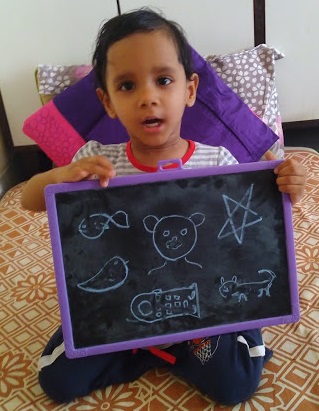
    My daughter – Adviti – has been kind enough to teach me some lessons on a regular basis. She reminded me of a Shloka of Bhagvad Geeta – “who is a Gyani (sage)?” Recently we gave her a slate and chalk so that she can scribble some things on it. She is too young – 2 years only – to write something useful. So, to keep her entertained, I make caricatures, animals or some drawings. It is a slate; it needs cleaning to scribble something next time. I am a very terrible painter, this has been a learning experience for me how to make something worth its salt. Slowly,2 I started drawing things that at least have some resemblance to the original. Now, I have started making something which is of at least some value – or I feel it is so.
    Adviti-Drawing-Lesson-Who-is-Gyani

    Initially it was ok for me, the drawings were awful and she was rubbing stuff. Yesterday I copied one of the drawings from her coloring book. I fell in love with that and as usual Adviti rubbed it clean. I tried to stop her, because I was very happy with the drawing. Probably for her there is no definition of beauty or ugliness. For her everything is equal. In fact there is a probability that the drawing I made was not worth it but I fell in love with it because I made it. So it was a lesson for me to let go and be equanimous in such situations. By the way, the picture on the side is about 2 month old, I make better drawing now 😀 😉

    http://business2buddha.com/2011/07/when-will-we-stop/

    Who is a Gyani (sage)?

    दु:खेष्वनुद्विग्नमना: सुखेषु विगतस्पृह: |
    वीतरागभयक्रोध: स्थितधीर्मुनिरुच्यते || 56||

    duḥkheṣhv-anudvigna-manāḥ sukheṣhu vigata-spṛihaḥ
    vīta-rāga-bhaya-krodhaḥ sthita-dhīr munir uchyate

    One whose mind remains undisturbed amidst misery, who does not crave for pleasure, and who is free from attachment, fear, and anger, is called a sage of steady wisdom.

    य: सर्वत्रानभिस्नेहस्तत्तत्प्राप्य शुभाशुभम् |
    नाभिनन्दति न द्वेष्टि तस्य प्रज्ञा प्रतिष्ठिता || 57||

    yaḥ sarvatrānabhisnehas tat tat prāpya śhubhāśhubham
    nābhinandati na dveṣhṭi tasya prajñā pratiṣhṭhitā

    One who remains unattached under all conditions, and is neither delighted by good fortune nor dejected by tribulation, he is a sage with perfect knowledge.

    I remember above shlokas of Bhagvad Geeta that she is effectively teaching me without even realizing. The lesson is “who is a Gyani (sage)?” I got too attached to the drawings – very trifling things – that would be gone over time. Whenever she wiped those I felt miserable, though I know these drawings are transitory.

    It is easy to relate to the slate and scribbling. It becomes difficult to apply this wisdom to our daily life. In our daily lives we are attached to the “bigger things” be it our certificates, designations or possessions. It’d be good if we learn this lesson for our daily life.

    Source – Bhagvat Geeta and the translation (Holy Bhagavad Gita).

  • What would you do in long term?


    In the long run we all are dead – John Maynard Keynes

    I was talking to my boss. He throws interesting questions – what do you think of next disruption? Ok do not talk about bitcoins, healthcare and analytics has already plateaued! Hum! That is a challenge. Wish I knew what is next disruptive business, technology or industry.

    I asked myself, is there lack of cloths that people die of severe cold in winter in India? Is there lack of food on earth that people die of hunger in world? If there is lack of cloths or food, why are our retail stores full with cloths, and food wastage is ~33% or so (National Geographic).

    My mind goes in a very long term when such questions come to mind. I believe in next hundred or hundred and fifty years or may be sooner, we would not need money (currency) or any such thing. This is very surprising for the financial system, businesses or capitalistic mind to believe. Let me elaborate. Have you seen Uber? Has Uber made ownership of car redundant for many people?

    What if our all basic requirements are fulfilled in the same manner – for example, I have some cloths in my wardrobe, I do not wear them all in a day. I wear only one at a time. Why should I have so many cloths? What if we can just select what to wear, wear it and return at some location when we are done! You may ask a question – then how would people earn money or offer services? Uber ride requires cash, card or wallet payment. Let us think of a future – car is driven by machine, cars are run by electricity, electricity is produced automatically by nuclear power and cars are manufactured by machines. No need of a human being for anything. Remember Keynes idea of working 4 days a week or lesser. Actually our capitalistic mind does not approve of this. People must work to earn their living. The best thing is – only capitalistic approach of running for better, more, improved can help us reach the state of future which is imagined here.

    When everything happens automatically, so what would humans do to earn, or say passing time? Can you relate the first part of previous sentence with the nature? Everything happens automatically for animals and they just pass time, they do not need to earn their living. Just think the phrase “Earning your living”! Does not it sound surprising thing, you just live, is not it? You do not need to earn it. I know you might have felt offended when you read automatically and comparing humans with animals. There will be a difference – our evolved sense of self and ability to think. This ability will force us to think about our existence. Our most of the time will be involved in thinking about our existence. This may take some time, when people will get fad-up with their pleasures – perhaps the way Gautam the Buddha got disenchanted. In that world we would not need money, we would not have a lot of possession, yet we will have everything on our finger tips.

    Just look at housing in Tier-1 cities in India. There are many unused inventory kept, most is out of budget for many people to afford. I see a future where whole world will be a rambling place and a type of hotel, where you can stay when you end your day. These houses will be built by machine and thus we would not need to buy or rent them either. Money as a concept will vanish. When you would have whole world at your feet, you would not steal, you would not look for possession. You would be lighter as Mirdad said in ‘The book of Mirdad“Less possessing – less possessed”.

    Here in above paragraphs we spoke about basic needs – cloths, food and shelter. I am sure humans will evolve to self-actualization phase – of Maslow’s need hierarchy – if the above happens (Ok give and take few carnal desires). In the short term, I would want to make that type of world envisioned above. In the longer term, I would want to be self-actualized or say enlightened in this life itself.

    What would you do in long term? was the topic for the week for LBC (Loose Bloggers Consortium). I had suggested this to the group where – Maria, Rummuser and Shackman also write. You can read other LBC authors opinions on their respective links.

  • How can I be liberated?


    The business of “I” is unique. We think that it relates to “me” but that the catch-22 situation. Whenever, I say this word “I” it reminds me of two consecutive chapters of The book of Mirdad. Mirdad is unique as his book, On one page he says – don’t use the word “I” it is forbidden word on the Noah’s ark; on the very next page he says “I” is the most creative word” (it is source and center of all things).

    When we say “I” it is largely the Ego talking, whereas when Mirdad says “I” (the creative word) it is the source of and frobuddhapixabaym the creator of the world. The question is – “Is ego ‘purpose of existence’ or a problem?

    Here is what The Buddha told Sariputta on the same.

    ————————-

    Sariputta came to Buddha.

    He asked Buddha, “How can I be liberated?

    Buddha said, “Do not come to me, go elsewhere – because I cannot liberate you, I can only liberate you from this ‘you’.”

    Buddha said further, “‘I’ is never liberated. One is liberated from the ‘I’. So if you are looking for your liberation, go somewhere else. But yes, if you want liberation from yourself, you have come to the right place. I will make you free from yourself. So do not ask how you will be liberated. You will not survive in your liberation. You should ask how to be free from this ‘I’ – how to be liberated from this ‘I’.”

    ————————-

    Liberated from what? If the “I” is dropped, the question ends, isn’t it!

    We can at most get attached to the actions we do, not the results. That is why I write about myself – “I’m passionate about my work and actions and empathetically careful, attached and committed to them.” Experts (read Lord Krishna) suggests do not even get attached to the actions! That is difficult, just imagine how difficult it is to detach from the “I”.

    Source – Osho, Finger Pointing To The Moon, Image source – Pixabay

  • Arrived… where?


    I checked the Whatsapp message, it was Jay Jiju (Jay Phadke my brother in law), my cousin sister’s husband. He had just sent a messagealien-house2 – “I was having lunch with Soham and we were discussing ‘what is home?’ ‘what is school?’ How do you define home/school etc”

    Soham is my nephew – 9 year old. Smart kid and at times grown-up to his age.

    Instantly I could relate his questions to the Book of Mirdad. The following are the lines from the same book

    ‘Happy are the staff-less,
    They stumble not.
    Happy are the homeless,
    They are at home.
    The stumblers only – like ourselves, Need walk with staff,
    The home-chained only, like ourselves,
    Must have a home.’

    Have you ever questioned yourself – what is home? My brother in law’s question of school some other time. Just concentrate on home. Home in day to day words is a place where we stay, live and dwell. We live even if  there is no place to live; we stay anywhere we go and dwelling is in a way dwelling similar to living or thinking about a point. So effectively what is a home? Is it a place where we get peace of mind, feel we have arrived or perhaps every end of day we run to reach there. But have we ever ‘arrived’? Have we ever really ‘stayed’ there? Home is at times a place where we spend some time.

    All these weird thought about arriving, staying et al remind me of The Buddha saying to Angulimala – “I have stopped long back, now it is your turn to stop”. Because even if we think that I have reached home, the exercise of going and than rushing back HOME never ends. Have we really arrived?

    Jay jiju send another message to me later. In this message he said – HOME, relates more to an experience/feeling. That feeling can be achieved at any other place. The point – it seems – is just ‘be’ – remain arrived.


  • Love


    Note – This blog was initially drafted on Oct 16th 2011 and was incomplete. The author thinks – however – that love is never incomplete.

    I have heard that “I” cease to exist in Meditation. I was thinking about it and heard a song on radio – Jane kyun log mohabbat kiya karte hai?… English translation of the title of the song is “I do not know why people fall in love?” ‘I don’t know’ is implied here. It’s a sad song from Bollywood Movie Mehboob ki mehndi staring Rajesh Khanna and Lina Chandavarkar as leads. I’ve heard this song umpteen number of times since childhood but I don’t remember watching this movie. No doubt Music by duo Laxmikant & Pyarelal is very good, lyrics from Anand Bakshi are to the point in many sense and Lata Mangeshkar cannot go wrong with single note ever. The song might fit in situations of many people’s life; therefore a very famous song of that time.

    These two things collided in mind – meditation & ceasing of ego, and love. The thoughts went in the direction love and analyzing the song. As a student of Hindi language I read different nature of love; but when I did image search on Google for LOVE, I saw either girl / boy or similar concept. Wonder what is the difference between lust and love in such search result. I searched on net for the Hindi lessons we learnt as student and found these 5 nature of love (read more here) –

    1. Santa-rati (reverence, neutral)Love Quotes
    2. Prita-rati (service)
    3. Preyo-rati (friendship)
    4. Vatsalya-rati (parental)
    5. Madhurya-rati (conjugal, sexual)

    What I learnt as student and what I get on Google made me think even further, for example check in the above quote image which I found randomly on Google Search. However good this quote sounds but there are points to ponder 1. we have “I” & 2. some result gets some importance! Love if it binds (forget blinds), makes one get attached to someone or something. This definition of love which binds or outcome becomes important is a problem. We have more ownership issues with love. Then whatever type of love – as mentioned above – that is a trouble. Love is an entanglement – a wonderful entanglement but an entanglement. Read more on entanglement here – Entanglement of an undergarment.

    I was thinking about the song (Jane kyun log mohabbat kiya karte hai?…) – and the way it represents the pain one goes through in love. At the same time, I was thinking about existence of ego – I.  I questioned myself – If the ego does not cease to exist in love, is it love? In a simple sentence “I love you”. I shows ego, you shows – you are separate from me. So, if both these words stay in the sentence is there any meaning of the word – LOVE?

    Than I remembered a quote from The book of Mirdad – (My blog on the same, The Book)

    ‘Less possessing – less possessed.
    More possessing – more possessed.
    More possessed – less accessed.
    Less possessed – more accessed.’

    Net net I thought – if love causes you to own someone / something, that is a problem and yes there is a relationship between Love and Mediation. Than I read this quote by Sri Sri Ravi Shankar “Love is not an emotion, it is your very existence.” If love is actually our existence, than I think “I” ceases to exist when someone is in true love, isn’t it?

    Image source – http://www.picturequotes.com/every-moment-spent-with-you-is-like-a-beautiful-dream-come-true-quote-16541

  • Owning up things


    alien-house2Recently I got married. Before marriage, I always planned and lived with minimum stuff. I never owned even a wheel of a bicycle. The most surprising stuff started just two days before marriage. Somebody broke into my apartment. When I reached home, my first reaction was – “com’on you must be kidding! How can one think that I would have stuff at home to steal?” The only possession I owned until recently was – 1. consumables, my books & my degrees; everything else at home is from my landlord. My landlord has been kind to offer fully furnished apartment.

    Anyways, so this journey of conversion from being a nomad to settler started just some time back. When we – I and my wife – traveled from her home to my home we had 60KG of suitcase stuff. A lot is still at her parents home. My luggage weighs at least 3 times that much; that is besides the point. Let me qualify the stuff I am talking about – its everything I own.

    Now, as a settler I am planning to buy things, we have started with a scooter, planning washing machine, fridge, TV, car and home etc. The list is almost endless. I am sure the burden of these purchases going to be more tiring.

    Now, I am changing, I have learnt – from Mahavir and the Buddha – “no hoarding, no stealing etc we have forgotten… we will leave everything here but still we want to own stuff.” Now, I am calling all those things written above as – “convenience”, “required to make life easier”. That is being mean – defining everything at one’s “convenience” (bending the definitions).

    But who says one must become masochist in the name of being an ascetic?

    I know owning up things should not becoming things owning me. Reminds me of The book of Mirdad, more blogs on the book here 

    Less possession less possessed.

    Image source – http://www.maydolly.com/wp-content/uploads/2014/02/alien-house2.jpg

  • Empowerment means slavery


    I am a heavy user of internet and mobile. There have been times when almost always I am on internet. In my office about 8-9 hours I am on my laptop. When I am traveling I am on internet through my mobile or fiddling with my mobile many a times completely unnecessarily. When I am at home, my Wi-Fi is on both laptop & mobile are connected to internet. Effectively, I was not using my electronics gadgets “only” when I am asleep!

    Responsive_Web_DesignMy friends kept on saying, I never believed that I use my mobile overly many times without any reason! My friend Nilesh Yeram sent me a link – install “Break Free” in your mobile. The app has shown me the mirror – “you have unlocked my mobile about 70 times”, of course I did not receive so many calls or SMSes. Eye opening notifications were “you are on twitter for 30 min!” “Get off call/whatsapp” This made me question myself – “Is Technology empowering us or enslaving us?”

    The word slavery looked too daunting to me. I felt how can I be a slave- my ego was speaking. So I checked Dictionary; Slavery according to Dictionary.com is “the condition of being subject to some influence or habit”. I am indeed a slave of mobile. I know I am empowered a lot by internet, but slowly I became a slave of these devices. This reminds me of The book of Mirdad – we live the statement Slave is master of the master.

    This I received on “WhatsApp” today!


    Related blogs –

  • Lesson from the Twitter…


    Twitter is a funny thing, at times, It teaches you some lessons unintentionally. This is what happened to me which made me think – am I writing what I feel is my opinion or I am writing what makes others feel good about my opinions? For a mere mortals – like I am – this question is of existence on twitter. So here comes my thoughts on survival on twitter.

    I wrote last month The Master is the Servant’s Servant. I remember reading this in the Book of Mirdad. Recently, I revisited this line – Master is the servant’s servant and vice versa. In this “virtually socially connected world” There is a new paradigm to looking at this saying of Mirdad.

    During Diwali, I purged my list of people I am following on Twitter. I unfollowed whom I thought I should not follow now. Similarly I looked at the list of people who are following me. I realized, that there was a time when I had more than 250 follower e.g. more than 250 people following me and getting my tweets on their timelines. Slowly this number had declined. Many people did what I did to few during Diwali ‘cleaning’! They simply “Unfollowed” me. So, I was wondering, how come I reached 250+ followers? I tweeted about 1. political opinions, 2. my view on economics 3. spirituality and 4. Business e.g. Intellectual Property Rights, Innovation, Startups, Entrepreneurship & VC/PE deals, Analytics, Big Data etc.

    Actually, many people followed when I tweeted what “sounded” good to their ears. Me being me – later on – I might have written something against those thoughts or something irrelevant to those followers – the simply went. No regrets – actually, that growing number gives you a false sense of pride – believe me it feels like that initially. I realized that ok – writing this or that makes people follow you. Should I start writing in this or that manner? I was getting in the trap of being salves of those few people who wanted to hear what suited most to them. Well, that was what making me servant (of others opinion) and them the master (of my owns opinion).

    So, it is a kind of question of one’s existence. cogito Ergo Sum (I think therefore I exist) or my thoughts echo with thoughts of the People therefore I exist (at least on twitter).

    Anyways the reality is – we are all interdependent and therefore the definition of salve and master is incorrect in itself.

    Disclaimer – I do not intend to demean those 1. who followed me, 2. later unfollowed me, 3. still following me 4. whom I follow, 5. I unfollowed and 6. I am still following etc on Twitter.

  • The master is the servant’s servant


    A master and his disciples were sitting under a tree. The master saw a man taking a cow with him. Man had this cow tied with a rope, walking in the front and cow, naturally, following the man.

    The master saw this, said – “see that cow it taking the man somewhere.” His disciples saw in the direction and replied, master you need to check it properly, the man is taking the cow somewhere. Master replied – what you see is not always the truth. Disciple replied – “please explain, in this case how cow is taking the man?”

    Master replied – Do one thing unchain the cow, see who runs after whom? The master need not run behind the servant. Since the cow is tied, it has no other option but to walk behind the man but cow is the master. The cow has the freedom to go wherever it wants to do – if unchained.

    I read this story as a kid, in Osho magazine. Earlier this year, One day I remembered this story. How? Let me tell you.

    I and one of my colleagues were talking about Amitabh Bachchan. On one endorsement of his, I said that product does not gel well with his grand personality (my 2 cent, opinion). To that my colleague replied – “well that endorsement could be enough for him to arrange for salary of his whole staff for a year, at least.” Suddenly I stopped, remembered the story of cow and the man. I did not speak, just smiled.

    Well, I had this talk with my colleague in the beginning of the year why writing now? The reason is – we have a maid who is so royal that she wakes up at 10 AM or late. Comes home 2 or more hours later than I had gone to office – needless to say I prepare tea and breakfast for myself, and our maid is a full time maid. So she in a way is master, I go for earning her monthly salary (e.g. my office) well before she comes for work. The other thing – we are hopelessly dependent on her. The way man is dependent on the cow in above story.

    So the question is – who is the master and who is the servant?

    Mirdad says (The book of Mirdad) – “the servant is the master’s master. The master is the servant’s servant.”

    Disclaimer – 1. I’ve no intentions to demean Mr Bachchan he is a big personality.

    2. Neither I intend to demean my maid – after all she offers me my daily bread.

    Kind of related blog – Irony

  • Ego


    Two men in a room, room is in an apartment, apartment is in a building
    Building is in a locality, locality is in a city, city is in a state
    State is in a Nation, Nation is in a continent, continent is on The Earth
    The Earth is in a solar system, solar system is in the galaxy
    The Galaxy is in the Milky way…

    We are so small still we create TWO WORLDs in a single room!

    Me on the top of the world
    ‘Me’ on the top of the world

    When I was in school, I read this poem in Hindi in my course. It is very meaningful and important story of our life. We are nothing if we follow the trace suggested by the poet. Yet, we create our own world and cause problems in our surroundings, our near and dears life and life of our colleagues. All this for what – to manage, boost and nurture our Ego. If the ego goes beyond our near & dear and colleagues, it goes to kill people in the name of our belief system. Majority of the wars fought in the world are because of Ego.

    Alexander the great – why “the great” because he conquered the world – with sword! Cold war – why? To prove WE are better than YOU. MY country is superior than YOURs. This applies to the recent attacks in cities of Afghanistan, social unrest in the Middle East (suppressed ego of citizen and suppressing ego of the respective rulers) and Nuclear ambitions of Iran and North Korea. We see political, religious, cultural and regional problems because of Ego.

    At the same time, I am of the opinion that ego is not a problem, the manifestation of the same is a problem. Self respect becomes ego when it crosses a certain line. I see many solutions to this, one is when we start looking at ourselves through the lenses of the poet who wrote the above lines. We are tiny small creatures and there are many things beyond I and MY GROUP. For some, ‘I’ and ‘My group’ becomes purpose of existence. Second solution I see is through the eyes of Mirdad. Other is through the peaceful methods e.g. meditation suggested by spiritual masters.

    What say you – is ego ‘purpose of existence’ or a problem?

    Related blog based on The book of MirdadForbidden word