Tag: Hinduism

  • Life is a celebration


    I was doing regular weekly followup at an Art of living center today morning. While breathing, I realized Something. Probably it’s nothing new for many – the moment I took the breath in, it became me! The air I breath became me and I was nothing without it. We become a part of something be it breath, food or the environment. As a kid, I enjoyed many festivals Ganeshotsva was one of them. Slowly I started feeling it is more political than social. I was disenchanted and grew over it. After coming in Mumbai, I connected to this festival once again. Slowly I this season and festival has become a part of me.

    This festival has been teaching a lot of things to me. Have you observed something special? Almost whole year we have some or the other festival and celebration in India. We go out to submerge the deity with full funfair dancing. This is going to happening once again predominantly in Western India (Maharashtra). Every year during this festival I learn – and forget later – that life is celebration.
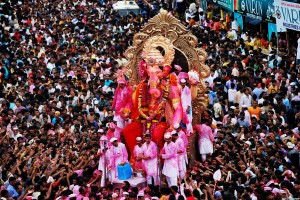
    Similar worship will start in few weeks in Eastern India (West Bengal) also in Gujarat. The god on the other side would be – Devi. Imagine, a deity brought home with full reverence, worshiped twice a day and in the end submerged.

    I get quiet surprised, in Indian system there is no particular festival (occasion) of mourning unlike another predominant religion. Shraddh paksh is there, but it is not exactly about mourning. Shraddh paksh is about paying respect and homage to the departed ancestors and remembering them. Probably the reason for not mourning is that we – most Indian religion – presume that there is coming back. So, why to mourn? We have to pay homage to our ancestors because of them we are here. However, they too will come back until Moksha.

    If there is no end, why be sad? Why be disappointed? Why not celebrate every moment? Had there been Ganesha, he would have loved these last 10 days, and would have danced on the way for submerging – he too would know – life is celebration. Life is a celebration, better we realized it earlier in our life time. A celebration with awareness, if not realized, “life is a trouble… death is not“.

    Whatever, good or bad I / you take in (be it food, thoughts or breath) becomes me / you. So it is a good idea to “be a celebration”.

    Moksha – attainment of self-realization, liberation from the cycle of life and death.
  • Imaginations, ‘The holy book’ & religion


    Occasionally I read some or the other story from the book – Prayer of the frog by Father Antony de Mello. The book is available in two volumes Prayer of the Frog Volume 1 and Prayer of the Frog Volume 2. The books have small and very interesting stories. One of the story I read recently is somewhat brazen, I must warn you – you may feel offended. So, read keeping your sword, words and hatred for me or late Father de Mello aside. Feel free to comment on the story.

    Stories are nothing but imaginations, some write book based on imaginations, other write blog :). There are few that are worth contemplating. One must always be inquisitive, that inquisitiveness gives opportunity to grow, learn and do something worthwhile.

    The art of making fire

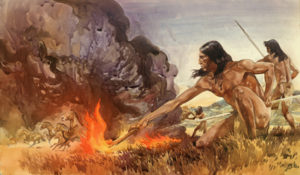
    After many years of labor an inventor discovered the art of making fire. He took his tools to the snow-clad northern regions and initiated a tribe into the art—and the advantages—of making fire. The people became so absorbed in this novelty that it did not occur to them to thank the inventor who one day quietly slipped away. Being one of those rare human beings endowed with greatness, he had no desire to be remembered or revered; all he sought was the satisfaction of knowing that someone had benefited from his discovery.

    The next tribe he went to was just as eager to learn as the first. But the local priests, jealous of the stranger’s hold on the people, had him assassinated. To allay any suspicion of the crime, they had a portrait of the Great Inventor enthroned upon the main altar of the temple; and a liturgy designed so that his name would be revered and his memory kept alive. The greatest care was taken that not a single rubric of the liturgy was altered or omitted. The tools for making (ire were enshrined within a casket and were said to bring healing to all who laid their hands on them with faith.

    The High Priest himself undertook the task of compiling a Life of the Inventor. This became the Holy book in which his loving kindness was offered as an example for all to emulate, his glorious deeds were eulogized, his superhuman nature made an article of faith. The priests saw to it that the Book was handed down to future generations, while they authoritatively interpreted the meaning of his words and the significance of his holy life and death. And they ruthlessly punished with death or excommunication anyone who deviated from their doctrine. Caught up as they were in these religious tasks, the people completely forgot the art of making fire.

    Postscript – if you are offended, perhaps you value the book more than the invention!

    It has happened with many religion in the world that we started value of the book than what was the actual useful method. This approach has resulted in a lot of conflict and is resulting in the conflicts.

    Imaginations was the topic for the week for LBC (Loose Bloggers Consortium). You can read other LBC authors opinions here – Maria, Rummuser and Shackman.

    Image source – http://listovative.com/top-11-inventions-changed-world-forever/

    Story source – The prayer of the Frog

  • Shanti Mantra


    I have always been very critical to Hinduism. When I was young, I used to feel – Ramayana and Mahabharata are well written novels. However, slowly my perception is changing. When I try to relate historical places (such as Panchavati, Nashik or Ujjain) and incidents around those places, you may call those incidents as stories, I think perhaps there is some veracity to these. The other thing I got to know about Sri Lanka tourism is places they show about the time of Ramayana Check Sri Lanka launches new product – Ramayana Trail – http://www.srilanka.travel/travel_news?news=267

    Those all points apart, I have always been critical of Hinduism. However, recently, I was listening to some hymns in Sanskrit. The hymn sounds so different and interesting. I could only understand a part of it when I heard it for the first time. Naturally the hymn is in Sanskrit so it was not straightforward for me to understand. The part which I could make out was – “Vanaspateya shanti”. The hymn speaks about peace of biological life or plant beings. It had stanza for peace for everything.

    I started searching for this hymn.

    I would relate this hymn to another Sanskrit shloka –
    ॐ सर्वे भवन्तु सुखिनः सर्वे सन्तु निरामयाः ।
    सर्वे भद्राणि पश्यन्तु मा कश्चिद्दुःखभाग्भवेत् ।
    Om Sarve Bhavantu Sukhinah Sarve Santu Nir-Aamayaah |
    Sarve Bhadraanni Pashyantu Maa Kashcid-Duhkha-Bhaag-Bhavet |

    In the above shloka and Shanti mantra, the scholars are praying for peace for every living being. When we see the kind of violence around us – terrorism or wars – this kind of philosophy fascinates me. The religion evolved in India have the concept of inner search, peace and renunciation. This is something whole world needs to learn from Indian religion.

  • As you sow, so shall you reap


    In Science we have studied – every action has equal and opposite reaction. We never take that seriously for life, that if we hurt someone that may be compensated. Here is an interesting idiom in English language (many other languages as well) – As you sow, so shall you reap.

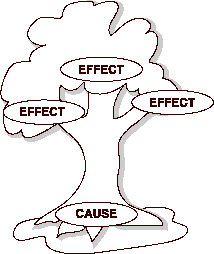
    Long before science could establish this fact as “the fact”, The Buddha and Hinduism had given the concept of Karma. Well, I cannot vouch for rebirth so here is what I have written earlier –cause_fx

    Heaven and Hell are ‘here and now’
    The way you pass each moment
    You define whether you are in Heaven or a Hell. Blog here

    Don’t rely on next birth, do good in this life time itself.

    Heaven and Hell are ‘here and now’
    The way you pass each moment
    You define whether you are in Heaven or a Hell. – See more at: http://business2buddha.com/2011/07/21/this-is-how-i-remember-it/#sthash.Aykwean2.dpuf
    Heaven and Hell are ‘here and now’
    The way you pass each moment
    You define whether you are in Heaven or a Hell. – See more at: http://business2buddha.com/2011/07/21/this-is-how-i-remember-it/#sthash.Aykwean2.dpuf

    This blog post is less inspired by the concept of Karma and the English idiom but is inspired by a SitCom I have watched long back – “How I met your mother“. This is/was a series just like previous famous sit-com “Friends”. In How I met your mother (HIMYM) there are five characters – Ted (lead character, who is telling this story to his kids), Barney, Marshal, Marshal’s girl friend (later wife) Lily and Robin (confusing to describe her – she is friend – with each one. She is girl friend of Barney and Ted in some series. She is wife of Barney once and in the end she marries Ted). In one particular episode season 2 Episode 15 – Lucky Penny, the concept of cause and effect is described with ease.

    Ted finds a penny and in the 22 minute episode, everyone is involved with the penny and the associated event result in Ted missing a flight to Chicago. In Hindi there is a saying – बात निकलेगी तो दूर तलक जाएगी it means – “If we start this discussion, it will go long back in the history”. Just to give you a perspective we may conclude on this question – “Why did Adam eat the Apple?” You know what I am saying?

    You must watch that 22 min episode of How I Met Your Mother to know in brief how causation might work?

    The Author does not claim any rights on the Youtube link and video. This link is attached here for reference and does not make the author liable for any copyrights violations. It is advised to the reader that if you want to watch the series please purchase it from any retailer where the media drives are available such as FlipKart Link.

    Image source – Cause and Effect – http://fcit.usf.edu/florida/lessons/railrd/cause_fx.gif

  • Morality, who is the judge?


    There is an after life, actions in past life have decided your current birth (Prarabdha) and future life will be a function of what you do in this life time. Does this philosophy remind you of something?

    The above is concept of re-birth, of almost all religion founded in India – be it Buddhism, Jainism or Sikhism no doubt Hinduism too. So, there are many questions around this. Personally, I believe in concept of rebirth but I have not understood the concept fully. What defines morality and who defines it, who and how my actions will be judged for next life? All these questions puzzled me, for few months.

    Just to give you a perspective here are few examples. 1. Say I eat non-veg (I don’t). But I don’t kill, I buy “Godrej” packed chicken. I never killed the chicken, who would take the blame of this killing? The poor fellow who killed that chicken; did it for his survival. Who would judge this situation. 2. A company does experiments on animals comes up with a cancer drug, animals are killed but many human lives are saved (prolonged to be more precise). Who to blame – the patient who fell sick of the disease of cancer (due to his misdeeds), the company (researchers, investors) or whole humanity? 3. Now replace cancer with AIDS. 4. Extra-merital affair, who to blame, if it is consensual who would decide the “punishment” for next life? etc

    I have been wondering about this, who decides what wrong I/someone did for decision on next life etc. At times, I say to myself “forget it! we get fruits of our deeds in this life time only, don’t worry about next life.” Than what happens to the belief of rebirth? Well, these questions are currently beyond me, while puzzled, I came across this video of Sadhguru so hope this question of morality dies here! Which actually has not died yet. May be I’d write on this in future too.


  • Cast(e)ing doubt – What’s your (last) name?


    In a lift one person, an old 70-75 year or so, looks at the other, smiles and thinks – New guy in the building! Looks educated ‘I can talk to him’. He asks – What is your name?

    Other person responds – Pravin

    Old man – Pravin what?

    2nd person – Pravin is my name.

    2nd person looks at the old man with a question mark on face, what does that mean?

    Old man – I mean your last name?

    2nd – I call myself KRD Pravin and my friends call me KRD (at times KRD P).

    Old man stares with a complete blank (!) and question on face?

    2nd person continues – Does not it sound like JRD (Tata)? One step ahead, that is in alphabet “K” comes just after “J” right? Smile!

    Old man – what does KRD mean?

    2nd person – KRD stands for my last name and father’s name.

    2nd person smiles and the old man insists on an answer.

    Old man – Ok! But what is your last name?

    2nd person (possibly getting the hint of apparent insistence now) – so you wanted to know my last name and not the name, is that right?

    Old man completely taken aback by such question, because he was only interested in the last name. What goes on in the mind of old man is – ok lad looks educated, but does not have manners, arrogant!

    Perhaps the old man is thinking – “I have a suitable girl for him in my mind?” Wait without knowing if 2nd person is married or not, how can one think like that? Anyways jokes apart.

    This is the reality, of few discussions (elevator talks). People are more interested in what someone’s ancestors did than what this young lad is doing? This is the problem of our caste system.

    I writing a series (on and off) of blogs on – against – the caste system of India (include black skin for other parts of the world). This is another installment in the series.

    One of my school friends (this is not a fiction he was indeed like this) used to make friends based on last name, he at times used to ask “what are you people? (that is you belong to what/which caste?)” If the other person does not fall in “his choice of category” he wont make friends with them. His selected types were – Hindus (in religion), Vaishya, Brahman and Kshatriyas (in caste). In the language of Indian quota system – he wont make friends with SC, ST or OBCs. I was surprised but well I made a note of this!

    I think we all were forest dwellers, once farmers. A blacksmith and mason is nothing but present day engineer. The more we developed the more we regressed actually! Even before the baby is born – he/she is black/white/sub-continent dweller. The day a baby is born we tag him/her as Christian/Hindu/Sikh/Muslim etc. Next tag is more clarification – You are a Shwetambar Jain, Or Saryuparayan Bramhan etc.

    What is this – why we do differentiate on caste? In India there are temples where even Hindus (shudra/Dalits/Untouchables) can not go. All over India this is widespread.

    Dalits give ‘donation’ to enter temple 2013 – The Hindu

    Dalits told to keep distance from temple 2013 – Times of India

    Dalits enter TN temple first time in 100 yrs – Times of India

    Below two news are almost same difference is the year. News from The Hindu newspaper site (by far the most respected and authentic newspaper in India)

    Dalits enter temple amid tight police security 2013

    Dalits enter temples with police protection 2009

    Tera Bhagvan (khuda) mere bhagvan (khuda) se alag hai!
    तेरा भगवान (खुदा) मेरे भगवान  (खुदा) से अलग है!

    Thy God is different than mine!

    When the creator is different there certainly is comparison – whose God is better?

    Meri Kamiz teri kamiz se safed hai

    मेरी कमीज़ तेरी कमीज़ से सफ़ेद है

    My shirt is brighter (better) than your shirt

    As if God is a trifling shirt or trouser! Who (which) can be better or worse.

    Related blogs –

    Cast(e)ing doubt –  everyone’s tears are salty

    We the societies

    When Buddha dies schools are born

  • Yoga – Secular or not?


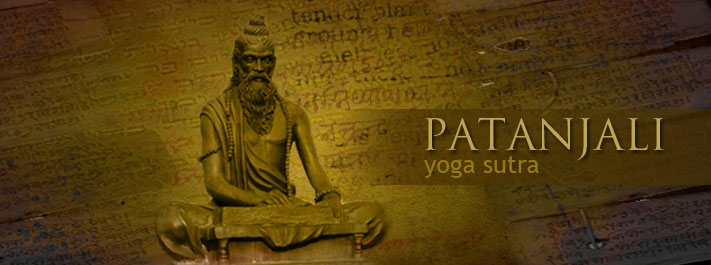
    Patanjali Yoga Sutras
    Source – Art of Living website

    It takes a lot of time for courts to offer a judgement, there are argument and counter-arguments. Logic and intuition fails if you do not have proof. That’s why Indian courts take 20 years even for high profile cases (e.g. Mumbai bomb blast), small cases are either solved out of court or not at all during the life time of an accused / plaintiff. Galileo died and hundreds of years later (in 1992) Churches exonerated him of the heresy – of saying Earth if not flat. People do not think logically and thus recently I have been bothered by fanatics on Twitter (follow me on Twitter @krdpravin). So, I feel petty on some things. Well, today I want to write about whether Yoga is secular or not?

    Disclaimer – I am discussing Yoga as Patanjali Yoga Sutra I am not an “authority on Yoga”.

    There was a case filed in California- “Yoga can not be taught in schools as Yoga is not secular”. Effectively the contention was Yoga is actually Hindu religion. California Judge rejected this claim.  Yet there is little more discussion needed on this.

    Think – is breathing secular or not? In yoga Patanjali has talked about Pranayams – breathing exercise. Is remembering (concentrating, meditating on) any God or whether Jesus or other prophet related to only “Hinduism”? Yoga talks about meditating on deity too. Is speaking truth not secular? I can list few more food for thoughts, however let me instead brief on Patanjali Yoga Sutra. Patanjali was a sage, he existed before Christ and had written Yoga Sutras. The sutras have eight limbs –

    1. Yama – 5 abstinence – non-violence, truth, non-covetousness, abstinence and non-possessiveness.

    In today’s world we need all these virtues, very importantly non-covetousness, non-possessiveness. Financial crisis is result of covetousness

    2. Niyama – 5 observances – cleanliness, contentment, austerity, reading scriptures, surrender to god.

    Here one may argue – reading scripture is religious. Did Patanjali say do not read Bible? Even in Surrender to God it is not mentioned that the God has to be only HINDU God!

    3. Asana – Discipline of the body and body posture.

    Largely – people all over the world (include many Indians and Hindus) think Yoga means Asana. Asana is just 12.5% (e.g. 1 part of 8 fold path of Patanjali) of what Patanjali said about yoga. Also, can you say that whatever games played in Olympics are religion? In this context – Hinduism? No! right?

    4. Pranayam – Control of breath

    Common we call breath and this would be idiotic to call breathing non-secular.

    5. Pratyahar – withdrawal of senses from their external objects.

    Well, many of us would not understand this. This is not talked in many religions – this helps in being non-covetous, non-possessive and being content. This is where I think Yoga is far more evolved and different than any Western religion. Though Yoga is not a religion.

    6. Dharana – concentration of the Chitta upon a physical object (say a photograph of Jesus, a frivolous example – Computer mouse).  Take an example of Rosary (a bead) and remembering any mantra / God. Use of bead is common in Islam too. Who says Dharana is about only one religion? It can be followed by any person whether following a religion or not.

    7. Dhyan – Meditation. It is largely professed by Indian religions e.g. Jainism, Hinduism and Buddhism. So, meditation is also not specific to only Hinduism. Additionally if someone prays with complete devotion that can become meditation.

    8 Samadhi – oneness with the object of meditation.

    Yoga is a very evolved science, of course developed and practiced more than 2000 years ago. But yes Yoga is science, there is no religious seal on it. My Indian and Hindu friends may argue against me saying – it is Hindu practice with various arguments. Foreigners may argue on same lines and state Yoga is religion.

    Well, I am of the opinion – religion is very personal matter and not a group matter. So, if I follow yoga practice (which I do not) I may say Yoga is my religion. But otherwise yoga is a way of life beyond and above all the so call religions of the world – which effectively are cause of troubles, war (include terrorism), fundamentalism and superiority complexes. And yes, Yoga is above the courts and laws too.

    Most importantly – Now do you follow what religious fundamentalism is? I am putting Yoga above everything which is what happens when fanaticism creeps in making a suicide bombers. I did the same in above para (by stating Yoga is above all).

    Yet please remember – 1st step of Yoga has first abstinence – non-violence. This includes not having superiority complex also.

    Image source – http://www.artofliving.org/patanjali-yogasutra

    One of the Authority on Yoga is – Sri Sri Ravishankar (Guruji)

  • Border-less world


    Let us imagine, a border-less world. A world where

    Source - http://praditaastarina.files.wordpress.com/2011/08/170580815_bbdabc8038.jpg
    Border-less world

    1. people can move from one place to the other without Visas
    2. goods and services can be bought and sold without import/export duties
    3. education is free (at least basic education)
    4. people would be free to do what they want to do (not taking law in their hand though)

    I believe both the leading economic “-isms” and many spiritual/religious “-isms” have been trying to do that for years.

    The economic “-ism” are capitalism and socialism. Socialists want this by making a world a single big society where everyone is working for the society. Capitalists are trying to do it through Washington Consensus and IMF. Until now the results have been failure. Russia failed, China becoming a capitalist USA (being protectionist) walking on the way to become more socialistic. Seems There could be a middle path where both these -isms are together.

    Religious groups “-ism” are Christianity, Islam, Buddhism, Hinduism etc. Christianity wants the world to be Christan, Islam talks about Universal brotherhood. I am not sure about the other two asking people to convert to their religion though. However, Hinduism talks about Vasidhev Kutumbakam. Vasidhev Kutumbakam means one world family. But the idea all over the world is unity and unifying the world in different ways.

    All this is failing because – the ulterior motives are money or fan following (I mean increasing number of followers of the religion).  Since both they ways seem not working, what if we turn to something else, no politician, no economist and no religious group to lead. People leading the people’s movement!

    Take the following case – Social media for social service, crowd sourcing based funding (crowd funding) and initiatives such as Janlokpal (India), Occupy Wall Street (USA), Jasmin revolution (Tunisia) and Tahrir square (Egypt) etc. If people are empowered yet are asked not to encroach on others freedom. What if we really become an educated world, without politics, without divisions, without borders.

    This may happen if we remove ego and greed from our society!

    Image Source – http://praditaastarina.files.wordpress.com/2011/08/170580815_bbdabc8038.jpg (Apologies for delayed update, it was updated in the image description but not visible on view)

  • Wealth and Wisdom


    Wealth is the abundance of valuable resources or material possessions. Wealth in itself is of no value, someone owning it gives “it” some “value”.  Similarly Wisdom (Hinduism) is considered a state of mind and soul where a person achieves salvation. Again here salvation is achieved by “someone”. So salvation may not be anything in itself, right? Once you achieve it there is no “self”, that is another side of it though.

    The definition of wealth (or for being wealthy) in my opinion is – when you have no more desire to earn more possession – when you have complete disinterest for money – you are wealthy. Because there is no end to earning. There may be a possibility that you are the wealthiest person on earth in the list of Forbes. You may not be interested to say “enough is enough!” I don’t need more money.

    http://media-cache-ec3.pinterest.com/originals/af/fa/97/affa97f31778a0e75cb506d1e38f0f95.jpg

    According to me one is wealthy – if one decides doing things because he/she enjoys doing the work and therefore does his/her work just for the hack of it. Say if I go to office with a motive of Salary at the end of the month, I am not wealthy. But if I do the same work because I enjoy doing it, feel self-satisfied and content. so the salary is not the desire but the fulfillment I achieve makes me wealthy. The later becomes reality with wisdom.

    What if wealth and wisdom meet? The age old approach of the west (wealth) meets the even older approach for life of the east (wisdom). I do not think the world would remain the same, this world would become wealthy and wise. Largely we would stop running for growth, to bailout countries and to make more money. This would be the world where the Business would meet the Buddha and people would do their work as their duty rather than compulsion.

    Definition source – Wikipedia

    Image source – Pinterest

  • Book review


    Few years back I read books written by Dr Brian Weiss. Dr Weiss is a psychotherapist, had published papers in journals and was teaching in a University. During late 70s and early 80s his life changed complete, when he was treating one of her clients. The first book of Dr Weiss I read was based on this patients treatment, title of the book is – Many lives many masters. It is a good book, about Past lifes and past life regression methods. After reading the third book – Only love is real, I wrote the following review on . In total I read four books of Dr Weiss
    1. Many Lives Many Masters,
    2. Same Soul Many Bodies,
    3. Only Loves Is Real and
    4. Messages From The Masters exactly in the same order.

    I am of the opinion that everyone should read at least Many lives many masters and Only love is real. One point, when you read the books please do not think of your ideology or what you have been taught since childhood, just read the book. The review is below.

    You believe in past life or not… you can learn from this book, sometimes you can read it as a novel. But believe me you will not only love reading it but will understand the depth of the phenomenon called “LIFE”.

    I am more of a spiritual but not religious, still after reading the book I felt the depth of the teachings of the Buddha and Hindu-ism. Please do not go to the dogmatic belief of any religion when you are reading this review.

    It would be good if you read Same soul many bodies (its almost the Buddha teachings in chapters), when I read that I felt that Buddhas teachings are retold. I would say read “Only love is real” and do not ask me more, but I would say read it and understand the meaning deep meanings.. we are not just this life we are all eternal be happy… be loving.

    On the contrary is Ashtavakra Geeta. So do not get confused, do read at least Many lives many masters and Only love is real. When I read those books the books were expensive, I think they are relatively economical now through online.