It happened about 30 years ago. We were in our early teens, returning from NCC camp. One of my close friends and fellow cadets Ashish Awasthi asked me – “Pravin, whats your take on solving bigger problems of India such as cleanliness?” It is ironic, we were at Indore bus stand it was dirty. By the way Indore is the cleanest city now in India!
I was one of those ultra-aggressive and kind of Subhash Chandra Bose kind of person. Subhash Chandra Bose wanted authoritarian rule (source Institute of Historical Review) in India for 20 years to ensure national unity and reforms. I bluntly replied – It requires hard handedness, strictness and big penalties plus severe punishment. Once done, everyone will fall in line.
Ashish asked the same question at the same time to my cousin, Hitesh. We all had been studying in same school, same locality and city. Hitesh’s response was complete opposite. He responded – “If everyone starts taking responsibilities, respecting the set guidelines and does his job as per the ask, that would solve not only the problem of cleanliness but also make discipline and orderliness easy.”
Hitesh’s response was itched in Ashish’s conscience. Ashish, Hitesh and I met in 2023 incidentally again in Indore – a city that has been winning award of cleanest city in India! In our conversations, this incident popped up. Ashish reminded this discussion to both of us. Unfortunately, both Hitesh and I had forgotten it. It happened 30 years ago and just a conversation at bus stop woke waiting for our return trip bus. A completely insignificant situation.
We were teens, the maturity of Hitesh’s response was so deep for Ashish that he always remembered it. While narrating this incident he added, that response was so profound for me that I kept thinking about it, and the depth helped me realize what if everyone does his or her job as per the expectations, no one would need to monitor or push for results. The outcomes will follow!
This applies to our work life as well. The need for goals, metrics are for youngsters who are new in the company. Senior people must define what outcome is expected and what additional new things are expected from the company’s growth.
I was speaking with one HR professional recently, he was discussing about performance and outcomes of some of the people. My response to him was – at what experience level you would feel someone saying “It is not my KRA” as an acceptable response? The question was about ownership and growth of individuals and professionals.
My cousin – Hitesh – knew ownership at an of 14, some do not have it even at 40!
Recently, I had an intriguing conversation with my friend Vikas on our society’s basketball court. Vikas is an excellent practitioner of Yoga, and he does his practices often around the court. Though we had never discussed spirituality or meditation before but this time we discussed not only work, books but also the Indian spiritual masters. After exchanging New Year pleasantries, we found ourselves talking about the impact of AI on our lives and businesses.
It was a casual conversation, as our past discussions never really ventured into the realms of spirituality. But as we spoke, I brought up an interesting prediction from the 1920s. Renowned economist John Maynard Keynes had forecasted that in the future, we would work only four days a week, thanks to advancements in technology. I mentioned that with AI progressing rapidly, this could very well become a reality (though it has been close to 100 years from the prediction). One of our common concerns, however, was about the future of jobs – would there be enough work to keep everyone occupied and economy running?
AI is already transforming every aspect of life, the endless possibilities of Biz Apps to generating artwork to creating videos. Initially, I believed that impact on creative work would be the last by AI, but my perspective changed when I watched a cat cook a meal in a video. While the video was amusing, it also made me rethink the boundaries of AI’s creativity.
One thing became clear to me—the future may hold something unique: people will increasingly seek out real human experiences. Activities that involve human participation or performances,, like dance, will hold more value than any AI-generated fantasy. People will want to see and connect with others, and the demand for authentic human expression will rise.
If we revisit Keynes’ prediction of “less work,” I am confident that it will happen. The real question is: what will people do with their newfound spare time? Will they continue to watch endless cat videos, or will they pursue things they genuinely enjoy? Over time, I believe the latter will take precedence. People will look for activities that engage them—activities that require human involvement, passion, and creativity.
This conversation with Vikas stayed with me, and the same weekend, the thought resurfaced. That Saturday, my daughter Adviti – who is learning Bharatnatyam few months – had a dance performance. The event concluded with a deeply insightful speech from her teacher. The teacher explained –
In Bharatnatyam, the performer has to be completely in the present moment. Body (through gestures and movements), mind (focusing on rhythm and mudras), and facial expressions (conveying emotions) all require perfect coordination of body, mind, and soul. Without this harmony, the performance falls flat. This concept resonated deeply with me, extending far beyond Bharatnatyam. It mirrored my understanding of meditation.
As an audience, we were moved by the kids’ performances, but we were absolutely entranced by the senior performers. The speech, combined with the mesmerizing performances, made me realize something profound: perhaps the true joy of a dance like Bharatnatyam lies not in watching it, but in performing it. It’s an activity that requires full human engagement – body, mind, and soul – something AI simply cannot replicate.
Reflecting on both my conversation with Vikas and the insights I gained from the dance performance, I saw a clear connection. The future will indeed offer fewer “work hours,” as Keynes predicted. But more importantly, people will likely grow tired of passive consumption – whether it’s endless reels or AI-generated content – and turn to more fulfilling, creative pursuits. Activities that involve deep personal expression, like cooking, dancing, or art, will become more valuable. In fact, it’s possible that many people will turn inward, exploring spirituality. It’s not just about watching a cat cook dinner, but about immersing yourself in the joy of cooking your own meal. Similarly, it’s not just about admiring a dance – it’s about becoming part of the rhythm, the movement, and the expression yourself.
In the end, AI may change how we work and live, but it will never replace the deep human need to create, to express, and to connect. The future, as I see it, will not be defined by what AI does for us, but by what we choose to do for ourselves.
A few weeks ago, a scooter accident shattered more than just my collarbone. It cracked my illusion of control. I’m always been a confident, “in-charge” kind of person, a planner – “get-things-done” kind of guy, proactive with reflexes sharper than most.
Just after the spill, the first blow was to my self-image. With reflexes honed from years of being a decent athlete (trophies gathering dust are proof, at least!).
The Fall:
Let me rewind. I was just in our society’s entrance ramp on my electric two-wheeler, the one with those big, supposedly stable 14-inch wheels – unlike most 10- or 12-inch options on Indian roads. I was barely going at a speed of 20 kilometers per hour (12.5 miles per hour).
Bangalore’s water woes were on display again, a spill from a water tanker creating a slick patch right on the entry ramp to our society. It all happened in a blink. The scooter skidded, and before I knew it, I was on the ground, the impact jarring my right shoulder.
Driving for almost 25 years, this was a first. It was funny and it was sad, quarter of a century, driven bike from Mumbai to Indore – a distance of 600 km – with just one stop. At least 60,000 km of riding two-wheeler experience on my back (this excludes experience of driving four-wheeler), it was funny that I fell at such a slow speed. It was sad that it happened even after full control, no highway, neither a vehicle ahead of me nor behind me.
The pain in my ankle was immediate, but it was the throbbing in my shoulder that told a different story – a fractured collarbone. As I lay there, a question gnawed at me: Was this a sign of age catching up? After all, until recently, my reflexes had been my saving grace. I could even pick up and steady my daughter while teaching her to skate or cycle (you might have seen those dads saving their kids videos! I have done almost all that kind of stuff).
The throbbing in my ankle seemed worse at first, but the X-ray revealed a fractured collarbone needing surgery and a metal plate – not exactly ideal for a guy who loves picking up his daughter and teaching her to skate.
Beyond Reflexes: The Illusion of Control
This initial worry about reflexes soon morphed into a bigger realization – the illusion of control. I kept replaying the accident in my head. How could I have fallen when everything seemed under control? The big wheels, the slow speed…it just didn’t make sense. Especially considering I’d been driving accident-free for almost 25 years!
Digging deeper, a chilling thought struck me: Are we ever truly in control of our lives? Looking back, I thanked my lucky stars that there weren’t any other vehicles around. The worst case could be, a water tanker running over me! Had that happened, you probably had read my obituary and not this blog.
Just imagine I had the whole Sunday planned. At 9 am, I was on my way home, 10 am this, 11:30 am that, lunch by 2 pm. In reality, at 10 am, I was in a hospital bed, unable to even lie down properly because of the backache (which, by the way, lasted two whole days!). I cannot imagine, the pain last very long even though I was on pain killers. The worst thing, I still cannot believe at such a controlled riding and slow speed, there could be such pain and problems. Life, it seems, has its own plans.
This whole incident shattered my illusion of control, my tendency to plan smaller things in life, and of course, the nagging question of age. But in its place, it brought a well-known yet hardly practiced appreciation for the unexpected and the importance of living in the moment.
These last couple of weeks were a reality check – a reminder that sometimes, life throws a curveball when we’re busy planning the perfect pitch.
I and my daughter were discussing. What should I have done to avoid the accident and what happened after accident? What I did or what happened and how? The conversation with my daughter, Adviti, sparked a deeper understanding of preventive versus corrective actions. On personal front, I am recovering now.
A Father-Daughter Conversation on Wellness
Advit and I discussed her eating ice cream so she said I like ice cream. I want to eat ice cream. I said Ok, you can eat ice cream, but after eating an ice cream, generally what happens to you? She said I get cough and cool.
We continued, I asked a question “how do we avoid cough and cold”? Adviti responded by avoiding ice cream.
The next thing I told her was “see, when you decide that I won’t eat ice cream even though I like it because I get cough and cold. That is called a preventive action. We want to prevent cough and cold therefore we avoid ice cream and other such things, ok.”
I added – “preventive action is when we void a bad outcome. What if you get cough and cold? We go to doctor, correct? That is a corrective action.
Corrective action is when we say, you ate ice cream. You fell sick and then you went to doctor who gives you medicine or injection. You take cough syrup, nebulization and other medicines, right? So that is a corrective action to become fit again.
This simple exchange led to a valuable lesson for her: avoiding ice cream (preventive action) helps her stay healthy, while medication (corrective action) becomes necessary when she does get sick.
This is wellness or health.
Swasthya: A Holistic Approach to Well-being
This conversation made me revisit the concept of wellness, particularly the unique Indian perspective called “Swasthya.” I have written earlier about wellness or Swasthya earlier.
asically, Swasthya is Swa (Su) + Stha – it loosely means comfortable situated but the best translation should be dwelling in yourself. Unlike the limited connotation of “health” in the West, Swasthya translates loosely to “dwelling in oneself,” encompassing physical, mental, and emotional well-being, along with a sense of contentment.
The English word Health or wellness is very shallow in its connotation. I could not teach Adviti – just a 6-year-old – about mental and emotional health at this point in time. So, I stopped at physical health.
The Importance of Mental Health
In the meantime, I have been speaking with three different friends of mine. One is a management consultant, other runs a business on mental health and the third is both a management consultant as well as a wellness plus mindfulness coach. The discussion highlighted a crucial point: the often-overlooked role of mental health in ESG (Environmental, Social, and Governance) initiatives.
Stress: The Gateway to Health Issues
As per Mayo clinic, executives face problems of less sleep, more work hours, and work-life balance etc. Most of the problems start with stress. Stress is mental health issue, that we overlook. Mental health issues translate into physical health issues.
So, when I spoke with these friends of mine, the conclusion came out to –
Even the UN has one of the top three goals as well-being in ESG
We mostly underestimate mental health issues
Mental health issues translate into physical issues
Preventive Care is Key
Our discussions led to key takeaways:
Prioritize Well-being: The UN prioritizes well-being within its ESG goals, highlighting its importance.
Don’t Underestimate Mental Health: Mental health issues can have a significant impact on our overall well-being.
Prevention is Better than Cure: Taking preventive actions to manage stress and prioritize mental well-being can prevent future physical problems.
This helped me circle back to my discussion with Adviti – my daughter. Preventive actions are better, one must take care of self. One should know and act fast for corrective actions. Especially, mental health issues should be tackled on priority before they translate into bigger challenges.
Taking Charge of Your Health
Remember, you are in control of your well-being. By taking preventive actions and addressing mental health concerns early on, you can avoid future challenges and live a healthier, happier life.
Let’s Talk Wellness!
I will be more than happy to discuss these. Feel free to reach out.
Remember the days of limited educational choices? Back then, the state board was the only option, a true “choiceless choice.” This “choiceless choice” reminded me of a concept in Indian spirituality – but that’s a conversation for another time!
Fast forward to today, not only there are so many boards but also they are USPs of each. Recently, in one session in my daughter’s school where they were introducing parents to different boards, the presenter emphasized the importance of asking questions as a core value. This sparked a thought: isn’t this very principle a cornerstone of both business success and spiritual exploration?
Inquisitiveness, they argued, was a core value of their educational philosophy. It got me thinking – I actually did the same thing with my daughter, Adviti, from a young age. I instilled in her the habit of asking “why” whenever something wasn’t clear. Though she is too young still and was even younger at that time to understand the meaning of asking questions.
Questioning Your Assumptions (Even in Business)
I have written on questioning your assumptions earlier as well. Here is an interesting story – I’ve been into management consulting. In such service business we do have tailored solutions yet the solutions have similar framework. We’re presenting to a potential client, during the discussions prospects and we were asking insightful questions to each other simultaneously learning about needs and challenges. By actively listening, engaging and asking for clarification, we tailor our solution as per their needs and secure a happy client.
The learning is – Asking questions demonstrates genuine interest, builds trust, and leads to better outcomes.
The Art of the Question (and When Not to Take Offense)
However, there are times when asking questions can be misconstrued. Imagine being added to a group by a senior colleague, only to discover a highly charged political atmosphere. When someone questions a post and you provide factual references to support it, you might expect a discussion, right? Wrong. Suddenly, you’re removed without explanation. This frustrating experience begs the question: When does a simple “why” or “what are the rules” become offensive?
It happened with me twice. A very senior person of my institute added me in his group of institute alumni. I did not know the rules of the group and later on came to know he is highly politically motivated. One fine day someone posted something and the admin questioned the varsity of the post. To bolster the original post, I shared news article links. Admin removed the person who had posted the message.
I replied, why have you removed him, I gave you references of sources, what the person wrote is correct. He did not respond. I asked – “what are the rules of the group?” What constitute a valid datapoint? “I was removed”.
This person is very senior retired officer of a PSU. I wondered if government offices in India worked like that few decades back. There were no set of rules and still you have to follow some rules? This is an inference from this individual’s stupidity, I may be wrong about the functioning of Govt offices in the past though.
So, when I asked some other alumni, I was told “Lunatic hai”, “even after retirement PSU mindset not gone”. I said, I want to know the rules of the group. I never got a response from him nor others in the group. I wish he gets a ticket to contest an election from his favourite pollical party, he would have a reality check ????
Is Curiosity a Lost Art?
Perhaps it’s a self-esteem issue. Could a fear of being challenged lead someone to shut down curiosity? It certainly makes you wonder what happens to those who can’t tolerate a healthy exchange of ideas. (This is a great discussion point in the comments! What are your thoughts?)
The Power of Curiosity in Spirituality
Now, let’s explore the spiritual angle. Indian spirituality often emphasizes the importance of inquiry. I have written on it earlier as well – there is no other religion of country where so many people have asked so many authorities. I am pretty sure if Indians will see God in human form, they will not spare him/her and ask umpteen questions to him/her. Take an example of Arjuna asking Krishna!
The Buddha travelled from one monastery to the other and had many teachers in his quest to Nirvana. He too had many questions, some answered by each of the teachers and some he learnt himself. Isn’t the entire concept of seeking enlightenment fueled by a deep-seated curiosity about the nature of reality and our place within it? Just like in business and education, asking questions paves the way for deeper understanding.
So, Let’s All Be Curious!
Here’s the takeaway: There are no bad questions! Asking questions demonstrates your engagement, your eagerness to learn, and your openness to new information. It helps you grasp information better, challenge assumptions, and ultimately, find better solutions. So next time you have a question, don’t hold back! Your curiosity might just unlock a world of possibilities, both personally and professionally. After all, life is short. Let’s embrace open discussions and learn from each other, just like my daughter is learning at her school!
Image source – Photo by willsantt: https://www.pexels.com/photo/child-holding-clear-glass-jar-with-yellow-light-2026960/
How often you delete a random post on social media because someone asked you to do it? I did it twice, once when my sister told me and once when Ramanna uncle ji told me.
Ramanna uncleji was my adopted uncle. This is a tribute to him. He passed away in April. I blog occasionally these days, so I am late. After moving to Bangalore, I tried calling him a couple of times, but I couldn’t connect. I wish I had met him before moving here.
In fact, when we had just moved in Bangalore, we were going to meet someone. I didn’t know the routes, so my wife was guiding and reading some signboards. She read at one place, “Ramana Maharshi Road,” and later, “Dr. Rajgopal Road.” She said, “Wow, we’re reading Ramana uncleji’s full name!” I called and sent a WhatsApp message to uncleji about it, but I didn’t get any response. Needless to say, my wife had met him and fondly remembers him too.
I read a blog-posts on his website and learned that he was no more. I finally gathered the courage to write this tribute.
He was more than an elderly person to me. He was a friend with whom I could talk about anything and everything. As I have written in my past post (Gratitude) – we could speak on anything under the sun from sex to super-consciousness.
We connected in 2011 when I stumbled upon his blogs. After reading a couple of blogs, I wrote to him. We connected via emails and phone calls, and finally we met at his residence in Pune. I was unaware that he was an MBA from IIM A. When he saw my surprised face, he said that he was lucky to be there. Successful people are humble.
He always surprised me by saying that “It just happened” with whatever he had achieved. I mean, how can one just get something, what about efforts and hard work?
This question brings me to our very first phone call discussion. When I called him, I asked – In your “about” section you have written “I stopped doing”. It reminds me of Ashtavakra Geeta. What do you mean by that? Obviously, we started off discussing spirituality. This point came up multiple times in our conversation. He was an accomplished professional too. When I asked him about all those successful professional years (he was retired when I met him), he brushed it aside by again saying – “It just happened, I was lucky!”
I am sure the luck part came after a lot of hard work.
In our conversations, he would recite a Sanskrit shloka and translate it, too. It could be from the Bhagavad Gita or any Veda. After that, he would explain the takeaway from the shloka to our present discussion. I used to look at him completely awestruck. Now, when I am writing about it, I am feeling lucky to have known him and met with him when I went to Pune.
When I met him in 2011, I was looking for marriage alliances too, all arranged marriages. He used to laugh at me. His was an inter-caste love marriage (about 50+ years ago), and it used to be another point of our discussion with him. He had a great sense of humor. I know it sounds very different from the previous paragraph, where I told you about his discussing spirituality. But remember, God loves fun. It is the title of a book by Sri Sri Ravishankar (Guruji). I understood the meaning of the book when I met uncleji. He had influenced me a great deal during those years.
My closeness with uncleji was such that when I used to have a little serious discussion with my prospective alliance, I used to share the profile with him and call him for his perspective. He used to give impartial perspective. I will continue this in next-to-next para.
In case you are not from India, here is a side story: In India, arranged marriages are where family or relatives arrange for alliances, and the discussion for marriage proceeds from there. Parents, families, and prospective bride and groom meet, and so on. With the digital age, this social norm in India has been digitized. People look for alliances on matrimonial sites such as Shaadi.com and Jeevansaathi.com. I had created a profile on these portals and used to get alliances or reach out to prospective alliances. Sounds funny, but yes, this is how it is. Also, if you are unaware about inter-caste marriage, ping me separately.
For my marriage alliance, I connected with about 24 families / girls. Many rejected me, I rejected some of them. Some over the phone calls no meeting so do not go by the number I kept it in my records as I have always been fascinated with numbers :D. It went on for about 2+ years! Whenever, I had a meaningful initial discussion I used to share the profile with Ramana uncleji (besides parents and my other mentors).
My friends and colleagues knew me as “no nonsense guy” “always thoughtful”, however a couple of girls told me that I have “good sense of humor” and I am “interesting”! I was shocked when I heard this for the first time. But probably when I used to speak with Uncleji I picked a few things.
The last thing, he said he is planning to write a novel. I never get to know what happened to it later on. I kept on probing him (check the comment) but he just did not budge.
I am sure he is resting in peace, having fun wherever he is. Needless to say, I miss him.
Do you enjoy driving in the city? Our urban landscapes are often congested with unruly traffic. Personally, I prefer cruising on highways. My wife jokingly says that whenever I’m behind the wheel, it seems like I want everyone to stay home so I can have the roads all to myself. She’s travelled with her colleagues too who vented their frustrations at fellow drivers while stuck in traffic. But let’s set these stories aside. I am writing after a long time, and I have something very special to share.
After navigating the labyrinth of city streets, there’s something truly refreshing about hitting the open highway. Here, you can pick up the pace, leave your road frustrations behind, and relish the journey by listening to your favorite songs or engaging in meaningful conversations with your fellow passengers. The experience becomes even more delightful when you’re cruising from Mumbai to Pune, where the highway unfolds like a welcome mat. I believe there are more such fantastic highways across India, thanks to the initiatives of Mr. Gadkari, who took charge of the transportation department of the Government of India. I’ve driven on routes like Mumbai to Pune, Nashik, and Indore multiple times, and each time has been an absolute delight. And so, I found myself back on the highway once more.
It was a Friday afternoon, and I never anticipated embarking on a journey on a workday, bidding farewell to Mumbai. As I started my car and slowly pulled away from the building, I intentionally drove at a leisurely pace, savoring one last look at the open roads and the beautiful buildings of Hiranandani Powai. I knew I’d miss this place. Another thought crept in – my daughter would miss it even more, as this was the only residential area she’d known in her five years of life. Nostalgia enveloped me, as I left behind 16 years’ worth of memories.
As I turned right onto JVLR (Jogeshwari Vikhroli Link Road), reality hit me. I didn’t own a flat in Mumbai, not even a small one. Why was I attached to Mumbai to this extent? The answer was evident. The city had been a profound teacher, imparting lessons in the value of time (remember the rush to catch that train?), respecting people’s privacy (or lack thereof on crowded trains “mind your own business”), and the resilience of Mumbai in the face of adversity. Of course, that last one is more a testament to individual survival instincts rather than the “Spirit” of Mumbai. In fact, I could write a practical lesson for each of these experiences. If you are from Mumbai, please do not mind the last statement, we all know the political humbug (tokenism for our helplessness) of calling “Spirit of Mumbai”.
As I paused at a traffic signal, I fired up my music playlist and began playing a devotional track. Yet, my gaze kept wandering outside, reminiscing about the places where my wife and I would go on our scooter to buy vegetables, or where I used to drop her off at Kanjur Marg station when she had to commute to South Mumbai.
With my music playing, including the melodious Nirvana Shatakam, and with a 1000-kilometer drive ahead of me, my plan was straightforward: leave Mumbai, spend the night at my cousin sister’s place, find a hotel for an overnight stay the next day, and arrive in Bangalore before evening on the day after that. There was no need to rush, I had good 48 hours with me to drive leisurely.
There was a time when I used to compete with other drivers on the road, trying to outpace the car ahead or the one that had just overtaken me. It was an adrenaline rush, and I even ended up with a speeding fine. After a few long drives to different cities, wisdom prevailed. I realized that my modest car couldn’t compete with those powerful 2000cc+ engines. Slowly, I adapted to the ebb and flow of highway traffic. This time, I was driving from Mumbai for what was supposed to be the last time, and I found myself on the scenic Pune highway.
As the music played on, transitioning from devotional songs in Sanskrit to Marathi, an interesting song came up – “Hum Jo Chalne Lage” from the movie “Jab We Met“. This time, I was driving alone. Most of the time, we tend to travel with company, but on this occasion, there was no one to talk to for the entire day. So, I sang along, listened, and thought deeply while driving.
This time, I was driving alone, whereas most of our trips were family affairs. There was no one to converse with throughout the day. So, I did more than just sing along and listen to music; I also engaged in some introspection. The road stretched ahead, and someone in a Skoda whizzed past me. Their vehicle had at least double the engine capacity of my car. I smiled and briefly entertained the idea of a friendly race. But then I had another thought: what was the hurry? I wasn’t in a rush; I’d be reaching Bangalore the day after tomorrow. I decided to enjoy the journey and not compete needlessly.
On the second day, the nostalgia of leaving Mumbai had subsided. The songs played on, and I found myself once again listening to “Hum Jo Chalne Lage.” I overtook some cars, and others overtook me. This time, I kept my focus on the road, the odometer, the speedometer, and the tachometer. Thoughts of racing and competing with others crossed my mind, but just as I contemplated overtaking a car, it took an exit. That moment struck me – I was on a journey to Bangalore, and there would be many detours and exits along the way. Why compete? Why should I rush to outpace others when I didn’t even know where they were going? Was life a race?
This internal competition I was engaging in reminded me of the broader aspects of life – personal and professional. This reflection on the impulsive race I was trying to win reminded me of how we often approach our personal lives and careers. The irony was that I didn’t even know the destination of the drivers I was competing with. It was a realization that everyone’s journey is unique, whether on the road or in personal and professional life. Even if someone is on a bus, after reaching the last stop, they still have to find their own way home, just as you do after completing your school or college, or you change jobs and workplace.
As I continued on the long journey, passing through villages, towns, and city bypasses, I encountered people who tried to cross the highway in unconventional ways, seemingly oblivious to the high-speed vehicles approaching them. It could be a heart-pounding experience, unable to brake quickly with another vehicle tailing closely behind. That’s when it dawned on me – the thrill of speed is one thing, but maintaining control is equally important. It reminded me of The Middle Path, as taught by the Buddha. In this context, the middle path meant enjoying the drive but at a speed that allowed me to stay in control.
Encounters with stray animals and people darting across the highway added another layer to my introspection. In life, you will encounter individuals who might disrupt your equilibrium. The key is to maintain control over your own vehicle – both your mind and body – and manage the situation or your journey. At best, you can honk your horn to alert others, but beyond that, you have no control over what’s happening in someone else’s life or their state of mind. It’s wiser to maintain control over your own vehicle.
It has been about 10 months since we left Mumbai. The city bestowed upon me valuable lessons and wonderful experiences. But sometimes, one has to move on. Of course, we miss Mumbai, and it’s only natural to weigh the pros and cons.
In the end, what truly matters is how safely, responsibly, and comfortably you navigate your journey. This perspective extends to life as well. My drive from Mumbai to Bangalore was not just a physical journey; it was a journey of self-discovery. Along the way, I learned several valuable lessons:
Everyone’s journey is unique (be it bus or the person overtaking you)
You have to control your life yourself (saving your car and self from accidents)
Advertently or inadvertently people may enrage you, your response has to be your mind body coordination (people honking on you, stray dog coming in front of your car etc)
Take care of yourself and the people in your life (people crossing the road without caring for the high-speed vehicle on highway)
Life is fun, enjoy the ride (listen to the song, sing with it and drive)
One has to move on in life, past is past with sweet or bitter experiences (leaving Mumbai)
Did you learn something interesting from a mundane day’s work? Do share.
Alexa play “bum bum bole”. This is a Hindi film song. The song teaches opening you mind, thinking, experiencing, and dreaming specially beyond your belief or knowledge. The song made me think in different dimension, questioning few things and conclude – experience beyond your belief.
Source Youtube, original – from Movie Taare Zameen Par
Alexa started playing bum bum bole song, Adviti was happy. Slowly she learned the lyrics of the song, for her the lyrics are not that very meaningful, yet she learnt singing few lines. She keeps on mumbling them while listening to the song.
She started saying “bhala machhaliya bhi kyu udati nahi? Socho, socho na.”
The above line is in Hindi, it means “think why the fish cannot fly, just think”. Somehow it came to my mind that fish can fly if we start calling a bird a fish ?
I asked Adviti, how about it? She didn’t understand. I reiterated Adviti let me explain
a bird can fly
if I start calling a bird. a fish
so the fish will start flying isn’t it?
A creative answer to a question that asks you to think.
I’m answering your question Adviti, you are calling a fish a fish so you are asking the question why can not a fish fly? If you start calling a bird a fish it will start flying 😀
I think she will need some time to figure out this logic.
Well this is on a lighter side however in reality our perceptions actually create our realities and whatever we think is based on our beliefs.
The formless
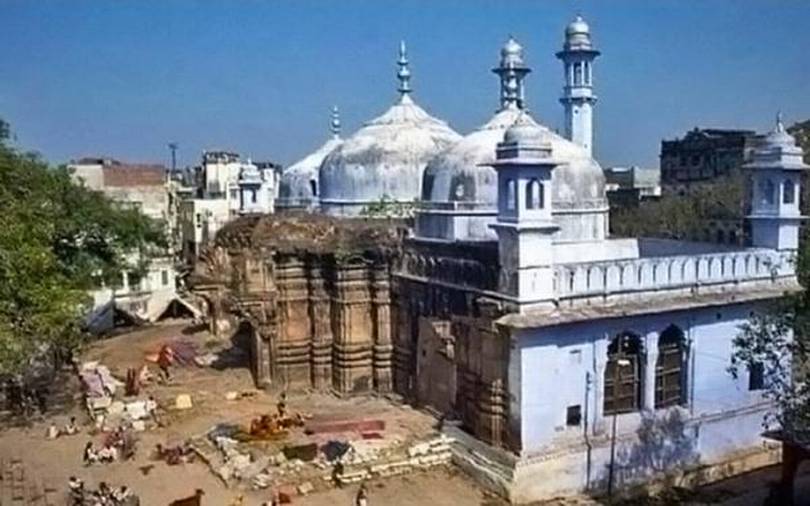
Recently a big public, judicial and political debate started in India. The row is of a Shivling in a mosque. Before we proceed further – Shivling is a representation of formless. It is a symbol of energy.
Gyanvapi Mosque Banaras Source Sunday Guardian
One group – Hindus – is saying that it is Shivling and the other group – Muslims – is saying it is a fountain. Let the competent authorities respond or prove to what exactly it is. The point I want to make is – this is how our belief systems are, we see what we want to see there may be some different reality out there.
If you dig deeper, Muslims theology states that the God is formless. Hindu’s Worship the formless in the form of Shivling. If you try to connect these dots conceptually the idea is same – formless. Method of praying or bowing to the same concepts of “formless” are different. This underling concept is still not clear to masses. Why create a fight for one upmanship? There are many more dimensions to the debate. I do not want to digress.
Belief system
Our beliefs blind us. In Ashtavakra Geeta, Ashtavakra says – you are seeing the rope as the snake because your mind is saying that it is a snake. this belief is making you feel the rope as a snake. Until you open your eyes and mind, you will feel the rope is the snake.
Our religions are also the same, some people believe in something, other people believe in something else. What is correct or what is true can only be proved when we become more objective, think, open-up and willing to experiment.
This is the reason I like Indic religions – specially Buddhism and Hinduism to a great extent. After reading few philosophical texts of Hinduism I see Buddhism as a subset of Hinduism.
Experience beyond your belief
Hinduism has given philosophy of Yoga, Meditation, Bhakti (devotion), Karma, Gyan etc. There are many ways to experiment and experience. The best part is no one asks you to follow a certain path or approach. You follow or practice what you feel comfortable with. In one family you may find members of the family following different paths Bhakti (Devotion), Yoga, and Meditation in some cases questioning everything and not following any. This chaos is perfectly fine in the family.
Experience beyond your belief
Out of all these methods, the key is – “experience”. Some paths gave recipe of experiments too.
Patanjali discusses Yoga Sutra, Shiv Sutra discusses 100+ meditation methods, Narad Bhakti Sutra discusses Bhakti (Devotion), Ashtavakra Geeta tells open your eyes see it, Krishna summarizes everything in Bhagvad Geeta. There are Upnishads, the list is very long to complete, contemplate, try everything and experience. Pick your options.
If I were to say something, here is my approach pick one in the beginning. I will recommend read Bhagvad Geeta. It gives you a wonderful summary of different paths. Try one or the other path for experience. Whatever suits you from within, go deeper in that path with additional text!
Interestingly, what the end results is? It is experience. All these paths proposed by the Indian theology are science. They do not want you to believe what is written. In fact, all the titles written above most have question between a speaker and listener. Do not just blindly believe what is written, ask what you have in mind.
Open your mind
What every human-being needs to do is – keep aside the belief system and move towards the experience system.
The takeaway is – open you mind, put aside your battle of belief, and fasten your seatbelts for the journey of experience.
We’d just returned from our B-school. We were living in a small apartment. One of our roommates said, “there is an AdMad competition tomorrow, I have registered our team”. AdMad was a competition for creating an advertisement for a random brand such as Superman’s underwear or Bereavement services. This night I learnt 4 unforgettable lesssons for life.
When it comes to ad creation, I am not that creative. I could at best play a second Fidel. After some discussion, somehow we – as a team – were ready for the competition.
Organizers had very unique conditions. This is generally the case when you are competing in B-school competitions.
The topics or brands were given late evening. We had to submit our entries by 5 AM the next day. Teams could not make corrections after submission etc. It was one hell of a challenge, not because of the terms and conditions – we were used to it by now. It was a tough task because such creative expression was new for us all engineers :). Additionally, the topics were beyond imagination.
Where to start?
When we got our brand, we started brainstorming. I was completely clueless about where to start. Then it stuck to us, let’s go to our lessons of “Integrated Marketing Communication” course notes. Mr. Sohan Shah taught us the course, he had taught us this course with a practical approach.
Learning – Desperately search for options, explore all the possibilities, and ask for help if needed.
In teams put ego aside
We got a good approach to start our entry. However, life is not that easy. After some initial brainstorming, we were working on my laptop for the final entry. My laptop had a battery issue. So, after some work, I requested two of my teammates to join me in the room. I and one other teammate were working in my room.
This small incident turned into an ego issue. One friend said “why can’t you come here?”
I explained the problem. Call it our naivety or any of the other multiple reasons – the pressure of participation and our other studies, fear of failure, the anxiety of doing something for the first time, and of course ego. We argued on where to work?
Forget about anything we did not have any creative concept on the board to have “creative differences” :).
We debated on sitting in one room or the other to start work. We stopped the project and tasks completely on a random non-issue. It was midnight. We were nowhere close to completing our submission.
After a while, I gave up and said I didn’t give my name as a team member, I won’t go. Whoever registered the team it’s his responsibility. The other two held their ground. The most composed of our team members was trying to build the bridge. All in vain. We were all in our beds, kind of giving up on the competition.
Some time passed, I came out and said if my name is on the list I will stand there on the podium even if I don’t have anything. I won’t run away. So, finally, two out of the four started working again.
Learning – Keep aside ego when it comes to a group task. Find solutions instead of issues.
Go back to the basics
We started off from where we had left. Where are the notes? Lets check what we learnt in “Integrated Marketing Communication” course. We started working on the basics.
Chapter 1, market research. What does customer research say about our brand? These are the finding.
Chapter 2 Segmentation, Targeting. Find who is the best fit segment or segments. How to address their needs
Chapter 3 Positioning. Let’s write a positioning statement. We followed the instructions to the tee as if someone is teaching us to write sentences. The statement was making sense.
Chapter 4 Ad insight. What is the insight and how do we want to communicate as per the insight.
Chapter 5 Execution – the storyboard.
The two team members had given some creatives for the entry. The rest of the creatives we search including the iStock images. It was looking really shabby. But finally, something was shaping up as a coherent story.
We concluded the entry by the wee hours. Reviewed our entry and sent it to the organizing committee and our other two teammates. They were still upset, nevertheless.
Learning – Go back to the basics and build up from there.
Do not be afraid, give it your 100%
Finally, after completing our regular classroom schedule, we were in the hall. The competition started. I and my friend were in the hall looking for our other team members. They had decided not to join.
One after the other teams presented their Ad or concepts. With each entry, I and my friend were literally sinking in our chairs. There were awesome videos, wonderful jingles, music, roleplays everything except a PowerPoint. We had a deck! On top of it, it was a bland deck.
Our entry was after 70% of the teams. We’re scared to even stand on the dais. But as I had said, I won’t back out. I will stand even without an entry if my name is there.
Our names came. Both of us went on the stage. The first thing was – only two out of a team of four were present. I started off “After this ad we’ve so many orders that the other two are working on backend supply chain and distribution channels :)” We could not discuss the issue we had on dias, isn’t it?
I started off the presentation again Chapter by Chapter of Mr. Shah’s class “Integrated Marketing Communication”. It was too convincing I think. Initially, people tried hooting us, but slowly the seriousness seeped in, and everyone was listening. We concluded the deck. Since there was silence, we felt it was damn boring and people dosed off within 2 mins. It was completely against the other interesting concepts, from fun to seriousness.
Once the last team had presented, it was jury time. We knew the result, we were the most frustrating, boring, and bland Ad. I and my teammate were sitting and listening to the results. First, and second prize was obvious. Ideally, it was the end of the competition. However, Professor Tomas Lopez (Sir I miss you) continued.
This is Professor Lopez virtually beating me with his shoe
He said – It was a great competition. All of you put in a lot of effort and brought some wonderful concepts. There were funny ads, emotional ads, good role plays, use of AV, technology, music everything. However, there was one ad that could bring customers to the counter, sales for the business. I know the execution or presentation could have been better, but given time and opportunity, it could be done. This special second runner-up is for “our team”.
We were astonished. But we were happy. It was a great surprise and the words of appreciation were more than the prize. It was our first such attempt – we all were engineers :).
Learning – Do not be afraid, give it your 100%. When in doubt go back to the basics and give it your 100%
Lessons
The lessons from this incident go beyond B-school. The learning is for personal, professional, social, and spiritual all walks of life. The lessons are
Search for options, explore all the possibilities, and ask for help if needed
Ego should not come in our way when it comes to a group task.
Go back to the basics and build up from there.
Do not be afraid, give it your 100%. When in doubt back to the basics and give it your 100%
Bonus – one must follow the plan and path carefully until that becomes second nature. They as it takes 10,000 hours to master something.
Additional bonus – Find solutions instead of issues.
We had challenges as a team. Our creative expressions were limited. We had unnecessary issues that we could avoid. For example – I could save work on my laptop. Put it to sleep go to the other room and start discussions. It was an easy solution that I didn’t apply.
We did a few things correctly. Going back to the basics and giving our 100%. Whenever in doubt go back to the basics. I have heard that when a boxer loses and his confidence is low, he goes back to smaller level competitions besides practice.
Since we were doing such creative work for the first time, the lesson is – one must follow the plan and path carefully until that becomes second nature. It is said that it takes about 10,000 hours to master a skill isn’t it?
I can go on giving examples of the lessons from personal, professional, social or spiritual life however that is for some other day.
Until then you can do your introspection on how these lessons could help you in your past incidents? It is likely that you did not apply and now you think I wish I had done that. It is likely that you did apply and now you think it made a positive difference. Do share your thoughts.
Recently, my father had a severe stomach ache. Doctors prescribed pain killers. It helped to a certain extent, however, two days later again he had the same issue. Some diagnoses gave no conclusive reasoning to the issue. The further diagnosis helped us figure out – the causes, possible approaches to avoid it in the future – what to eat, what to avoid, and what should be the lifestyle – besides the medicines.
Behavioral issue
How often do we make similar kinds of errors in treatment? If you get angry often, you are asked to undergo an anger management course. Attending an anger management course is like administering a painkiller. It would help – but how long? Do you think it is going to help? How often does it help the person?
It is often found that the cause of anger is impatience, inability to handle pressure, unwillingness to accept the situations, etc. On a lighter note – it can be a sense of entitlement too that causes anger – as they say often in Delhi “Janta hai mera baap kon hai?” “Do you know who my father is?”. This question sometimes provides a sense of entitlement to commit a mistake and get scot-free. Well, that is for some other day.
The solution to these problems is not attending Anger Management courses. The deeper analysis and reflection is the better and long-term solution. As in the case of my father’s severe ache, the solution to your behavior also lies in a bit deeper diagnosis, identification of the right causes, and lifestyle.
The behavior here goes beyond the act of getting angry or losing a temper. The behavior encompasses multiple possible ways one reacts to situations or people. I am a strong believer that spiritual awakening is a big solution to mental health. I mean spiritual awakening as in – Indian spiritual methods. The methods were taught by the many spiritual masters of India including the Buddha.
When I say meditation and spirituality are some of the solutions to many behavior issues, it may sound like this is a magic bullet. In a way it is. Especially, when you are concerned about you yourself – spirituality and meditation are the potent solutions. When I say that I mean Indian mysticism.
How and why spirituality and meditation for the behavioral issues?
Have you seen two sets of people standing in a queue – one worried, restless, and one overjoyed and happy? You can observe it in – a cinema ticket queue or a sports event ticket purchase. You could have observed it (in old days) Indian Railway’s reservation counters too. Have you ever asked yourself this question, why do two people in the same situation may have different mindsets or behavior?
The reason for different people behaving in the same railway reservation counter is different. One may be going home after a long journey and the other leaving the loved one behind. Same place, the same action of booking a ticket but different feelings. The reason is different people behave differently.
In fact, the first thing one learns in Marketing – respond to different customer or customer segments differently! This applies to our daily lives too. So, each person standing in the queue of reservations may have a different mindset and each mindset may require handling situations differently. Isn’t it correct?
Spirituality and meditation
Now when we have established that the different mindsets require different solutions, how can a set of religious practices or methods solve the same problem? This is where religion fails many of us. Religion deals with the masses and is like a herd mentality. Spirituality is for self and soul. So, mostly religion may not solve your problems but spirituality can.
You can solve your behavioral problem with your working “on yourself”. Meditation is the technique that works on “your” self. The problem of anger – for example – is an individual’s problem therefore the solution of that also lies at the individual’s level. It requires a diagnosis. The one that gives some conclusive reasoning to the issue. Spirituality gives that one. As was the case with my father’s stomach issue, a deeper analysis was required for the solution.
Our behavioral issues also require deeper analysis. And that my friend can be done with spiritual practice such as meditation. Give it a try. I can vouch for the Art of Living Foundation as I have done their courses – check a few online courses here.