Tag: sai kaka

  • Uncertainties and acceptance

    It has been more than a week, we wake up to the no-water in the overhead tank of our wing of our residential complex. Initially, it was annoying. Daily, I or my wife went downstairs to tell the security to switch on the water pump. We raised the issue to the society manager, secretary, etc. I think it takes about 3 days to form a habit, soon we accepted this challenge as part of our life. The new ritual now is – wake up, open the tap – hoping system is fixed, go downstairs tell security to switch on the pump, come back and proceed as per the available resources. After a week, now security calls me daily to ask “do you have water in your taps now?”

    Uncertainties and acceptance

    Uncertainties make us jittery and annoyed. It depends on the situations, in some cases uncertainties make us anxious too. There was news that Deepika Padukone wanted to face the Narcotics Control Board (NCB) with her Husband because of anxiety; it is just an example. This initial annoyance made way for the acceptance of the situation. Once, we accepted the situation, we started planning our next day before we went off to sleep. The morning started with the acceptance of the unavailability of water and our workflow was changed to accommodate the situation. Once we had figured it out, life was easy, the disappointment of delay in fixing the problem was there but the annoyance and frustration ended. This happens many times in our business too.

    A conversation

    We had figured it out for our daily life. I and my wife were talking about it in the morning, the same evening I received a call from my ex-colleagues – Deepak Taunk. By chance, we happened to speak about the certainties of the outcome. The discussion started with analytics, human intelligence, AI, and business processes. It was an interesting discussion on how our brain connects the dots from analytics and business processes to our daily lives. He is a creative person who questions assumptions. So, when we spoke about some business processes he shared his displeasure with the templatization of work. When I say templatization, I mean making work process-driven and asking others to follow the guidelines. It is not that he is not process-driven – he is a very successful project manager. His point was the templatization results in blindly “follow the guidelines”. People are discouraged to ask questions.

    It is a very valid objection. His point of view was – educated people must be allowed to understand “the why”, freedom to figure it out, otherwise what is the need of highly educated people when they have to always follow the SOP (Standard Operating Procedure). I personally have seen this issue that even intelligent people follow things blindly or are asked to follow blindly. In case some ask questions they are termed as “unfit” or non-cooperative. This becomes the responsibility of the team leader or the leadership, in general, to figure out the best course of action. There is no right or wrong in being templatized for few things and creative for others. We need both the ways to run a business well – follow the process and question the assumptions.

    World of possibilities

    In business, personal life as well as in spiritual path too both the approaches are required. I had been an inquisitive person, including on my small journey of spirituality. I asked a lot of questions to many of my guides – Dr SaxenaRamana uncle ji, my father, Sai KakaDada ji, and Dr Agashe, my art of living teacher. Dr Agashe told me – “…for a few things you need to trust the predecessors/process for others ask questions, do not stop any of these. Indian spirituality offers you both the ways…” Interesting isn’t it?

    Following the process brings certainty of outcome whereas questioning assumptions bring opportunities. Uncertainty many times brings opportunities. One has to be aware of the uncertainties, accept the situation, and find out options. When we look at situations, accept the situation(instead of fighting it), look for options, and be creative we have a whole world of possibilities.
  • Perceptions

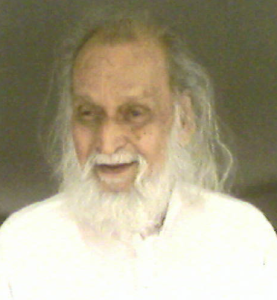
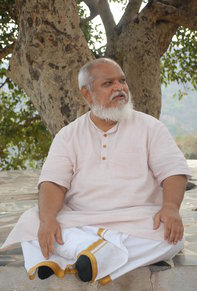
    Perceptions are our realities – however, how real are these perceptions? The reality persists until we get to understand the other side too. Long back, I met Sai Kaka and he told me very interesting lines explaining how we are stuck and how the “beyond” is experienced. If you look at many opinions and “-isms” you would realize that almost all are bound and jailed in the opinions of their own. What Sai Kaka told me was this –

    Sai Kaka

    Sanskar yukt chaitanya jab (संस्कार युक्त चैतन्य जब)

    • chintan karata hai to usko chitt kahate hai (1. चिंतन करता है तो उसको चित्त कहते है)
    • manan karata hai to usko man kahate hai (2. मनन करता है तो उसको मन कहते है)
    • nirnay karata hai to usko buddhi kahate hai (3. निर्णय करता है तो उसको बुद्धि कहते है)
    • asmita ka bhan karata hai to usko aham kahate hai (4. अस्मिता का भान करता है तो उसको अहं कहते है)
    • inme se sansakar nikal jaye to jo bachata hai vo shuddha chaitanya hai (इनमे से संस्कार निकल जाए तो जो बचता है वो शुद्ध चैतन्य है)

    This in English means –

    When a conscious filled with rituals (or say the lessons learnt about ‘way of living’)

    • thinks we call it mind (imagination)
    • contemplate we call it Mind [there is a difference between Chitt and man which I am not able to translate in English]
    • makes a decision we call it intellect
    • perceives pride we call it Ego

    Now when the rituals or ‘way of life’ learnt, get out of this conscious mind, what is left is the pure consciousness.

    I recalled these lines from Sai Kaka when I read the story of Prayer’s of the frog on Perception.

    Story from Prayers of the frog

    A monk was walking in the monastery grounds one day when he heard a bird sing. He listened, spellbound. It seemed to him that never before had he heard, but really heard, the song of a bird.

    When the singing stopped he returned to the monastery and discovered, to his dismay, that he was a stranger to his fellow monks, and they to him. It was only gradually that they and he discovered that he was returning after centuries. Because his listening was total, the time had stopped and he had slipped into eternity.

    Prayer is made perfect

    when the timeless is discovered.

    The timeless is discovered

    through clarity of perception.

    Perception is made clear

    when it is disengaged

    from preconceptions

    and from all consideration

    of personal loss or gain.

    ‘Then the miraculous

    is seen and the heart is filled with wonder.

    http://business2buddha.com/2014/03/10/amazing-isnt-it/
    I have written on Amazement/wonder read here

    Ashtavakra Geeta talks about Wonder, Janaka responds to Ashtavakra with astonishment. This veil takes time to cast-off. Our perceptions create our reality and we are stuck with that reality with our preconceived notions. When this perception, way of life, Sanskar is removed what is left is consciousness – pure bliss ( इनमे से संस्कार निकल जाए तो जो बचता है वो शुद्ध चैतन्य है).

    I have thoughts on the conflict of perception, in my mind that I shall try to put next week.

  • How to fix your mindset?

    My colleagues Akshay Chalke and Gaurav Thosani are full pictionaries of movies. While our group has some discussion, they relate to some or the other sequence of a movie, say, the dialog and start laughing amongst themselves. At times, we’re clueless what transpired, other times few other friends also start laughing when present context and movie sequence is clear. Initially, I used to look at Akshay and Gaurav with confusion, what the heck? What’s the meaning, what’s so special in that? At times, when they used to inform about the movie sequence (mostly I’d not watched) I used to feel what’s funny in that? In some chats, when I’d watched the movie, I went back about quarter of a century (I’m very old!). These small incidents helped me learn how can you fix your mindset?

    My story

    It was 1997, I’d just started traveling, that too alone – a distance of 500km (overnight bus journey) for my engineering. Being the youngest in family, naturally, I had lived in lot of protection and guidance. On top of that I was emotional & quick to get nostalgic. Those days, about 25 years back, video coach buses were cheaper and used to provide entertainment by playing a movie till mid night.

    It’s a nuisance if you don’t like the movie and a headache if you want to sleep for next day’s college. On top of all this, my mindset and disappointment with my present situations, made me uncomfortable and disappointed by the world in general. Though, the movies used to be light comedy like- Ishq or Govinda- movies of 90s. Some movies used to be slapstick comedy – no sense, just laughter rides. But, my mental condition, disappointments and nostalgia made me hate these movies. I never liked some hit comedy movies of that time, such as Ishq, Dulhe Raja, Auntie No. 1, Bade Miyan chhote miyan etc. In fact some songs made it to the list for example song of movie Ishq Nind churayi Meri kisne o Sanam; although I always liked singer Udit Narayan over others of that time.

    You can read other blog on “Situation.” how this single word sentence changed my approach to life.

    Read more about teachings of my professors about satisfaction.

    Read another one on how our sanskara‘s create our reality and possible Karma

    Lessons

    I started giving some thoughts on the incidents when Akshay, Gaurav and colleagues laughed on that movies sequences etc. I realized, if one’s mind is disturbed anything around doesn’t feel good. In fact the association with situations and mindset can be as long as decades. The next thought was now when I know it is mind’s problem, how to fix your mindset?

    I’ve watched few of those movies in last few years. Now I wonder those were not as bad, in fact, few were hit of that period. Slowly I realized, these are small moments of fun and lightening the mood. At the end of the day, one must be happy that’s the bare minimum one can have in life.

    How to fix your mindset?

    The point is, how can one be beyond one’s mental state and situations and still be happy / balanced in tough times?

    1. one way is to be in the present moment (tough hum?)
    2. learn to differentiate between the situation you are facing currently with the general state of your mind that’s created by other situations in life. You must have heard of keep your work and personal life separate (Easier said than done right?)
    3. fake happiness (balance or equanimity) as in the movie Three idiots “All iz well”
    4. look at learning opportunity in this tough time. Focus on lesson than the pain (easier)
    5. meditate daily (the best)

    Fixing your mindset become easy if you start any of the above steps. In my opinion is a better method of fixing mindset. Otherwise we become headless chicken driven by the situations around us. Still, if you’re unable to make your mind, reach out to me, we can speak on this lesson. Lastly read this simple telephonic discussion that could give you an idea or this may give some drift.

  • Guru poornima


    I have had privilege of meeting at least three enlightened masters in my life (until now), mentors and coaches. Some of the mentors may be enlightened masters and I am not aware about those. However, rest three I am sure – Sai Kaka, Dada ji and Guruji. It is difficult to have very close day-to-day meeting with the enlightened masters. The mentors have a special place they guide, encourage, handhold, and challenge, I have been fortunate that I have a long list of mentors.

    I received a wonderful story on whatsapp “Importance of Guru” or mentor or coach in life.  Without much ado here is this wonderful story on Guru Poornima.

    ——————

    Once upon a time, a cow went out to graze in the jungle. Suddenly, she noticed a lion racing towards her. She turned and fled, fearing that at any moment the lion would sink his claws into her. The cow desperately looked for someplace to escape and at last, saw a shallow pond. Barely evading the lion’s reach, she jumped into the pond, and in the heat of the chase, the lion blindly leaped after her.

    Sai KakaTo the surprise of them both, the pond was extremely shallow yet filled with deep recesses of mud. After toppling over each other, the cow and the lion found themselves a short distance apart, stuck in the mud up to their necks. Both had their heads above water but were unable to free themselves no matter how much they writhDada Gavanded.

    The lion repeatedly snarled at the cow and roared, “I am going to enjoy the sound of crunching your bones between my teeth!”

    He thrashed about in fury but soon became fretful as he found no prospect of escape.

    The cow thoughtfully laughed as the lion struggled to free himself and asked him, “Do you have a master?”

    The lion disdainfully replied, “I am the king of the jungle. Why do you ask me if I have a master? I myself am the master!”

    The cow said, “You may be the king of the jungle, but here all your power has failed to save your life.”

    “And what about you?” Retorted the lion. “You are going to die here in this mud too!”’

    The cow smiled mildly and said, “No, I am not.”

    “If even I, the king of the jungle cannot free myself from this mud”, snapped the lion, “Then how can you, an ordinary cow?”

    The cow gently replied, “I cannot free myself from this mud, but my master can. When the sun sets and he finds me absent at home, he will come looking for me. Once he finds me, he will raise me up and escort me home sweet home.”

    The lion fell silent and coldly glared at the cow.

    Soon enough, the sunset and the cow’s master arrived. He immediately recognized the plight she was in and lifted her to safety. As they walked home, the cow and the master both felt renewed gratitude for one another and pitied the lion they both would have been happy to save if only the lion had allowed them.

    The cow represents a surrendered heart, the lion represents an egoistic mind, and the master represents the Guru. The mud represents the world, and the chase represents the struggle for existence therein.

    —————————————–

    Its good to be independent and not rely on anyone. But don’t take it to an extreme, you always need a partner/coach/mentor who will be always on the lookout for you.

    Having them does not mean you are weak, it’s just that you can be stronger with their help.

  • Hidden potential


    I had inflammation of gums recently and was not able to eat properly. Instead of looking for solution first, I started looking for causes why I had this swelling? Root cause of the same of my eating roasted corn. So, next time onwards I will be careful when eating roasted corn. Currently, I am having backache, all due to wrong postures while working in office seating in office.

    We do not even notice small integral parts of our body such as gums or back until we have a trouble with them. These parts exist and function as per their role in the physiology of our body, yet we are in oblivion of them, until those have some issue – for us those are almost nonexistent until they let us know they exist and have some limits, in my case it was backache and gum’s swelling. I had kept on noticing gums every time I put something in my mouth, back is reminding me of it’s existence until now.

    What is hidden? Hidden – to us human beings – is something that we cannot perceive. The gums and back was something hidden until I had troubles there, it existed physically, I knew it existed but I did not notice it.

    Perceptions are another limitation, our perceptions are limited to our five senses. If something exist beyond these senses we may not know of it’s existence such as noise beyond a certain range.

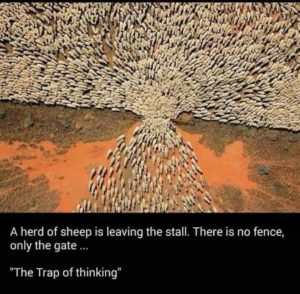
    We cannot see air, it does not mean it does not exist, we know air is there because our sense of touch can feel it – breeze or cold. A seed has a possibility of become a tree, that is it’s hidden potential. We cannot see it manifested and thus we do not believe in it; that is our problem. Our perceptions are actually created by our previous learning. In the image here, there is no gate or fence, it is all in the minds of sheep.

    I have written on it earlier on perceptions and specially here what I learnt from Sai kaka, about our past impressions –
    Sanskar yukt chaitanya jab (संस्कार युक्त चैतन्य जब)
    1. chintan karata hai to usko chitt kahate hai (1. चिंतन करता है तो उसको चित्त कहते है)
    2. manan karata hai to usko man kahate hai (2. मनन करता है तो उसको मन कहते है)
    3. nirnay karata hai to usko buddhi kahate hai (3. निर्णय करता है तो उसको बुद्धि कहते है)
    4. asmita ka bhan karata hai to usko aham kahate hai (4. अस्मिता का भान करता है तो उसको अहं कहते है)
    inme se sansakar nikal jaye to jo bachata hai vo shuddha chaitanya hai (इनमे से संस्कार निकल जाए तो जो बचता है वो शुद्ध चैतन्य है)

    A rough English translation of the same is –

    When a conscious filled with rituals (or say the lessons learnt about ‘way of living’, include religion)

    1. thinks we call it mind (imagination)
    2. contemplate we call it Mind [there is a difference between Chitt and man which I am not able to translate in English]
    3. makes a decision we call it intellect
    4. perceives pride we call it Ego

    Now when the rituals, religion or ‘way of life’ learnt, get out of this conscious mind, what is left is the pure consciousness.

    It means “pure consciousness” is blurred by our different (Sanskara) learning about life. Therefore in some cases religion becomes a problem.

    This is the problem of our perceptions such as we think East is far different from the West. Can we try experimenting – a kid born in Say US should be reared in India and vice versa. Would these kids grow up to behave in similar manner such as US born kid raised in India, would behave like any kid born and raised in US and vice versa? When we talk about East Vs West our perception are based on the “sanskar”, at times those are the hidden potentials.

    Hidden potential was an old LBC topic, I wrote on it today. Loose Bloggers Consortium is where MariaRummuserAshokShackman and I write. You can visit their blogs and read their thoughts on the topic.

    Image source – unknown currently.

  • Sai kaka


    I met Sai Kaka about 4 1/2 years back. He is from Sangli, a city in Maharashtra.  I read a book on him (in Hindi) Pooja Ka diya and quickly had an opportunity to meet him. I was  impressed with his straightforward and practical approach. Take an example Sai Kaka says “Religion is an individual choice, in groups it is not a religion but a community and where there is community there can be communalism!” What we see in India or world over, maximum wars are fought over in the name of religion, right? More about Sai Kaka is on his website. The most important lesson he taught to me was this –

    Sai KakaSanskar yukt chaitanya jab (संस्कार युक्त चैतन्य जब)

    1. chintan karata hai to usko chitt kahate hai (1. चिंतन करता है तो उसको चित्त कहते है)

    2. manan karata hai to usko man kahate hai (2. मनन करता है तो उसको मन कहते है)

    3. nirnay karata hai to usko buddhi kahate hai (3. निर्णय करता है तो उसको बुद्धि कहते है)

    4. asmita ka bhan karata hai to usko aham kahate hai (4. अस्मिता का भान करता है तो उसको अहं कहते है)

    inme se sansakar nikal jaye to jo bachata hai vo shuddha chaitanya hai (इनमे से संस्कार निकल जाए तो जो बचता है वो शुद्ध चैतन्य है)

    This in English means –

    When a conscious filled with rituals (or say the lessons learnt about ‘way of living’)

    1. thinks we call it mind (imagination)
    2. contemplate we call it Mind [there is a difference between Chitt and man which I am not able to translate in English]
    3. makes a decision we call it intellect
    4. perceives pride we call it Ego

    Now when the rituals or ‘way of life’ learnt, get out of this conscious mind, what is left is the pure consciousness.

    It means “pure consciousness” is blurred by our different (Sanskara) learning about life. Therefore in some cases religion becomes a problem.

    Thanks to http://www.quillpad.in I could write in Hindi and http://hindi-english.org for translation help.

  • You cannot drive car looking at the rear view mirror


    I was watching a movie “Do Aankhen barah haath”, a very old Hindi movie directed by V Shantaram and also the lead role played by him. Since it is a very old movie acting is melodramatic, could be questioned and people can find many faults too, however as I wrote earlier in one of the blogs “Lost in translation” what is more important message or the presentation? So, you can watch the movie for the message.

    I related the movie to a part of the Buddha’s life. Many of us must have heard the story of Angulimala, a bandit. However, how many know the story of him before he became Angulimala and after the meeting with the Buddha?

    Angulimala was a bandit, killer of people just to get their fingers and make a garland. Yes thats what is known about him. The real name of Angulimala was “Ahinsak” or “Ahimsak“, a Sanskrit/Pali word meaning “nonviolent”. The pre Angulimala view about Ahinsak is on the link. What happened to him after he met the Buddha? When he met the Buddha, he became a Bhikku.

    The following part is from the book Blog – Old path white clouds (Book – Old Path White Clouds). Soon after he became a Bhikku he died, how? As a Bhikku he went to the same village where he killed people for making the garland of fingers. People attacked him to take the revenge, not noticing that he is a Bhikku, completely changed person now and he is not even reacting to the attack. The message of the attack reached the Buddha, he rushed to the place. Severely wounded, Angulimala, died in the laps of the Buddha.

    Similar situation arrives in the movie “Do Aankhen barah haath”, I could relate those sequences to the story of Angulimala.

    My Engineering college professor Dr Anand Swaroop Saxena told me way back (in 2001 some time) – “inherently people are not flawed, situation drive people to react in the way they react.” Dr Saxena taught me a great deal, I worked with him on my undergraduate project (published in a national journal :)). He always intrigued me with his simple, profound and ruminating words. For one question he said “…situations are responsible.”. Later I met a Sant Sai Kaka, he too said almost the same thing with more details and profundity. The reaction part comes from the prior experience (sanskar) one had in life. These statements changed the paradigm for my thinking. Yet it is the responsibility of the person to control oneself not to be driven by the situation/sansakar/prior experience.

    Two points to make here – 1. inherently people are not flawed, situation drive people to react in the way they react and 2. past experiences are the milestone you have left behind while you drive to a destination. You cannot drive car looking at the rear view mirror – is not it right!