Tag: perception

  • Change in belief

    Incidents shape our experience, experiences shape our opinions and opinions in long term shape our beliefs and set of belief become our religious practices. With time everything must evolve and must change! We must always remember – This too shall pass and should always be ready to accept change in belief, questioning our assumptions based on new experiences. Here is an incident that changed a laughing stock of our life into a serious affair after the Corona pandemic in which more than 2,00,000 reported deaths have happened until now.

    Our incident

    It was the year 2015, I had married to Simple – my wife – for only 8 months. In these 8 months, I had to travel out of India twice for a month or more. So before leaving for the second time, I had arranged for my wife’s travel to join me in Toronto. Due to her half-yearly audit preparation, she flew later. This is a story how things make or change us.
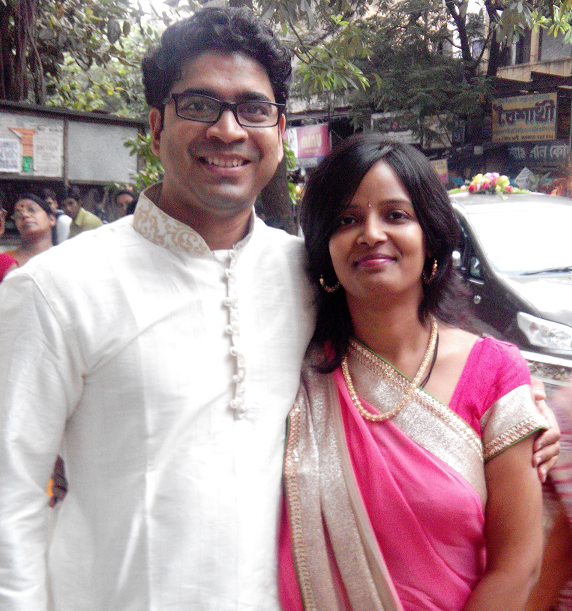
    While in flight, Simple sneezed. Fellow passenger, who was flying to the USA, was somewhat taken aback. She quickly took out her first aid box and gave a tablet to Simple. Initially, Simple was a bit hesitant to take this medicine. Remember we were told in our childhood – “while traveling do not eat anything given by others.” She said I am alright, it was due to the cabin temperature I do not have a cough or a cold. Probably the co-passenger was also told something like, don’t eat anything given by strangers, in her childhood. So the co-passenger read the content line by line and said it is just multivitamin. Somehow Simple got away this time. However, she sneezed again, this time she could not say no to her. Simple had realized by now how petrified the lady on her next seat was. So, this time around she took the medicine – unwillingly though. So, the whole flight afterward was peaceful for both – Simple and the passenger.

    Simple landed in Toronto and the first thing that she narrated was this incident. We laughed together on this and, I told her somehow in India it is not a big deal, I think we are so immune to it isn’t it? We remembered this incident whenever we flew, smiled at each other. Karma you call it. This small smile and fun started haunting me recently.

    Change-in-belief

    This Corona happened and we are all locked down at home. Now whenever we go out for buying essentials, we get hand sanitizer at the entrance of D-Mart as if it is a Prasad! Honestly speaking, touching the shopping trolley I feel scared and giving cash or card, I tell myself hope this person is safe. Now, I realize how that co-passenger must be feeling about sneezing of Simple. How life, experience and opinions change, isn’t it?

    One virus that is bothering everyone across the globe has given a new perspective to the joke we used to tell each other almost every time we flew. Small or big all types of incidents shape us as we grow up. So I changed my opinion about coughing, sneezing and more! If someone coughs around us now the eyebrows rise. Simple and I changed our opinion towards the fellow passenger of Simple in 2015.


    http://business2buddha.com/2019/11/10/this-too-shall-pass/
  • “Greedy” monk

    Prayers of the Frog Volume 1 and Volume 2 is a wonderful story book. Here is another story from the same. This story connects the dots with perception that I had been writing. We do have some monks like this in our society. Do read the story for now.

    Monk

    Greedy monk

    Gessen was a Buddhist monk. He was also an exceptionally talented artist. Before he started work on any painting, however, he always demanded payment in advance. And his fees were exorbitant. So he came to be known as the Greedy Monk.

    A geisha (Japanese women who entertain through performing the ancient traditions) once sent for him to have a painting done. Gessen said. “How much will you pay me?” The girl happened to be entertaining a patron at that time. She said, “Any sum you ask for. But the painting must be done right now before me.”

    Gessen set to work at once and when the painting was completed he asked for the highest sum he had ever charged. As the geisha was giving him his money, she said to her patron, “This man is supposed to be a monk but all he thinks of is money. His talent is exceptional but he has a filthy, money-loving mind. How does one exhibit the canvas of a filthy-minded man like that? His work is good enough for my underclothing!”

    With that she flung a petticoat at him and asked him to paint a picture on it. Gessen asked the usual question before he started the work: “How much will you give me?” “Oh, any sum you ask for,” said the girl. Gessen named his price, painted the picture, shamelessly pocketed the money and walked away.

    • Many years later quite by chance someone found out why Gessen was so greedy for money. A devastating famine often struck his home province. The rich would do nothing to help the poor. So Gessen had secret barns built in the area and had them filled with grain for such emergencies. No one knew where the grain came from or who the benefactor of the province was.
    • Another reason why Gessen wanted money was the road leading to his village from the city many miles away. It was in such bad condition that ox-carts could not move on it; this caused much suffering to the aged and the infirm when they needed to get to the city. So Gessen had the road repaired.
    • The final reason was a meditation temple which Gessen’s teacher had always desired to build but could not, Gessen built this temple as a token of gratitude to his revered teacher.

    After the Greedy Monk had built the road, the temple and the barns, he threw away his paint and brushes, retired to the mountains to give himself to the contemplative life and never painted another canvas again.

    Read other such good stories and learn for yourself. I have referred to the book and its stories many times earlier too check here.

    http://business2buddha.com/2018/07/21/intentions/
    http://business2buddha.com/2018/07/08/perceptions-create-reality/
    http://business2buddha.com/2011/02/15/no-judgement-its-all-about-perception/

    Essence – A person’s conduct generally shows what the observer imagines it to show.

    Again this boils down to perception.

    http://business2buddha.com/2020/04/06/perceptions/
  • Perceptions, perspectives and expectations

    I was watching Mahabharat episodes. The epic is the best depiction of conflicts we keep on going through on a daily basis. The biggest conflict and learning is the shloka of Mahabharat that teaches the value of the action and no entitlement of the results. Dhritrashtra’s perception was he is the eldest so the throne belonged to him. Bhishma’s perspective was that he has to take care of the kingdom (even if the king is incorrect). Dronacharya’s expectation from teaching Kuru prince was to take revenge from Panchal king. Many in the epic knew that their opinions are based on ideology applied incorrectly in the given situation, yet they did not amend their ways. When the battle started everyone took side not based on what is right or lawful but which side my enemy is on. This is the result of these perceptions, perspectives, and expectations. The outcome was – people were fighting their own battles at the backdrop of Pandavas and Kauravas.

    Perception

    Aurora borealis

    When I was thinking about aurora borealis (or polar lights), I thought that such a phenomenon or any other related ionization must be happening at different wavelengths that are beyond the human eye’s abilities to see. Our incapability to see does not mean some things do/did not happen. Sound below 20 Hz and above 20,000 Hz exist, we humans are unable to hear it. Our senses and perceptions create our realities. I wrote last week “our past experiences – Sanskara – condition us”. We need to go beyond the conditioning to change our perceptions.

    http://business2buddha.com/2011/02/15/no-judgement-its-all-about-perception/

    Perspective

    In some of the satsangs of Art of living, I heard a few romantic Bollywood movie songs. Earlier when I had heard these songs I felt ok it is a romantic song sung by the lover for the loved one. However, when I heard the same song in a different setup it was as perfect in Bhakti too! These presentations of songs change my perspective, examples are in the below videos –

    The perceptions made these songs to be romantic songs however when I looked at these songs from a different perspective the meaning of the song itself changed.

    Expectations

    कर्मण्येवाधिकारस्ते मा फलेषु कदाचन ।

    मा कर्मफलहेतुर्भुर्मा ते संगोऽस्त्वकर्मणि ॥

    You have a right to perform your prescribed duty, but you are not entitled to the fruits of action. Never consider yourself to be the cause of the results of your activities. Bhagavad Gita, Chapter II, Verse 47. Effectively, we must do our actions as per need of the hour and do not be feverish about either the actions or the results.

    Conclusion

    http://business2buddha.com/2010/08/19/playing-golf-work-and-meditation/

    In Mahabharat, each person was living his perceptions, defining his stand in his own’s perspective and having different expectations. These three things blinded people. Isn’t it true that we live in the cage of our perceptions, perspectives, and expectations? Meditation can help change in all these three.

  • Perceptions

    Perceptions are our realities – however, how real are these perceptions? The reality persists until we get to understand the other side too. Long back, I met Sai Kaka and he told me very interesting lines explaining how we are stuck and how the “beyond” is experienced. If you look at many opinions and “-isms” you would realize that almost all are bound and jailed in the opinions of their own. What Sai Kaka told me was this –

    Sai Kaka

    Sanskar yukt chaitanya jab (संस्कार युक्त चैतन्य जब)

    • chintan karata hai to usko chitt kahate hai (1. चिंतन करता है तो उसको चित्त कहते है)
    • manan karata hai to usko man kahate hai (2. मनन करता है तो उसको मन कहते है)
    • nirnay karata hai to usko buddhi kahate hai (3. निर्णय करता है तो उसको बुद्धि कहते है)
    • asmita ka bhan karata hai to usko aham kahate hai (4. अस्मिता का भान करता है तो उसको अहं कहते है)
    • inme se sansakar nikal jaye to jo bachata hai vo shuddha chaitanya hai (इनमे से संस्कार निकल जाए तो जो बचता है वो शुद्ध चैतन्य है)

    This in English means –

    When a conscious filled with rituals (or say the lessons learnt about ‘way of living’)

    • thinks we call it mind (imagination)
    • contemplate we call it Mind [there is a difference between Chitt and man which I am not able to translate in English]
    • makes a decision we call it intellect
    • perceives pride we call it Ego

    Now when the rituals or ‘way of life’ learnt, get out of this conscious mind, what is left is the pure consciousness.

    I recalled these lines from Sai Kaka when I read the story of Prayer’s of the frog on Perception.

    Story from Prayers of the frog

    A monk was walking in the monastery grounds one day when he heard a bird sing. He listened, spellbound. It seemed to him that never before had he heard, but really heard, the song of a bird.

    When the singing stopped he returned to the monastery and discovered, to his dismay, that he was a stranger to his fellow monks, and they to him. It was only gradually that they and he discovered that he was returning after centuries. Because his listening was total, the time had stopped and he had slipped into eternity.

    Prayer is made perfect

    when the timeless is discovered.

    The timeless is discovered

    through clarity of perception.

    Perception is made clear

    when it is disengaged

    from preconceptions

    and from all consideration

    of personal loss or gain.

    ‘Then the miraculous

    is seen and the heart is filled with wonder.

    http://business2buddha.com/2014/03/10/amazing-isnt-it/
    I have written on Amazement/wonder read here

    Ashtavakra Geeta talks about Wonder, Janaka responds to Ashtavakra with astonishment. This veil takes time to cast-off. Our perceptions create our reality and we are stuck with that reality with our preconceived notions. When this perception, way of life, Sanskar is removed what is left is consciousness – pure bliss ( इनमे से संस्कार निकल जाए तो जो बचता है वो शुद्ध चैतन्य है).

    I have thoughts on the conflict of perception, in my mind that I shall try to put next week.

  • Perceptions create reality


    What defines something as good or bad, best or worst? Isn’t it all about perceptions? ‘Perception’ this word is made up from a verb “Perceive” which means – to become aware of through the senses. Is “something sensed” by sense organs actually truth? Let us expand the question stem, what is truth? These are some weird questions I had. Our perceptions create our reality. The reality is very relative in that sense.

    I had written the brief of this blog in Jan 2017, kept it as a draft. Now when I review the text, it reminds me of a story of The Prayer of the Frog. The book is in two volumes Volume 1 and Volume 2. If I try to elaborate perceptions and reality it would be very long. So read a story from the book, I shall write my longer version of thought some time later. In the mean time, relish this story –

    Half full, half empty, possibility thinking, optimism, pessimism… and a fearless heart.
    There was a loud knocking in the seeker’s heart. “Who’s there?” asked the frightened seeker.

    “It is I, Truth,” came the answer.

    “Don’t be ridiculous,” said the seeker. “Truth speaks in silence.”

    That effectively stopped the knocking—to the seeker’s great relief. What he did not know was that the knocking was produced by the fearful beating of his heart.

    The Truth that sets us free is almost always the Truth we would rather not hear. So when we say something isn’t true what we all too frequently mean is: “I do not like it.”

    ——

    Our perceptions create our realities, and many of the times we believe these are the “sacred truth” and most of the time, we mean – “I do not like the truth”. Because more often than not – the heart knows yet the mind does not want to believe or accept.

  • Hidden potential


    I had inflammation of gums recently and was not able to eat properly. Instead of looking for solution first, I started looking for causes why I had this swelling? Root cause of the same of my eating roasted corn. So, next time onwards I will be careful when eating roasted corn. Currently, I am having backache, all due to wrong postures while working in office seating in office.

    We do not even notice small integral parts of our body such as gums or back until we have a trouble with them. These parts exist and function as per their role in the physiology of our body, yet we are in oblivion of them, until those have some issue – for us those are almost nonexistent until they let us know they exist and have some limits, in my case it was backache and gum’s swelling. I had kept on noticing gums every time I put something in my mouth, back is reminding me of it’s existence until now.

    What is hidden? Hidden – to us human beings – is something that we cannot perceive. The gums and back was something hidden until I had troubles there, it existed physically, I knew it existed but I did not notice it.

    Perceptions are another limitation, our perceptions are limited to our five senses. If something exist beyond these senses we may not know of it’s existence such as noise beyond a certain range.

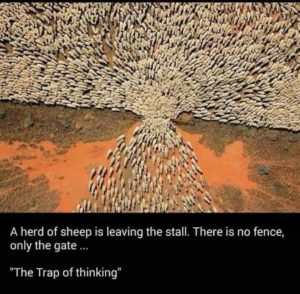
    We cannot see air, it does not mean it does not exist, we know air is there because our sense of touch can feel it – breeze or cold. A seed has a possibility of become a tree, that is it’s hidden potential. We cannot see it manifested and thus we do not believe in it; that is our problem. Our perceptions are actually created by our previous learning. In the image here, there is no gate or fence, it is all in the minds of sheep.

    I have written on it earlier on perceptions and specially here what I learnt from Sai kaka, about our past impressions –
    Sanskar yukt chaitanya jab (संस्कार युक्त चैतन्य जब)
    1. chintan karata hai to usko chitt kahate hai (1. चिंतन करता है तो उसको चित्त कहते है)
    2. manan karata hai to usko man kahate hai (2. मनन करता है तो उसको मन कहते है)
    3. nirnay karata hai to usko buddhi kahate hai (3. निर्णय करता है तो उसको बुद्धि कहते है)
    4. asmita ka bhan karata hai to usko aham kahate hai (4. अस्मिता का भान करता है तो उसको अहं कहते है)
    inme se sansakar nikal jaye to jo bachata hai vo shuddha chaitanya hai (इनमे से संस्कार निकल जाए तो जो बचता है वो शुद्ध चैतन्य है)

    A rough English translation of the same is –

    When a conscious filled with rituals (or say the lessons learnt about ‘way of living’, include religion)

    1. thinks we call it mind (imagination)
    2. contemplate we call it Mind [there is a difference between Chitt and man which I am not able to translate in English]
    3. makes a decision we call it intellect
    4. perceives pride we call it Ego

    Now when the rituals, religion or ‘way of life’ learnt, get out of this conscious mind, what is left is the pure consciousness.

    It means “pure consciousness” is blurred by our different (Sanskara) learning about life. Therefore in some cases religion becomes a problem.

    This is the problem of our perceptions such as we think East is far different from the West. Can we try experimenting – a kid born in Say US should be reared in India and vice versa. Would these kids grow up to behave in similar manner such as US born kid raised in India, would behave like any kid born and raised in US and vice versa? When we talk about East Vs West our perception are based on the “sanskar”, at times those are the hidden potentials.

    Hidden potential was an old LBC topic, I wrote on it today. Loose Bloggers Consortium is where MariaRummuserAshokShackman and I write. You can visit their blogs and read their thoughts on the topic.

    Image source – unknown currently.

  • Perceptions and illusions


    Off late, I have – kind of – become forgetful. One of my friends shared someone’s phone number with me, a couple of days later, I bet with him that I ddin’t get that number. We checked Whatsapp, SMS, emails and not to miss address book too. I almost won the bet, thankfully it was not a monetary bet. I still kept on searching – in my “notes” app too I could not find. My friend told me the whole incident and I got a hunch, I think he did share the number! But to my utter surprise I could not find the number anywhere.

    Well, I asked him that number again, he was bit annoyed yet gave me the number. I recalled – he had shared such number once – though I did not remember the whole number. It made me think about what happened in this situation? This incident made me understand that many a times we take things for granted, we tend to ignore many things. When we ignore things we are likely to be bodily at one place and mentally at another – in some fantasy or illusionary world. Isn’t it? The illusion we create through such mental images either become our perception or mend it and thus our limited (or at times incorrect) realities are created. For example – my forgetting my friend’s sharing the number with me as “You didn’t share the number”. If such incidents are not realities how do we know what is reality? In fact I think we need to ask ourselves – what is reality?

    Life is simple – the illusions we assume as reality make it difficult. The fantasy we create are based on our perceptions or our belief of some reality. Our perceptions make our life difficult isn’t it? Let us say – an illusion – “our religion is under threat!” If a religion is one of the biggest in terms of number of followers – what is the threat?

    We are so preoccupied with our own illusionary world that we miss many small things needless to say important or that which are the realities.

    I suggested this topic for LBC, however for last couple of weeks I was not able to write regularly. You can read my fellow bloggers post on this topic at – Ramana uncelji, Shackman and Maria. I am trying to catch up with my backlogs of weekly blogs on spirituality, management and business.

    Related blogNo judgement – its all about perception

  • Blindness


    My mother teaches in a school where there are few blind students also. She talks about them passionately and praises their intelligence beyond the other students. By chance I have not been closely associated with the blind people, however I have filled my eye donation form when I was 18 years. Yes, I would want any and every body part to be utilized after my death, the value of each organ will increase if it remains and be useful to someone after me. This “AFTER ME” puts me on another tangent of thoughts – we are not the body – but here I am not writing on those thoughts anyways.

    So coming to the topic – Blindness. How do you define blindness? Inability to see, is that the only definition? According to me, the definition of blindness goes beyond just the inability to see. Or if I think more, in some sense of the word “see” may includes many things which we generally overlook.

    [Tweet “‘Our’ perceptions create ‘our reality’ – than whatever is the truth.”]

    ‘See’ should not be only associated with eyes. After your eyes see, what happens next? The mind creates a picture and mind infers the picture. The inference also has a sense of blindness too. Inability to infer, inability to understand and misconception of actions; these are few other things that need to be included in defining “blindness”. “Our” perceptions create “our” reality – than whatever is the truth.

    quote-Helen-Keller-the-highest-result-of-education-is-tolerance-103858An example that came to my mind is related to a recent incident in the US. A young man unleashed gunfire in Tennessee military facilities. Initial reports were stating that it could be an act of terror. This man had stayed somewhere in Middle East for more than 1/2 year in 2014. His high school friends of this man say he was a good guy and it was shocking and unbelievable that he did it (paraphrase a CNN news report heard earlier). So point is what happened that this young man did what he did?

    If I cannot see Blue color, I am color blind for that color, if I cannot see peace and only fed with what wrong is happening with “my community” by “other commutes” I am blinded by what good the other community is doing. Many a times, the bad is more of perception than a reality. This is how people are blinded to see only what they are told to see.

    This Tennessee shooter was blinded in the same manner. That is also a kind of blindness too. The intolerance we see in many people is because they can only see what is right for them and they are blind for opinion of the other. Perhaps the young man got brainwashed by some education which was rather reverse of Education – “The highest result of education is tolerance” Helen Keller. [assuming it was a terror attack, as it was speculated initially]

    [Tweet “”The highest result of education is tolerance” Helen Keller.”]

    In a similar manner, I am blinded to see only peace, growth, happiness. On a lighter note – I see many vehicles with their number plate as 23XY, reason is – my vehicle is numbered 2315, its not that these vehicles were not visible earlier, now I notice them intentionally and ignore vehicle with some other numbers.

    I am late to write on this LBC post. This topic was suggested by Lin, for the weekly Friday Loose Bloggers Consortium where currently nine of us write on the same topic every Friday.  I hope that you enjoyed my contribution to that effort.  The seven other bloggers who write regularly are, in alphabetical order – AshokgaelikaaLinMaxiPadmumRamana UnclejiShackman and The Old Fossil. Do drop in on their blogs and see what their take is on this week’s topic. This time I was the one who posted very late, do visit blogs of others they must have posted their opinions too.

  • Just arrived!


    I was standing at the platform, waiting for train. I was worried because rainy seasons trains are either late or cancelled. Naturally, platform was very crowded. Thankfully, a train arrived. Without any exception, unreserved category was already jam packed. People looming out side the gate as well. So, a few standing on platform jostled to get in, traveler standing on gate said – “there is no place why are you pushing me”. People standing on platform still tried pushing almost quarreling with – kind of – “gatekeepers”. They kept on pushing stating they want to get it and place can be made etc. Some reached from platform to the train compartment no doubt looming on the gate. Once they reached in – they started saying to those who were still trying – “there is no place!”

    Instead of trying to board the train – I was looking at the faces of those who had just “arrived” from the platform to the train boggy!

  • Blind men and the elephant


    I read this story in a book. A father once gave his son a telescope. One day the boy was using the telescope, he was little disappointed with the performance, he went to his father and said “father it is useless, I can see better without it. Everything is too small.” Father smiled, the boy was looking from the wrong side, he was not getting the BIG PICTURE at all. The boy had a narrow outlook through the glass. The father turned the little telescope around.

    The father had widened the son’s outlook. The boy grew up and improved the primitive telescope and with it discovered the moons of Jupiter, the rings of Saturn and the Mountains on our moon. The boy was Galileo.

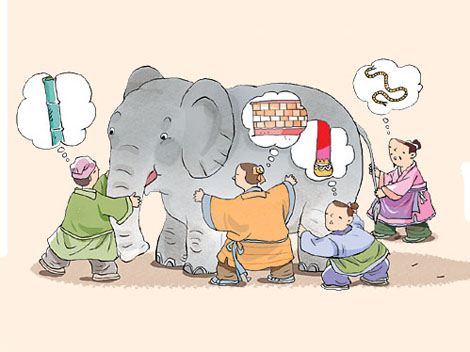
    What is important is seeing things in proper perspective and we must widen our outlook. So it is generally about the perspective, outlook and the way we look at things on which I wrote earlier. Similarly, there is a story about blind men and the Elephant. I took it from Wikipedia for the blog, however this story is very famous in India and we learnt this as kids. The story goes like this…


    A king has the blind men of the capital brought to the palace, where an elephant is brought in and they are asked to describe it.”When the blind men had each felt a part of the elephant, the king went to each of them and said to each: ‘Well, blind man, have you seen the elephant? Tell me, what sort of thing is an elephant?” The men assert the elephant is either like a pot (the blind man who felt the elephants’ head), a winnowing basket (ear), a plowshare (tusk), a plow (trunk), a granary (body), a pillar (foot), a mortar (back), a pestle (tail) or a brush (tip of the tail).

    I searched for books on blind men and the Elephant and found out that there are many books with this title for professionals are –
    Blind Men And The Elephant : Demystifying The Global It Services Industry
    The Blind Men And The Elephant: Mastering Project Work and
    on spirituality The Elephant And The Blind Men, Finding The Oneness Of God And Man you can check these books if you want to read them.

    Image source – http://history.cultural-china.com/en/38History960.html