Tag: Karma

  • Dependent co-arising

    Interdependent co-arising is a very key concept of The Buddha’s teachings. The other interesting names of this concept are dependent co-arising and dependent origination. Dependent co-arising is a deep concept. The depth requires an understanding of the concepts of Buddhism. So, I keep writing at a very shallow level examples to drive home the point. Whenever I read the book – Old path white clouds by Thich Nhat Hanh I get itched to this very concept. He explains this concept in easy words – “From interdependent origins, all things arise and all things pass away.”

    Thich Nhat Hanh

    I have shared multiple examples specifically for dependent co-arising on my blog. These examples were shallow yet practical relationship between the teachings of the Buddha and the present-day Business.

    Here are some examples

    Vaccination and interdependence (pulse polio elimination initiate of Govt of India)
    Societal impact
    Interdependent co-arising a farmers example
    Entrepreneurship
    Intra-country example and macro-economic example

    Whenever I try to interpret this concept; besides the interdependence, this concept touches on another concept of Hinduism (or Indic religions) – the concept of Karma. Karma gives us a guiding principle of cause and effect. It is easy to understand with the help of an English proverb – as you sow; so shall you reap. A very easy example of the cycle of Karma can be seen in an episode – Lucky penny – of How I met your mother.

    However small we think we’re as an individual, we’ve the power to make an immense impact on the world. You may have heard – if a butterfly flutters its wings in Amazon forest, it may cause a hurricane in Japan. I came across this interesting Domino effect video. I could relate it to the butterfly effect and thus to dependent origination.

    Watch this and relate the accumulated energy of the bar to Karma, the first piece as the butterfly fluttering wing and in effect interdependence of everything as a cycle.

  • Interdependent co-arising in long run

    Last week I was in the US. I spoke with a friend of mine he is a professor in a college in USA. We discussed many things, what got our attention was the dependence of many moving parts of our society such that everything impacts everything else. This is nothing but interdependent co-arising.

    Related blogs –

    Vaccination and interdependence (pulse polio elimination initiate of Govt of India)
    Societal impact
    Interdependent co-arising a farmers example
    Entrepreneurship
    All interdependent co-arising related blogs

    We discussed the school system of USA, how the impact of 2008 great recession is going to impact funding of schools in coming time. The story is like this – during the collapse of late 2007 early 2008, birth rate in USA reduced. This is researched and published fact refer here “…the college-going population will drop by 15 percent between 2025 and 2029 and continue to decline by another percentage point or two thereafter…”. The researcher states birthrate as the factor, quote from the same source “…When the financial crisis hit in 2008, young people viewed that economic uncertainty as a cause for reducing fertility,” said Grawe. “The number of kids born from 2008 to 2011 fell precipitously. Fast forward 18 years to 2026 and we see that there are fewer kids reaching college-going age…”

    After 17 years when expected students those who could go to college have reduced this is impacting overall finances and the operations of schools. Look at the impact, how one things affects other. This is interdependent co-arising. What goes around comes around, impact on education may cause other impacts example – job market, sustainability of businesses and resulting in another possible economic crisis – it is a loop.

    Abstraction of this scenario

    You must have heard – if a butterfly flutters its wings in Amazon forest, it may cause a hurricane in Japan. We at times miss the power of small things and ignore them. This understanding of sensitivity of impact of one thing on a larger scale makes a person compassionate. Currently the world needs compassion more than the mad rush to reach somewhere. In the long term, impacts are what are left behind not the individual goals we kept in our mind.

    Image source – NeedPix

  • Virtues and wisdom

    I had a question some time back, whether or not should I teach virtues to Adviti. This question came in mind after witnessing a lot of corruption cases in India. I got a feeling that Karma – that a lot of Indic religion followers believe in – does not do justice at least in a visible sense. The inference of Karma missing its duties comes in mind when we see a lot of people wrongdoing and still happily manipulating systems to practically prove themselves to be on the right side of the law.

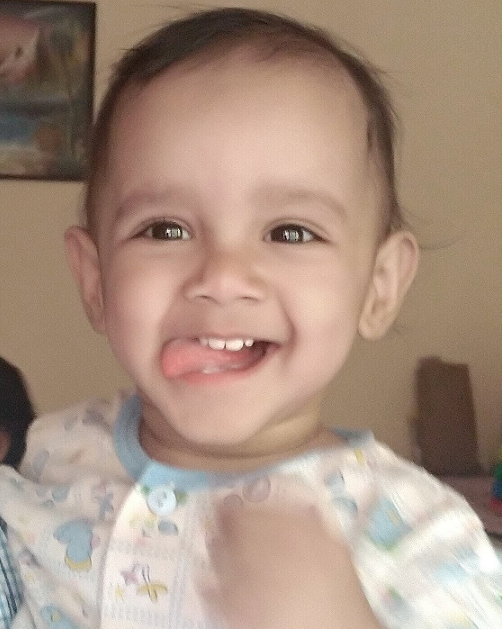
    Smiling-Baby

    In the previous blog – teaching virtues to Adviti – I had pointed to a politician. He, at last, got in custody recently. Yet the point remains, is Karma giving as good as it should? Indian judiciary is a long and mostly not very pleasant ending for cases against politicians. Why should anyone teach virtues and ethical practice to offsprings when everything can be bent as needed?

    Anand Utsav – course with Guruji Sri Sri Ravi Shankar – had been a great learning and rediscovering. Learning is a continuous process that is still going on. Now, when I have been having some more perspective on myself, I believe I should continue teaching virtues to Adviti that I had been questioning myself off late. The point is – with teaching virtues one must teach the discerning skills as well to the kid.

    One must not get carried away by what good or bad others are doing. It is their way of living. Some will be worst off and will get Scott free too, in the court of justice. Everyone must learn the basic ethics in formative years, however, in addition to ethics another learning should be the ability to make a decision who should be treated how.

  • Adviti and perspective change


    Adviti is growing up, she has started turning and every now and then she turns. When feeding her, she turns that makes putting food in mouth difficult. It was surprising initially to feed her used to be irritating that she is turning in no time. Once, I was talking to a relative, she said – Adviti will keep on doing it because it provides her a different perspective to the world. As an infant, how good and easy for them to change perspective – make it exactly 180 degree and enjoy. How difficult for us to change our perspective?

    This change in perspective gave me an opportunity to question my own opinions. So, first was marriage in particular caste. The other apparent Indian customs such as – girls parents to not step in her home once girl is married! Yes that I have heard in conservative families. I don’t know how much is it followed now. So, when I badgered Lingayat community for disrespectful behavior on marriage issues, today I try to look at another perspective.

    perspectiveOne of the possible reason for people looking at their own community or professional background could be that a girl grown up in similar environment may find it easy to settle in new family with similar customs or work requirements. If a farmer marries a goldsmith’s daughter would not it be very difficult for her to get accustomed to the new way of living?

    Second, when society used to say not to go to girl’s home after her marriage, the possible reason could be – avoiding conflicts. Indian soap opera’s show it often. Additionally, olden days, it used to be a wish that girl is married in a family of economically higher standing. So, possible that girl or her parents should not feel uncomfortable, or should not be named for their out of place demeanor by the boy’s family. My small mind could think of only these possible reasons.

    Lastly, eastern religion – all have concept of rebirth and karma. Personally, I not only follow but also believe in these concepts. A different paradigm from these seemingly good concept is here. If you tell a student that you’re not good at mathematics because in last life time you moneylender and did mischievous calculations to let the borrowers keep on paying you unnecessarily, that is a bad perspective on the concept.

    There are many wars, fights and arguments due to perspectives. Be it capitalism vs socialism, one religion vs the other or political biases. We can be passionate about our perspective yet should be compassionate to listen to others view too. Otherwise there will always be wars, fights and arguments.

    Adviti is teaching me a lot of things with her growing up. The recent one is changing perspective and looking at the other side, even if it seems incorrect prima-facie. This is a difficult task, I am trying to learn though, she changes her perspective by 180 degree easily at this age. Are we as adults going to learn something from our next generation?

    Image source – https://commons.wikimedia.org/wiki/File:Point_of_view_bias.jpg

  • Why-Analysis – Karma


    In operations consulting we used to do why-why analysis. It is a method to identify cause of an occurrence. There are other methods also available for doing such analysis. The objective of such different methods is be to find the root cause of some occurrence.

    Why this happened? Because of that. Why that happened? because of something else.This why question is asked on the answer of previous question until an actionable cause is identified. Mostly a root cause is reached in maximum of 5 why’s. It is a very commonly used cause and effect analysis tool in operations management.

    I watched this video and could relate to karma, our entanglement to karma (Maya) and that root cause analysis technique mentioned above. The lesson here is, one must try to find “The cause of cause”.

    Guruji (Sri Sri Ravi Shankar) is saying in this video that when you stick at one or lower levels of the cause attribution you do not get to the real cause. On the contrary that entangles you, in Karma, even more.

    If we do not perform Why-Why analysis correctly, we get frustrated and the operations do not get improved. Thus, properly performing this analysis will get to the root cause – mostly management. How and why a decision was made which resulted in the issue say for example high inventory or poor quality output. Thus that can help improve operations of the organization.

    Similarly when we analyze karma we would reach to the ultimate – the cause of all the causes. Guruji calls it – Shiv tatva in this video.

    Karma plays a role everywhere, be it spiritual life or professional. However, doing a why-why analysis on operations is easy on the contrary doing a why-analysis on “the cause of all the causes” is easier said than done.

  • Karma


    The Endless Knot

    Associating Karma with financial success seems completely falsified way of using the doctrine of Causality.

    I was reading an article and it referred to financial success of people as the results of their Karma. Specially when we speak of “Karma” the context is effect of past life on the current one. Additionally, Karma of current life influencing the future life.

    The conceptual explanation of financial success of people to their Karma made me question the concept of Karma itself. Does Financial success mean everything and is the END in itself?

    I believe – Not necessarily.

    I have seen kids playing with mud, plastic bottles & almost without cloths very happy and kids with LEGO toys at home crying for something else. Just let the kids be little old and see adults or old aged people – they start grumbling about money! But we forget we leave empty handed. Karma in my opinion should be construed as – something that will help us progress. Progress spiritually – if finances help in spiritual progress – be it. But otherwise putting the whole concept of Karma around Financial success is not agreeable.

    Specially, when west misunderstands the concepts and tries to prove every point of their belief using concepts such as Karma – I remember Ashtavakra. I remember reading that Ashtavakara in his Geeta denied the concept of Karma.

  • As you sow, so shall you reap


    In Science we have studied – every action has equal and opposite reaction. We never take that seriously for life, that if we hurt someone that may be compensated. Here is an interesting idiom in English language (many other languages as well) – As you sow, so shall you reap.

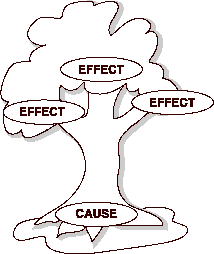
    Long before science could establish this fact as “the fact”, The Buddha and Hinduism had given the concept of Karma. Well, I cannot vouch for rebirth so here is what I have written earlier –cause_fx

    Heaven and Hell are ‘here and now’
    The way you pass each moment
    You define whether you are in Heaven or a Hell. Blog here

    Don’t rely on next birth, do good in this life time itself.

    Heaven and Hell are ‘here and now’
    The way you pass each moment
    You define whether you are in Heaven or a Hell. – See more at: http://business2buddha.com/2011/07/21/this-is-how-i-remember-it/#sthash.Aykwean2.dpuf
    Heaven and Hell are ‘here and now’
    The way you pass each moment
    You define whether you are in Heaven or a Hell. – See more at: http://business2buddha.com/2011/07/21/this-is-how-i-remember-it/#sthash.Aykwean2.dpuf

    This blog post is less inspired by the concept of Karma and the English idiom but is inspired by a SitCom I have watched long back – “How I met your mother“. This is/was a series just like previous famous sit-com “Friends”. In How I met your mother (HIMYM) there are five characters – Ted (lead character, who is telling this story to his kids), Barney, Marshal, Marshal’s girl friend (later wife) Lily and Robin (confusing to describe her – she is friend – with each one. She is girl friend of Barney and Ted in some series. She is wife of Barney once and in the end she marries Ted). In one particular episode season 2 Episode 15 – Lucky Penny, the concept of cause and effect is described with ease.

    Ted finds a penny and in the 22 minute episode, everyone is involved with the penny and the associated event result in Ted missing a flight to Chicago. In Hindi there is a saying – बात निकलेगी तो दूर तलक जाएगी it means – “If we start this discussion, it will go long back in the history”. Just to give you a perspective we may conclude on this question – “Why did Adam eat the Apple?” You know what I am saying?

    You must watch that 22 min episode of How I Met Your Mother to know in brief how causation might work?

    The Author does not claim any rights on the Youtube link and video. This link is attached here for reference and does not make the author liable for any copyrights violations. It is advised to the reader that if you want to watch the series please purchase it from any retailer where the media drives are available such as FlipKart Link.

    Image source – Cause and Effect – http://fcit.usf.edu/florida/lessons/railrd/cause_fx.gif

  • Bhavachakra – the wheel of life


    On this buddha Poornima (Sunday 6th May), came across detailed explanation of Bhavchakra. I thought to share it on blog.

    Life seriously is a wheel, is not it? For individuals – Wheel of emotions, wheels of personal development and wheels of social interactions. For organizations and society too this wheel goes on – growth, development and destruction. Check any Indian Soap of prime time, you would come to know what we are surrounded with. It is up to us to learn about this wheel and help ourselves to get out of this – app dipo bhava (be a light unto yourself).

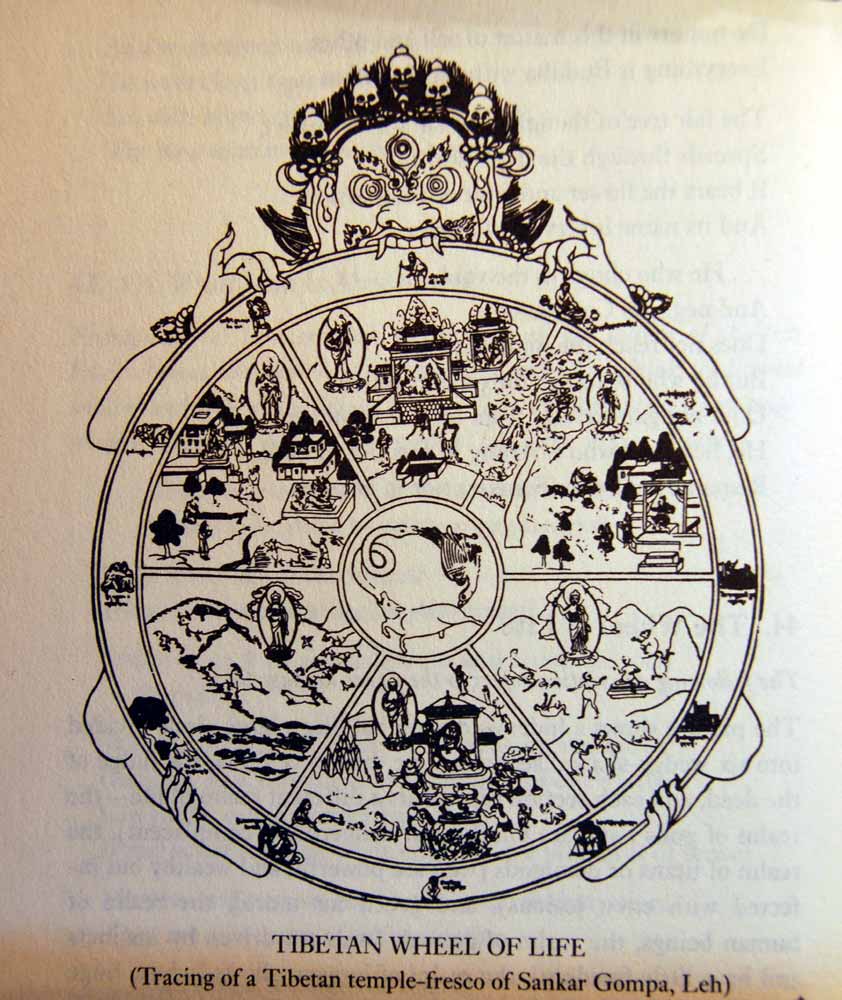
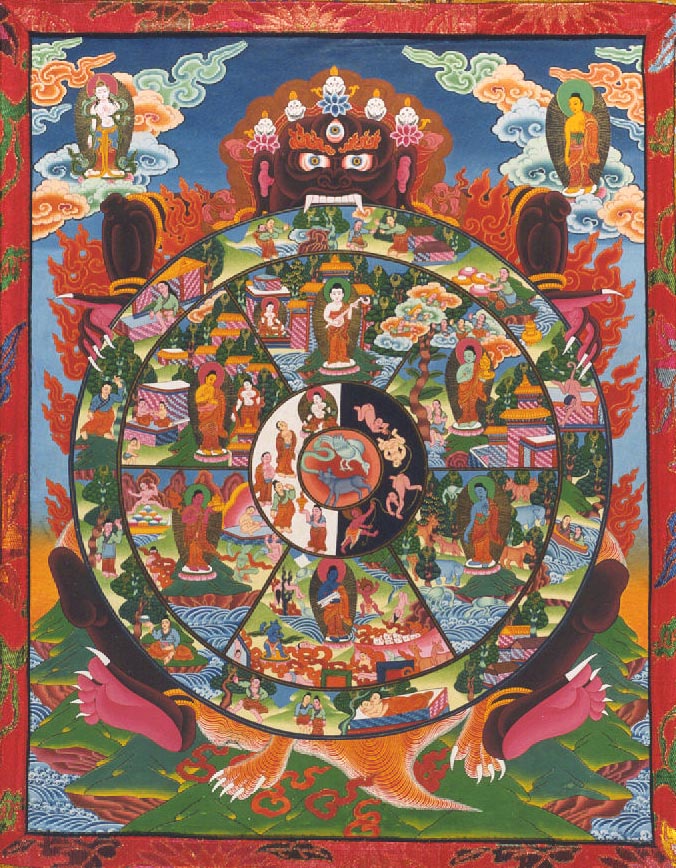
    The following content as well as image on bhavachakra is from this link, which explains it well.

    Bhavacakra or Wheel of Becoming/Wheel of Life is a form of a mandala or tanka (painted wall hanging), used primarily in Tibetan Buddhism.  The painting of a tanka is itself a form of mediation.  Its meaning is very complex, and can be read to represent at least three different realms of manifested effects ofkarmic actions.  It can be read as a diagram for the six different kinds of existence into which one may be born into during the middle rounds of samsara.  It can be read as symbolizing each of the different realms of human existence, lived out by certain kinds of people according to their karmic fortunes of personality type and socioeconomic status.  Or it can be read as a description of situations or states of consciousness that everybody passes through again and again in the course of a single day.
    Its iconographic meaning is correspondingly complex as well.

    In the background are varied Buddhist symbols, such as the moon, clouds in shape of swastika, and always a representation of at least one Buddha orBodhisattva, seen attempting to help sentient beings to find their way to Nirvana.

    The wheel is held by the jaws, hands and feet of the demon, Yama, the judge of the dead, who turns the wheel.  Yama represents the ignorance that comes from greed and “selfhood,” that keeps the wheel of suffering turning.

    The outer rim of the wheel is divided into twelve sections, called the Twelve Interdependent Causes and Effects – 1. ignorance, 2. volitional action or conditioning, 3. consciousness, 4. name and form, 5. six sensory organs (eye, ear, nose, tongue, body and mind), 6. contact or touch, 7. sensation, 8. desire, craving, thirst, 9. grasping, 10. becoming or existence, 11. birth, and 12. decay and death.

    The areas between the six spokes represent the six forms of unenlightened existence.

    There are six wedged-shaped sections, with each representing a different realm of life –

    1. realm of the Gods – Devas (who are blissful but dangerously complacent; always at the top of the wheel)

    2. the realm of the titans, demigods and fighting demons – Asuras (lowest rank of gods, who are powerful and wealthy but infected with envy, jealously, and greed for more; always in the upper half of the wheel)

    3. the realm of “human beings” (always in the upper half of the wheel)

    4. the realm of “animals” (sentient beings, less intellectually advanced than humans, driven by instincts and have little freedom, but can still experience suffering and project karma; always in the bottom half of the wheel; inclusive of birds, fish, and even a worm)

    5. the realm of “hungry ghosts” – Pretas (whose huge bellies but pinpoint mouths and eyes suggest insatiable craving; always in the bottom half of the wheel)

    6. the realm of “hell beings” (who are consumed with relentless rage; always at the bottom of the wheel; beings brought to hell for  past karma, but beings who can escape it through good deeds and reincarnation).

    At the center or hub of the circle is a smaller circle containing the Three Poisons, within a rim of binary demarcation of black and white. The black section represents the Dark Path on which sentient beings are moving downward to the hellish realms. The white section represents the Path of Bliss on which beings are moving upward to the Godly realms. The Three Poisons are personified as a rooster or fowl, a pig or boar, and a snake, chasing one another around and around. They symbolize the forces that keep people caught up in the samsaric round of existence: the rooster stands for greed, the pig for ignorance or delusion, and the snake for hatred.

    The wheel can thus hold distinct meanings, each speaking to different sensibilities.