Tag: John Maynard Keynes

  • Grass grows by itself


    For last couple of years, I have been buying stuff (mostly grocery and vegetables) from where I get a bill (invoice), even if I have to pay a bit more. Reason has been straightforward – I am fine paying more because presumably the one who gives me bill pays tax. It reduces burden on my tax and thus country can improve and prosper. Straightforward logic. However, another thought runs in mind – things are getting automated, be it agriculture or industries. Technology based jobs are likely to get automated too. This will create a scarcity of jobs. We should support roadside vendors otherwise how will they sustain their livelihood.

    Next level challenges for Governments and even for private sector will be job creation at grass root. The other thought says possibly there would not be a need of job creation. Things will happens automatically due to automation. On a philosophical level as Ramana uncle keeps on quoting – Sitting quietly, doing nothing, spring comes and the grass grows by itself. ~ Basho. This no one would require to do job, the same possibility suggested by Keynes.

    The world thus would be a kind of utopia, we hopefully wont require ruling over the other. It would be a time of soul searching, digging inside doing inner revolution. I strongly believe prosperity of each individual is the best way to reach the Utopian world. Economics, fails at such Utopian world, because where there is scarcity there is demand and supply. However, if everyone is prosperous probably no one will feel wealthy. Feeling of being wealthy at that time would be defined by some other measures – not necessarily by money. Currently too we are on the verge of redefining wealth, money is not what you have in your pockets or home is no more the only wealth. Wealth is – stocks you have, count of zeros in your accounts, may be in future we would look at bitcoins in your electronic wallets.

    Possibly, the Buddha was disillusioned by wealth – he was a prince after all, wealthiest of kingdom – when he saw a sick old man, a dead body etc. Likelihood of seeing a Buddha like person is far higher in prosperous economy. India was at peak of its economic, scientific and spiritual knowledge. The world now and in future needs to think about spirituality and economics in same plane. The world we are creating for our coming generations should have growth, livelihood, sustainability and spirituality together. This requires learning a couple of concepts of Buddha’s teachings deeper – i. interdependent co-arising ii. the middle path and iii. righteousness (speech, action, livelihood,efforts, mindfulness, concentration, view and resolve).

    I think we need to think beyond jobs creation, wealth, we need to think about a holistic development of human race because the grass grows by itself.

    Happy Buddha Purnima, may everyone become The One soon.
  • Capitalism’s possible impact


    Keynes in an essay had said “his grandchildren’s generation would only work 15 hours a week.” Apparently, that generation is in the workforce now. Are we working <2 working days a week? Far from it. According to some studies, working population of the developed countries are still working at least 34 hours a week (if not 40 hours). Possibly the prediction was incorrect by a generation.

    On a leisure weekend, we were wandering in one of the biggest cities of Latin America last month. It was our first visit to the country. We were talking about the way of living there and possible future for us. I said, in future, we may be working for enjoying what we do, not for earning our living. So, when Keynes said working 15 hours a week, it is possible that rest of the time, people do what they otherwise would want to do – it can be work too. Given a choice I would want to study, read books, wrote blogs 🙂 share my knowledge etc. Some of it I still do though, but over the weekends. Was this the future that Keynes saw as possible? I think yes.

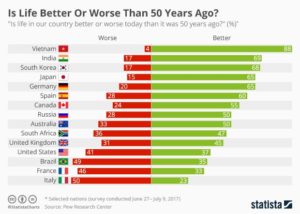
    Uber, Apple and Google are working on autonomous cars. We’ve technology intervention in everything – industrial revolution brought partial automation, technology revolution increasing automation. It is possible that in future organizations will be minting money on robots alone. Hopefully when we reach that state, we will be beyond food, shelter and social standing. In fact that possibly can be one of the reasons for the following outcome of a research – population of developed countries are not that happy. Perhaps our mind has the habit of occupying itself. When there is nothing to be occupied with, either one is unhappy or one can think of bigger purpose in life.

    The statistics can be contested such as – how were these 50 years compared? This discontent and prosperity will surely lead to the questions towards spirituality. When a society is prosperous that is when it starts or tend to move inwards – at times capitalism it is that provides opportunity to dig deeper within [From my previous blog]. I see a lot of people pursuing Buddhism or for that matter meditation in west.

    Besides, when development will lead to unhappiness, the journey of inwards will start. People will ask question – what makes me happy? That is when people will start working for 15 hours a week for wages and rest for self. I see that as an impact of capitalism. When that happens economies would not remain purely capitalistic. There will be change in our approach of economy, it wont remain purely capitalist.

    Image Source – https://twitter.com/nareshnshahani/status/938937338431807488 tweet from – Mr Naresh Shahani.

  • What would you do in long term?


    In the long run we all are dead – John Maynard Keynes

    I was talking to my boss. He throws interesting questions – what do you think of next disruption? Ok do not talk about bitcoins, healthcare and analytics has already plateaued! Hum! That is a challenge. Wish I knew what is next disruptive business, technology or industry.

    I asked myself, is there lack of cloths that people die of severe cold in winter in India? Is there lack of food on earth that people die of hunger in world? If there is lack of cloths or food, why are our retail stores full with cloths, and food wastage is ~33% or so (National Geographic).

    My mind goes in a very long term when such questions come to mind. I believe in next hundred or hundred and fifty years or may be sooner, we would not need money (currency) or any such thing. This is very surprising for the financial system, businesses or capitalistic mind to believe. Let me elaborate. Have you seen Uber? Has Uber made ownership of car redundant for many people?

    What if our all basic requirements are fulfilled in the same manner – for example, I have some cloths in my wardrobe, I do not wear them all in a day. I wear only one at a time. Why should I have so many cloths? What if we can just select what to wear, wear it and return at some location when we are done! You may ask a question – then how would people earn money or offer services? Uber ride requires cash, card or wallet payment. Let us think of a future – car is driven by machine, cars are run by electricity, electricity is produced automatically by nuclear power and cars are manufactured by machines. No need of a human being for anything. Remember Keynes idea of working 4 days a week or lesser. Actually our capitalistic mind does not approve of this. People must work to earn their living. The best thing is – only capitalistic approach of running for better, more, improved can help us reach the state of future which is imagined here.

    When everything happens automatically, so what would humans do to earn, or say passing time? Can you relate the first part of previous sentence with the nature? Everything happens automatically for animals and they just pass time, they do not need to earn their living. Just think the phrase “Earning your living”! Does not it sound surprising thing, you just live, is not it? You do not need to earn it. I know you might have felt offended when you read automatically and comparing humans with animals. There will be a difference – our evolved sense of self and ability to think. This ability will force us to think about our existence. Our most of the time will be involved in thinking about our existence. This may take some time, when people will get fad-up with their pleasures – perhaps the way Gautam the Buddha got disenchanted. In that world we would not need money, we would not have a lot of possession, yet we will have everything on our finger tips.

    Just look at housing in Tier-1 cities in India. There are many unused inventory kept, most is out of budget for many people to afford. I see a future where whole world will be a rambling place and a type of hotel, where you can stay when you end your day. These houses will be built by machine and thus we would not need to buy or rent them either. Money as a concept will vanish. When you would have whole world at your feet, you would not steal, you would not look for possession. You would be lighter as Mirdad said in ‘The book of Mirdad“Less possessing – less possessed”.

    Here in above paragraphs we spoke about basic needs – cloths, food and shelter. I am sure humans will evolve to self-actualization phase – of Maslow’s need hierarchy – if the above happens (Ok give and take few carnal desires). In the short term, I would want to make that type of world envisioned above. In the longer term, I would want to be self-actualized or say enlightened in this life itself.

    What would you do in long term? was the topic for the week for LBC (Loose Bloggers Consortium). I had suggested this to the group where – Maria, Rummuser and Shackman also write. You can read other LBC authors opinions on their respective links.

  • Did Keynes fail in Japan?


    It all started in 1990s when Japan took the step to deflate its economy – Yen devaluation, lower interest rate, money supply etc. The effect is observed till today and in fact we may get into another slowdown in 2015-16. Actually, that’s what is the fear. Some experts are forcing Euro-zone not to make the same mistake Japan made in 1990s. If one sees debt of the developed countries one may be forced to conclude – we are sitting around next slowdown. Take Japan – about 250% debt to GDP ratio! Surprising right? Nope, situation is not better in US either, USA is also at 100% debt to GDP. Many are already blaming Quantitative Easing for the next likely downfall.

    I happened to read a news last month on Keynes failing Japanese economy. Well, I agree with the concept of Keynesian economics; you may even call me anti-capitalistic – though I am not. I am more in the league of following the middle path. May be Japanese have become too devoted of Keynes’ concept – so I started questioning myself on many fronts i. Is Keynesian economics the problem? ii. Did Japan over do it? iii. How things work around here? Etc These questions may be comforting to those who are against the Keynesian economic theory.

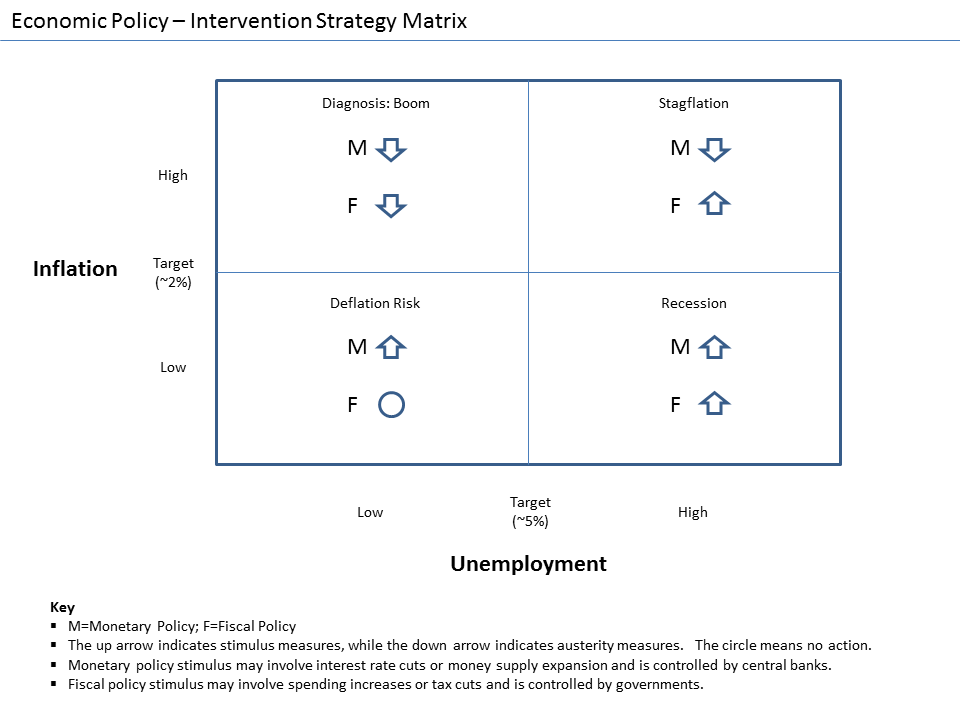
    Economic_Policy_-_Intervention_Strategy_MatrixSince, Keynesian economics had worked in relatively less connected world of 1930s I dismissed the question 1 for future blog. Japan’s overdoing it and how the system works were somewhat related questions. So, that question became central in my very tiny analysis.

    The question I had was – how does Govt issue bonds and how does it get circulated in the market? Well, that is done through the banks and the bankers. Aha! did I hear bankers? Those bankers who went to the President (USA) and said – “we would buy Jet for our executives?” Ok! If those who still blame Keynes, would you ask with each slow down who makes the most money? Is not it the same – bankers? At least the Govt is putting money in the system in the hopes that this method will work to keep the economy afloat. I was checking Wikipedia article on Economy of Japan. An external states that – Japan possesses 13.7% of the world’s private financial assets (the second largest in the world) at an estimated $14.6 trillion [2010 data]. This data states that – Keynesian economics is doing more services to the Capitalism than otherwise!

    [Tweet “Japan has 13.7% of the world’s private financial assets! #Keynesian #economics does more service to #Capitalism than otherwise”]

    Who is playing with the hopes and cheating the system? I am little too critical when I say “cheat” because some people are in the profession of making investment decision and those decision at times counter intuitively work against the basic premise (hope) on which at the first place Govt had put money in the system. I think a solution for the problem of Japan or for that matter world economy (likely next economic burst) lies in answer to the question(s) – who has actually hoarded the money? How to make amend for this workaround of Keynesian method of boosting economy?

    I asked Prof Mankad about his opinion on Japan. He shared this – “One of the real reasons for Japanese stagnation through the last decade of twentieth century had little to with Japanese policy. It was caused by two important external forces viz., depreciation of dollar (and hence default appreciation of Yen) and rise of ‘low cost’ China which deprived Japan of its traditional export markets. The fault of Japanese policy makers was absence of policy response to the changing situation and rise of China.”

    So there is seemingly an emotional explanation [which questions the other side] from my side. There is another more analytical, logical and thoughtful explanation from Prof Mankad. Whichever you want to ponder upon – Keynes did not seem to have failed Japan.

    Yet at the same time, every generation needs a revised look at things & our generation too! Keynesian Economics was successful when the world was not that connect, now QE of USA is invested in India/China which did not happen in 1930s.

    Image source – http://upload.wikimedia.org/wikipedia/en/a/a7/Economic_Policy_-_Intervention_Strategy_Matrix.png

  • Keynes


    I enjoyed learning economics in my MBA, thanks to Prof Mankad for teaching Macroeconomics as a well narrated story of History of the world. He taught it so brilliantly that we all used to sit, go through the roller coasters up and down the history lane by-lanes and learn the development in economics and policy making.

    Being an average engineer, I too was unaware (still am) about economics before taking the course with Prof Mankad. This was the class where I came to know about John Manyard Keynes and keynesianism. I buy into his theory of Govt intervention (which wont go down well with many capitalists); however the way I have seen recent past is – challenges and largely corruption in implementation. In India, Govt has launched Food Security, Employment schemes – seems good as Keynes suggested, but the money is not reaching the right place.

    Well, I thought to write on Keynes because something moved me deeply in Prof Mankad’s class. That statement itched profoundly, whenever I thought about future that sentence resounded. Prof Mankad talked about Great Depression in his lectures. He introduced us to the Keynes and his idea, opposition to his idea and so on. In the lecture Prof Mankad said – what Keynes was – “in the long run we are all dead”.

    This statement is right however we can think on this two ways –

    1. (bad one) Anyway I will die one day – why worry, indulge and enjoy. [may be Tarun Tejpal (recent Tehelka sexual harassment case) and many others think this way]

    2. (Good intentions) Yes, if I am going to die, everyone dies, so what is the purpose of my being here? Am I like any other animal or plant, or I have some brain, who gave it to me? And so on…

    So, if …in the long run we are all dead… why all this drama (delusion)? in Hindi – यह प्रपंच क्यों?