Tag: interdependent co-arising

  • Just do it… ok try it


    It was a rainy day of 2007. As usual Sachin and I got down from our 7th floor rented apartment to have a ” morning cutting chai”. Cutting Chai in India is a 1/2 cup tea generally preferred over large quantity. Irony is – people drink as much as 8-10 cuttings a day not realizing it.  I was to go to office after that small tea time and Sachin, back to get ready for office. Evident, I was in formals with my laptop bag. We were talking and enjoying that our tea with some drizzle. The perfect thing – tea during the rain!

    This morning too, without any exception the day for all those small temporary shop owner was starting. The temporary shops are established in the morning and wrapped-up – literally – in evening (many times without a trace). Generally, you may find an ecosystem of shops in India (specially in Mumbai). A chai-wala (tea stall) next to a idly-dosa or Sandwich (breakfast) stall. These things become complementary and good business ecosystem as well as service ecosystem for people.

    We were enjoying tea and Sunil – a paratha wala (temporary shop – sample image) came. He had his paraphernalia in a hand driven cart (Thela gadi – sample image). He asked for help to chai-wala (being neighbor and knowing each other). Reason was – his thela gadi was not balanced and he had to take down stuff, in fact go back and bring something more too. Chai-wala refused – “its raining and blah blah..”. I found it strange, told “him tomorrow you may need his help”. He laughed. I felt bad at the plight of the paratha wala, kept my bag aside went out of shade helped him take stuff down. As it was raining, I was wet and had some blots on shirt because of his few dirty things. I felt happy helping Sunil in need, though I got wet and my shirt was dirty. But the help was selfless act. The whole day my morale was high and I felt very happy.

    Recently when I started reading Sikh literature I see emphasis on selfless act (seva). Seva is preached by the Art of Living foundation as well. Really if you help someone or do something without expecting any returns you feel very good. Just start doing it… ok try it. I bet if you would not enjoy doing it.

    Remember – no expectation and complete selfless act.

  • The circle, conflicts and avoiding conflicts


    Perform an experiment – a simple 2-minute experiment. Take a blank sheet of paper and a pen. At the center of the page, put a dot. What is it? A dot nothing else right? Now draw a big circle with the dot as the center of the circle. Now what is the dot? It is center of the circle, right? Everything on the page is around it “now”.

    The dot was nothing when there was no circular periphery. The dot was meaningless in itself. The periphery gave it a very powerful definition. It became the center of the existence e.g. the periphery. Now for a moment if you remove the dot (the center of the periphery), the periphery losses its definition. The periphery would not remain a circle without the dot “center”. This is interdependent co-arising in one sense for the center and the circle.

    Visualize the page you took is the universe and the dot represents you. We think that “I am” the center of the universe. This is the case with many of us – if not all. We are self centered. Everything is around me and everything should happen as per my desire. But there are more dots on the page with each one having its periphery, these periphery intersect which causes conflict. How to avoid the conflicts? I see there are three possible ways to avoid it –

    When I was searching for an image for this blog I found this image

    1. reduce the periphery such that only you remain in that periphery
    2. increase the periphery such that everything falls under it without intersection
    3. Make your periphery someone (only one) else with “full devotion”

    In Indian philosophical context first two could be path of meditation and third is path of devotion (Bhakti). Do you know any other? Please share.

    Image source – http://www.astronomyforum.net/blogs/astroval/106-where-center-universe.html

    A different perspective on dot – http://phataktejas.wordpress.com/2012/02/15/dot-hain-to-hot-hain/

  • Interdependent co-arising intra-country example


    In previous blog “Coalgate…” I touched on the topic of Dutch Disease. The concept of Dutch disease rebounds me to the interdependent co-arising once again (interdependent co-arising means – we are all dependent on each other.). This concept of Buddhism is applicable in every walk of life. If we (each individual) do not understand it we are going to remain in the problems we face. Check previous blogs on the same below.

    Interdependent co-arising farmers example (ground level example) – this blog is about how interdependent co-arising relates to a smaller level of activity of one businessman / farmer. This could be you or me in our regular work environment.

    Interdependent co-arising macroeconomic example (world level example) – this blog is about how interdependent co-arising relates to macro-economics.

    This blog is a country level example of interdependent co-arising (Pali original concept – Pratītyasamutpāda – at Wikipedia).

    What is Dutch disease?

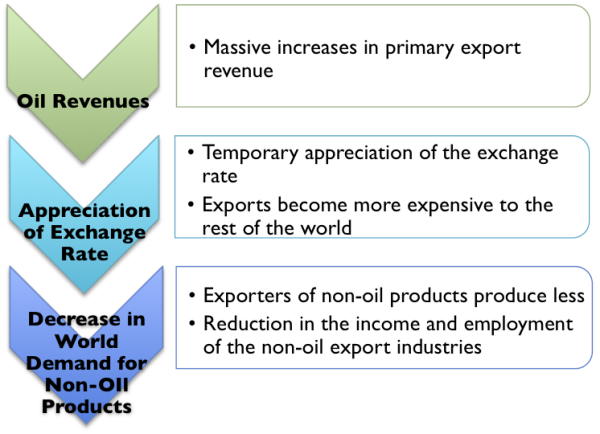
    The inflow of capital leads to an appreciation of the currency, making imports cheap and export expensive. The name comes from the Netherlands experience following the discovery of gas in the north sea. Natural gas sales drove Dutch currency up, seriously hurting the country’s other expdutch-diseaseort industries.

    In late 50’s Netherlands found huge source of natural gases. This resulted in 1. investments (largely foreign direct investments) in that sector 2. decline in other sectors e.g. one example could be people moving for jobs in that sector (consider Indian IT sector as reference) 3. investments (specially foreign investments) in that sector resulted in stronger currency. The excessive investment made Netherlands currency stronger resulting in making exports expensive eventually resulting in decline of export from Netherlands. Manufacturing suffered and thus jobs in manufacturing too go to step 2.

    This convoluted – action/reaction and impact at not so obvious industries – example again suggests to us that even if industries are not linked directly they are linked in some way. This link is interdependence. This interdependence should make one value the existence.

    The  “Dutch disease” should make us once again think about the invisible connections we share with each other.

    Image source – http://globalprosperity.wordpress.com/2010/08/19/oiling-africas-gears-for-democratic-change/

  • Interdependent co-arising – macro-economics example


    I hae written on Interdependent co-arising (older blogs at the link) earlier.  The concept simply means – we are all dependent on each other.

    Those who want to know the concept in layman term follow this blog – interdependent co-arising example of a farmer.

    Definintion of interdependent co-arising is below with a macro-economics example. In late 90’s the East Asian countries faced a very serious economic challenge of decades. The financial system came down like a house of cards. Dr Joseph Stiglitz – Economics Nobel Prize winner of 2001 – shares the concept of interdependent co-arising (dooming in otherwords) in his book  – “Globalization and its discontent“. On Page 106-107 he invariably – and inadvertently perhaps – explains what is interdependent co-arising. Hope economists would understand this lesson, if not from the Buddha then from Dr Stiglitz.

    Beggar-Thyself Policies

    Of all the mistakes the IMF committed as the East Asian crisis spread from one conuntry to another in 1997 and 1998, one of the hardest to fathom was the Fund’s failure to recognize the important interactions amont the policeis pursued in the different countries. Contractionary policies in one country not only deepened that country’s economy but had adverse effects on its neighbors. By continuing to advocate contractionary policies the IMF exacerbated the contagion, the spread of the downturn from one country to the next. As each country weakened, it reduced its imports from its neighbors, thereby pulling its neighbors down.

    The beggar-thy-neighbor policies of the 1930s are generally thought to have played an important role in the spread of the Great Depression. Each country hit by a downturn bolster its own economy by cutting back on exports and thus shifting consumer demands to its own products.A country would cut back on export by imposing tariffs and by making competitive devaluation of its currency, which made its own goods cheaper and others countries’ more expensive. Howeer, as each country cut back on imports it suceeded in “exporting” the economic downturn to its neighbors. Hence the term bagger-thy-neighbor.

    Solution to all these economic, social, personal, spiritual or other problems?

    Its interdependent co-arising itself. We all need to help each other grow – grow the pie and share it well, if not equally!

  • Ted Talk – Bob Thurman: We can be Buddhas


    This is a TED talk I heard yesterday. Thanks to my mobile and TED app found this video. This is a very interesting & small talk by Bob Thurman. I felt to have the transcript too so have searched and pasted it below.

    [ted id=130]

    And I feel like this whole evening has been sort of amazing to me, I feel it’s sort of like the Vimalakirti Sutra, an ancient work from ancient India, in which the Buddha appears at the beginning and a whole bunch of people come to see him from the biggest city in the area, Vaisali, and to bring some jeweled parasols to make offering to him. All the young people, actually, from the city — the old fogeys don’t come, because they’re mad at Buddha, because when he came to their city he accepted, he always accepts the first invitation that comes to him from whoever it is, and the local geisha, a movie star sort of person, raced the elders of the city in a chariot and invited him first.

    So he was hanging out with the movie star, and of course they were all grumbling, “He’s supposed to be religious and all this, what’s he doing over there at Amrapali’s house with all his 500 monks,” and so on. They were all grumbling, and they boycotted him, they wouldn’t go listen to him. But the young people all came. And they brought this kind of a jeweled parasol, and they put it on the ground. And as soon as they had laid all these, all their big stack of these jeweled parasols that they used to carry in ancient India, he performed a kind of special effect which made it into a giant planetarium, the wonder of the universe. Everyone looked in that and they saw in there the total interconnectedness of all life in all universes.

    And of course in the Buddhist cosmos there are millions and billions of planets with human life on it, and enlightened beings can see the life on all the other planets — so they don’t, when they look out and they see those lights that you showed in the sky, they don’t just see sort of pieces of matter burning or rocks or flames or gases exploding, they actually see landscapes and human beings and gods and dragons and serpent beings and goddesses and things like that.

    The made that special effect at the beginning to get people to think about interconnection and interconnectedness and how everything in life was totally interconnected.

    And then Leilei (I know his other name) told us about interconnection and about how we’re all totally interconnected here and how we’ve all known each other, and of course in the Buddhist universe we’ve already done this already billions of times in many many lifetimes in the past. And I didn’t give the talk always…, YOU did, and we had to watch you, and so forth.

    And we’re all still trying to, I guess we’re all trying to become TEDsters, if that’s a modern form of enlightenment. I guess so. Because in a way, if TEDster relates to all the interconnectedness of all the computers and everything, it’s the forging of a mass awareness, of where everybody can really know everything that’s going on everywhere in the planet.

    And therefore it will become intolerable — what compassion is, is where it will become intolerable for us, totally intolerable that we sit here in comfort and in pleasure and enjoying the life of the mind or whatever it is, and there are people who are absolutely riddled with disease and they cannot have a bite of food and they have no place or they’re being brutalized by some terrible person and so forth, it just becomes intolerable.

    With all of us knowing everything, we’re kind of forced by technology to become Buddhas or something, to become enlightened.

    And of course, we all will be deeply disappointed when we do.

    Because we think that, because we are kind of tired of what we do, a little bit tired, we do suffer, we do enjoy our misery in a certain way, we distract ourselves from our misery by running around somewhere, but basically we all have this common misery that we are stuck inside our skins and everyone else is out there.

    And occasionally we get together with another person stuck in their skin and the two of us enjoy each other, and each of us tried to get out of our own, and ultimately it fails of course and we’re back into this thing.

    Because our egocentric perception — from the Buddha’s point of view, misperception — is that all we are is what is inside our skin. And it’s inside and outside, Self and Other, and Other is all very different. And everyone here is unfortunately carrying that habitual perception, a little bit, right?

    You know, someone sitting next to you in a seat , that’s okay because you’re in a theater, but if you were sitting on a park bench and someone came up and sat that close to you, you’d freak out. “What do they want from me?” Like, “Who’s that?” And so you wouldn’t sit that close to another person because of your notion that it’s you versus the universe — that’s all Buddha discovered.

    Because that cosmic basic idea that it is us all alone, each of us, and everyone else is different, then that puts us in an impossible situation, doesn’t it? Who is it who’s going to get enough attention from the world, who’s going to get enough out of the world, who’s not going to be overrun by an infinite number of other beings — if you’re different from all the other beings?

    So where compassion comes is where you surprisingly discover you lose yourself in some way, through art, through meditation, through understanding, through knowledge actually, knowing that you have no such boundary, knowing your interconnectedness with other beings. You can experience yourself as the other beings when you see through the delusion of being separated from them.

    When you do that, you’re forced to feel what they feel. Luckily, they say — I still am not sure — but, luckily, they say that when you reach that point, because some people have said in the Buddhist literature, they say “Ooh, who would really want to be compassionate, how awful! I’m so miserable on my own, my head is aching, my bones are aching, I go from birth to death, I’m never satisfied, I never have enough, even I’m a billionaire I never have enough, I need a hundred billion, so I’m like that, imagine if I had to feel even a hundred other people’s suffering. It would be terrible.”

    But apparently, this is a strange paradox of life, when you’re no longer locked in yourself, and as the wisdom, or the intelligence, or the scientific knowledge of the nature of the world, that enables you to let your mind spread out, and empathize, and enhance the basic human ability of empathizing, and realizing that you are the other being, somehow by that opening, you can see the deeper nature of life, and you can, you get away from this terrible iron circle of I, me, me, mine, like the Beatles used to sing.

    You know, we really learned everything in the ’60s. Too bad nobody ever woke up to it, and they’ve been trying to suppress it since then. I me me mine, it’s like a perfect song, that song. A perfect teaching.

    But when we’re relieved from that, we somehow then become interested in all the other beings. And we feel ourselves differently. It’s totally strange, it’s totally strange.

    The Dalai Lama always likes to say, he says that when you give birth in your mind to the idea of compassion, it’s because you realize that you yourself and your pains and pleasures are finally too small a theater for your intelligence, it’s really too boring whether you feel like this or like that, or what, you know — and the more you focus on how you feel, by the way, the worse it gets. Like, even when you’re having a good time, when is the good time over? The good time is over when you think, How good is it? and then it’s never good enough.

    I love that Leilei said that the way of helping those who are suffering badly on the physical plane or on other planes is having a good time, doing it by having a good time.

    I think the Dalai Lama should have heard that, I wish he’d been there to hear that. He once told me, he looked kind of sad, he worries very much about the haves and have-nots, he looked a little sad because he said, Well, a hundred years ago, they went and took everything away from the haves. You k now, the big communist revolutions, Russia and China and so forth, they took it all away by violence, saying they were going to give it to everyone, and then they were even worse. They didn’t help at all.

    So what could possibly change this terrible gap that has opened up in the world today?

    And so then, ah, he looks at me.

    So I said, Well, you know, you’re all in this yourself. You teach: it’s generosity. Was all I could think of. What is virtue.

    But of course, … I think the key to saving the world, the key to compassion is that, it is more fun. It should be done by fun. Generosity is more fun, that’s the key.

    Everybody has the wrong idea — they think Buddha was so boring, and they’re so surprised when they meet Dalai Lama and he’s fairly jolly

    Even though his people are being genocided, and believe me he feels every blow on every old nun’s head, in every Chinese prison, he feels it. He feels the way they are harvesting yaks nowadays, I won’t even say what they do. But he feels it.

    And yet he’s very jolly, he’s extremely jolly.

    Because, because when you open up like that, then you can’t just, what good does it do to add being miserable with others’ misery? You have to find some vision where you see how hopeful it is, how it can be changed.

    Look at that beautiful thing Chiho showed us, she scared us with the lava man, she scaaared us with the lava man is coming, then the tsunami is coming, but then finally there was flowers, and trees, and it was very beautiful. It’s really lovely.

    So, compassion means to feel the feelings of others, and the human being actually IS compassion. (The human being is almost out of time.)

    The human being IS compassion because what is our brain for? Now, Jim’s brain is memorizing the almanac. But he could memorize all the needs of all the beings that he is, he will, he did. He could memorize all kinds of fantastic things to help many beings. And he would have tremendous fun doing that.

    So the first person who gets happy, when you stop focusing on the self-centered situation of “how happy am I?” where you’re always dissatisfied as Mick Jagger told us — you never get any satisfaction that way — so then you decide, “Well, I’m sick of myself, I’m going to think of how other people can be happy. I’m going to get up in the morning and think, ‘What can I do for even one other person, even a dog, my dog, my cat, my pet, my butterfly.’” And the first person who gets happy when you do that, you don’t do anything for anybody else, but YOU get happier, you yourself, because suddenly your whole perception broadens, and you suddenly see the whole world and all of the people in it. And you realize that this — being with all these people — is the flower garden that Chiho showed us.

    It is Nirvana

  • Tender coconut


    I live in a place where there are many coconut trees nearby. No doubt we get tender coconut on a regular basis. In fact for months I had been playing with my niece – Chinu – with those tiny coconuts by helping her throw them in the sea. What I never noticed while helping her play with those tiny coconuts was – “how it grows from a nothing to so many things!” That blossoming of coconut from just a tiny coconut with nothing to a tender coconut with water and coconut with oil and thick shell with husk and so on made me think.

    Source - indiaheals.blogspot.com
    Tender Coconut
    Source – indiaheals.blogspot.com

    Recently, I went to our regular tender coconut milk joint. I saw some completely ripe coconuts kept in the shop. That made me thinking. I have seen those small non-entity coconuts. I started wondering, how come this thing gets water? Slowly that water converts into a shell. The same shell then helps create the outer cover of a ripe coconut (brown in color), coconut and the outer husk. Where does the husk on that green outer cover come from? Even in a ripe coconut the husk is not visible!

    See it is very interesting, the same content converts into many forms. The tree is the same, its receive same nutrients from ground and sunlight. Tree does the same activity but different parts grow in different ways. Everything is so perfect at its place, making that non entity to a perfect coconut.

    I was lost in my thoughts that nature has strange ways to convert one thing into other. More deeper in thoughts, I started thinking about us – Humans. We also are from the same source. We get our energy, color and share everything from the contents of the earth, right! In a unique way we are different but at a macro level we are humans. If we think about future we would leave everything here – the iron of our blood, calcium of our bones and water of our body. We got everything from the earth and we would leave everything behind when we would die. Still we fight when we are alive!

    This tender coconut helped me realize this clearly that we are made from same contents. Though in my mind I always knew it, perhaps everyone of us knows this. Yet we generally think it as “obvious” and overlook it.

    Related blogs –

    Blogs on Interdependent Co-arising

    Death

    Death is inevitable

  • For Profit Businesses


    Businesses are made for profit making, is there a question in this assumption or argument? For the time being, I am assuming there is no doubt about the argument that business exist for making profit.

    I have been thinking about the topic of “measuring growth” I wrote recently. People may say there are businesses as “Not for Profit Businesses”. This concept of “Not for Profit” in many cases is about reinvesting profit in business rather than giving dividends to the shareholders/investors.

    There are other businesses which are “social enterprise”, I wrote on such businesses with reference to a book “I have a dream”. These are businesses which exist for making profit; however their primary reason of existence is social upliftment with moderate profits. I wanted to ask myself – why not all For Profit Business be like that?

    In my previous career engagement, a couple of times I had a chance to meet CMO of a big Mutual Fund house. In one interaction he told my boss – “you do X, Y and Z; Calculate your cost; add your 20% profit on that and charge me. I need this X, Y and Z done.” This statement was very liberal to hear. I had seen many organizations trying to squeeze their service provider. Thus the statement became a guide for me to think about such clarity and about fair co-existence. I relate the same to the previous post of “measuring growth”. When I tried understanding Islamic banking and asking the feasibility of the system, I saw contrary view points. I read somewhere Islamic banking does not call “interest” (on debt) as interest whereas terms it as profit sharing (say 20%). So there may be businesses so clear and there could be predictability in cost, profit and growth of business and economics.

    This kind of approach is very simple. However, the above case is very simplistic and everything (many things) would become very predictable – how would finance experts – involved in complex transactions and certificates  – would be able to manipulate market? There can still be demand and supply gap and market may run into a relatively predictable and stable equilibrium.

  • Collective Materialism – likely future of economy!


    I have written about socialistic capitalism or capitalistic socialism. When I say that I simply mean that we would move our economies and businesses in a direction where there would be a balance. It would be a kind of middle path where enterprise would exist at the same time there would be a concern for the society and social development. Take an example of corporate social responsibility (CSR), however the word CSR would become more of a practice than a statement in annaul reports. The reason for the same would be – we are all connected. If I do not earn how would bank generate savings? If banks do not generate saving how would they offer loan and so on. In terms of Buddhism it is similar to interdependent coarising.

    In more sophesticated words the tripple bottomline would be the corporate mantra in future enterprise. I thought of an example which could be the model for this concept of triple bottomline. I happen to read corporate philosophy of Sahara India Parivar – “Collective Materialism”. This company is very interesting and different – it calls itself a family and everyone is a worker first. According the the website of the company the philosophy of collective materialism is as follows –

    “In any human relationship, it becomes imperative to take into consideration the materialistic aspect of life – we do so but by giving it second priority.

    The first priority is given to emotional aspect and with perfect blending of materialism with emotionalism results in continuous collective growth for collective sharing and caring, that gives an impetus to our philosophy.”

    On a lighter note collective materialism is not what Government of India doing – filling pockets of few select few (so it is collective and materialism both) Sahara shree – Subrato Roy – deservers the credit for this philosophy.

    Related blogs

    The middle path

    Balancing act

    Cause…

  • “Social Strategy” – a step in the future!


    A couple of days back I was on Facebook. Yes it happens when you are too occupied with work and commitments are such that you are socially cut-off – even if you do not want to. I checked Facebook update of one of my friends – Nishant Jain, a Supply Chain specialist with HCL – “Outsourcing is dead. Co-sourcing is the only way to go” by Vineet Nayar. This comment of Mr Nayar and subsequently sharing the statement by Nishant makes an statement that we are going to grow together, there is no other way out! I wrote on this earlier – Collaboration in logistics… What we call competition or what we see as “servicing clients” is actually helping client perform their duty better and there needs to be more ‘open-ness’ and involvement in what service/product we are offering. I started writing my blogs with the same concept (Refer – Why this title?).

    …“When Ferrari and Honda run on the racing track competing for the first spot, they are not eying at the first spot, they are racing to offer best product to their customers.” The Buddha’s teaching on ‘Dependent co-arising’ teaches me this. “Each one of us is a rung of a ladder to the other and vice versa, hence for self development and moving higher up, one’s ladder should be strong enough, even one’s competitors.” I believe this will be the extension of P&G’s present approach of Connect & Develop in future; working on various fronts with the competitors such as IPR – strategically innovating – besides others…

    I requested Nishant that would it be fine if I refer you in the blog? He is kind enough to say yes. Around the same time, when I was drafting this blog I happened to read an article in McKinsey Quarterly – The social side of strategy.  This article, Nishant’s facebook update and my owns earlier blog connected all the dots. I could see the relationship between Business and the Buddha in another dimension yet again.

    According to the McKinsey article companies are trying their hands on social strategy. Further it states that such strategy planning efforts would be more inclusive, action oriented, detailed and of course measurable. The other advantage of such efforts would be enthusiasm people would have; it would provide ownership to the execution. The reason for these strategic initiatives to be far more measurable is that these would increase accountability. Everyone in the organization would review progress of each initiative resulting in improved quality.

    Effectively, we are moving toward a more inclusive society and more inclusive organizations. Caution – the idea of open strategy or social strategy is to provide a platform to the organization for brainstorming, yet the whole idea is not yet completely evolved. So, companies need to open up slowly in some regards such as intellectual property.

    As Indian philosophy states – Vasudhev Kutumbakam (one-world family), I sincerely hope to see that happening.

    I would continue this in future blogs, too. Until then thank you for reading.

  • Pocahontas – “Colors Of The Wind”


    I heard these lyrics and liked it, specially few lines, thought to share it on my blog. Though, I do not want to take beauty of  lyrics yet cannot stop myself  from writing

    “…And we are all connected to each other” – this relates to interdependent co-arising

    “…Come roll in all the riches all around you” – I felt it often, that (at least in metro cities) we are so much bogged into  our daily commitment that we don’t even look up in the evening at these beautiful constellation of stars. We are running behind the ‘riches’ of pockets and losing on the wonders around us

    [youtube=http://www.youtube.com/watch?v=HvvZ1TEQRB8]!

    You think I’m an ignorant savage
    And you’ve been so many places
    I guess it must be so
    But still I cannot see
    If the savage one is me
    How can there be so much that you don’t know?
    You don’t know …

    You think you own whatever land you land on
    The Earth is just a dead thing you can claim
    But I know every rock and tree and creature
    Has a life, has a spirit, has a name

    You think the only people who are people
    Are the people who look and think like you
    But if you walk the footsteps of a stranger
    You’ll learn things you never knew you never knew

    Have you ever heard the wolf cry to the blue corn moon
    Or asked the grinning bobcat why he grinned?
    Can you sing with all the voices of the mountains?
    Can you paint with all the colors of the wind?
    Can you paint with all the colors of the wind?

    Come run the hidden pine trails of the forest
    Come taste the sunsweet berries of the Earth
    Come roll in all the riches all around you
    And for once, never wonder what they’re worth

    The rainstorm and the river are my brothers
    The heron and the otter are my friends
    And we are all connected to each other
    In a circle, in a hoop that never ends

    How high will the sycamore grow?
    If you cut it down, then you’ll never know
    And you’ll never hear the wolf cry to the blue corn moon

    For whether we are white or copper skinned
    We need to sing with all the voices of the mountains
    We need to paint with all the colors of the wind

    You can own the Earth and still
    All you’ll own is Earth until
    You can paint with all the colors of the wind

    Source – http://www.stlyrics.com/lyrics/classicdisney/colorsofthewind.htm#.T70bBkXzsZw