Tag: interdependent co-arising

  • Bhavachakra – the wheel of life


    On this buddha Poornima (Sunday 6th May), came across detailed explanation of Bhavchakra. I thought to share it on blog.

    Life seriously is a wheel, is not it? For individuals – Wheel of emotions, wheels of personal development and wheels of social interactions. For organizations and society too this wheel goes on – growth, development and destruction. Check any Indian Soap of prime time, you would come to know what we are surrounded with. It is up to us to learn about this wheel and help ourselves to get out of this – app dipo bhava (be a light unto yourself).

    The following content as well as image on bhavachakra is from this link, which explains it well.

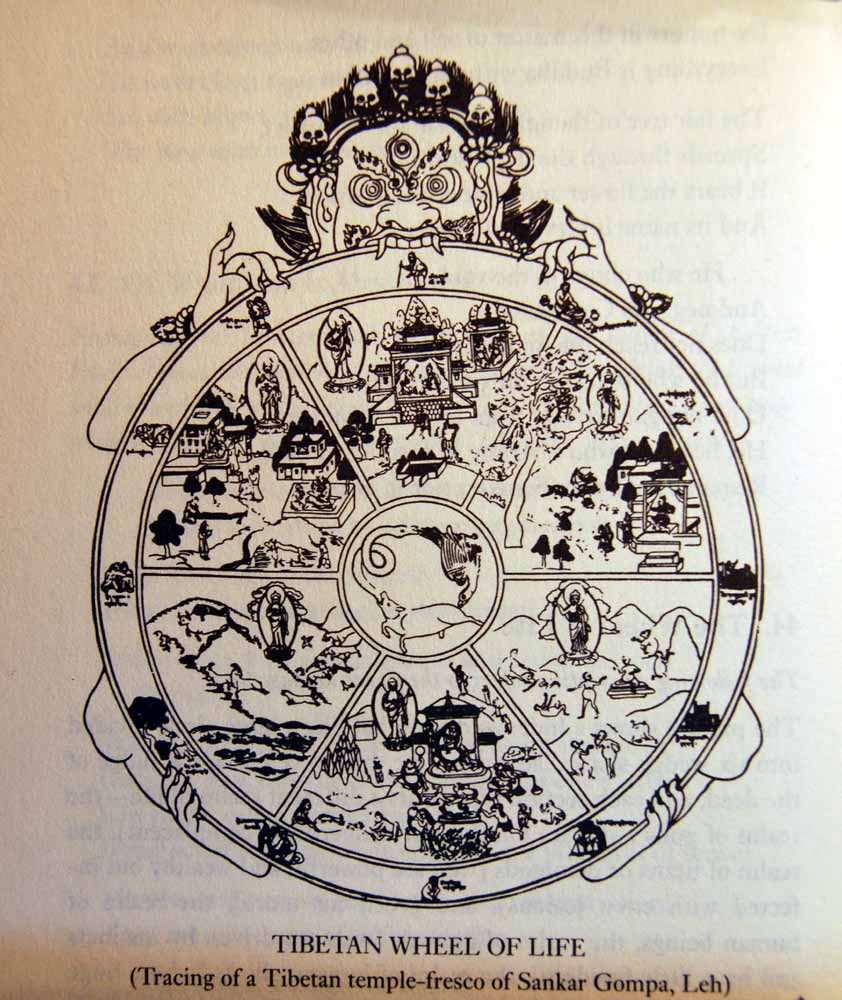
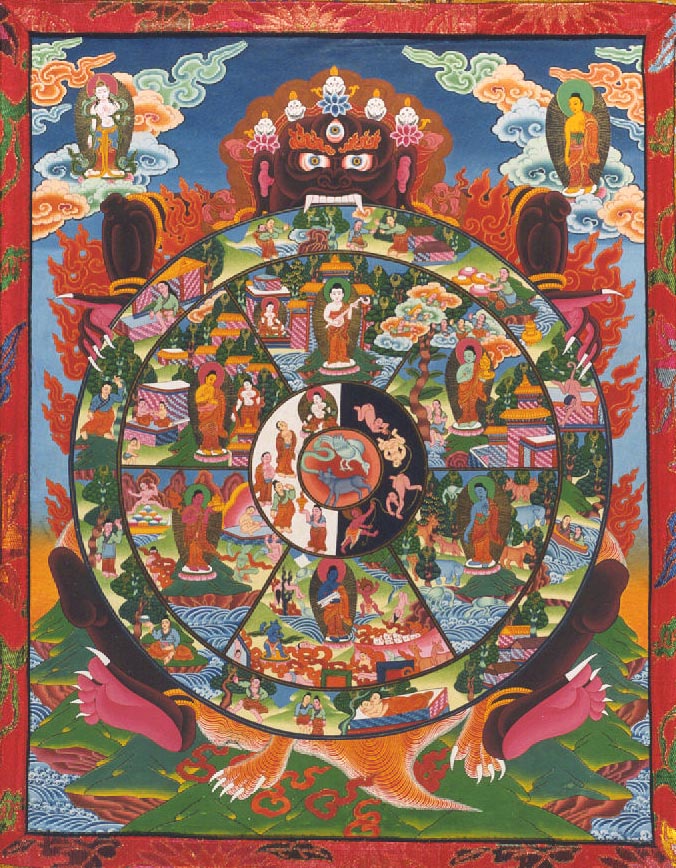
    Bhavacakra or Wheel of Becoming/Wheel of Life is a form of a mandala or tanka (painted wall hanging), used primarily in Tibetan Buddhism.  The painting of a tanka is itself a form of mediation.  Its meaning is very complex, and can be read to represent at least three different realms of manifested effects ofkarmic actions.  It can be read as a diagram for the six different kinds of existence into which one may be born into during the middle rounds of samsara.  It can be read as symbolizing each of the different realms of human existence, lived out by certain kinds of people according to their karmic fortunes of personality type and socioeconomic status.  Or it can be read as a description of situations or states of consciousness that everybody passes through again and again in the course of a single day.
    Its iconographic meaning is correspondingly complex as well.

    In the background are varied Buddhist symbols, such as the moon, clouds in shape of swastika, and always a representation of at least one Buddha orBodhisattva, seen attempting to help sentient beings to find their way to Nirvana.

    The wheel is held by the jaws, hands and feet of the demon, Yama, the judge of the dead, who turns the wheel.  Yama represents the ignorance that comes from greed and “selfhood,” that keeps the wheel of suffering turning.

    The outer rim of the wheel is divided into twelve sections, called the Twelve Interdependent Causes and Effects – 1. ignorance, 2. volitional action or conditioning, 3. consciousness, 4. name and form, 5. six sensory organs (eye, ear, nose, tongue, body and mind), 6. contact or touch, 7. sensation, 8. desire, craving, thirst, 9. grasping, 10. becoming or existence, 11. birth, and 12. decay and death.

    The areas between the six spokes represent the six forms of unenlightened existence.

    There are six wedged-shaped sections, with each representing a different realm of life –

    1. realm of the Gods – Devas (who are blissful but dangerously complacent; always at the top of the wheel)

    2. the realm of the titans, demigods and fighting demons – Asuras (lowest rank of gods, who are powerful and wealthy but infected with envy, jealously, and greed for more; always in the upper half of the wheel)

    3. the realm of “human beings” (always in the upper half of the wheel)

    4. the realm of “animals” (sentient beings, less intellectually advanced than humans, driven by instincts and have little freedom, but can still experience suffering and project karma; always in the bottom half of the wheel; inclusive of birds, fish, and even a worm)

    5. the realm of “hungry ghosts” – Pretas (whose huge bellies but pinpoint mouths and eyes suggest insatiable craving; always in the bottom half of the wheel)

    6. the realm of “hell beings” (who are consumed with relentless rage; always at the bottom of the wheel; beings brought to hell for  past karma, but beings who can escape it through good deeds and reincarnation).

    At the center or hub of the circle is a smaller circle containing the Three Poisons, within a rim of binary demarcation of black and white. The black section represents the Dark Path on which sentient beings are moving downward to the hellish realms. The white section represents the Path of Bliss on which beings are moving upward to the Godly realms. The Three Poisons are personified as a rooster or fowl, a pig or boar, and a snake, chasing one another around and around. They symbolize the forces that keep people caught up in the samsaric round of existence: the rooster stands for greed, the pig for ignorance or delusion, and the snake for hatred.

    The wheel can thus hold distinct meanings, each speaking to different sensibilities.

  • Where is growth?


    The mobile was ringing, suddenly phone was picked and the statement – wait! Mumbai Indians needs only 5 runs to win in last 6 balls. I said ok Sir I will call you in five minutes. The turmoil of thoughts continued in my mind. What am I thinking, what are the questions in my mind, so many things how do I connect all these dots etc. Mumbai Indians eventually won, Prof Mankad informed me in next five minutes.

    We started talking – the market is steady, if not bull than not bear too. Indian Prime minister and Finance minister both are making statement that “We are going to grow at 6.9% if not at 8%”. Still, there is some uncomfortable feeling. I told Prof Mankad, “Sir I am not convinced. Further to it I said – news is Facebook is licensing the AOL patents – owned by Microsoft now – for close to 550 million. Next thing which I forgot to ask him was – news of bribing in Mexico by senior executive of Wal-Mart. Wal-Mart was running behind growth – sometimes in 90’s – and got in this trouble recently when the case was surfaced. I further added that Italy and Spain are showing -ve growth (to be precise signs of recession), where is growth?

    As always these questions were simple to answer for Prof Mankad. What he said very closely resembled to my thinking of inclusive growth. He said – hold your horses, the questions are right, this growth is notional and specific to IT and finance industry, largely to few services industries so to speak. The questions are pertinent, sir said. If I remember correctly he also informed me that Italy not only Spain has declared recession, French election would surely put more light on the already tough Euro crisis. Sarkozy is likely to lose, and then there are more elections coming up in Europe e.g. Germany etc. Political parties in Holland have agreed on austerity measures. Growth would happen and thus recession would be arrested only once we see growth in all the industries otherwise we are in a bad shape. It is not possible to say that we are growing at so and so rate when only one or two industries are showing signs of growth.

    This reminded me of my most loved theory of the Buddha – Interdependent Co-arising. I have written on this often and the current situation shows us yet once again that we are all connected, nothing can be isolated and growth is a collection of small growth in each industry. Each industry is a building block for the overall movement of the engine of economy world across (with few riders). No China can survive without US or Europe, no India or Philippines can grow its service industry until there is overall growth in the demand of service industry in developed nations.

    Where is growth? There would be growth when we all learn that we need to think about each other and help each other grow – we are all interdependent and we would successfully grow only when we grow together.

  • Pulse polio and dependent co-arising


    Its been three weeks I did not write anything on blog. I felt as if I am not doing justice with my blogging. However, I was too busy with work and therefore could not fulfill this commitment. This passion when put on hold by professional responsibilities, I can understand how difficult would it be for us to think of some lesser important things which may hamper our personal life. Well, whom to apologies for this – to myself?

    Since 1995-96 India is on a mission – Remove Polio from India. I remember I – as a student – had to participate in a speech on the same in 1995-96. Daughter of one of my acquaintance herself went to a stall of Pulse Polio mission and got administered these drops (she was quite adventurous!). This mission is still running, apparently every year February to April the activities are quite high. Last Sunday my niece was administered these drops. This initiative made me think.

    I remembered my MBA class of economics. In that class Prof asked – what if I alone have a Fax Machine in the whole world? There is no use of such device when one cannot send or receive faxes, right? I tried extended this concept of network effect on the Polio issue. Even if a child is left without treatment for polio chances are that the decease may extend to coming generations. I could also connect this network effect and treatment of polio to interdependent co-arising. Needless to say, Polio virus would not see if a child is born rich or poor, belongs to which caste, color or religion. Therefore, the important thing is – we need to help each other as a society and get rid of things such as Polio or let us go beyond Polio – corruption, greed and selfishness etc etc. Because we are all connected to each other.

  • Humans are social animals


    Have you ever asked a question to yourself – why? Why am I doing it? Why am I running from pillars to posts either aimlessly or with an aim. Once the aim is achieved – what next? Every strategic question stems a WHY in the mind of management also, right?

    So the question, why? Leads organizations as well as individuals. This question has led me to think about far in the future how we (individually, socially and economically) might evolve, as well as how I see things should/could happen. This is where I see the collaboration would play a bigger role. Look at crowd sourcing, look at open source. My assumption is – in a given day – maximum downloads in the world are happening from Android market place. That is again a collaboration – a freemium service (free+paid).

    *If I talk about some more technical stuff – at times companies make their intellectual properties ‘public’ without a patent, for example SQL. It was invented at IBM however was kept open (not patented, of course you may argue on the possibility of software patent in 1970s etc etc). Also you may argue that it was a mistake.*

    A couple of years back I wrote articles on format wars and the failure of Betamax (and of HD DVD). Have you ever seen there are times when you have to stop fighting and start working together? There may be times when a company has to collaborate because of its dependence or loss in the market place. The fact of the matter is – at times collaboration is forced and in other cases by choice. Yesterday I read a news article on The Hindu that RIM (manufacturer of Black Berry) introduced its new operating system (OS) for its BlackBerry PlayBook tablets with additional functionalities, including the ability to run Android-based applications. Nokia with Windows, Blu-ray with content providers and manufacturers, VHS with OEM. I am confident the future businesses would be built on Collaboration, association and aggregation.

    …And as the cliche is – humans are social animals – we would remain social animals and collaboration would be the name of the game. So, for business some “business rules” would go on shelf and some new rules would evolve.

    * Readers are warned that the IBM and SQL part is not a professional advice as a registered patent agent, the example is used as representation of authors thoughts about the future.

  • Interdependent co-arising – a farmer’s example


    Recently Dr Raghunathan shared a link of his interview with Wharton with me We are individually very smart but collectively dumb. The very first paragraph of the interview has an example of a farmer. A farmer whose corn won top awards year after year. When a reporter asked about the secret of his success, the farmer attributed it to the fact that he shared his corn with his neighbors. Why, the reporter wondered, would the farmer want to share his seed when those neighbors also competed with him for the prize? The farmer’s reply was, “The wind picks up pollen from the ripening corn and swirls it from field to field. If my neighbors grew inferior corn, cross-pollination would steadily degrade the quality of my corn. If I am to grow good corn, I must help my neighbors do the same.”

    I am writing time and again on interdependent co-arising and how it applies to businesses, I think this small story on BUSINESS – a winning business – states a lot about ‘interdependent co-arising’. This example applies beyond India, the long term gain for world economy would be working on the concepts of interdependent co-arising.

    Related blogs on interdependent co-arising

  • Theory of constraints


    Prof Moradian taught us concept of the Theory of Constraint. He also suggested us to read a book by Eliyahu Goldratt – The Goal. In the novel, protagonist is struggling with the operational inefficiencies of his plant and therefore facing a constant fear of management decision to close the plant.

    Well, what is this theory of constraints (ToC)? In brief ToC states that “A chain is no stronger than its weakest link”. I was thinking that this concept is applicable to our society too. We are evolving, we are constantly developing some thing or the other, society is a sort of factory. And the concept of the ToC applies equally to our life. Look at it this way if rich becomes richer the poorer would become weaker link of the society. Have you heard that during recession crime rate increases? This is ToC for our society. Lately, lot of demonstrations are happening across world by the title Occupy Wall Street. This is where I think that ToC can be applied in the society.

    I thought about interdependent co-arising and the Theory of Constraints in conjunction. My understanding of interdependent co-arising is that – we are all dependent on each other and for growth of each individual other has to necessarily grows. In other words, if society wants to evolve, everyone in the society has to evolve. The weakest link of the society may hamper the growth of society in total. Here I see a solution to the constraint, perhaps a socialistic one. We as a society have to help each other to grow (strengthen the weakest link), otherwise we would see increasing “Occupy Wall Street” kind of movements or increasing crime rates in future.

    I shared these thoughts with Prof Moradian and he said the idea is good why don’t you think about throughput and operating expenses and develop this concept of ToC in society further? This made me dig deeper. It is said that ‘a stitch in time saves nine’. If we rewind to 2008, after months of searching for alternatives Mr Barnanke, Mr Paulson and others had to bail-out banks of USA. Why not we start doing something now and for future. I see the operating expenses of this approach as deferred expense of brand building (building society) exercise for future. The throughput of the exercise would be availability of competitive, capable and intelligent work force for companies. These capable people would be the spenders of tomorrow – moving the wheel of consumerism forward – effectively, the solution may not be as socialistic as I think.

    Related blog – Ideate – save the sinking ship

  • How long will we live in the world of $! from ‘Network’


    The following are few dialogs (curtsey – www.imdb.com)… It is interesting so sharing on my blog. ‘How long will we live in the world of $!’

    The concept of movie is based on how a news channel management and one of its anchor share relations and What happens in an apparent conflict. This movie was released in 1976 (after the oil crisis – perhaps ’70s- , before the economic crisis in US – early ’80s). So effectively, we have been like that and we will remain the same, provided we learn a lesson this time around. The time is here and now, to learn – we would have an economic crisis again in 3 years and I wonder how long it will take to get back to normalcy. This movie was made 30+ years back, world saw 1910’s (World war), 1920’s (Great depression), 1930’s-1940’s (world war and after effect) and then 1970’s (oil crisis) and 1980’s (economic slow down). When did we have a peaceful time? There has to be some sense in the world – we need to learn, we have to learn – how long will we live in the world of $? Life also exist beyond the turmoil of $.

    The dialogs are below –
    Arthur Jensen (owner of the channel): [bellowing] You have meddled with the primal forces of nature, Mr. Beale (the anchor), and I won’t have it! Is that clear? … The Arabs have taken billions of dollars out of this country, and now they must put it back! It is ebb and flow, tidal gravity! It is ecological balance! You are an old man who thinks in terms of nations and peoples. There are no nations. There are no peoples. There are no Russians. There are no Arabs. There are no third worlds. There is no West. There is only one holistic system of systems, one vast and immense, interwoven, interacting, multivariate, multinational dominion of dollars. Petro-dollars, electro-dollars, multi-dollars, reichmarks, rins, rubles, pounds, and shekels. (I wonder why we do not understand interdependent co-arising only in terms of dollar) It is the international system of currency which determines the totality of life on this planet. That is the natural order of things today. That is the atomic and subatomic and galactic structure of things today! And YOU have meddled with the primal forces of nature, and YOU… WILL… ATONE!

    Arthur Jensen: [calmly] Am I getting through to you, Mr. Beale? You get up on your little twenty-one inch screen and howl about America and democracy. There is no America. There is no democracy. There is only IBM, and ITT, and AT&T, and DuPont, Dow, Union Carbide, and Exxon. Those *are* the nations of the world today. What do you think the Russians talk about in their councils of state, Karl Marx? They get out their linear programming charts, statistical decision theories, minimax solutions, and compute the price-cost probabilities of their transactions and investments, just like we do. We no longer live in a world of nations and ideologies, Mr. Beale. The world is a college of corporations, inexorably determined by the immutable bylaws of business. The world is a business, (in my opinion – world is more than *JUST* business or in other words everything is a business) Mr. Beale. It has been since man crawled out of the slime. And our children will live, Mr. Beale, to see that… perfect world… in which there’s no war or famine, oppression or brutality. One vast and ecumenical holding company, for whom all men will work to serve a common profit, in which all men will hold a share of stock. All necessities provided, all anxieties tranquilized, all boredom amused.

    Howard Beale: [ascending the stage] So, you listen to me. Listen to me: Television is not the truth! Television is a God-damned amusement park! Television is a circus, a carnival, a traveling troupe of acrobats, storytellers, dancers, singers, jugglers, side-show freaks, lion tamers, and football players. We’re in the boredom-killing business! So if you want the truth… Go to God! Go to your gurus! Go to yourselves! Because that’s the only place you’re ever going to find any real truth.

    [youtube=http://www.youtube.com/watch?v=7sySuIXG_IM]

  • The Machine that Changed the World


    I read this book recently “The Machine that Changed the World“. It is indeed a good book every businessman should read it. “The business is run on trust” or “the business will be run on trust”. When we hear this statement it seems odd, however it is true Trust is the factor. I wrote often about ‘interdependent co-arising‘ (Blog 1, Blog 2 and Blog 3). When I read this book I realized that it is practiced in Japan for many years. Toyota has substantial equity share in its suppliers and the suppliers of suppliers. This is a complete mesh of cross-locking equity structure. They trust each other decide a profit margins rather than hiding the cost structures. According to the book “…This system has replaced the vicious circle of MISTRUST into VIRTUOUS circle of COOPERATION…”.

    The cross linking equity structure goes to a deeper level and different competitors also own each others share. This shareholding pattern is to help each other raise funds. Reference to this is – “The Machine that Changed the World” page 194 perhaps it is edition 1.

    What I found interesting (page 151 of the book I think first edition) – when the volume of demand changes and assembler gives notice to the supplier and in case the volume (demand forecast) fluctuates “…The assembler will work with the supplier to look for other business…”. This is not only interesting but also a surprising and welcoming effort to build trust. One more thing I found very impressive and useful – “…we (suppliers) work without safety net, so we cannot afford to off the high wire…” and thus suppliers maintain the quality not only for their own sake but also for the assemblers.

    The other interesting fact is not just production but also product development is done in cooperation. We hear “crowd-sourcing” as a means for innovation however, a crude system has been used by Toyota for years now. New product development at Toyota involves the suppliers and major work of NPD is done by the suppliers.

    One more interesting factor I realized while reading the book. When we say “one customer at a time” and “managing customer relation in Marketing”, this concept was far more ingrained in the Lean system of sales even in 60s. So beyond Operations the Lean system has been a pioneer in Marketing and Sales too.

    Still after praising the book I am of the opinion that there would be some method which will change the game even further. The question to ask is when and how (which I contemplated earlier)?

  • Porters five forces


    Three or four years back when I was reading the book – Blog – Old path white clouds (Book – Old Path White Clouds), I started looking at businesses with a changed mindset. In India, there are small stalls on roadside. The stalls could be tea stall, paratha stall, idly dosa stall, Sandwich or others. What I observed was, at many places these stalls were near each other e.g. tea stall near the sandwich stall or the idly stall. This is so common that we overlook such arrangements of shops.

    What is the reason of them being next to each other? The reason is roughly 50% of the buyer of sandwich would buy a cup of tea or the other way round some people buying tea would order for a paratha. These offerings are seemingly different for the stall owners, they are selling a refreshing drink or a breakfast however, from the point of view of a customer it is a wholesome offering – tea with paratha/sandwich.

    Well the point I am trying to make with the example is one and the same. In terms of business Prof Mohan Sawhney (of Northwestern University) says ‘Metamarket’ and in Buddhism they called it interdependent co-arising.

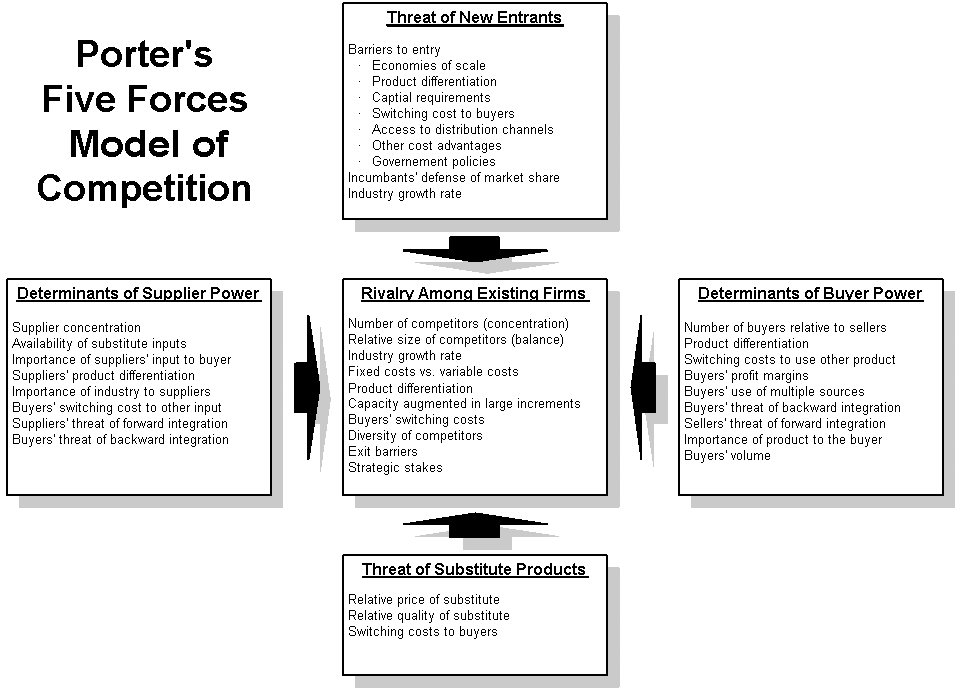
    Representation of porters five forces
    In organized retail, there are two parties catering to the end customers. One the manufacturer and the other retailer. Here too, we would see the collaboration or the dependence of one on the other. If I relate the concept of interdependent co-arising further with the very basic management lessons – Porters Five Forces – we would observe few things. Earlier the manufacturers had power (suppliers power) and now the retailers are gaining power (buyers power), and this cat and mouse game would continue. This power would shift to the ultimate buyer – the customer – perhaps it will happen in the future.

    How can the forces be balanced? Well, when we look in the basics we would learn. The idea in any game theory based dilemma (Prisoners dilemma) is that when each one starts co-operating everyone wins. That would apply in long term. Net net – we would have to be on the basics – the concept of interdependent co-arising.

    Image source – http://www.smartcode.com/

  • A cup of tea


    I see at this cup of tea kept upon my table. Oh yes this cup is full of tea :)… I have to consume it… I have heard a tagline (Cafe Coffee Day an Indian Coffee chain) – “a lot can happen over coffee”. Let me replace Coffee with Tea.

    ‘A cup of tea’, it actually relates to many industries. The packaging industry, the cup/disposable cup manufacturing, tea company, tea farm, sugar (if added), Milk, Energy (utilized in making tea as well as manufacturing/processing other parts). Energy goes to a different tangent again – how produced, how transmitted etc. So this simple cup of tea kept on my table makes me think about so many things. Wait let me drink it, it is getting cold and horses of my mind are running unnecessarily. Whatever is the case this cup of tea has made me think of ‘interdependent co-arising’.

    ‘Interdependent co-arising’ is a concept in Buddhism. This concept states – everything in the world is dependent on other thing and things evolve together. [This is my understanding of the concept…]

    If we extend this concept to business – observe the value chain of any business. The cup of tea I was thinking about is a perfect example of Interdependent co-arising. I read a concept proposed by Prof Mohan Sawhney (of Northwestern University) – ‘metamarket’. Metamarket is a cluster of complementary product. The complementary product actually belong to diverse set of industries. This goes again to the cup of tea and a very basic as well as vital concept for each one of us to understand – interdependent co-arising.