Tag: interdependent co-arising

  • Business and the Buddha – Does It Still Stand?

    In 2010 when I started the blog Business to Buddha, my hypothesis was simple – there is a connection between business, economics, management and spirituality. At that time, I found it very logical. But today, I sometimes stop and ask myself – does it still stand true? Or was it only a nice thought to start a blog?

    I go back to Buddha’s teaching of dependent co-arising – we grow when others grow. In business language, this looks like collaboration, co-innovation, ecosystem play. One company wins, but not at the cost of the other, rather both become stronger in the process. In my first blog, I had taken the example of BMW launching Z3 with James Bond movie. Or even in racing – Ferrari and Honda compete, but they push each other to make better cars. Competition, yet mutual growth.

    That is why I felt Business to Buddha makes sense.

    But where does it not work? The reality of quarterly numbers, investor pressure, market share fight – these are not spiritual conversations. Here sometimes compassion or equanimity takes a back seat. You can’t tell your board, “let’s wait for the muddy water to settle before we act.” In these moments, spirituality looks like a luxury.

    Krishna’s Wisdom

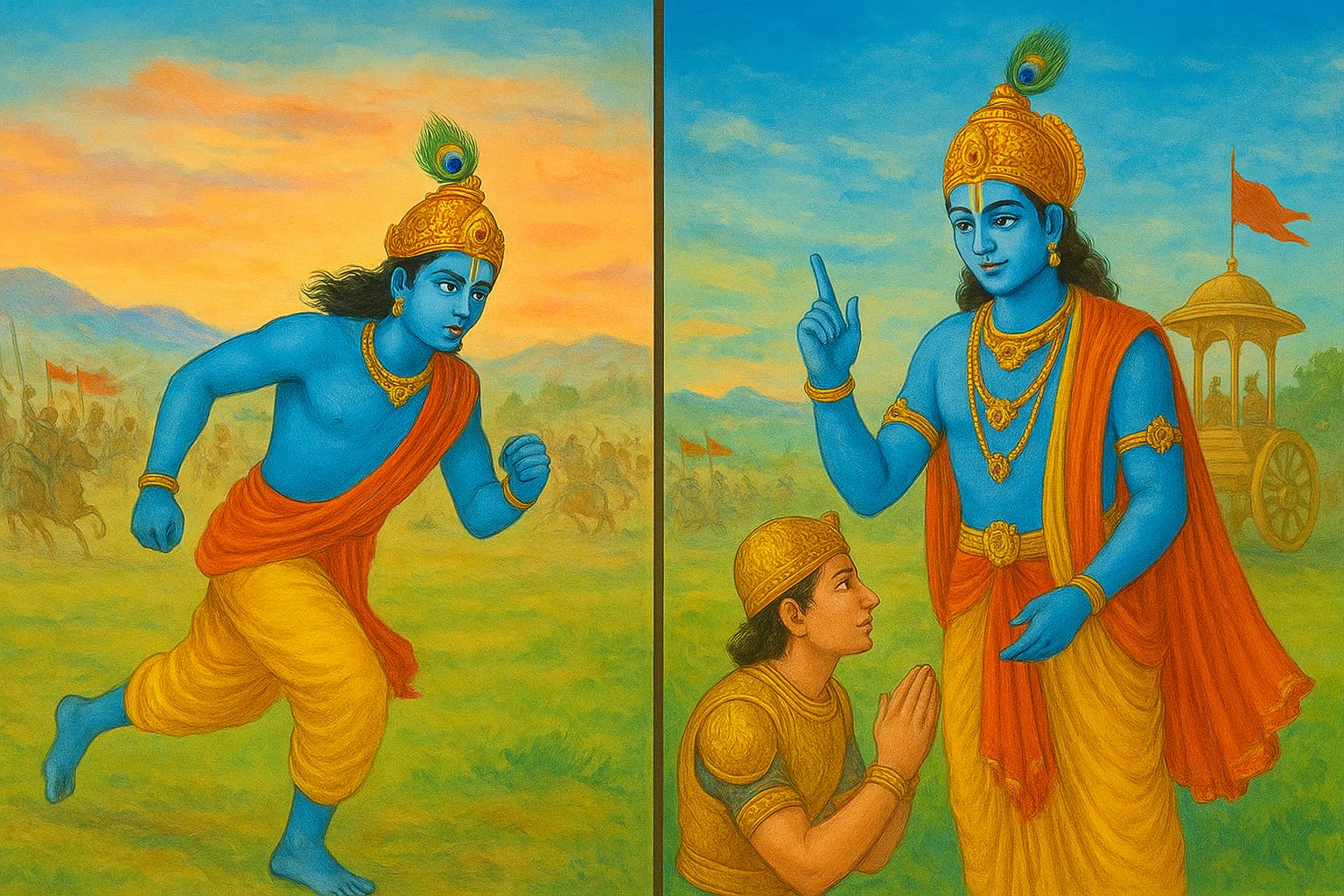
    This is where I feel balance is important. If you see Mahabharata – Krishna himself ran away from one war (Jarasandh and Kalayavan, if I recall right) but later encouraged Arjuna to stay and fight at Kurukshetra. Same Krishna, two different situations, two opposite responses. Business also needs that balance. Sometimes retreat, sometimes full action. The wisdom is to know when to do what.
    Chanakya also wrote – artha (economics) and dharma (ethics) go hand in hand. If either is missing, the state collapses. Maybe that’s what we miss today – we run only for artha and leave dharma behind.

    So does Business to Buddha still stand? I’d say yes, but not as a formula, more as a reminder. It is not that every board decision must sound like a sermon of Buddha. Rather, it is about remembering there is a middle path – between hard business realities and human values. Between quarterly pressure and long-term trust.

    The Buddha said walk the middle path. Krishna showed both – running away once, fighting another time. Chanakya tied economics with ethics. Somewhere in between these, lies the balance for us – in boardrooms, in markets, and in our lives.

    Maybe that’s why this blog continues. Not because I have answers, but because I still feel the question is valid – can we connect business with the Buddha? For me, yes – because life itself is this balance.

    Image generated using AI model

  • Impermanent and trifling or forever and important

    I was playing with Adviti in our building’s parking area. There were some small dead branches of a tree. On the face of it, it looked an impermanent and trifling item to me. I took it in my hand, showed it to Adviti. We started talking, I told her this was a branch of the tree above. It had leaves, that nourish the tree. Well, I did not go up to photosynthesis, Adviti is only three years currently. I questioned myself with the chain of thoughts – are things Impermanent and trifling or forever and important?

    Smiling-Baby

    Deep inside, I started feeling multiple things, one as if the branch and leaves had their own life. What I mean is – the life of a tree and the life of a leaf or branch were separate. It was a strange thought, this is like saying my hair, or skin, or nails have a separate life other than my own body. It becomes even weirder from here. How do I know that I have only “This Life” that I perceive? I have written earlier – and we all know – our body hosts umpteen living organisms. I cannot experience them therefore they are separate or they do not even exist for me, is it?

    All these thoughts were going on with the disturbing news of deaths due to Covid. I came home after the small walk with Adviti and started re-reading a chance chapter of Old Path White Clouds book. It was luck that the chapter was based on interdependent co-arising, the concept of Buddhism I love the most. news of death makes one feel a void, and question the existence. At the same time, the thought of the impermanent and trifling nature of our life comes to mind. At the same time when I think from a larger perspective, our life seems forever and important.

    Let me share some paraphrase parts of the philosophy of the Buddha on “Impermanent & trifling” vs “forever and important”.

    While The Buddha was meditating he was a Pippala leaf. Looking deeply at the leaf The Buddha perceived the leaf had a presence of The Sun, the stars, and the Moon. Without the sun, without the light and warmth, the leaf could not exist. Similarly, the leaf contained the clouds, without the rains this leaf could not exist. Similarly, the earth, time, space all were present in the leaf. The entire universe existed in the leaf. The leaf was a manifestation, it existed before and it will exist even after the physical form is gone. Impermanence is the very basis of growth.

    Impermanent and trifling or forever and important

    The Buddha’s perception concludes with these thoughts – “To accept life means to accept impermanence and emptiness of self. The source of suffering is a false belief in permanence and the existence of separate selves. There is neither birth nor death, production nor destruction. These false distinctions are created by the intellect. If one penetrates the empty nature of all things, one will transcend all mental barriers, and be liberated from the cycle of suffering.”

    Everything is Impermanent and trifling or forever and important. It is the perception with which we look at things. My understanding of interdependent co-arising makes me conclude that even the speck of sand is also forever and important – only form changes.

  • Politics, self-interest and the results

    I started writing on self-interest. However, the larger scheme of things conspired to include politics in it. Most of the time, self-interests do less good than the general betterment of everyone. All of us apply self-interest in many ways. At times, the actor is unaware that his/her actions are driven by self-interest. However, most of the time actions are more motivated with the expected end result in mind – self-interest. Self-interest that is called profit maximizing approach in game theory. However, in game theory you’ve an opponent; here the case we’re going to discuss is related to self vs the larger public good.

    A humble Indian farmer

    Recently, a final closure of Brexit has happened, we have seen farmer protest in India and even the western countries are talking about it as if the law impacts their farmers.

    Self-interest

    The king was talking to his confidant. The confidant was none other than his younger brother. He told his brother – why are you just a spectator in the courtroom? We have studied together, you know the subjects, law, and Ethics as much or better than the other ministers. You must take part in day-to-day activities and decision making discussions.

    The confidant was very insightful; he knew the functioning of the courtroom, decision makings of the kingdom, and a great deal about the ministers. A great observant, yet a humble right-hand man of the king. He responded – you are correct my brother, it is not that I have limited understanding. In the courtroom, many have their self-interest ahead of other things. Many times decisions are not made in the best interest of the kingdom but in the self-interest of the most powerful in that regard.

    I will quote a recent example. It is regarding our dispute with the neighboring kingdom for the distribution of water of the common river. Our ministers proposed a solution either based on incomplete information, or the detailed information was not shared with the committee. The reason? Our minister wanted to influence the decision in support of the other kingdom, reasons may be best known to the minister. The whispers are that minister’s brother-in-law lives and own the land touching the river and could benefit most from our agreement. The minister is corrupt and it is not unknown in the whole ministry; am I right, brother?

    The King knew all of this. He took a pause and responded. At times, you have to close an eye for the larger good of society. Let us assume we had not budged on the water agreement, it might have resulted in a war – however, limited it could be.

    The confidant said – that does not absolve you of your duty as a king, you have the power to get rid of the minister! The minister, though was not as powerful as the king, knew the inner workings of the ministry so he could rebel. At last, the king was also working in the self-interest of staying in power.

    Results

    This is how even the less powerful control the kingdom. This is how democracy undermines good governance too. An example is recent farm law protest in India. Though personally I could not make my mind for or against it as such. At times this is how organizations are at the ransom of these less powerful yet resourceful people. At times these insiders can damage the organization more than the benefit they may offer. Greed and self-interest can make a kingdom or government or an organization average or at worst failed one. There are umpteen examples of this – the Kuru clan in Mahabharat, most likely Pakistan (or other examples of the Middle East of the early 2010s) in coming years or read the HBR article. 

    In essence, though I find it difficult to write – “politics is not bad”. I may not be particularly good at it. However, the self-interest that drives many actions and decisions end up making few organizations or kingdoms average or moderately successful if not a failure. And lastly, self-interest defeats the concept of interdependence – interdependent co-arising.

  • Dependent co-arising

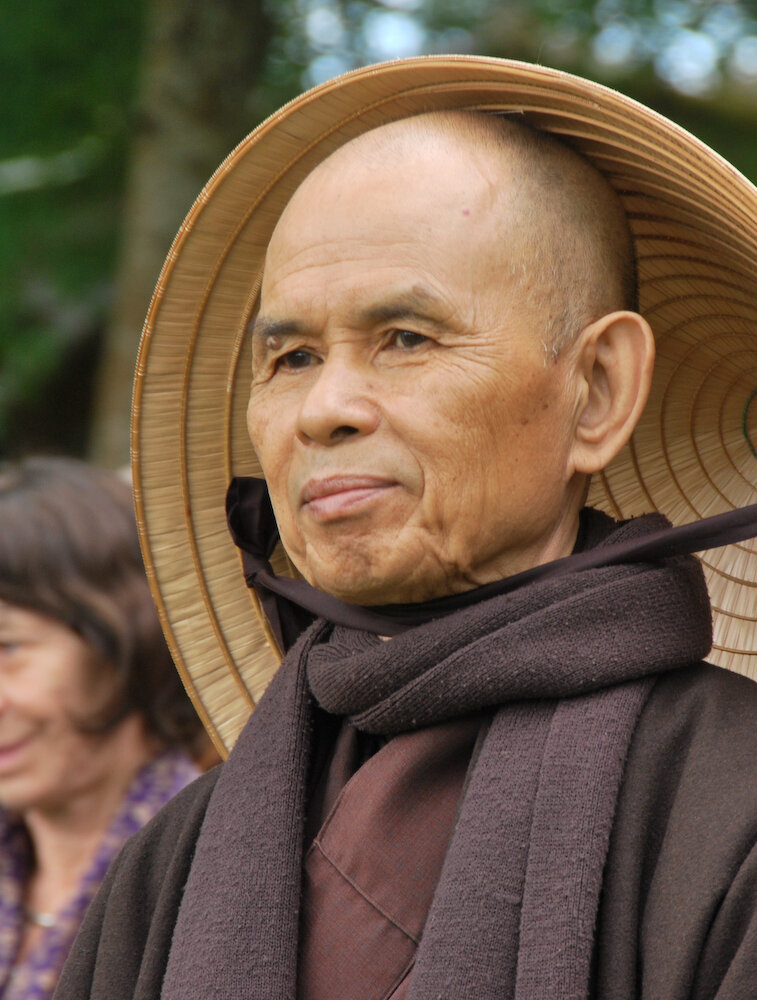
    Interdependent co-arising is a very key concept of The Buddha’s teachings. The other interesting names of this concept are dependent co-arising and dependent origination. Dependent co-arising is a deep concept. The depth requires an understanding of the concepts of Buddhism. So, I keep writing at a very shallow level examples to drive home the point. Whenever I read the book – Old path white clouds by Thich Nhat Hanh I get itched to this very concept. He explains this concept in easy words – “From interdependent origins, all things arise and all things pass away.”

    Thich Nhat Hanh

    I have shared multiple examples specifically for dependent co-arising on my blog. These examples were shallow yet practical relationship between the teachings of the Buddha and the present-day Business.

    Here are some examples

    Vaccination and interdependence (pulse polio elimination initiate of Govt of India)
    Societal impact
    Interdependent co-arising a farmers example
    Entrepreneurship
    Intra-country example and macro-economic example

    Whenever I try to interpret this concept; besides the interdependence, this concept touches on another concept of Hinduism (or Indic religions) – the concept of Karma. Karma gives us a guiding principle of cause and effect. It is easy to understand with the help of an English proverb – as you sow; so shall you reap. A very easy example of the cycle of Karma can be seen in an episode – Lucky penny – of How I met your mother.

    However small we think we’re as an individual, we’ve the power to make an immense impact on the world. You may have heard – if a butterfly flutters its wings in Amazon forest, it may cause a hurricane in Japan. I came across this interesting Domino effect video. I could relate it to the butterfly effect and thus to dependent origination.

    Watch this and relate the accumulated energy of the bar to Karma, the first piece as the butterfly fluttering wing and in effect interdependence of everything as a cycle.

  • Connectedness

    The world is divided into countries, races, religions, and god knows how many different factions and sections. There may be valid reasons for such sections. However, everything and everyone is connected. Problem to one results in problem to everything else around it. We have to learn the lesson of connectedness, be it hard way or easily.

    Connectedness

    Once different body parts were annoyed with the stomach. They were unhappy that they had to procure food and bring it to the stomach while the stomach itself did nothing but devour the hard work the parts did.

    In a meeting, all body parts decided they will stop bringing food to the stomach. The hand won’t lift it to the mouth, teeth won’t chew and throat won’t swallow it. This would force the stomach into doing something.
    After all, they were part of the whole. They had forgotten this basic reality. The decision to stop bringing food to the stomach resulted in making the body weak, feeble, and brought the body to the death bed.

    In the end, they all learned a lesson that in helping one another they were really working for their own welfare.

    Interdependence

    I had written about witnessing an incident of rioting firsthand. The learning from that incident was that we must learn managing our emotions. We can learn this by learning meditations. In fact, meditation brings compassion too. Result – more balance and peaceful response to situation instead of rioting – “Connectedness“.

    https://business2buddha.com/2019/05/heart-mind-action-awareness-meditation/
    https://twitter.com/SVNewsAlerts/status/1299458895396646915
    Protest should be representative not damaging public property

    Recently, I heard of the news of riots in a city in Sweden. Similar things occurred in two of the biggest cities in India – Delhi, and Bangalore. In our selfishness, if we miss the connectedness we end up harming not just ourselves but the whole surrounding. In our shallowness, we may consider ourselves as different or separate from the other however this aloofness ends into troubling everything.

    Note – Story source – Father Anthony de Mello, Prayers of the frog

  • Key to success

    I enjoy watching lawn tennis. This interest germinated since childhood watching Boris Baker, Agasi, Sampras, etc play in grand slams. In the late 2000’s I preferred Nadal over Federer. Slowly I grew over this rivalry. Now I enjoy watching more with a disinterested appreciation of the skills of Nadal, Federer, Novak, and other players. I do not even consider competing with any of the great players, why? Because it is not in my consideration set. Forget about going to the lawn tennis court; I never even held a racket in my hand. Many of you must be having such similar interests be it Cricket or watching movies. We do not compete with those whom we enjoy watching play a character or play a sport. We just enjoy and come back to work. So, suddenly why compete when we look at our colleagues? Is it a key to success? Nope apparently not.

    I had this question in my mind for as long as a decade when I started blogging about Business to the Buddha. When I wrote my first blog I interpreted interdependent co-arising as “When Ferrari and Honda run on the racing track competing for the first spot, they are racing to offer the best product to their customers.” This interpretation leaves room for competition at an individual level. 

    Key to success

    These days we keep on competing. If you remember, there is a competition for even “your shirt is white compared to mine!” In most of our race, we engage with “other”, it is an outwards journey. My point of view is competition with self.

    Key-to-success

    Two weeks back I wrote about how my friend was an inspiration for improving myself. I watched the movie Fashion last week. A good story of rivalry and moving above it. If we open our eyes we can learn so many things from some any places. In this case, it was the movie Fashion. We end up outwardly and compete with others. Instead, we must try to be a better version of ourselves, isn’t it?

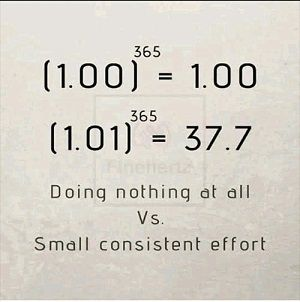
    The above image was so apt that I borrowed it for this blog post. If I look back, had I tried to compete with Nikhil I probably might have got into anxiety or frustration. Nikhil was an inspiration for improving myself there was a lot of learning. Thank you once again, Nikhil. Nikhil was an inspiration for improving myself there was a lot of learning. Thank you once again, Nikhil. The key to success is improving ourselves and being a better version of self (1.01)^365 on a daily basis, focus and competing with self.

    Image sourceLinkedIn timeline of Mr Deepak Taunk title also courtesy of Mr Taunk

  • Competing with ourselves

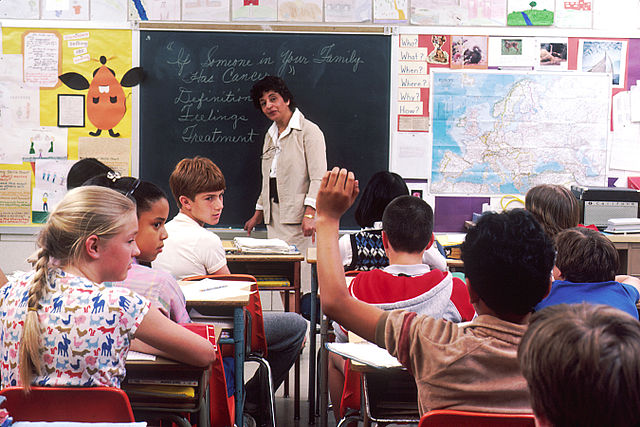
    Learning is learning, what is the scope or meaning of competition in that? Everyone has his or her level of comprehension and skillset. Some take more time to learn math but are wonderful at poetry others take less time but not good with creativity. Isn’t it common? So life is good when we try to be a better version of ourselves, competing with ourselves rather than trying to compete with everyone out there. I hope the new education policy, keeps this at its core rather than making kids slog to get more marks.

    https://business2buddha.com/2018/10/i-want-to-be-the-winner/
    Now, when I look back I feel most of the times, it is about collective growth rather than me over you. After reading about interdependent co-arising I have always believed in collective growth.
    https://business2buddha.com/2017/07/education/
     some times, “it is ok to stop in life instead of rushing.”
    https://business2buddha.com/2020/02/interdependent-co-arising-in-long-run/
    We at times miss the power of small things and ignore them. This understanding of sensitivity of impact of one thing on a larger scale makes a person compassionate.

    Inspiration for competing to improve myself

    I was an (above) average Joe in school days, used to do a lot of extracurricular. This happened when I was in grade 11. In 11th, we all took admission in this school from different schools. I started sitting with my colony friend Sumit and his friend Nikhil. Both of them were far more intelligent, toppers, and NTSE (National Talent Search Examination) scholars. At the beginning of grade 11, I wasn’t very serious about studies. I wanted to be an engineer however I was still in many extracurricular kind of lacking focus. I found the focus on studies after an interesting incident, and yet continued with extracurricular.

    school

    One day, Nikhil was sitting with his Mathematics “book” and thinking something. Because this book was kept below the desk and there was no notebook. I asked, “what are you reading”? He replied, “I am solving a problem”. I said there is no notebook and you seem to be reading a book. He said “trying to solve it mentally”. I asked again – what problem is it. It was 2 or 3 chapters ahead of our school math classes chapter.

    It made me serious about studies and made me think about how can I solve problems mentally rather than on just pen papers. When I look back, I realized that Nikhil was an inspiration for me. There was no competition for me with him or anyone else in the class. I just wanted to be better than what I was earlier. In fact on a serious note, Nikhil always scored a perfect 100 in Math that I could never. It seems like if I take the Math exam again, there will be still room for improvement. Effectively, he helped me be a better version of myself, I could never become like him in Math though. 🙂

    What better recognition one can expect? Within a year I had improved myself a lot. Once in grade 12, he said “Computer ko lekar Brahma ne banaya kya?” (Did God make you with a computer?) for solving either probability or integration/differentiation problem in class – I used to do it in the head without touching pen paper. This, coming from the same person was a testimony that I had achieved what I set as a goal. Nikhil did not know that he was eventually praising himself because he had motivated me to do something like this.

    Competing with ourselves

    There are inspirations as Nikhil was for me – how can I be like him, solve problems in mind itself. However, when we limit ourselves we either have envy or competition. The world is too big to compete with everyone – currently about 7 billion. It’d be endless and completely outwards journey as Alexander (the great) had. He kept on trying to win the world and died too young learning “I’ll die empty-handed“.

    The endless competition with “self” is better because the goal is to improve oneself daily. Nikhil had been a positive influencer who became an inspiration, not a competition. In fact, Sumit and Nikhil both became an influencer for me (read another incident from the same school here), Sumit was the state topper in 12th. A lot later in my life, I came to understand and relate to these learnings with both of them as interdependent co-arising. I wonder what they learned from me but I improved a lot. The word “competition” must be looked at with a positive perspective, it should help one improve oneself rather than becoming a race. A perspective and an approach make a huge difference in one’s life. Thank you, Nikhil for inspiring me and eventually helping me learn that one has to compete with ourselves rather than the endless world.

    https://business2buddha.com/2019/06/societal-impact-of-interdependent-co-arising/
    We all grow when we help each other to grow whether it is our subordinates or our competitors.

    Competing with ourselves in business

    I understand it becomes difficult to digest the concept of competition in academics, professional life, and business. I shall share more thoughts on that in some future blogs. Here is a pointer until that blog, I am reading a book by my MBA professor – The new rules of business. This book also gives a perspective on competition. A wonderful lesson from that can be paraphrased as – if you compete with your competitors you may end up being a copy of them in fact one may end up doing the mistakes your industry is doing.

  • Pandemic – why companies should choose to spend

    Coronavirus pandemic is a global phenomenon, as of now 160 countries out of 193 recognized countries are affected. Many countries are in lockdown. All the developed countries are affected, therefore, the economy worldwide is severely affected. In this trying time, the whole world needs Keynesian economics. In nutshell, the concept says – “Increase government expenditures and lower taxes to stimulate demand and pull the global economy out of the depression.” Here I am going to discuss my opinion on why companies should choose to spend and continue working on their ongoing plus upcoming projects.

    http://business2buddha.com/2013/11/24/keynes/

    Keynesian economics considers or provides guidelines to the Governments. You can check India approves 1.70 lakh Crore package for poor, $2 trillion package US Congress has approved recently. Apparently, this is the biggest package US or for that matter, any government has approved. Government spending is only one part. I am of the opinion that every industry must seriously consider not only spending but also sustaining employees. Short term “shareholder value” can wait for better long terms sustenance. I know this sounds counter-intuitive – special when all companies are losing revenues due to lockdown, expecting retaining employees and to sustain a business. Surely this will impact the survival of many firms, projections and revenue targets of almost every company and shareholder returns. Let me give you some basic reasoning for my opinion of private firms too should continue their investment and how can it help bring the economy on wheels again.

    coronavirus-hospitality-industry-impacted

    Due to Coronavirus few industries are directly affected, namely; Airline, Hospitality and discretionary expense items e.g. beauty or apparel. People are going to spend on their basic necessities for the next few weeks or who knows months. The impacts revenue and therefore growth-related projects of these industries. Let us take an example as an explanation.

    Example

    An apparel company wanted to increase its footprints in a new region. That would require – finding retail space, employees for the store, furniture/store interiors design, products to put in the shelf and technology e.g. internet, hardware, POS and marketing to bring shoppers in-store. Due to the impact of a pandemic the apparel company will delay all these. The domino effect will be on – real estate, prospective employees, interior designers, producers (who produce for the apparel company in terms of aggregate demand), internet service provider, IT company planning to provide hardware and software and the marketing activation agency that was supposed to engage in the project – right from printing flyers. Why I brought flyers? Because this and interior decorators have many unskilled laborer working for them. The result – the domino engulfs many part-time workers. When these part-time workers do not have money they will have an impact on purchasing many other things. A self-fulfilling prophecy – read more about self-fulfilling prophecy here.

    At this time, what should private businesses do? At whatever negotiated discounts – they must continue their projects be it starting footprints in new regions as given in the above example. The companies must continue their spending because sooner or later things will fall in place. People will start consuming and the economy will be on track again. If spending is done as usual – the economy will come on its feet faster than it other would. Therefore I am suggesting that after the lockdown due to pandemic – why companies should choose to spend.

    Summary

    I fell in love with research of McKinsey and company, “Grow Fast or Die Slow” sustaining growth in technology companies. Paraphrase of this research is –

    1. Growth matters more than margin or cost structure
    2. No correlation between cost structure and growth rate

    Net-net one cannot cost cut to grow the business. Business growth requires “growth”. This is why I suggest that companies should choose to spend. Cost rationalization is important, questions are the discretion, putting costs in the right perspective and strategic decisions on these investments. This is the time when project costs will be more rational compared to a booming economy. At this tough time, many companies will look at cost reduction – what leadership across the globe must know is that – this is the time to look at a big picture and work towards completing the unfinished projects, starting the planned projects and reopen the businesses as usual after lockdown. Why? Because sooner we start spending on our planned projects, sooner economy will be back on track and most importantly we will be able to reach our projections, targets, and shareholder value.

    The concept of interdependent co-arising perfectly fits this conclusion. When we keep our investments on, the fund will be available to others to either spend or pay as salary. This spending results in moving the circle of growth.

    Related newsCognizant to offer extra 25% of base salary

  • Interdependent co-arising in long run

    Last week I was in the US. I spoke with a friend of mine he is a professor in a college in USA. We discussed many things, what got our attention was the dependence of many moving parts of our society such that everything impacts everything else. This is nothing but interdependent co-arising.

    Related blogs –

    Vaccination and interdependence (pulse polio elimination initiate of Govt of India)
    Societal impact
    Interdependent co-arising a farmers example
    Entrepreneurship
    All interdependent co-arising related blogs

    We discussed the school system of USA, how the impact of 2008 great recession is going to impact funding of schools in coming time. The story is like this – during the collapse of late 2007 early 2008, birth rate in USA reduced. This is researched and published fact refer here “…the college-going population will drop by 15 percent between 2025 and 2029 and continue to decline by another percentage point or two thereafter…”. The researcher states birthrate as the factor, quote from the same source “…When the financial crisis hit in 2008, young people viewed that economic uncertainty as a cause for reducing fertility,” said Grawe. “The number of kids born from 2008 to 2011 fell precipitously. Fast forward 18 years to 2026 and we see that there are fewer kids reaching college-going age…”

    After 17 years when expected students those who could go to college have reduced this is impacting overall finances and the operations of schools. Look at the impact, how one things affects other. This is interdependent co-arising. What goes around comes around, impact on education may cause other impacts example – job market, sustainability of businesses and resulting in another possible economic crisis – it is a loop.

    Abstraction of this scenario

    You must have heard – if a butterfly flutters its wings in Amazon forest, it may cause a hurricane in Japan. We at times miss the power of small things and ignore them. This understanding of sensitivity of impact of one thing on a larger scale makes a person compassionate. Currently the world needs compassion more than the mad rush to reach somewhere. In the long term, impacts are what are left behind not the individual goals we kept in our mind.

    Image source – NeedPix

  • Cost of poor quality

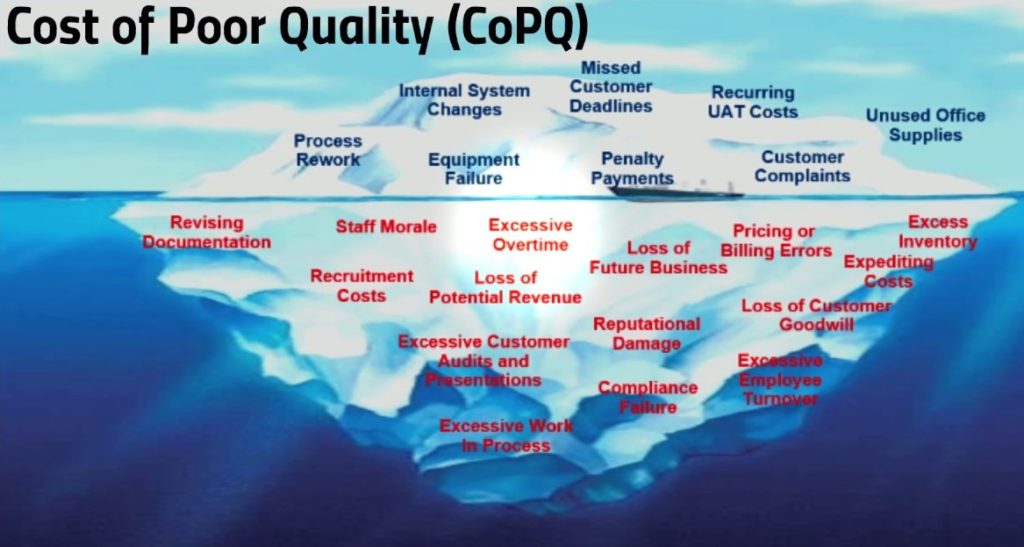
    Cost of poor quality (CoPQ)

    In operations improvement, Cost of poor quality is a common management term. Sum total of all the costs that are generated due to defective material produced by a system is CoPQ. There are various costs defined in management systems for this. You can read more about CoPQ at iSixSigma.

    A naive example

    cost-of-poor-quality

    Since, management example for CoPQ can be complicated by jargon. So, I am taking liberty of making it very layman with few variations in explanation. The context is very India-centric here. There is lot of corruption in road construction projects in Indian cities. Almost every year during rain (otherwise too at some places), these roads are full with potholes. Some people say – you need to search road within the potholes. Why go to any other city – Mumbai is a living example of the same. These roads result in – untoward events (possible serious accidents), high cost of vehicle maintenance and repairs, poor vehicle mileage and at times backache to the travelers even with good quality shock-absorbers of the vehicle.

    The evident cost, in case of Mumbai roads alone, is repairing same patch of road in single season at least 3 times.

    Example of CoPQ In life

    Terrorists – they are an example of CoPQ to society, they waste their life as well as killing other people. Say one of the person’s killed is an educated, married person with a child in his 30s. Death of this person is a loss to the Society, a talent who added to the GDP. The loss to the GDP is for about 20+ years the person could do. Family and child lost a support system. This loss of support could eventually result in inability to blossom and become a better contributor to the society. Society can be better off if a terrorist commits suicide without causing any other damage. Though it is a loss again to the society that a person is dead without adding any value to the society, however it is better than the trouble that person could be to the world.

    Depression of an individual is CoPQ for self and society. The society is losing time and skills of this depressed person. Actually, interdependent co-arising plays an important role in our society. CoPQ can be derived from interdependent co-arising too. If we understand the concept of interdependent co-arising society can reduce terrorists and depression patience.

    How to reduce CoPQ for society?

    When I was thinking about what we humans ban do to reduce the cost, I came back to the same old point – meditation, spirituality and teachings of Buddha and Jain Thirthankars. Both Jainism and Buddhism emphasis on concepts such as non-violence, non-stealing, fidelity etc. Corruption is a type of stealing and terrorism is violence. If one gives proper heed to the virtues, roads will be of good quality and if one meditates regularly his quality of live will improve multi-fold. In essence, practicing these principles the Cost of poor quality can be reduced drastically.

    Image source – Cost of Poor Quality – pt4 youtube video