Tag: education

  • Education, religion and spirituality

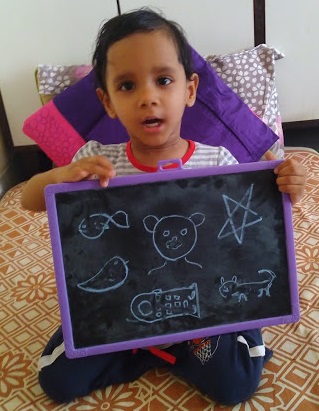
    Adviti showing sketch

    Adviti is attending school now, this started off with thoughts on education, religion, and spirituality. She is three years and we opted for online schooling finally. We avoided it initially, but the Chinese virus (Covid-19) gave us no option of formal school for her. It has been only two weeks. This time around the questions were more than just why do we educate kids? and also the race we start with our kid’s schooling.

    During our primary education, we read this story in our syllabus. This is apt for our life in general and I take a parallel from this story in religion and spirituality as well. Let me first narrate the story to you.

    Hunter and the parrots

    A jungle was famous for its species of parrots. One day a hunter crossed by this jungle. He was mighty impressed with these different types and colors of parrots. The hunter put his net and no wonder he could catch a lot of parrots. He sold those in the market and made a lot of money. He started visiting this jungle often.

    Brighter-day

    A sage lived in this jungle too. He observed that the number of parrots was drastically reducing. Sage being sage, compassionate, and friendly to every animal of the jungle, started teaching these parrots.

    The sage taught these parrots –

    The hunter comes, spreads his net,
    puts some grains, we should avoid this trap

    The exact words we learnt in the Hindi version was 

    शिकारी आता है. जाल फैलता है.
    दाना डालता है. हमें जाल में नहीं फ़सना चाहिए।

    The parrots learned it quickly. They started singing it all the time. When the hunter came he was taken aback. He was fearful now he won’t get these parrots. With a heavy heart, he put his net again. To his surprise, all the parrots were in the net and singing the same song

    The hunter comes, spreads his net,
    puts some grains, we should avoid this trap

    With immense pleasure, he took his prized possession. This time he had value-added parrots – parrots who spoke language!

    When the hunter crossed sage’s hut, sage was smiling. He saw all the parrots singing the song inside the trap that they had to avoid.

    The moral of the story

    We must learn instead of rote memorization. we must learn instead so that conceptual learning can be applied in many walks of life.

    Additionally, there are chances that someone says one thing but does another. We must learn two things – first, we must walk the talk, and second, identify people who do not walk the talk and be cautious.

    Education

    When Adiviti sits for her school sessions, I sit with her. Initially, I was frustrated (at times now too) with her slow response. She knows the things but does not respond, at times she does not understand – because she predominantly understands Marathi and Hindi and not English. She does not follow instructions.

    We learn a lot of very basic and important things in our schools. How much do we apply in our life? Be it learning instead of rote method or the basics – do not steal, do not tell lie, etc.

    Religion

    Another thought triggered in my mind. We learn almost all the ten commandments of Abrahamic religions in School, isn’t it? Most of the religion teach such basic things in our life. If this is the only lesson of religion our school or syllabus of school education is no less than a religious book. In fact, in this case, the schools and education are much more than many of the religions of the world.

    Though I know I have made this comparison on a very high level. In whatever case, what more the religions teach? Follow what is taught, in some cases do not use your brain. Do not question the authority, isn’t it?

    Religions that do not allow questioning is far lesser than school education. At least school education allows asking questions!

    I am a born Hindu (a Lingayat), I have questioned almost everyone and everything religious since childhood. When I was unconvinced I stopped going to temples. When I started understanding few things about Hinduism and started reading few scriptures, I realized many scriptures are dialogs. On the battlefield, Arjun asked questions, Janaka asked questions to Ashtavakra, and Vashisth and Rama discussed multiple things. When someone wrote Upnishad no one asked to believe those by force.

    The Buddha or Mahavir (and other Tirthankaras of Jainism) also gave the point of view without forcing others to accept those as gospel truth.

    Spirituality

    I have written on religion vs spirituality earlier. In that blog, I had given an analogy between religion and spirituality to sex and love. Since now I am looking at education, I created another analogy between education and learning to religion and spirituality. You can learn without formal education. I have heard of a past CM of Maharashtra – Vasant Dada Patil He was educated to only 4th grade. However, he was the harbinger of the robust canal and irrigation system of Maharashtra.

    If we look at multiple definitions of spirituality what best comes to my mind is – “search for meaning in life”. I can connect to the Indic religion (Buddhism, Jainism, and Hinduism) to a large extent. Spirituality is beyond any geography, religious rituals, and believing in a single book alone. Spirituality includes every living being – I can write more on that however that is for some other day.

    In fact, if I take the freedom to extrapolate the story, the hunter (शिकारी) is our false sense of self, net (जाल) greed, lust, ego etc and the grains – bait – (दाना) is our false sense of satisfaction or pleasure. We should not get in the net (जाल), here WE is the SELF.

    Education, religion, and spirituality

    What I have observed is that education and religion are like parrots in the cage. They know what they are saying but they do not understand the meaning of what they are saying. It is with many people and religions worldwide. In fact just because of that either we see terrorism or atheism in the world. People have either lost trust in religion or they are so faithful that they see killing those who do not comply with the point of view of the killer.

    At the same time, learning and spirituality are conceptualizing, synthesizing, and questioning, and exploring. Learning involves a sense of experience similar to spirituality. Look at religion you would get a lot of people who can reiterate books word by word without knowing and experiencing. This is what differentiates religion and spirituality.

    I saw a tweet from Elon Musk once – “I hate when people confuse education with intelligence, you can have a bachelor’s degree and still be an idiot.”
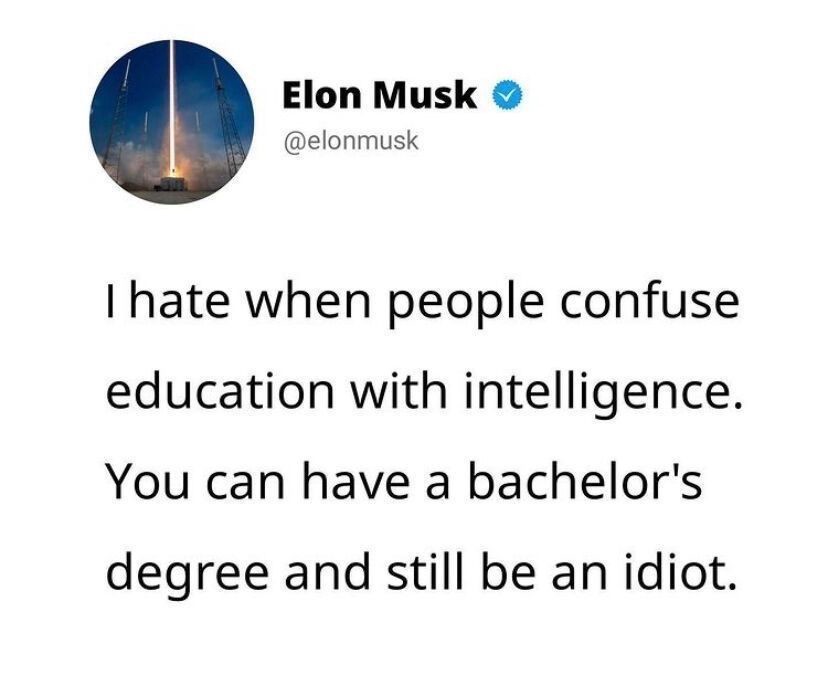
    Education, intelligence Elon Musk tweet

    The corollary, in this case, is – one can be known for religion and religious knowledge without actually being a spiritual master. Whereas Spiritual masters many times are against the dogmas and are more practical and clear about what they say, do, and mean.

    Adviti’s schooling is a learning experience for me. I have to get off the showjumping thing we have observed. I have to let her learn at her own pace. What matters is how intelligent she becomes with the education not how much she scores in school. What is more important is she becomes a virtuous person who walks the talk – not like the parrots who are in the cage reiterating the lesson –

    The hunter comes, spreads his net,
    puts some grains, we should avoid this trap

    The exact words we learnt in the Hindi version was 

    शिकारी आता है. जाल फैलता है.
    दाना डालता है. हमें जाल में नहीं फ़सना चाहिए।
  • Competing with ourselves

    Learning is learning, what is the scope or meaning of competition in that? Everyone has his or her level of comprehension and skillset. Some take more time to learn math but are wonderful at poetry others take less time but not good with creativity. Isn’t it common? So life is good when we try to be a better version of ourselves, competing with ourselves rather than trying to compete with everyone out there. I hope the new education policy, keeps this at its core rather than making kids slog to get more marks.

    https://business2buddha.com/2018/10/i-want-to-be-the-winner/
    Now, when I look back I feel most of the times, it is about collective growth rather than me over you. After reading about interdependent co-arising I have always believed in collective growth.
    https://business2buddha.com/2017/07/education/
     some times, “it is ok to stop in life instead of rushing.”
    https://business2buddha.com/2020/02/interdependent-co-arising-in-long-run/
    We at times miss the power of small things and ignore them. This understanding of sensitivity of impact of one thing on a larger scale makes a person compassionate.

    Inspiration for competing to improve myself

    I was an (above) average Joe in school days, used to do a lot of extracurricular. This happened when I was in grade 11. In 11th, we all took admission in this school from different schools. I started sitting with my colony friend Sumit and his friend Nikhil. Both of them were far more intelligent, toppers, and NTSE (National Talent Search Examination) scholars. At the beginning of grade 11, I wasn’t very serious about studies. I wanted to be an engineer however I was still in many extracurricular kind of lacking focus. I found the focus on studies after an interesting incident, and yet continued with extracurricular.

    school

    One day, Nikhil was sitting with his Mathematics “book” and thinking something. Because this book was kept below the desk and there was no notebook. I asked, “what are you reading”? He replied, “I am solving a problem”. I said there is no notebook and you seem to be reading a book. He said “trying to solve it mentally”. I asked again – what problem is it. It was 2 or 3 chapters ahead of our school math classes chapter.

    It made me serious about studies and made me think about how can I solve problems mentally rather than on just pen papers. When I look back, I realized that Nikhil was an inspiration for me. There was no competition for me with him or anyone else in the class. I just wanted to be better than what I was earlier. In fact on a serious note, Nikhil always scored a perfect 100 in Math that I could never. It seems like if I take the Math exam again, there will be still room for improvement. Effectively, he helped me be a better version of myself, I could never become like him in Math though. 🙂

    What better recognition one can expect? Within a year I had improved myself a lot. Once in grade 12, he said “Computer ko lekar Brahma ne banaya kya?” (Did God make you with a computer?) for solving either probability or integration/differentiation problem in class – I used to do it in the head without touching pen paper. This, coming from the same person was a testimony that I had achieved what I set as a goal. Nikhil did not know that he was eventually praising himself because he had motivated me to do something like this.

    Competing with ourselves

    There are inspirations as Nikhil was for me – how can I be like him, solve problems in mind itself. However, when we limit ourselves we either have envy or competition. The world is too big to compete with everyone – currently about 7 billion. It’d be endless and completely outwards journey as Alexander (the great) had. He kept on trying to win the world and died too young learning “I’ll die empty-handed“.

    The endless competition with “self” is better because the goal is to improve oneself daily. Nikhil had been a positive influencer who became an inspiration, not a competition. In fact, Sumit and Nikhil both became an influencer for me (read another incident from the same school here), Sumit was the state topper in 12th. A lot later in my life, I came to understand and relate to these learnings with both of them as interdependent co-arising. I wonder what they learned from me but I improved a lot. The word “competition” must be looked at with a positive perspective, it should help one improve oneself rather than becoming a race. A perspective and an approach make a huge difference in one’s life. Thank you, Nikhil for inspiring me and eventually helping me learn that one has to compete with ourselves rather than the endless world.

    https://business2buddha.com/2019/06/societal-impact-of-interdependent-co-arising/
    We all grow when we help each other to grow whether it is our subordinates or our competitors.

    Competing with ourselves in business

    I understand it becomes difficult to digest the concept of competition in academics, professional life, and business. I shall share more thoughts on that in some future blogs. Here is a pointer until that blog, I am reading a book by my MBA professor – The new rules of business. This book also gives a perspective on competition. A wonderful lesson from that can be paraphrased as – if you compete with your competitors you may end up being a copy of them in fact one may end up doing the mistakes your industry is doing.

  • I want to be the winner

    Couple of weeks back, I was reading a psychology based assessment and relevant review of the same. In the review, I found one particular pointer – “I want to be the winner”. I read it, then re-read it. This stuck me and I paused.

    Winning in corporate battle or academics

    I have always been a very competitive person. However, this time when I was reading this statement it looked too complicated to define a person. So I re-read the statement – “I want to be THE WINNER”. Yes it is always a wish to be a winner, but THE WINNER! This drifted me from the overall review and psychology stuff to a general social issue.

    Are we really making youngsters competitive or we are pushing them to be a “CUTTHROAT”. Just read the word again – cut throat. In another words it means kill!

    So, the psychology questionnaire and its review had my attention even more. What defines a person as most likely or least likely for “I want to be the winner”. If someone is reading it in a passing reference, it will be just a statement, however if you look that statement in a social, personal, academic or professional context this statement may be very fatal.

    This can be fatal when we think everyone wants to be the winner. Our education system makes us compete at times when it is not required! I have written on this reference earlier – the problem of top 5%. Why top 5%? Because I was never in top position in academics :). When I look back at myself 20 years when I was in 12th, I realize that what kind of damage I might have done to the class in which I studied. Now, when I look back I feel most of the times, it is about collective growth rather than me over you. After reading about interdependent co-arising I have always believed in collective growth. Even the economy cannot survive if only some people grow – bad precedent is trickling down economy, that is a mirage.

    I believe, life is like a team sport, take an example Football. When you play, you play with a team on your side, you are competing to score a goal, it is not likely that a football team goalkeeper will score, but if the team wins, the goalkeeper naturally is one of the winners.

    There is no problem in being a winner, wanting to be a winner, however “THE WINNER”?

  • Education


    I and my wife were rushing to our offices on our two wheeler. This a routine happens daily (include Saturday for her). Actually, this race to office is common place in Mumbai. Many go without interest and many others like us go not only with choice but also to make a difference. Yes, sounds strange – what difference one person can make? But this is how I and my wife take our jobs “very seriously”. This race starts in the morning at about 7:30 AM and ends at about 7:30 PM in evening or later. Now, do not ask – how much difference we have made in our respective companies or our own life. When I ask this question to my self – at times I feel as if we both are running on a treadmill. We are running very fast but are not reaching anywhere on a treadmill.

    This day was no different, we were on our two wheeler, it was not raining. Rain had played a lot of games with us recently. Whenever we were wearing raincoat, it didn’t rain. It was bit sunny and therefore we thought its may not rain today, hopefully by we reach office. Suddenly it started raining and raining like anything, yes this was shocking but happens. So instead of rushing I stopped our vehicle at a bus stop shed and we both wore our raincoat, besides we waited for rain to subdue – it was not very cloudy so we knew it wont rain for long. Ten minutes and it stopped, we started our rush to office again, this time we did not take off our coats.

    In these ten minutes I learnt something interesting – some times, “it is ok to stop in life instead of rushing.” On the contrary it was good to take that break in this particular situation rain stopped.

    When are we going to teach such things to our coming generation? I thought that we teach many things to our children however most of the time, it is for economics returns and not necessarily for living a fulfilling life, just an example – instead of rushing and running just being. An after thought of this question is this – education is a very formal approach, whereas learning is informal. Learning is – stop somewhere instead of rushing; on the contrary education – that is a formal one – makes one assuming rushing to the destination is the solution. Before anyone makes any opinion about my thoughts – I am not trying to undermine education (certificate based formal teaching), it is required to help an individual to be economically better off and help the society take an example of Kashmiri stonepelters – if they get a regular job they wont unnecessarily go out to support terrorists.

    Education was last week’s LBC topic where Maria, Rummuser, AshokShackman and I write weekly. You can visit their blogs and read their thoughts on the topic.

  • Blindness


    My mother teaches in a school where there are few blind students also. She talks about them passionately and praises their intelligence beyond the other students. By chance I have not been closely associated with the blind people, however I have filled my eye donation form when I was 18 years. Yes, I would want any and every body part to be utilized after my death, the value of each organ will increase if it remains and be useful to someone after me. This “AFTER ME” puts me on another tangent of thoughts – we are not the body – but here I am not writing on those thoughts anyways.

    So coming to the topic – Blindness. How do you define blindness? Inability to see, is that the only definition? According to me, the definition of blindness goes beyond just the inability to see. Or if I think more, in some sense of the word “see” may includes many things which we generally overlook.

    [Tweet “‘Our’ perceptions create ‘our reality’ – than whatever is the truth.”]

    ‘See’ should not be only associated with eyes. After your eyes see, what happens next? The mind creates a picture and mind infers the picture. The inference also has a sense of blindness too. Inability to infer, inability to understand and misconception of actions; these are few other things that need to be included in defining “blindness”. “Our” perceptions create “our” reality – than whatever is the truth.

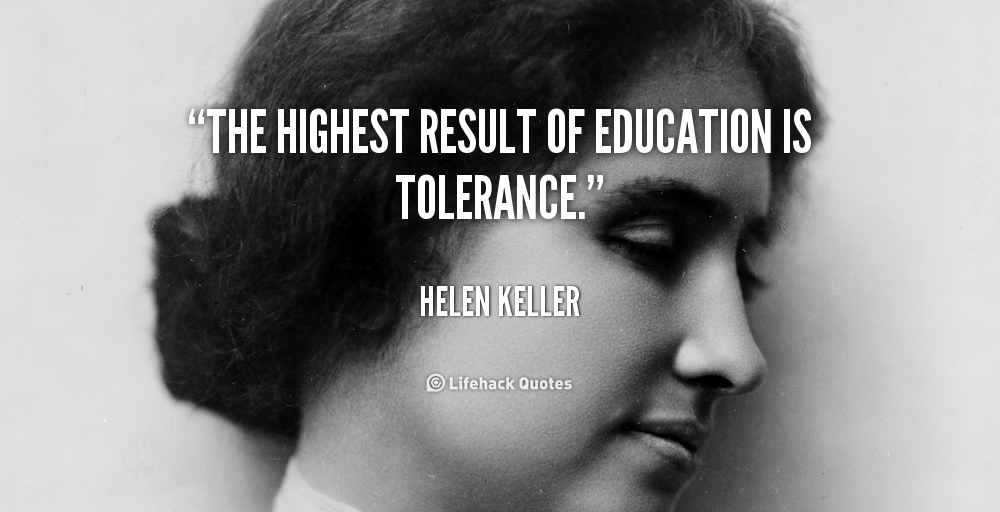
    quote-Helen-Keller-the-highest-result-of-education-is-tolerance-103858An example that came to my mind is related to a recent incident in the US. A young man unleashed gunfire in Tennessee military facilities. Initial reports were stating that it could be an act of terror. This man had stayed somewhere in Middle East for more than 1/2 year in 2014. His high school friends of this man say he was a good guy and it was shocking and unbelievable that he did it (paraphrase a CNN news report heard earlier). So point is what happened that this young man did what he did?

    If I cannot see Blue color, I am color blind for that color, if I cannot see peace and only fed with what wrong is happening with “my community” by “other commutes” I am blinded by what good the other community is doing. Many a times, the bad is more of perception than a reality. This is how people are blinded to see only what they are told to see.

    This Tennessee shooter was blinded in the same manner. That is also a kind of blindness too. The intolerance we see in many people is because they can only see what is right for them and they are blind for opinion of the other. Perhaps the young man got brainwashed by some education which was rather reverse of Education – “The highest result of education is tolerance” Helen Keller. [assuming it was a terror attack, as it was speculated initially]

    [Tweet “”The highest result of education is tolerance” Helen Keller.”]

    In a similar manner, I am blinded to see only peace, growth, happiness. On a lighter note – I see many vehicles with their number plate as 23XY, reason is – my vehicle is numbered 2315, its not that these vehicles were not visible earlier, now I notice them intentionally and ignore vehicle with some other numbers.

    I am late to write on this LBC post. This topic was suggested by Lin, for the weekly Friday Loose Bloggers Consortium where currently nine of us write on the same topic every Friday.  I hope that you enjoyed my contribution to that effort.  The seven other bloggers who write regularly are, in alphabetical order – AshokgaelikaaLinMaxiPadmumRamana UnclejiShackman and The Old Fossil. Do drop in on their blogs and see what their take is on this week’s topic. This time I was the one who posted very late, do visit blogs of others they must have posted their opinions too.

  • Why not define smaller things?


    Last month I met Prof Mankad. I always think whenever I meet him I should record our conversation. He is indeed a library of knowledge in himself. We discussed about our education system besides many other things (blogs written last weeks) Purpose of education and Showjumping. Dr Mankad told me – “one of the real problems with our daily life is our weird definitions e.g. success. We define success as owning that BMW. Until we get that BMW we don’t feel content. Thus, we avoid being satisfied, we do not live a fulfilling life. Though as an individual we can, but the weird definition makes us estranged from many small things.”

    Vada Pav
    Vada Pav

    He further shared an experience. One of his friends landed in India from the US (at about 12:00 AM or 2:00 AM). Next day 6:00 AM he was at Prof Mankad’s home, and asked to just accompany him. They drew to Karjat had some special Vadapav of that place and drove back to Mumbai.

    Well, all this made me question few very basic things we generally overlook. We do not think much about basics of life, but still have some preconceived notion about those things. As Dr Mankad shared example of success, another example is beauty. I watched this video in my MBA Marketing class. Our definition of beauty is weird watch this <2 min ad of Dove, to understand how our perceptions are defined; at times created. Many girls want to be fair, those who have curly hair want straight and vice versa!

    How often have we thought on these seemingly simple, stupid, strange yet serious questions. What is the meaning of Success (for me or you)? Does our definition of success change over time? what is the purpose of life? Why are we studying (at least when in college)? How will I/you know when I/you reach the target (a 100,000 INR or 10,00,00,000 INR), the goal is always a moving one! What is the benchmark? I think we need to just pause at times, and think how we want to shape our life, what is important for ourselves at least that instance, isn’t it? I think that is what enlightened masters call “living in present”

    Related – 1. Why are you doing what are you doing? 2. What more you need? 3. Entanglement of a langot 4. Race – never ending

    Race – never ending
    Why are you doing what are you doing?
    Why are you doing what are you doing?

  • Why do we educate our kids?


    Rat raceWhen I visited my sister last time, I asked her this question – What is the purpose of education? She is a teacher, she was the best person to ask this question.

    I felt pity on my nieces, so I asked this question. My nieces (one just 4.5 years other 10 years) go to school even in April! I went there to spend some time with them and they went to schools! This is their age to try new things – painting, playing different sports, learning some music. Let them find what they enjoy doing rather than forcing them to sit in the classroom in the summers.

    My sister’s answer reminded me of Prof Mankad’s Macroeconomics class of my MBA. His exams used to be unique (not disclosing it though). His reasoning for such unique exam was- Information is accessible now a days; I want you to think, I want you to cultivate abilities to connect the dots of various subject matters you come across and develop ability to make decisions, opinion and inferences. These theories should not be crammed. You can make these graphs / search them any day / any time while you work. Practice of using these theories in making your opinions etc is what I want you to develop.

    Surprisingly, many Google search terms “Exam paper of Professor Mankad” and “Exam paper of Prof Boman Moradian” have ended up on my blog post. Here I never wrote about what they ask in their exams. I feel strange some students search such things also!

    So my sister – who teaches Science – answered – “I want students to see things for themselves, to experimeReady to Racent; science is something which will help them develop analytical skills”. My sister and Prof Mankas’s answers were not what I see the approach of marketing any school – B-School to Medical School to the Public school for K-12 levels. Our B-Schools & Tech-Schools talk about post education Salaries as benchmark for success! In fact, IVY league guys went to jails because of bigger crimes e.g. insider trading; and if not in jails they caused more troubles to an average human being than a pickpocket who also goes to jail for small crimes for troubling one average human being at a time.
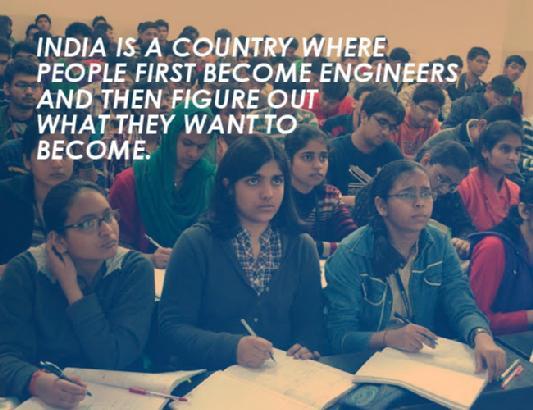

    Why should we educate kids? Don’t you think that the purpose of education be set first. At least we have been doing this for executing businesses well. At least ask the kid what he/she wants to do – after a certain age – instead of making everyone an Engineers or Doctor?

    Related blogs – Showjumping, Race – never ending, Entanglement of an undergarment, Neeraj in Kabir’s style

    Image source – Alka Arya’s article http://hillpost.in/2012/04/revised-rate-race/44257/

    Here is what I found on LinkedIn – Engineers in India

  • Showjumping


    It was a Monday morning I woke up at 6:00 AM, got ready for office. Call it Monday blues for others but for me Monday’s are s different type of race. Race to get to the main road, catch a cab (cabbies dont want to go short distance ~6 KM <60 INR), board a local train to Andheri station run from there too to catch an Auto or Bus; where there is already a big line! Seriously, at times I feel “life is a race” (reminds me of a dialog in movie 3 idiots), no one knows race for what and where! The story does not end here. Whenever I cross NALCO (a stop for buses in Andheri East area), I see kids walking to school. One thought comes to my mind – these kids too have their office! That office is called school.

    At least till 8th standard, I don’t remember if I had gone to school, after exams for 1 full month of April month. My niece, she is not even 5 years finished her LKG in March; goes to her office (e.g. school) at 8:00 AM in April Month – yes she is in UKG now – she has got promoted! In our offices too we have a system of promotion (at least examination in March-April) isn’t it?

    This does not seem to me as education – we are making machines. My sister teaches in a school – I asked her what is the purpose of education? Why are you a teacher? Her response was unconventional. She said I want to make the kids expand their horizons. I added do you think schooling is doing it right? She had a mixed response.

    I feel forcing kids to school is not education, it can at best be schooling. Here please think of “Schooling” – as a verb! Such as training a horse for Showjumping!


  • Leadership and education


    Election results of couple of Indian states are out and largely there are clear mandates in all states. So, there are not many permutations and combinations happening for forming governments. I was wondering about the elections, results and post results – five years. The long term thoughts (five years after results) were hampered by a news of rabble rousing activities in UP. Does the confidence of victory create so much defiance that people do not mind taking law in their hands or crossing the limits?

    This question lets me ask myself – what do we need? Politicians or leaders? Are politicians really leaders? I was thinking about this and on LinkedIn I read a question. IF YOU HAVE GOOD STRATEGY, DO YOU STILL NEED A LEADER?

    Can a good strategy create a leader or leaders can create effective strategies? My answer is leaders can create effective strategies. Also, I heard someone say – An army of sheep led by a lion are more to be feared than an army of lions led by a sheep.

    I was talking to Prof Ramanathan, he told me “…Pravin I see there is a lack of leadership at various levels, be it corporate or others…”

    The fact of the matter is the crisis is wide spread are we creating leaders? Are we creating excel, power point and ivory tower experts of solutions? When I read the book – I have a dream I realized that there are people who took initiatives, who rolled their sleeves and got down to work. There may be many more not covered in the book, yet how many of us have become leaders after studying at Ivy league?

    Recently, I met Prof Mankad, we discussed Greek crisis and the visible solutions to it. He made a good observation on the economic power of China that made me think – having and managing power requires a sense of responsibility and ability to be fair. This ability requires courage and confidence to say – ‘yes I erred’ when one did commit mistake. Does our education teach kids to have these qualities?

  • Next is what?


    I was reading a newspaper, the question came in mind – next is what? For a moment Samsung mobile advertisement came in my mind. So keep guessing, next is what for Samsung (off late for Nokia too)? Jokes apart, the question is serious, forward looking and for soul searching.

    The question is very natural, after completing graduation person asks him/herself – what next further education or a job? The question is still there and will always be there in our mind – thinking species.

    In terms of existence and growth of an organization this question is apparent. Organizations think of short term and long term strategies, I have heard some plan for next 25-50 years too and they do it sincerely every year. So, the question “Next is what?” is an eternal, perennial question.

    Next is what, was the question at the time of independence for India. Singapore became a part of bigger Malay nation in 1960’s with a vision of The Next. Though it failed, what makes us feel really great about Singapore is – the vision of Mr Lee Kuan Yew. He rose to the occasion and see where is Singapore in forty years of its independence. Singapore has emerged as an economic power and hub for Asia Pacific, I admire leadership skills of Mr Yew.

    Next is what? is the question currently for Egypt too. What we learnt in strategy planning is – scenario planning and what.. if analysis. Egypt needs an able leader one similar to Mr Yew of Singapore and make long term agile strategies and take short term actions to realize those plans.

    After Egypt, Algeria, Yemen and Bahrain are protesting, “Next is what?” for Egypt is the question to ask and this is equally pertinent for these other countries. We will see the results in coming time.