Tag: Anand Saxena

  • My Favorite Fictional Character


    Have you ever thought about fiction and reality? Fiction is something untrue, made-up or imaginary. How can I say that the Buddha or Krishna or Jesus was someone who actually walked the face of earth. Is it a possibility that these were imagination of someone? This thought puts me to another thought, what if I myself am is some imagination and a reality is somewhere, something else.

    Have you ever had a dream, Neo, that you were so sure was real? What if you were unable to wake from that dream? How would you know the difference between the dream world and the real world? Morpheus The Matrix

    What makes something real? Is it because I think, see, feel (perhaps smell or hear) and my mind makes me feel that this is something real because I can sense it? Or something is real because it exist without someone’s ability to sense it or no. Take an example of light – we cannot see light beyond a certain frequency range. Does it make the light non-existent?

    These questions remind me of a very interesting movie – The Matrix.

    “…The Matrix is everywhere. It is all around us. Even now, in this very room. You can see it when you look out your window or when you turn on your television. You can feel it when you go to work… when you go to church… when you pay your taxes. It is the world that has been pulled over your eyes to blind you from the truth…”

    I have had a couple of Morpheus in my life to teach me. I have written about almost everyone on this blog. I would want to be Morpheus too, for someone or few in future. I love the character of Morpheus from The Matrix the most. Morpheus is a believer, he courageous. The best part is, the kind of confidence Morpheus has in Neo, it makes me feel that I want to be Neo too. Laurence Fishburne played the role so well that I keep on watching his teachings (dialogs) whenever I feel I should. There are a lot of learnings in those dialogs – “Do not think you are, KNOW you are.” I have written on the movie (red pill) earlier too. I was so fascinated with the movie that I used to tell people that I am fine being a spot-boy for the movie – alas I am in India :(. The movie is so philosophical and spiritual to me that I repeatedly watch it.

    Instead of me talking (writing), I would want to share some videos of the movie (Youtube), not sure about the copyright permissions there.

    I see many of my teachers in Morpheus – they are indeed my Favorite (they are real) human beings, this blog post is dedicated to all of them. This was the title of this weeks Friday Loose Bloggers Consortium. Con You can read other LBC bloggers thoughts here – Rummuser and Shackman.

  • I was robbed… learnt something


    IMG_20141204_194356I was very happy. Just before I was planning to leave for my wedding ceremony, I had received a congratulatory message from my friend, philosopher, guide and deity – all in one person. Whenever I had communicated with my personal god – all in one – I have always felt blissed.

    I reached home after office at about 7:30 PM on 4th Dec. I was shocked when I saw there is no lock at the door. I live alone and there was no reason for door to be unlocked. With shock, surprise and a question in my mind – “who could have done this?” I went inside. I saw my stuff was scattered all over the places. In utter shock, dismay and puzzle I took some pics (bag), informed my landlord and told him that I am going to police station to lodge a complaint.

    I had never thought that someone would break into my apartment. I am just a nobody in the crowd of millionaires/billionaires in Mumbai. I was thinking do I have any valuables that someone should break in my apartment? Except consumables everything is owned by my landlord. I think thieves do not know that I am a guy next door.

    This incident helped me learn a very important lesson. I had been robbed and an unknown amount of things have been robbed and some thousand rupees physical damage was done. However, beyond these material possessions there are some things that none can steal from a person. One I had owned the day my apartment was broken by robbers. Deep down somewhere in my heart I was happy/elated/blissful, I had just had a communication with that special person. That blissful experience could not be robbed from me. I wondered in all ados around the world, somethings cannot be stolen – one should strive for that possession not the material ones. Who knows these material possessions can be taken anytime without your knowledge.

    I had another parting thought when I wrote this blog – why should one STRIVE for even this possession. Mirdad says in The Book of Mirdad

    Less Possession Less Possessed.

    Wish I can live upto it sooner rather than later.

  • Interdependent co-arising – macro-economics example


    I hae written on Interdependent co-arising (older blogs at the link) earlier.  The concept simply means – we are all dependent on each other.

    Those who want to know the concept in layman term follow this blog – interdependent co-arising example of a farmer.

    Definintion of interdependent co-arising is below with a macro-economics example. In late 90’s the East Asian countries faced a very serious economic challenge of decades. The financial system came down like a house of cards. Dr Joseph Stiglitz – Economics Nobel Prize winner of 2001 – shares the concept of interdependent co-arising (dooming in otherwords) in his book  – “Globalization and its discontent“. On Page 106-107 he invariably – and inadvertently perhaps – explains what is interdependent co-arising. Hope economists would understand this lesson, if not from the Buddha then from Dr Stiglitz.

    Beggar-Thyself Policies

    Of all the mistakes the IMF committed as the East Asian crisis spread from one conuntry to another in 1997 and 1998, one of the hardest to fathom was the Fund’s failure to recognize the important interactions amont the policeis pursued in the different countries. Contractionary policies in one country not only deepened that country’s economy but had adverse effects on its neighbors. By continuing to advocate contractionary policies the IMF exacerbated the contagion, the spread of the downturn from one country to the next. As each country weakened, it reduced its imports from its neighbors, thereby pulling its neighbors down.

    The beggar-thy-neighbor policies of the 1930s are generally thought to have played an important role in the spread of the Great Depression. Each country hit by a downturn bolster its own economy by cutting back on exports and thus shifting consumer demands to its own products.A country would cut back on export by imposing tariffs and by making competitive devaluation of its currency, which made its own goods cheaper and others countries’ more expensive. Howeer, as each country cut back on imports it suceeded in “exporting” the economic downturn to its neighbors. Hence the term bagger-thy-neighbor.

    Solution to all these economic, social, personal, spiritual or other problems?

    Its interdependent co-arising itself. We all need to help each other grow – grow the pie and share it well, if not equally!

  • Money worth earning


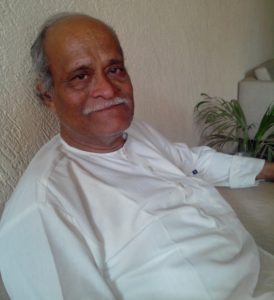
    Recently, I met my Engineering College Professor Dr Anand Swaroop Saxena (in picture). He was my Engineering degree Major project guide, actually a guide in many ways. We were discussing something and he shared the following  lines (in Hindi these are called Doha).

    गो धन, गज धन, काज धन, सबे रतन धन ख़ान|
    जब आवे संतोष धन, ये सब धुरी समान||

    Go dhan, gaj dhan, kaaj dhan sabe ratan dhan khan
    Jab aave santosh dhan ye sab dhuri saman.

    Meaning:

    It is true that owning cattle, jewels or kingdoms is mine of wealth
    But when you own wealth of contentment (satisfaction) those mines (cattle, jewels etc) of wealth become worthless (like dust)

    Note – In old days cattle used to be a measure of wealth of a person, therefore go (cow) and gaj (elephant) in this doha.

    I thought about it and added two points –

    1. This does not mean we should block our owns progress in the name of contentment.

    2. Point 1 makes everyone think – when should we stop? Because if someone should not block his/her progress, that slowly converts into greed and running behind many things (at time unnecessary things).

    I thought that one should always try to utilize one’s capability to the hundred percent in doing whatever one is doing. This thought let me to Famous shloka of Geeta

    कर्मणयेवाधिकारस्ते मा फलेषु कदाचन।
    मा कर्मफलहेतुर्भूर्मा ते सङ्गोऽस्त्वकर्मणि।

    Meaning: “You’ve a right to perform your prescribed action, but you’re not entitled to the fruits of your action. Never consider yourself the cause of the results your activities, and never be associated to not doing your duty.”

    And I felt contentment (satisfaction) is in becoming content (satisfied) and not in running behind anything, not even the desire to become content (satisfied with anything).

    Related blogs –

    When will we stop?

    Swasthay – dwelling in oneself

    What more you need?

    Source of Geeta shloka meaning – Deeds, not words, should speak