Tag: Adviti

  • Education, religion and spirituality

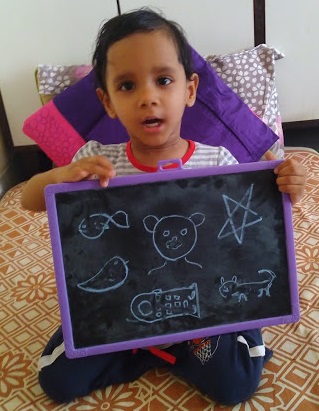
    Adviti showing sketch

    Adviti is attending school now, this started off with thoughts on education, religion, and spirituality. She is three years and we opted for online schooling finally. We avoided it initially, but the Chinese virus (Covid-19) gave us no option of formal school for her. It has been only two weeks. This time around the questions were more than just why do we educate kids? and also the race we start with our kid’s schooling.

    During our primary education, we read this story in our syllabus. This is apt for our life in general and I take a parallel from this story in religion and spirituality as well. Let me first narrate the story to you.

    Hunter and the parrots

    A jungle was famous for its species of parrots. One day a hunter crossed by this jungle. He was mighty impressed with these different types and colors of parrots. The hunter put his net and no wonder he could catch a lot of parrots. He sold those in the market and made a lot of money. He started visiting this jungle often.

    Brighter-day

    A sage lived in this jungle too. He observed that the number of parrots was drastically reducing. Sage being sage, compassionate, and friendly to every animal of the jungle, started teaching these parrots.

    The sage taught these parrots –

    The hunter comes, spreads his net,
    puts some grains, we should avoid this trap

    The exact words we learnt in the Hindi version was 

    शिकारी आता है. जाल फैलता है.
    दाना डालता है. हमें जाल में नहीं फ़सना चाहिए।

    The parrots learned it quickly. They started singing it all the time. When the hunter came he was taken aback. He was fearful now he won’t get these parrots. With a heavy heart, he put his net again. To his surprise, all the parrots were in the net and singing the same song

    The hunter comes, spreads his net,
    puts some grains, we should avoid this trap

    With immense pleasure, he took his prized possession. This time he had value-added parrots – parrots who spoke language!

    When the hunter crossed sage’s hut, sage was smiling. He saw all the parrots singing the song inside the trap that they had to avoid.

    The moral of the story

    We must learn instead of rote memorization. we must learn instead so that conceptual learning can be applied in many walks of life.

    Additionally, there are chances that someone says one thing but does another. We must learn two things – first, we must walk the talk, and second, identify people who do not walk the talk and be cautious.

    Education

    When Adiviti sits for her school sessions, I sit with her. Initially, I was frustrated (at times now too) with her slow response. She knows the things but does not respond, at times she does not understand – because she predominantly understands Marathi and Hindi and not English. She does not follow instructions.

    We learn a lot of very basic and important things in our schools. How much do we apply in our life? Be it learning instead of rote method or the basics – do not steal, do not tell lie, etc.

    Religion

    Another thought triggered in my mind. We learn almost all the ten commandments of Abrahamic religions in School, isn’t it? Most of the religion teach such basic things in our life. If this is the only lesson of religion our school or syllabus of school education is no less than a religious book. In fact, in this case, the schools and education are much more than many of the religions of the world.

    Though I know I have made this comparison on a very high level. In whatever case, what more the religions teach? Follow what is taught, in some cases do not use your brain. Do not question the authority, isn’t it?

    Religions that do not allow questioning is far lesser than school education. At least school education allows asking questions!

    I am a born Hindu (a Lingayat), I have questioned almost everyone and everything religious since childhood. When I was unconvinced I stopped going to temples. When I started understanding few things about Hinduism and started reading few scriptures, I realized many scriptures are dialogs. On the battlefield, Arjun asked questions, Janaka asked questions to Ashtavakra, and Vashisth and Rama discussed multiple things. When someone wrote Upnishad no one asked to believe those by force.

    The Buddha or Mahavir (and other Tirthankaras of Jainism) also gave the point of view without forcing others to accept those as gospel truth.

    Spirituality

    I have written on religion vs spirituality earlier. In that blog, I had given an analogy between religion and spirituality to sex and love. Since now I am looking at education, I created another analogy between education and learning to religion and spirituality. You can learn without formal education. I have heard of a past CM of Maharashtra – Vasant Dada Patil He was educated to only 4th grade. However, he was the harbinger of the robust canal and irrigation system of Maharashtra.

    If we look at multiple definitions of spirituality what best comes to my mind is – “search for meaning in life”. I can connect to the Indic religion (Buddhism, Jainism, and Hinduism) to a large extent. Spirituality is beyond any geography, religious rituals, and believing in a single book alone. Spirituality includes every living being – I can write more on that however that is for some other day.

    In fact, if I take the freedom to extrapolate the story, the hunter (शिकारी) is our false sense of self, net (जाल) greed, lust, ego etc and the grains – bait – (दाना) is our false sense of satisfaction or pleasure. We should not get in the net (जाल), here WE is the SELF.

    Education, religion, and spirituality

    What I have observed is that education and religion are like parrots in the cage. They know what they are saying but they do not understand the meaning of what they are saying. It is with many people and religions worldwide. In fact just because of that either we see terrorism or atheism in the world. People have either lost trust in religion or they are so faithful that they see killing those who do not comply with the point of view of the killer.

    At the same time, learning and spirituality are conceptualizing, synthesizing, and questioning, and exploring. Learning involves a sense of experience similar to spirituality. Look at religion you would get a lot of people who can reiterate books word by word without knowing and experiencing. This is what differentiates religion and spirituality.

    I saw a tweet from Elon Musk once – “I hate when people confuse education with intelligence, you can have a bachelor’s degree and still be an idiot.”

    Education, intelligence Elon Musk tweet

    The corollary, in this case, is – one can be known for religion and religious knowledge without actually being a spiritual master. Whereas Spiritual masters many times are against the dogmas and are more practical and clear about what they say, do, and mean.

    Adviti’s schooling is a learning experience for me. I have to get off the showjumping thing we have observed. I have to let her learn at her own pace. What matters is how intelligent she becomes with the education not how much she scores in school. What is more important is she becomes a virtuous person who walks the talk – not like the parrots who are in the cage reiterating the lesson –

    The hunter comes, spreads his net,
    puts some grains, we should avoid this trap

    The exact words we learnt in the Hindi version was 

    शिकारी आता है. जाल फैलता है.
    दाना डालता है. हमें जाल में नहीं फ़सना चाहिए।

  • Half knowledge

    We learn things slowly. Slow learning is ok, however continuous learning is important otherwise the knowledge becomes half knowledge. The baby steps we take make us learn, yet at the same time, if we stick to the only what is written in the book without using our brain, we may get constricted and end up knowing only what we read – result – half knowledge. It is detrimental.

    Half knowledge is lie goat eating a piece of paper
    Source Flickr

    Half knowledge is equivalent to goat eating a piece of paper that had information. Goat would digest the paper but not the knowledge on that paper. I will share some examples.

    H for Hen ‘and much more’

    My daughter – Adviti – is learning alphabets – both Hindi and English. She has difficulty in saying ‘R’ and few other Hindi alphabets so she mixes up few things. In alphabets, she says E for Hathi. Because she knows the photo and she knows the name of the animal in Hindi. She used to say H for Tap tap (for horse). She found pronouncing Horse difficult so she said tap tap because horse runs with that kind of sound. We found it funny, but we wanted to correct it. Now we teach her H for Hen. Once we were teaching her and for something I said Hand. She got confused H for Hand or H for Hen! This is a learning process, we slowly understand that H for Hen was just for us to learn the alphabet H. H has many more alphabets be it a noun or otherwise. Imagine Adviti restricting herself to H for Hen alone! She will miss a multitude of things in life (more than 33000 words starting with H included). Half knowledge can restrict one’s horizons.

    Knowing book by page number is not knowledge

    The second incident is about half-knowledge but knowing some stuff to the T. I loved Chemistry subject, in standard 12, and especially a textbook ‘Comprehensive Chemistry’ the most. My special liking was Organic chemistry. I read the book multiple times such that I remembered the page number, the image of the page, and the content of the pages. Even after a year, when someone asked me a question, I responded – open Comprehensive Chemistry, go to page 236, it is on the left side of the book, in the center, there is a picture just below the picture read 2nd para (say the last para) you will get the concept. The answer to your question is – “XYZ”. Do not search for the book and pages now – I am talking about 1998, many things might have changed by now in the textbook :).

    Knowing such details of the book (One book precisely) did not make me an expert in Chemistry for sure. Because all that was mostly bookish knowledge with few experiments in Chemistry lab of School. At best, I had a photographic memory – not expertise in Chemistry, isn’t it? Even a Ph.D. may not say (s)he knows the fundamental subject line Chemistry / Physics completely.

    Hathiphant

    The other incident happened with my cousin brother and my eldest sister. They were talking about the education system of India. My cousin brother said there are downsides to teaching kids a medium (language) that is not the mother tongue. He recalled a neighbor who used to call an elephant – ‘Hathiphant’. This coined word is a mix of two words; Hathi a Hindi word for Elephant and part of Elephant – Phant. Merge these words and you will get Hathiphant. This confused toddler learned both words at home and in confusion made the Elephant a Hathiphant. Half knowledge can make one jumble multiple things and make a conclusion that may be incorrect.

    This has happened to me too when I was a student. We learned something and later that something became another thing (Hathi to Elephant). Let me tell you how can q kid get confused. I learned – I live in Dhar (a small city in India). Later, I learned- I live in Madhya Pradesh, lastly, I learned- I live in India. How is that possible? A 6-year-old cannot understand why and how can one person be in three different places? Later it was clear what living in three docent paves meant?. In 3rd we had nine planets, later Pluto was removed from the list, funny isn’t it?

    Half-knowledge

    Well, no it is not funny. We keep on learning. If we stop learning and improving our knowledge becomes half knowledge. This half-knowledge is harmful. Our learning makes us understand that our knowledge is limited and we are consistently adding to our body of knowledge. Alas! Some people, knowing one book, feel as if they’ve known everything. Reciting few books by page number and chapter plus paragraph didn’t make us intelligent or omniscient.

    I had a photographic memory of the Chemistry book, but I wasn’t fully aware of the field of Chemistry, isn’t it? Well, but why am I talking about it here? This applies to spirituality too, have you heard people reciting verses from books? Do they have the knowledge, mostly no? They at best have a photographic memory to vomit words from a reference book. Knowledge and experience on the spiritual path are pristine, once you hear those enlightened masters you quickly get connected. I have met a few of such masters in person, I have that first-hand experience of witnessing the presence.

    Similarly, in businesses too, not all business grads become successful managers or entrepreneurs. Becoming a successful business person requires more than the degree, knowledge, isn’t it?

    The point is, be it the path of spirituality or business, or a toddler learning language, we keep on learning and experiencing new things. Every experience is unique and thus, if we assume that photographic memory of any certain book is the knowing everything; it is – in effect – detrimental to not just one person but everyone around. On the path of spirituality and religion it a disaster for sure.

    Every situation demands a unique set of tools. I think that is why Krishna was needed on Pandavas’s side during the Mahabharat war. Yudhisthir – and all Pandava brothers were – (was) predictable. They went by the book, defeating Pandava’s won’t have been tough for Kaurava’s because they knew Pandava’s would go by the books all the time, besides having a bigger army. That is where unpredictability and Krishna’s intelligence came in handy. Experience of bending the rules could play in the hands of those who understand the situation and learn from experience. Those who learn from and are ready to learn from the experiences do not have half the knowledge. Be ready for learning, implementing, experiencing, and continuing it lifelong.

    Image source – Flickr

  • Impermanent and trifling or forever and important

    I was playing with Adviti in our building’s parking area. There were some small dead branches of a tree. On the face of it, it looked an impermanent and trifling item to me. I took it in my hand, showed it to Adviti. We started talking, I told her this was a branch of the tree above. It had leaves, that nourish the tree. Well, I did not go up to photosynthesis, Adviti is only three years currently. I questioned myself with the chain of thoughts – are things Impermanent and trifling or forever and important?

    Smiling-Baby

    Deep inside, I started feeling multiple things, one as if the branch and leaves had their own life. What I mean is – the life of a tree and the life of a leaf or branch were separate. It was a strange thought, this is like saying my hair, or skin, or nails have a separate life other than my own body. It becomes even weirder from here. How do I know that I have only “This Life” that I perceive? I have written earlier – and we all know – our body hosts umpteen living organisms. I cannot experience them therefore they are separate or they do not even exist for me, is it?

    All these thoughts were going on with the disturbing news of deaths due to Covid. I came home after the small walk with Adviti and started re-reading a chance chapter of Old Path White Clouds book. It was luck that the chapter was based on interdependent co-arising, the concept of Buddhism I love the most. news of death makes one feel a void, and question the existence. At the same time, the thought of the impermanent and trifling nature of our life comes to mind. At the same time when I think from a larger perspective, our life seems forever and important.

    Let me share some paraphrase parts of the philosophy of the Buddha on “Impermanent & trifling” vs “forever and important”.

    While The Buddha was meditating he was a Pippala leaf. Looking deeply at the leaf The Buddha perceived the leaf had a presence of The Sun, the stars, and the Moon. Without the sun, without the light and warmth, the leaf could not exist. Similarly, the leaf contained the clouds, without the rains this leaf could not exist. Similarly, the earth, time, space all were present in the leaf. The entire universe existed in the leaf. The leaf was a manifestation, it existed before and it will exist even after the physical form is gone. Impermanence is the very basis of growth.

    Impermanent and trifling or forever and important

    The Buddha’s perception concludes with these thoughts – “To accept life means to accept impermanence and emptiness of self. The source of suffering is a false belief in permanence and the existence of separate selves. There is neither birth nor death, production nor destruction. These false distinctions are created by the intellect. If one penetrates the empty nature of all things, one will transcend all mental barriers, and be liberated from the cycle of suffering.”

    Everything is Impermanent and trifling or forever and important. It is the perception with which we look at things. My understanding of interdependent co-arising makes me conclude that even the speck of sand is also forever and important – only form changes.

  • Behind our eyebrows

    The world that we see is not outside, it is behind our eyebrows unless we can qualify what we see accurately. Many times, what we see may not be the reality, it is a reflection of what we think we are seeing. Ashtavakra’s explanation is “the rope on the ground is seen as a snake because your mind thinks it is a snake”.

    Shut the mind off

    Mumbai has hardly any winter. This was Feb thankfully we were not sweating after our bath – as we do now in Apr. Thus, we feel good in whatever winter Mumbai has. As usual, this morning also I was doing my daily morning Sadhana (meditation practice). My daughter – Adviti – had just learned to enjoy a toy that moves, throws light, and plays song alongside. She had this toy with her for over a year. When we tried it a year back, she got frightened with the light, sound, and movement of this toy. However, off late, she accepted the toy, and now she keeps on playing with it. A drawback with this toy is – it does not have a volume control option.

    Adviti-with-me-Pranayam

    I was meditating and she was dancing around with the noise of the toy. After a while, I felt that I should go and stop the toy so that I can peacefully practice today’s Sadhana. Meditation aside, this thought followed up with others. First, it was a noise for me, music for her. She was unaware – as my wife and parents were too – that the sound was uncomfortable for me. The toy was the world for her, she was enjoying it with her heart and soul dancing around it, giggling, and inviting her mother and grandparents to join her. Generally, you feel elated when your child or grandchild is happy. My wife and parents were also engrossed in Adviti’s joy. At the same time for me, meditation was my world. In the same room, we were in two different worlds.

    This happened for a couple of days with me. Somehow, I could keep on continuing my practice without asking for stopping the toy. Within few days, I realized my meditation is my practice, it should not be impacted by external factors. If our mind feels something is a problem we can analyze it with disinterested reasoning or shut the mind off because it creates unnecessary noises behind our eyebrows that we do not even realize.

    The summer has set-in in Mumbai, now after the bath, we start sweating. We do not complain, we cannot change it. Every Mumbaikar has a response for summer of Mumbai – “accept it” – either put an AC at home or apply deodorant.

    Behind our eyebrows

    It happens with all of us. We end up creating our own problems. The mind makes us feel or believe something that may not necessarily be correct. Before assuming something or making a perception a verification can help.

    In March, someone accused me of a thing that neither I intended nor I did. In fact, I had no role in what was going on in this gentleman’s mind! The bigger surprise is – “I was not even the actor in what he though Mr X did, but I was the accused!” I was literally a third party, Mr X, the gentleman and I (one who had no active or passive role in actions of Mr X). I tried justifying myself to him. When I realized the mindset of the other person; I stopped defending myself. Since I had just learned a lesson with Advity’s playing with the toy I could relate the learning. I moved on thinking “if your mind is corrupted, you would be responsible for the words, actions, and consequences. How can someone help you until you are open to listening?”

    Actually, the thought in Hindi was this – “Agar tumhare dimag me bhusa bhara hai to aag bhi dimag me hi lagegi, koi aur uske liye kya kare?” अगर तुम्हारे दिमाग में भूसा भरा है तो आग भी तुम्हारे दिमाग में ही लगेगी, कोई और उसके लिए क्या करे? It would be great if someone can help me translate this effectively in English.

    Everyone lives in his own world. This world is made up of what we live in our minds. What we see is not ahead of our eyes, it is behind our eyebrows.

    After writing the blog, I searched if some enlightened master’s comment is available on these thoughts, I found a pertinent one from Sadhguru.

  • The trusted friend

    We all have friends around us. Some friends are closer than others. A trusted friend is one who can guide us. The guidance can be about our capabilities and strength or out of our unpleasant behavior. I happened to hear a case study recently and could relate to multiple things regarding trusted friendship. A child trusts her parents. Therefore, as parent, the responsibility is immense to help a child believe in herself. A guide is important to help you realize your powers to cross the ocean – of life or spiritual progression. Read further to see how trusted friends are key to personal growth.

    3-small-lessons-from-;leader

    Trusted friend in mythology

    The whole army of Sugriva – the money king – was at the tip of southern India. The army was stuck! There was no clear path from here to the Lanka – where Lord Rama’s wife was. It is at this time that Jambvant told Hanuman what infinite power he has. He can fly, he can change his size, and he is invincible.

    How did it happen that Hanuman was unaware of his powers? Well, the story goes like this – when Hanuman was a kid, he was mischievous. His mischief created a lot of trouble. To everyone’s surprise, he was invincible, so however small he was, no one could fight with him. Besides this, he was anyways a child. Who would want to fight with a child, right? One day when he bothered some community again, a sage cursed him – “you will forget all the powers you have until someone reminds you of these again.”
    Just one sentence and Hanuman became Hanuman we know. Isn’t it interesting? We all need such friend and guide in our life who can make us believe in ourselves and remind us of our powers.

    Trusted friend for child

    We experience the same too. As a child, we hear more of what “Not” to do and what is wrong and avoid it. I am experiencing this whenever I tell Adviti – my daughter – not to do A or B thing. Oh yes, she is mischievous. I get the impression that when we tell kids about No and Nots, we create a virtual limitation in their subconscious mind. These limitations create a boundary that they start making around their capabilities and strength. Otherwise, almost every child is like Hanuman – except the flying and changing the size bit.

    This is a learning experience for me. I must change how I should communicate with Adviti. She needs to learn how to believe in her capabilities and utilize those to do certain things that “are acceptable” as non-mischievous 🙂 A trusted friend for a child is parents, isn’t it? Watch this brief video from the movie Kung Fu Panda, the lesson is You Must Believe. I just love this movie, it has many lessons in less than 100 minutes.

    Trusted friend for professional

    I was talking to one of my close friends about one of his case studies of a course. In this case study, there was a certain new employee in a company. Even though he was new his passion helped him learn technical and non-technical aspects of the job quickly. In no time, he could successfully argue about the technical stuff with his seniors and convince about his point of view to almost all. His skill set helps him climb the ladders quickly. When there is passion, supporting leaders, and no fear of failure one can grow faster. None of his seniors cut him off or short ever to let him feel about his being new, inexperienced, or anything else. This kind of environment can help a person grow professionally too. Isn’t it?

  • Choices

    My daughter, Adviti is growing up. She has started asserting her liking and choices gradually. She decides what she wants to eat when she wants to change the song, and what she wants to wear. It is turning out to be a fascinating life lesson for me.

    We start making choices since childhood. I remember spending time with my niece Chinu when she started making choices. She liked watching Kung Fu Panda (movie) I enjoyed watching Kung Fu Panda with her, she also collected pebbles as I did as a kid.

    Smiling-Baby

    I believe some of our choices are involuntary, and some are self-made. Let me take an example – Adviti likes us chanting of Bhojan Mantra (video below) before meals because she has seen us doing it for as much as the last six months. I wonder if she understands it, or whether the rendition is clear. However, she loves it, and if we start eating our meal without the chanting, she forces us to chant the mantra. Possibly this is what Sanskar is. I’d call it an involuntary choice – I may be wrong though, she may be forcing us because she understands! When she changes the Youtube video – it is most likely a self-made choice.

    Choices, Liking and Love

    Though I found time now to write about it, however, I had been thinking about Adviti’s likes, dislikes, and choices for a while. Those who know me know that for my arrange marriage I met two dozen girls. Many rejected me, I rejected some. In these discussions, some accused me of – you are not proceeding further “because I am fat”; “because I am darker shade” etc. I had to respond to these because these were genuinely not the reasons. I will share few arguments that I shared with these prospective alliances.

    One, on complexion, I said, let’s assume I get to marry the fairest girl in the world. Every evening I come from the office. and we start fighting on a trifling matter. In that case, what is the value of the “fairness” to me? It is said that beauty is skin deep, isn’t it?

    Two, on complexion and shape, I said, let’s assume I get married to someone, she met with an accident, or I met with an accident resulting in a body deformity. Would the other person leave the better half who met with an accident? I had to take this example because one alliance had such an incident. I had to tell her that such things are possible after marriage too. A bad example but I took such an example.

    Lastly, on the shape, I said who is going to remain like this forever? With age, we all will be out of shape. why worry about it from now? One must be fit for a healthier life but one should not take serious decisions giving one-factor full weightage.

    Those long discussions (or at times long-distance discussions), in some cases the contest of mind vs heart, for alliances made me look at likes and dislikes little objectively. I asked myself – if I love someone because of face or shape or behavior (or family – yes Indian marriages are not just two people it is their family and extended family too) what if one parameter changes in the same person? In the end, I came to realize – choices are made (or someone or something is loved) because of the whole and not because of the parts. Check this section of an Indian movie – Nayak the real hero – where protagonist is explaining his “dream girl” and what that turns out to be by his father who is a cartoonist.

    If I love someone or something – I love that because of the uniqueness. The uniqueness includes possible flaws. If I had to respond to “why I love someone or something” what would my response be? If my response is because of X, Y, Z and A, B, C, etc. There may be more people with those same qualities. Would it be possible to love those others too? This question helped me realize the lower strata of love. This stratum is for love, liking, or choices we make in the material world. The spiritual world has compassionate affection – of the Buddha – for everyone or full devotion – Bhakti – for the loved one.

    The realization was that we make choices in the whole and start intellectualizing the choices part by part for bringing balance between heart and mind. This justification brings reasoning of “why” and “because of”. Most likely Adviti makes her self-made choices on the whole, once she grows older she too will start intellectualizing the choices to justify her liking.

  • Gyani in professional life

    The Bhagvad Geeta defines who is a gyani (sage) as follows – “One who remains unattached under all conditions, and is neither delighted by good fortune nor dejected by tribulation, he is a sage with perfect knowledge.” It is very difficult to implement in life. The practical approach for trying is – “Pandemic has happened, we are in lockdown. This is our current reality. We cannot change it, isn’t it? What we can do now is detach ourselves from this reality and look at what can we do as a professional and as a person.” If we approach situations in this manner we can be Gyani in professional life – a saint in suit. Here is a very small example with me how I failed in it recently and learnt a lesson.

    My recent experience

    My daughter – Adviti – has been kind enough to teach me some lessons on a regular basis. She reminded me of a Shloka of Bhagvad Geeta – “who is a Gyani (sage)?” Recently we gave her a slate and chalk so that she can scribble some things on it. She is too young – 2 years only – to write something useful. So, to keep her entertained, I make caricatures, animals or some drawings. It is a slate; it needs cleaning to scribble something next time. I am a very terrible painter, this has been a learning experience for me how to make something worth its salt. Slowly,2 I started drawing things that at least have some resemblance to the original. Now, I have started making something which is of at least some value – or I feel it is so.

    Adviti-Drawing-Lesson-Who-is-Gyani

    Initially it was ok for me, the drawings were awful and she was rubbing stuff. Yesterday I copied one of the drawings from her coloring book. I fell in love with that and as usual Adviti rubbed it clean. I tried to stop her, because I was very happy with the drawing. Probably for her there is no definition of beauty or ugliness. For her everything is equal. In fact there is a probability that the drawing I made was not worth it but I fell in love with it because I made it. So it was a lesson for me to let go and be equanimous in such situations. By the way, the picture on the side is about 2 month old, I make better drawing now 😀 😉

    http://business2buddha.com/2011/07/when-will-we-stop/

    Who is a Gyani (sage)?

    दु:खेष्वनुद्विग्नमना: सुखेषु विगतस्पृह: |
    वीतरागभयक्रोध: स्थितधीर्मुनिरुच्यते || 56||

    duḥkheṣhv-anudvigna-manāḥ sukheṣhu vigata-spṛihaḥ
    vīta-rāga-bhaya-krodhaḥ sthita-dhīr munir uchyate

    One whose mind remains undisturbed amidst misery, who does not crave for pleasure, and who is free from attachment, fear, and anger, is called a sage of steady wisdom.

    य: सर्वत्रानभिस्नेहस्तत्तत्प्राप्य शुभाशुभम् |
    नाभिनन्दति न द्वेष्टि तस्य प्रज्ञा प्रतिष्ठिता || 57||

    yaḥ sarvatrānabhisnehas tat tat prāpya śhubhāśhubham
    nābhinandati na dveṣhṭi tasya prajñā pratiṣhṭhitā

    One who remains unattached under all conditions, and is neither delighted by good fortune nor dejected by tribulation, he is a sage with perfect knowledge.

    I remember above shlokas of Bhagvad Geeta that she is effectively teaching me without even realizing. The lesson is “who is a Gyani (sage)?” I got too attached to the drawings – very trifling things – that would be gone over time. Whenever she wiped those I felt miserable, though I know these drawings are transitory.

    It is easy to relate to the slate and scribbling. It becomes difficult to apply this wisdom to our daily life. In our daily lives we are attached to the “bigger things” be it our certificates, designations or possessions. It’d be good if we learn this lesson for our daily life.

    Source – Bhagvat Geeta and the translation (Holy Bhagavad Gita).

  • New Year resolution

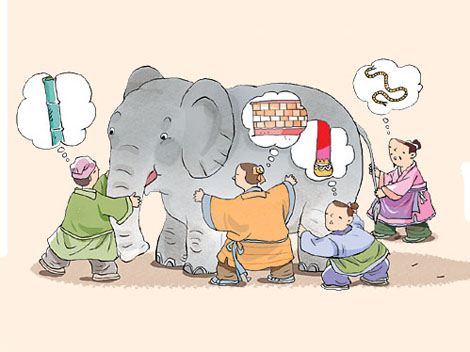
    Our experiences shape our world. We tend to behave in a manner based on how we have experienced some similar situations earlier. These experiences can be inaccurate too because we may have limited knowledge of the situation. This limited knowledge based inference may create a limited world view for us, because we get conditioned by our experiences and therefore responses. Our past experiences shape our judgments, should we have a new year resolution that we wont be judgmental about things around us? You might have experienced with some people, they take everything in a wrong direction. You might question yourself that how to help this person understand other perspective, isn’t it? Remember this personality type might have been a result of their past experiences.

    Judgement-elephant-by-blind

    Let me explain this with a very recent incident with my daughter, she is not even 2 years, she speaks monosyllables only. My daughter used to cry in a peculiar manner. We found it bit funny and I started imitating it. Whenever she cried I imitated it. She looked at me and started pointing my crying to her grandmother (my mother) or her mother (my wife). Once, I did it in front of our guests to show them how she makes a pout and points finger at me. All this while we have been thinking that she is trying to say that – I am imitating her and they should stop me from doing it.

    However, recently I realized she does not know what imitation is as such. This clicked to me that all this while she was trying to convey to my mother or her mother that something is wrong with me and they should help pacifying me (because I was also crying). She does not know what copying means! She wanted a genuine help for me from Grand-mom or her mom.

    There is a saying in Hindi / Sanskrit – Yatha drishti tatha shrishti. You will see the world as you perceive the world. That is – what you perceive the world to be, you will see it that way. Most of the times it may be a partial truth. Your perceptions create your reality.

    I made fun of Adviti by imitating her; I did not understand the follow up as her genuine concern. We thought it is her complain that someone is imitating her, though it was her concern to offer help. We laughed and within a weeks she has stopped crying in that manner or when she has any concern. With kids we have to be very careful to inculcate right behavior to make them sensitive and caring.

    Related blogs

    Many people take a New Year resolution every year, this year what if we have a resolution that we would keep experiential barrier aside and would see the world as it is. Our experiences are the veil through which we see the world; the clearer we keep our judgment about situations better it is to have a response.

  • Living in the moment, how?

    Have you been disturbed by the outside environment? Is it that you lose your temper when some external factor influences you? It is nothing new, isn’t it? I too face the same time to time. Recent observations helped me look at these incidents little more carefully. Thus, I could question myself – How can one be centered and focused from the outside distractions? How can one live in the moment? Here I’m with some of my own’s answers too.

    Incident

    I’ve been associated with the Art of living since 2004 and practicing the practices taught there. This involves some yoga asanas, pranayam, Sudarshan Kriya (A breathing exercise) and meditation. I’m continuing with my practice after marriage and my daughter Adviti‘s birth. The only difference now is that Adviti comes and sits on my laps occasionally. It is kind of distraction. Though it was good that it happened, now I’m more aware and question myself, how can one be a saint in professional life? The saint in professional life thought came to mind because there are multiple distractions and problems we face daily, how can one be focused even after so many distractions?

    Initially, I was bit uncomfortable that Adviti is disturbing me. Somewhat worried when doing asana if my hand or leg may hurt her. It is said that when someone is meditating or doing his/her spiritual practice you must not disturb the person. In fact it is said that you must not even touch the person. Here this infant is sitting on my laps, holding my hands and asking me to join her to play something. It happens rarely to me that I’m in a meditative state when I’m “doing” something.

    Long back I had a blog draft, in which I had contemplated what must be going in the mind of a sadhu (monk) who has left everything and gone to the Himalayas. He must have achieved the peace of mind he might be looking for. I had lot of questions to this fictional sadhu about he lessons. A thought cropped up when Adviti started sitting on my laps during my practice. Will a sadhu – who has attained peace at Himalaya – remain the same peaceful person in the world where there are distractions? The distractions can be traffic to office or noise of road construction or for that matter, your daughter wanting you to play with her, when you’re meditating.

    Learning

    My daughter has been a great learning to me. She is a cute little doll who enjoys moment to moment she lives in the moment. In fact she is so full in the event that if she is crying “she is crying” period. This is the case with every infant and kid, they are in “the now” all the time. Adviti does not know what I am doing or if she should stay away from me during those 30 min or so. She is fully involved, perhaps she is not aware that it is called awareness and still she is completely AWARE of her action.

    How to live in the moment?

    Almost for all questions my answer ends with spiritual practices. There is nothing wrong in this, I think. At the end of the day we all are spiritual being in various levels of evolution. There can be few simple to do points to be aware –

    1. Becoming aware of our thoughts, many a times we are doing one thing and thinking another. This distraction should be minimized. Keep an eye on the distractions.
    2. Do any activity with full awareness, it is difficult in the beginning. Why – read point 1 above. Keep aside your mobile, stop all notifications (except calls perhaps). This is how babies are, fully involved in the now
    3. Meditate, sit silently for some time and make it a daily practice. It helps. I know there are a lot of meditation techniques (Vigyan Bhairav talks about 100+ such techniques)
    4. As a professional, whenever you are doing an activity – know what is the outcome expectation from this activity. By the way outcome expectation is an innovation method too. When you are aware about the outcome, your actions should “ideally” be directed towards the outcome. It sounds contrary to the most famous guidance of Krishna (paraphrase) – “You do your duty, fruit of duty is not in your hand.” Though, here the guide is your actions should be directed towards the outcome. It implies here that plan for the result, and act in the moment.

    Results of action with awareness are better than just actions. We get distracted by event. The ability to respond to the activities around (and inside) with awareness improves us as an individual.

  • Virtues and wisdom

    I had a question some time back, whether or not should I teach virtues to Adviti. This question came in mind after witnessing a lot of corruption cases in India. I got a feeling that Karma – that a lot of Indic religion followers believe in – does not do justice at least in a visible sense. The inference of Karma missing its duties comes in mind when we see a lot of people wrongdoing and still happily manipulating systems to practically prove themselves to be on the right side of the law.

    Smiling-Baby

    In the previous blog – teaching virtues to Adviti – I had pointed to a politician. He, at last, got in custody recently. Yet the point remains, is Karma giving as good as it should? Indian judiciary is a long and mostly not very pleasant ending for cases against politicians. Why should anyone teach virtues and ethical practice to offsprings when everything can be bent as needed?

    Anand Utsav – course with Guruji Sri Sri Ravi Shankar – had been a great learning and rediscovering. Learning is a continuous process that is still going on. Now, when I have been having some more perspective on myself, I believe I should continue teaching virtues to Adviti that I had been questioning myself off late. The point is – with teaching virtues one must teach the discerning skills as well to the kid.

    One must not get carried away by what good or bad others are doing. It is their way of living. Some will be worst off and will get Scott free too, in the court of justice. Everyone must learn the basic ethics in formative years, however, in addition to ethics another learning should be the ability to make a decision who should be treated how.