Category: Business to Buddha

  • Exploring the unexplored

    More than 100 years back, ice harvesting was a whole business model ecosystem in USA. There were ice harvesters, ice storage (kind of warehouse), and ice deliverymen. When refrigerators were first introduced the harvesting ecosystem improved their harvesting mechanism, storage systems and delivery systems. It happens with businesses, at times, we try to increase our efficiencies of doing what we know the best even though the whole industry is changing. In few years they lost to the new industry refrigeration! It happens many a times, either organizations are blinded or do not change resulting in the death or reduced shareholder value. It reminds me of a quote of former CEO of General Electric Jack Welch – If the rate of change on the outside is greater than the rate of change on the inside, the end is near.

    I learnt this lesson practically in my MBA too. I dedicate this post to Prof Lopez. unfortunately he is no more, but his memories and teachings – specially to me, are long lasting. He always put me in a spot, not just me but other students also. When you are in a spot, either you are numb or your mind starts working faster, thankfully for me it was the later. He pushed me to think more and more and challenged me to unbind myself from my limited approach (Engineer-ish thinking style on which I wrote earlier). What is strikingly similar between my reaction and any organization is – initially I tried doing (number crunching) what I was good at, I tried it even harder. This is what happens to companies fighting for survival. As I explained from the ice harvesting industry. The idea of giving your full energy to something is great, however at times one has to think in blue sky – without inhibition. Situations that the ice harvesting industry was facing needed that blue sky approach. This was a great learning for me from Prof Lopez.

    Later the exploration of unexplored began, when I realized why am I doing what am I doing? I realized that I was digging a hole even harder, faster and deeper when I had to get out of the hole and search my unexplored dimension. There are facts beyond numbers; there are reasons when digging in numbers is not THE only thing which is required to be done.

    Besides the books, case studies and team projects other MBA lessons included sustaining and keep learning spotted by him, in uncomfortable situation. This one learning came from the sessions of Prof Lopez, the extra learning I took was – one may have to face such situations in organizations or from competitor organizations / business environment, how to handle such uncomfortable situations?

    Prof-Lopez-Pravin-shoe

    Here is a picture of me attending one of his class (extra class of other stream). In which I responded – correctly – to a question. However, the question was changed later and I got his shoe as a reward for this – literally as a beating me for that response. Source – Jaydutt Kamat’s uploads, may require login to Facebook. Missing you Professor Tomas Lopez on this day – your birthday. I would have written to you for permission to write this blog – unfortunately you are not with us today.

    Death of ice harvesting industry is not the only example for us this story has been repeated umpteen number of times. In fact some research suggests that the average life of companies are reducing drastically. Thank you so much Prof Lopez, you gave a great learning to me, I am sure I would less likely be the person who would work with an organization that is getting into ice harvesting industry type scenario, if probably I do, I am better equipped to have a direction before it is too long. Prof Lopez’s putting me in a spot helped me explore the unexplored on personal and professional level to be better equipped in decision making. I can summarize this lesson – being receptive in toughest situation.

  • Data as a narrative

    I listen to even the data driven opinions with a pinch of salt now. I did it unwillingly and learnt it one can present data to please bosses even if the findings are unfavorable. It happened with a client of ours. They’d invested about 8 Cr rupee in their Above The Line (ATL) marketing. We used to do offer data analytics solution to them. So, we were told measure the impact. We found out, there was almost no impact – statistically, even if you take p-values and seasonality and market condition etc etc. The 8 Cr had gone in drain. However, we’d to help our manager at client’s office “look smart”. We’d to make a presentation that look and feel sound, statistically such that the branding efforts have had a positive impact. We somehow did it, against my wish. I quit the organization soon after, due to various reasons.

    Actually we had conveniently changed the goalpost for the client. Our clients objective of the ATL was generating investments, however the presentation of the data was done completely for branding. All the communication for the ATL was regarding “invest with us”. The presentation was not about the impact of that in terms of call to action “investment” as such. Human being are smart, we create our own narrative from what we see, hear and observe.

    You-see-what-you-want-to-see

    So, one must take data and findings with open eyes and willingness and honesty to question. I’ve been favoring capitalism over socialism (or some sort of communism), the data suggests that capitalism is somewhat better than socialism. We have many examples – South America going through the upheaval North America is better off, USSR broke down, India moved to more open economy after 1993. Mass production or mass anything is great for economy of scale and businesses. I happened to stumble upon the episode of “Last week tonight” by John Oliver on Amazon or warehouses. John Oliver presents concepts interestingly. He adds humor with numbers and in 20 minutes drive home his point and makes you accept the conclusion.

    After watching this episode of Last week tonight, I thought of writing on this. However, as I said, I have started taking data with pinch of salt. I asked myself, are these the only few stories about work condition at Amazon? Why other such stories not coming out? Should one get to see other perspective instead of believing only one side? I came across similar thought published in NYT, so I made up my mind to type it down. My opinion still stays – the quantum can be more or less, presentation may make the statistic look appalling.

    The NYT article touches what John Oliver is talking about in his show – work conditions at Amazon. In fact Amazon is forcing competitors to match its standards, which affects lives of employees. I wonder if we really need that toilet paper at lightening fast speed, as John Oliver talked about in his show. Are we sure we want such competitive and capitalistic world? I wish no. Mass production results in unwelcome competition and possible corrupt practices example – using fertilizers for farm produce affecting the soil quality or destroying work life balance of employees for quality of service that may not be the demand of customer.

    I’d not envisioned capitalism of this kind to win over socialism – where there is no trickling down as expected by economists however not happening on ground as recently economists found out. If we do not improve our capitalist approach to be more inclusive we will surely pay a huge price of inequality – as Prof Joseph Stiglitz had pointed out in his book by same name.

    We need a world that is more balanced, the competition of capitalism can eat into mental peace of individual. Socialism as we know it, tries to make everyone equally poor that bad too, we need balance – the middle path. Few months back when I visited a village, I saw how Modi govt’s socialistic approach of govt worked. I see promise in such approach where there is a balance – in Govt trying to balance socialistic giving and encouraging competitiveness. Though currently, according to data the economy of India is not doing that great. Also some time back GDP calculation method was changed. Should we trust data that can be manipulated to suit narrative? Before trusting anything, should not we ask questions on validity of data and representative-ness of the same?

    Image source – https://www.skepticink.com/

  • Virtues and wisdom

    I had a question some time back, whether or not should I teach virtues to Adviti. This question came in mind after witnessing a lot of corruption cases in India. I got a feeling that Karma – that a lot of Indic religion followers believe in – does not do justice at least in a visible sense. The inference of Karma missing its duties comes in mind when we see a lot of people wrongdoing and still happily manipulating systems to practically prove themselves to be on the right side of the law.

    Smiling-Baby

    In the previous blog – teaching virtues to Adviti – I had pointed to a politician. He, at last, got in custody recently. Yet the point remains, is Karma giving as good as it should? Indian judiciary is a long and mostly not very pleasant ending for cases against politicians. Why should anyone teach virtues and ethical practice to offsprings when everything can be bent as needed?

    Anand Utsav – course with Guruji Sri Sri Ravi Shankar – had been a great learning and rediscovering. Learning is a continuous process that is still going on. Now, when I have been having some more perspective on myself, I believe I should continue teaching virtues to Adviti that I had been questioning myself off late. The point is – with teaching virtues one must teach the discerning skills as well to the kid.

    One must not get carried away by what good or bad others are doing. It is their way of living. Some will be worst off and will get Scott free too, in the court of justice. Everyone must learn the basic ethics in formative years, however, in addition to ethics another learning should be the ability to make a decision who should be treated how.

  • Single word sentence that changed me

    It was year 2000, I was doing my Engineering away from home. This session was stressful; I had never failed in any academic exam until that year. I failed in one subject of my engineering. The result was about 5% for that subject for our batch – across the university. There were various discussions on the results in University, colleges and among students. Some toppers or top 10% student have also failed in the exam. Disclaimer: I was not a topper during Engineering. Once, professor who taught, set paper and evaluated the subject had openly said in classroom – “I had passed few students because I knew their parents!” It was a shock to many.

    The above mentioned was kind of first of my academic failure. Though one was inability to make it to IIT, however it was mixed feeling that time, as I had made it to State Pre-Engineering test (with rank). There are shocks and failures that teach you biggest lessons in life than any success.

    Single word sentence that changed me

    With the grievance, I went and spoke with a professor of our department. He was also aware about the whole incident of this particular subject, exam, teacher and batch. I was immature, outspoken and outraged. When you are away from home, no family support and just crossing your teens, you may become very aggressive or meek. The young age also gives you extra bit of adrenaline. With full of anger, I spoke with him– “<a lot of story>. Does the institute want me to ask my parents to come and network with professors? They are also teachers; they too have responsibility of teaching students to make their future. I never failed, had been a bright student academically, who is responsible for this result? How can I secure only 22 marks when my mathematical equation based solution worth 20 marks was correct? Who is responsible for this?” I was venting out like anything!

    He heard me carefully, looked at me patiently, and responded – “Situations!” This one word sentence I don’t know how, made an immense impact on me. Probably, the reason was not that one sentence alone, it was the countenance, the manner, care and concern. It was said with compassion that made the difference. That one word resonated with me for a long time. Perhaps, it is difficult to understand what I am saying, however this interaction left a mark on me.

    Lesson for life

    We get carried away by results, we many a times, consider ourselves something probably we are not. In this particular case – I thought of myself as a failure, though I was not. There were circumstances where someone fail, that does not prove that the person is a failure. It is like seeing a steam of water flowing. You be an observer, water keeps on flowing, as Lao Tzu said – “…grass grows by itself.” Our life situations are like this, most of the times we get carried away, the way I was. We get wet in the stream of water. However, when we become an observer, our perspective and paradigm changes for many things.

    Our problem is that we get carried away by people, situations, results and many things around us. These things make us vulnerable. When we become an observer life changes multifold. My professor’s answer “situation” somehow changed my paradigm of thinking. It was difficult to understand what has changed within at that time, now when I look back I realized that one answer changed me and involuntarily made me an observer, that time I had not practiced any meditation either, that one word somehow moved me towards spirituality.

    I did not apply for revaluation; I had lost faith in the examination system – where a teacher wanted my parents to network, rather than me study or teacher doing his duty diligently. Next semester I passed the subject, which had to happen anyway. The biggest positive for me was I became mindful, spiritual and aware.

  • Cost of poor quality

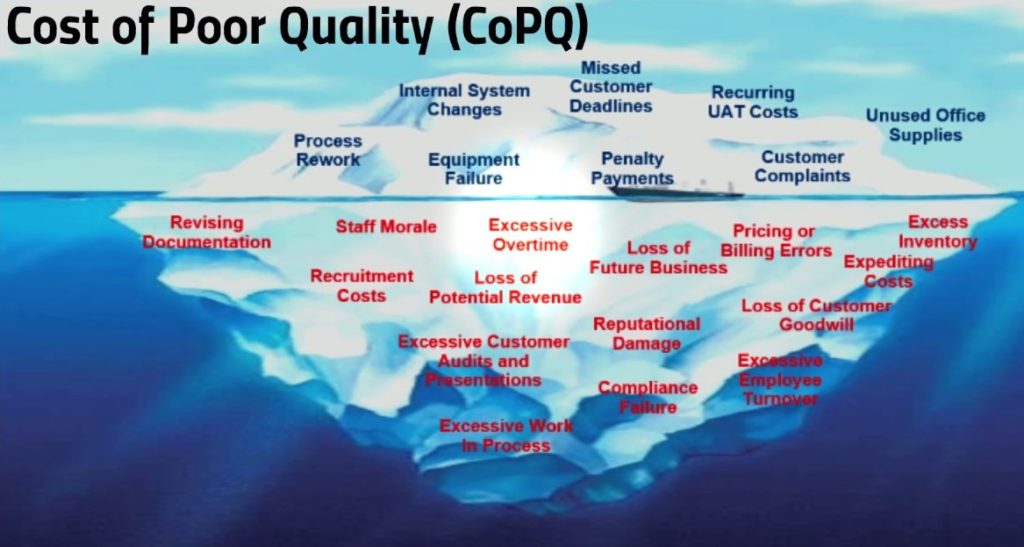
    Cost of poor quality (CoPQ)

    In operations improvement, Cost of poor quality is a common management term. Sum total of all the costs that are generated due to defective material produced by a system is CoPQ. There are various costs defined in management systems for this. You can read more about CoPQ at iSixSigma.

    A naive example

    cost-of-poor-quality

    Since, management example for CoPQ can be complicated by jargon. So, I am taking liberty of making it very layman with few variations in explanation. The context is very India-centric here. There is lot of corruption in road construction projects in Indian cities. Almost every year during rain (otherwise too at some places), these roads are full with potholes. Some people say – you need to search road within the potholes. Why go to any other city – Mumbai is a living example of the same. These roads result in – untoward events (possible serious accidents), high cost of vehicle maintenance and repairs, poor vehicle mileage and at times backache to the travelers even with good quality shock-absorbers of the vehicle.

    The evident cost, in case of Mumbai roads alone, is repairing same patch of road in single season at least 3 times.

    Example of CoPQ In life

    Terrorists – they are an example of CoPQ to society, they waste their life as well as killing other people. Say one of the person’s killed is an educated, married person with a child in his 30s. Death of this person is a loss to the Society, a talent who added to the GDP. The loss to the GDP is for about 20+ years the person could do. Family and child lost a support system. This loss of support could eventually result in inability to blossom and become a better contributor to the society. Society can be better off if a terrorist commits suicide without causing any other damage. Though it is a loss again to the society that a person is dead without adding any value to the society, however it is better than the trouble that person could be to the world.

    Depression of an individual is CoPQ for self and society. The society is losing time and skills of this depressed person. Actually, interdependent co-arising plays an important role in our society. CoPQ can be derived from interdependent co-arising too. If we understand the concept of interdependent co-arising society can reduce terrorists and depression patience.

    How to reduce CoPQ for society?

    When I was thinking about what we humans ban do to reduce the cost, I came back to the same old point – meditation, spirituality and teachings of Buddha and Jain Thirthankars. Both Jainism and Buddhism emphasis on concepts such as non-violence, non-stealing, fidelity etc. Corruption is a type of stealing and terrorism is violence. If one gives proper heed to the virtues, roads will be of good quality and if one meditates regularly his quality of live will improve multi-fold. In essence, practicing these principles the Cost of poor quality can be reduced drastically.

    Image source – Cost of Poor Quality – pt4 youtube video

  • Businessman Buddha

    I was extrapolating to get into a mind. The mind of a person – who left everything and went to the Himalayas. What changed for him, how his mind responded to the alone-ness. What was going on in there – in the mind? Why he left the society and went to the hills? What conspired? How he changed there? Would he be the same changed person when – in case – he comes back to the society?

    Middle-Path

    Can one have the same mindset of a hermit of Himalaya, in the concrete jungles? Can one balance being a hermit in the concrete jungle? Is it true that people find peace of mind in Himalayas? What is different there and here in the worldly city?

    My recent experience of Art of living‘s Anand Utsav course has given me few more questions and dimensions. Last week I wrote about listening to the tik-tik of wall clock. My wife entered the room switched on the fan, I missed the tik-tik. This is what happens with us in our daily highly demanding and at times stressful professional life. We miss very many things in the noises of becoming someone, owning valuable things, money, designation etc.

    The long and short of all this is balancing the life with awareness and becoming a saint in a professional life. Do we really need to be a monk to be spiritual? Most of us are running to be someone or to achieve something. There is no problem in having ambition and goals; the point is ,it make one restless. Why to be restless and anxious? Is not it a possibility that a person can be centred and yet ambitious? Is not it a possibility of a person being spiritual, professional and successful? These questions have become easier for me to have a perspective after the Anand Utsav course. I would certainly repeat more courses of Art of living.

    Just-be

    One can follow the middle path of being an enlightened master without leaving everything. One can be an enlightened master without leaving family. I see future enlightened masters will be successful professionals. These future generation enlightened master would / may not even talk about high flying esoteric spirituality. They will do their work as any worldly person does. These masters will not leave everything for the Himalayas, they may not sell their Ferrari. I think that is what is the lesson of the Buddha – Middle path. I think that is why current generation enlightened master’s are bringing spirituality to masses and to the day to day life.

    As Osho said long back, many of the masters will be like the Zorba. Zorba the Buddha (Osho’s book) – “… Zobra is Love and Buddha is Awareness… when you are Zorba the Buddha, you have attained the greatest height that is possible in existence…”

    Image source of monk https://www.theguardian.com/technology/2011/apr/17/untangling-web-aleks-krotoski-religion

  • Anand Utsav

    Anand Utsav

    Bangalore-Ashram

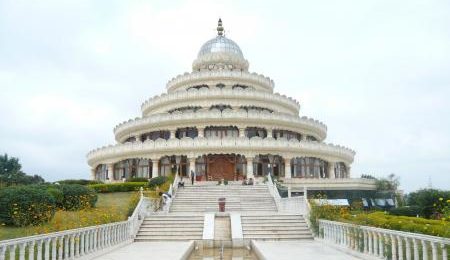
    I recently attended a course of the Art of living foundationAnand Utsav. Anand Utsav is a Hindi word (rough translation “festival of bliss”). Sri Sri Ravi Shankar (Guru ji) himself guided the course via webcast. This has been happening for last couple of years in the month of August. I could not attend Anand Utsav earlier. This time, the moment I got message, I was determined to attend it.

    Sri Sri Ravishankar, Art of living, Guruji
    Guruji

    I am associated with AoL for a long time now, whenever someone asks me about the happiness course (basic course or part I course as it is known), I say only one thing – “Before you die, do Sudarshan Kriya at least once.” There are two reasons for this statement. Firstly everyone has a unique experience because everyone’s life circumstances and situations are / have been different. Further, something inside changes profoundly. Something that is not easy to define. With both these points, I can only say – do it before you die.

    So, when I attended the course, thankfully, I had plans of vacation in subsequent week. The course finished on Sunday, I attended office on Monday (a typical chore day) and came the much awaited vacation. It was interesting because during our routine we may not be able to identify or sit back and reflect. During the vacation I could reflect. In my case typical Monday was same, the usual chasing the clock and running to office without contemplation. Tuesday morning we had to travel out. My daughter, Adviti, is an infant. When you’ve infant at home, everything moves as per the infant’s schedule.

    We had a plan to start at 7 AM but we started at 7:40 or so. We were late, however it was different from being late on any other weekdays. I knew when we’re late there will be lot of traffic on roads, the Mumbai traffic which irritates me almost daily (can make any sane person insane), was not a problem for me that day. There was no rush to reach somewhere, almost daily it is a race to reaching office. We are running an endless race daily as professionals. This race is in many shapes and forms, right from boarding our regular train, acquiring a seat in bus, owning the dream job / car / home / kid scoring certain score or getting the deal signed by prospective client.

    This day there was a difference in my approach to things and situations around me. Few things that made me get frustrated soon, were not making me like that. I looked at the sights on / around highway after a long time with such ease, amusement and astonishment as I did this time around. I was centered / focused from within.

    When we reached Mumbai again, I lost wallet, all my credit and debit cards. I had given it to my wife, she forgot it on a counter. She panicked, I did not. With full composure, I handled Adviti, consoled Simple (my wife) and walked where she felt she misplaced the wallet. I inquired and got the cards back full 15 minutes later. Any other day, I might have got more restless than Simple but this day I was not. Even Simple was surprised.. This time when I attended Anand Utsav this something changed in me. I was like this a couple of years back (I remember my MBA days), centered, peaceful and in control. Things changed a lot for me, I needed to attend Anand Utsav long back – Better late than never.

    Honestly, you must attend the Art of living Happiness Program once. Just go with the flow, sit in the course, follow instructions until the last day, ask every question that you have on the last day. Do not interrupt yourself from any instruction. Just do as directed without bothering for anything – not even the results. If still you are not sure to attend the Happiness Program – read the blog again – do Sudarshan Krita before you die.

    My Anand Utsav (festival of bliss) is continuing will you join me? I am sure you would thank me for this blog post later :).

  • Reality!

    I received this story on some group a couple of weeks back. I do not know the source now. It is so wonderful that I could not stop putting it here.

    Reality

    A young widower lived with his five-year-old son. He cherished his son more than his own life. One day he left his son at home while he went out on business. When he was gone, brigands came and robbed and burned the entire village. They kidnapped his son. When the man returned home, he found the charred corpse of a young child lying beside his burned house.

    He took it to be the body of his own son. He wailed in grief and cremated what was left of the corpse. Because he loved his son so dearly, he put the ashes in a bag which he carried with him everywhere he went. Several months later, his son managed to escape from the brigands and make his way home. He arrived in the middle of the night and knocked at the door. At that moment, the father was hugging the bag of ashes and weeping. He refused to open the door even when the child called out that he was the man’s son. He believed that his own son was dead and that the child knocking at the door was some neighborhood child mocking his grief. Finally, his son had no choice but to wander off on his own. Thus father and son lost each other forever.

    If we are attached to some belief and hold it to be the absolute truth, we may one day find ourselves in a similar situation as the young widower. Thinking that we already possess the truth, we will be unable to open our minds to receive the truth, even if truth comes knocking at our door.

  • Ego – “growth”

    Smiling-Baby

    Adviti – my daughter – is close to 1.5 years now. I have been witnessing her growth as any parent would. Earlier, she used to cry mostly when she was hungry then slowly the “needs” increased and “reasons” for crying too. When something she wants does not happen, she expresses it her own way. Slowly she has learnt another method of expressing herself – either making a sharp sound or fists to show her anger. In all these months, I see there is a kind of growth. The growth I am talking about starts sticking with us. It is about our ego, getting the things done our way.

    I was discussing a situation with a friend of mine. He is too talkative – yes more than me. During our call based on the situations and narratives, I was finding loopholes in his arguments and interrupting him. I told him that the situation in your case proves that you are egoist, reasons a, b and c. He gave alternative reasoning to my pointers to which I gave more alternative reasoning. The call concluded, it was futile to explain to him from an outsider’s perspective.

    My days with Adviti are turning more interactive, expressive and entertaining. I see, the recent phone call and Adviti’s activities in a lens that makes me feel that we grow in certain way and ego starts blending in our lifestyle sooner than probably we expect.

    Adviti is able to differentiate between herself and others. She is slowly understanding that we appreciate few things and do not few others. If she has to getaway with unacceptable actions she has started knowing her away out. My friend was trying the same – finding a way out with alternative arguments.

    I doubt if I should call it ego in case of Adviti she is barely 16+ months. Yet, when I see her at times looking for recognition, at times faking sobbing and showing bit of anger it shows she is growing, she is recognizing her liking and possibly her way of getting things done.

    When we start growing and our ego is in between it limits our possibilities of blossoming, be it personal life or professional. My friend is stuck, he still needs to learn it is his ego that is causing him the pain.

  • Why would people remember you?

    My previous post was kind of misunderstood. Some friends messaged me about purpose and having no goal in life. My answer to that is We are trying to create a correlation between goal and people remembering you. The point I think is somewhat missed – the question was why would people remember you? I believe a person’s goals in life should not be inspired by a wish that people should/must remember you. I concluded my previous blog – the inspiration and remembrance is choice of other person not necessarily goal of a-person.

    A singer sings, because he has a good voice. People listen and appreciate the singer for his/her voice, probably for the music or lyrics etc. Does it mean the singer sings only for getting those appreciations? If yes, the goal of singer is very low, of course goal is certainly the choice of the singer but it does not mean that every singer will sing for appreciations or money or being remembered for. There were, are and will be many such talented people who would perform their talent for their owns satisfaction. Some will be remembered and many others will be forgotten. Does that make the forgotten talents any lesser talented?

    Personally speaking I have run around with a lot of lofty goals in life, I still have many. My opinion is that my personal goals are my inspirations and “personal”. If someone feels inspired by them, it is their choice. It is their prerogative as well as their own wish. Occasionally, I ended up with the endless need for the next goal and then the next one and so on. Result – it had been a hedonic treadmill run, faster you run it gets faster without any end in sight. I have written on these goals, running around and what next a couple of times earlier. Everything ends up for me on a very famous shloka of Bhagvat Geeta –
    कर्मण्येवाधिकारस्ते मा फलेषु कदाचन।
    मा कर्मफलहेतुर्भूर्मा ते सङ्गोऽस्त्वकर्मणि॥ २-४७
    Romans
    Karmanye vadhikaraste Ma Phaleshu Kadachana,
    Ma Karmaphalaheturbhurma Te Sangostvakarmani
    Meaning –
    You’ve a right to perform your prescribed action, but you’re not entitled to the fruits of your action. Never consider yourself the cause of the results your activities, and never be associated to not doing your duty.

    So effectively, one’s purpose of live or goal should be limited to the action. Others remembering you or validating “your purpose” is useless (as long as your purpose is not to kill others / infringe on other’s freedom). Further, when I connect these things to spirituality, even “wishing” something, somewhere gives at least a slightest hint of ego.