Category: Business to Buddha

  • Measuring growth


    I had been asking myself a very naive question. How do we measure growth? Well the answers is not “the GDP” etc. What if I sell things very expensive? GDP might grow, right? So, I zeroed down to interest rate as one vehicle to measure growth.

    Well, let me be more fairer in providing one more reason for taking debt as a metric. I had been wondering about 2008 crisis and the fancy word – Corporate Debt Restructuring. When we look at these and other special purpose instruments we would realize that humans try to fool themselves or fool others. Therefore I considered  Debt as one metric to measure growth. I noticed Kingfisher drowning  recently – I mean the airline in India. We all have witnessed crisis of 2008. In the enthusiasm and to show fat books banks start providing loans to people; once a person is not able to repay the debt banks auction those properties. These two big cases and the housing bubble, all these things are examples of our assumption based “Growth” of economy. Here we assumed growth is represented by the ability of people/organizations to take loan. Interest rate of loans would become a representative of metric of growth.

    We all are in this mess of economic slowdown because of the concept of debt. The ability of big, smart and mighty people and organizations to restructure these debts. When I was doing a course on Independent Directors with Institute of Directors I was wondering in one session – “What if  we don’t have this concept of Debt?” In Islamic banking there is no concept of debt. We may say that Islamic banking has a more refined concept (debt), it is called as profit sharing.

    I am not a scholar of Islamic Banking and therefore whatever I am writing here is with reference to what I was told by one of my colleague and friend (Abdullah Pijvi). He too suggested to me that he is speaking from his experience (he had taken some loan) and therefore he knows that there is no straightforward concept of Debt/loan. It was interesting to know that concept however I had a question in my mind – if Islamic banks don’t have the concept of debt how do they grow? And I started defining metric of growth as – debt and interest rate!

    Related blogs – Where is growth?, What else you need? and Abundance of scarcity

    Disclaimer – 1. In this blog technicalities of economics were not considered very seriously. So readers are warned to do their research in formulating their arguments for/against such thoughts. 2. More thoughts on Islamic banking in future blogs
  • Currency for the future?


    In his class, Prof Mankad asked us “what is money?” He answered – “Money is what is accepted as money”. Very apt definition. Here I am taking small freedom to change it a bit. I am changing the word “accepted” to “trusted”. Of course trust is a very heavy word. We have built a concept “of money” on trust. The question is where is trust? On a lighter note – There was a time when banks did not trust each other (recession of 2008). I have heard this idiom – “put your mouth where the money is.” Should money be replaced with “trust”.

    I was watching 3 idiots last Sunday and thought that kids like Rancho (character played by Amir Khan) – who could solve problems of class 10th while studying in class 6th – are not that rare in India. You go to Super 30 in Bihar, or any institute in Kota (Aakash, Bansal etc) you would encounter many such kids. Then what happens? Why don’t we see such extraordinary kids as stars of tomorrow? Because in future all these kids realize that the only measurement stick (metric) this world has is – Money! See the video of Staffi Graph – how much money do you have? Well, I am not blaming Staffi for that. This is just a representative video of our society. The measurement of success is how much money do you have? Not how did you get it. Also, the measurement is not how satisfied or happy you are?

    [youtube=http://www.youtube.com/watch?v=PlA_hL3NyyU]

    When these extraordinary kids get out of college, are paid enough and more so that they do “what the company wants them to do”, not what they would want to do. Most of them choose to accept that offer because measurement metric for the society is – Money.

    Let us flip the coin and say “Trust” is the currency. What would happen? Those who have hoards of currency may be the most bankrupt people on the earth. Perhaps, a business of trading of trust would start (Bomday Trust Exchange or National Trust Exchange). Would the world be a different place then when currency would be mutual trust (well not necessarily Mutual such as DLF and Robert Vadra ;))

    The day I started writing this blog I also had a brief discussion with Mr Shreekant Shiralkar and he was of the opinion – Money becomes immaterial after a certain time, what you do, what satisfaction you get from work and the trust you build is important. When he said Trust his thoughts were different compared to what I am presenting here. However, what I feel is the currency for future should be trust you build, the good you do to the society and how satisfied and happy you are.

  • Death is inevitable


    For Humans – Death is inevitable; there is no hiding from this truth. For Companies – Only the paranoids survive!

    Well, it was a coincident that my previous blog was on death and the season of Ganesha festival (an Indian festival) arrived.  This Ganesh festival I had seriously thought about the Indian culture, festivities and the small – often overlooked – lessons. In India every good work starts with invoking Lord Ganesh, even prayers, pooja etc starts with first invoking lord Ganesh and then the other “main” pooja’s.

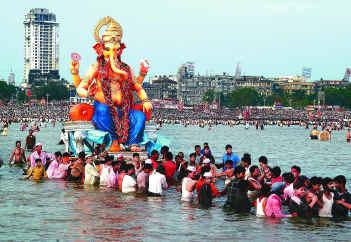
    The festival of Ganesha is a period from Ganesh chaturthi to Ganesh Chaturdashi a ten day period often in September month. During this festival, families and societies bring idol of lord Ganesh, worship the idol and within a couple of days immerse the idol in water. Similar to what happens to us – we are born one day and would be cremated one day.

    (source - http://www.thehindubusinessline.in/2004/09/28/stories/2004092802271700.htm)
    Visarjan procession in Mumbai

    Every year we follow this cycle of birth and death with our God. A God revered so sincerely that every things starts with his name – Shri Ganeshay Namah. Hats-off to this culture which has this concept of death embedded in its roots so truthfully. I think we should understand that death is inevitable and learn some lessons. (The Buddha saw this once and started his quest.)

    I started looking beyond my grieving moments and towards businesses. What I realized is that ‘the reality‘ of death applies to even companies too! As innovation consultants we used to share statistics on survival of companies. Out of Fortunes list of 1920’s and 30’s many companies do not exist now. Take an example of Kodak – a very innovative company –  filed for chapter 11 recently. If we just take Kodak as an example – Xerox was born out of Kodak’s lab. Xerox created such brand image that Photocopy became synonyms to Xerox. HP with its printing challenged Xerox. So the cat and mouse run of companies is on. The conclusion I made was if companies do not reinvent themselves, those are likely to die over a period of time.

    Last weekend I was attending a course meant for board members or to make people capable to contribute to boards. In the course (Retd) Maj Gen Mhaisale shared some HBS and McKinsey reports about shrinking life time of companies. Earlier average life of companies used to be about 40 years now it has shrunk to 16 years (in some countries 6-10 years too). Take the same example life span of Kodak was about 100 years, Xerox about 40 or so (please don’t take these life span as sanctity numbers)!

    Interesting part is a contradiction that human life expectancy is increasing and average life span of a company is decreasing. There is a lesson to learn – either be paranoid (as Andrew S Grove said in his book – Only the paranoids survive) and keep on reinventing your company or – death is inevitable!

    Related blogs – Death

    Source – BMG India training material on innovation (created and referred as a trainer) and IoD training sessions

    Image source – Business Standard

  • Collective Materialism – likely future of economy!


    I have written about socialistic capitalism or capitalistic socialism. When I say that I simply mean that we would move our economies and businesses in a direction where there would be a balance. It would be a kind of middle path where enterprise would exist at the same time there would be a concern for the society and social development. Take an example of corporate social responsibility (CSR), however the word CSR would become more of a practice than a statement in annaul reports. The reason for the same would be – we are all connected. If I do not earn how would bank generate savings? If banks do not generate saving how would they offer loan and so on. In terms of Buddhism it is similar to interdependent coarising.

    In more sophesticated words the tripple bottomline would be the corporate mantra in future enterprise. I thought of an example which could be the model for this concept of triple bottomline. I happen to read corporate philosophy of Sahara India Parivar – “Collective Materialism”. This company is very interesting and different – it calls itself a family and everyone is a worker first. According the the website of the company the philosophy of collective materialism is as follows –

    “In any human relationship, it becomes imperative to take into consideration the materialistic aspect of life – we do so but by giving it second priority.

    The first priority is given to emotional aspect and with perfect blending of materialism with emotionalism results in continuous collective growth for collective sharing and caring, that gives an impetus to our philosophy.”

    On a lighter note collective materialism is not what Government of India doing – filling pockets of few select few (so it is collective and materialism both) Sahara shree – Subrato Roy – deservers the credit for this philosophy.

    Related blogs

    The middle path

    Balancing act

    Cause…

  • Bit of commitment, that’s it!


    For a month I was in a kind of self imposed exile from blogging. I had ideas to write yet as a couple of people earlier suggested, I wont be able to continue blogging with time. I think their ideas ‘kind-of-caught-up’. It is my 100th blog so I was thinking about writing something special and thus waited to write a necklace (blog) having different blogs (as its beads and thread) in the 100th blog.  I’m keeping my idea of connecting my previous blogs in a necklace for future and writing on commitment. It only require small commitment and consistency to do something e.g. blogging.

    Yesterday evening, I was travelling from Nasik to Mumbai. I took a bus and therefore I had a chance to see farm lands, small villages and small water ponds on either side of road. During rainy season we see – at times – naturally created water ponds. It is surprising that in the summers we see acute water shortage. I was wondering about it. Simultaneously, my sister was reading a blog post of Sri Sri Ravi Shankar (Guruji) – Knowledge sheet. Here I am thinking about water-shed project concept and listening to my sister reading – austerity, what Guruji say – “…Austerity is often mistaken to be poverty, self-denial. It is neither. Austerity comes out of maturity. It is a sign of social health.

    Often people who practice austerity are resentful of richness. This is a very pitiable state. Such austerity is not born out of maturity but out of compulsion. The true austerity has tolerance for richness and is never resentful…”

    I see two connections here in my thoughts – commitment and austerity. The “austerity measures” being talked for a long time are not based on “social health” and therefore are opposed – because there would be a handful of people losing their “facilities” for doing service for the society. This austerity has come from compulsion. Isn’t it? There is lake of commitment in the actions of austerity.

    It was true in my not blogging too that I waited to write a very special blog on connecting all dots of my previous thoughts in the line of the concept of my blogging. We observe lack of commitment is the case in water-shed also. I remember my days as a kid in Dhar (MP). There I have faced water shortage problem and I personally used to travel long distance to bring water in summers. When we shifted to Indore I suggested few officials for rainwater harvesting, they did it. In the building where my parents live now, they have done rain water harvesting and that is not rocket science. I was wondering why we all are not doing it? We can fight and die for water but taking a small step is not possible. Why? because it requires “a-bit-of-commitment”.

    I have lost hopes from politicians and therefore not writing about that. Dhar where I used to live as a kid, had a king – King Bhoj – about 1000 years ago. He – unlike our politicians – knew the problem and worked to solve it. There used to be 12 lakes in Dhar, these lakes were connected, water overflow from one would end up collected in another and so on. We – as an Independent Indian – are fighting for “NOT CONNECTING RIVERS”, because it requires a bit of commitment. With Team Anna coming in the front I see a ray of hope that things would fall in place.

    What it requires is a commitment? Take one project complete it, whatever constraints are there resolve them. Next time I would write about commitment and theory of constraints.

  • Ideas Vs reality


    Recently found an interesting story in a book – ‘The prayer of the Frog’ by Father Anthony de Mello, S.J.. The story I am referring here is from ‘The prayer of the Frog – Volume 2, Page 113, Part – Human nature

    A group of tourists, stranded somewhere in the countryside, were given old rations to eat. Before eating the food they tested it by throwing some of it to a dog who seemed to enjoy it and suggered no after effect.

    The following day they learnt that the dog had died. Everyone was panic-stricken. Many began to vomit and complained of fever and dysentery. A doctor was called in to treat the victims for food poisoning.

    The doctor began by asking what had happened to the body of the dog. Enquiries were made. A neighbour said casually, “Oh, it was thrown in a ditch because it got run over by a car.”

    The author concludes –

    Human beings react, not to reality,
    but to ideas in their heads…

  • …because there are only means!


    On Saturday I read a twitt of Paulo Coelho – renowned author – “A warrior of the light knows that the ends do not justify the means. Because there are no ends, there are only means”. I inferred from the statement that – means are values on which we base and live our life. Some time back I had written on integrity as one value for organization and individuals. Another article I glanced through in Outlook India – “How Not To Court The Law” by Uttam Sengupta. At the end of the article Mr Ranjan Mondal commented – “…where is our Ethics in law?”

    Recently, I happened to meet and discuss the same with Mr Abhaynath Mishra. He is a trainer, consultant and is extensively working on value system of individuals and organizations.  He said, sustainability of an organization is based on values and ethics it follows. In short run there may be loss but the long run success of an organization is assured by the belief and sticking to the values. Also, I had a few telecon with my MBA Professor Ms Mala Kapadia – we too discussed on Values and Business. Mala Ma’am suggested “…somewhere I feel interpretation of Bhagwat Gita too has been wrong, in saying that war for Dharma is justified.”

    I asked this question to myself – do ends justify means? and What are the values business follow, do the businesses really follow these, values? I stopped at a very good question – where is ethics? We seldom talk about it in debates, in our closed rooms and perhaps in boardrooms. Ethics are there in closed door – safe, not touched by anyone! In practice – well, we practice everything except ethics because for a long time we have imbibed lessons such as “ends justify the means.” Now is the time when we – as a community – are questioning the means used to achieve goals, ethics in business and values of individuals. The reason to ask such questions is the problems we face today – recession, political unrest and other personal problems. The biggest identified cause for these problems is  ‘greed’. The problems can be resolved when we learn what Paulo Coelho twitted recently – ends do not justify the means. Because there are no ends, there are only means. Be ethical …because there are only means!

  • What more you need?


    I was watching Padosan (Old Hindi Comedy movie). The movie is interesting and I came to know that it has been made in different Indian languages. In that movie the protagonist (Sunil Dutt) repeats a couple of times an ancient concept of Hindu culture.  The concept is Ashramas of human life. According to these Ashramas there are four stages of life each divided in roughly 25 years duration. These duration and our current life style made me think. I have always been wondering about what we want? We all have been running, some know why, some do not know why are we running? Many of those who know are running behind money, other few are behind fame and so on. Yes money is required to fill our stomach on a daily basis, is required for basic amenities. Beyond a certain point do we still need money? Yes!

    When we are not satisfied with what we have. We run behind something either closing our eyes or because we can not think of anything else.

    Rajat Gupta

    Whole life we have been running behind money, if one day at an age of 60 we are told – ‘stop it!’ For some time we would feel uncomfortable what to do? Then since whole life we have been doing just one thing we would start the race again. Unknowingly money becomes purpose of life, if this running around wont be there we wouldn’t have any reason to survive, right?

    Maslow’s Hierarchy of Needs

    With due respect to those who have made a lot of money, I was wondering about a recent case of insider trading, involving Mr Rajat Gupta. Mr Gupta made it big in the corporate world, proved how successful a person could be. Yet in a recent court case sentenced for 25 years imprisonment. The reason – an  inadvertent (probably) or wishful (probably) – sharing of boardroom discussion. I was seriously wondering what more a person needs? You are famous, you are rich and you have had a very successful life, what more?

    Maslow‘s needs need hierarchy theory seems to have failed us repeatedly. There seem to be no end to the level of ‘Esteem’. What more we need to move beyond Esteem to self-realization?

    Image source – Maslow’s need hierarchy – Wikipedia, Mr Rajat Gupta – The Hindu

  • “Social Strategy” – a step in the future!


    A couple of days back I was on Facebook. Yes it happens when you are too occupied with work and commitments are such that you are socially cut-off – even if you do not want to. I checked Facebook update of one of my friends – Nishant Jain, a Supply Chain specialist with HCL – “Outsourcing is dead. Co-sourcing is the only way to go” by Vineet Nayar. This comment of Mr Nayar and subsequently sharing the statement by Nishant makes an statement that we are going to grow together, there is no other way out! I wrote on this earlier – Collaboration in logistics… What we call competition or what we see as “servicing clients” is actually helping client perform their duty better and there needs to be more ‘open-ness’ and involvement in what service/product we are offering. I started writing my blogs with the same concept (Refer – Why this title?).

    …“When Ferrari and Honda run on the racing track competing for the first spot, they are not eying at the first spot, they are racing to offer best product to their customers.” The Buddha’s teaching on ‘Dependent co-arising’ teaches me this. “Each one of us is a rung of a ladder to the other and vice versa, hence for self development and moving higher up, one’s ladder should be strong enough, even one’s competitors.” I believe this will be the extension of P&G’s present approach of Connect & Develop in future; working on various fronts with the competitors such as IPR – strategically innovating – besides others…

    I requested Nishant that would it be fine if I refer you in the blog? He is kind enough to say yes. Around the same time, when I was drafting this blog I happened to read an article in McKinsey Quarterly – The social side of strategy.  This article, Nishant’s facebook update and my owns earlier blog connected all the dots. I could see the relationship between Business and the Buddha in another dimension yet again.

    According to the McKinsey article companies are trying their hands on social strategy. Further it states that such strategy planning efforts would be more inclusive, action oriented, detailed and of course measurable. The other advantage of such efforts would be enthusiasm people would have; it would provide ownership to the execution. The reason for these strategic initiatives to be far more measurable is that these would increase accountability. Everyone in the organization would review progress of each initiative resulting in improved quality.

    Effectively, we are moving toward a more inclusive society and more inclusive organizations. Caution – the idea of open strategy or social strategy is to provide a platform to the organization for brainstorming, yet the whole idea is not yet completely evolved. So, companies need to open up slowly in some regards such as intellectual property.

    As Indian philosophy states – Vasudhev Kutumbakam (one-world family), I sincerely hope to see that happening.

    I would continue this in future blogs, too. Until then thank you for reading.

  • Inner revolution


    Recently heard that UK has declared recession, Spain and Italy has done so earlier, Greece has once voted against the austerity measures and Sarkozy is no more French president – which is a dent on austerity measures of Eurozone. This is the story of Euro! USA employment numbers are not that encouraging, employment should be about 250,000/month however last time I noted it was 150,000 or so. China showed reduced production and Indian GDP is down.

    The picture looks gloomy, however have you seen importance of stars during full moon?  No! The importance and glitter of stars is prominent during darkest of nights. I believe this tough economic time is hinting of such nights when we would realize the importance of small things which impact us in big way. Take an example corruption! Take an example Greed! Though it seems a lesson on moral science but what else we are saying when we talk about the “Moral Hazard” as the biggest reason of recession and financial turmoil! In Indian context we need to work on reducing corruption (byproduct of greed) which is the biggest moral hazard here. In Europe and US Greed is the problem.

    I asked myself – are we going to see a revolution in the world? This revolution I believe would be on a tangent – it would not only happen in the society, not only by the society but also it would happen on the self! We have seen societies changing, cultures evolving  however these changes die down slowly and moral hazard starts again.

    Guruji

    I was attending an Art of Living (with Guruji :)) session today and the idea of ‘inner revolution’ stuck to me at that time. This makes a perfect sense – if everyone becomes righteous, we would not need to change the society, it would change itself.

    We need to get ready for inner revolution and help change the world for better today and tomorrow! Remember this would start from each one of us.