Category: Business to Buddha

  • Theory of constraints


    Prof Moradian taught us concept of the Theory of Constraint. He also suggested us to read a book by Eliyahu Goldratt – The Goal. In the novel, protagonist is struggling with the operational inefficiencies of his plant and therefore facing a constant fear of management decision to close the plant.

    Well, what is this theory of constraints (ToC)? In brief ToC states that “A chain is no stronger than its weakest link”. I was thinking that this concept is applicable to our society too. We are evolving, we are constantly developing some thing or the other, society is a sort of factory. And the concept of the ToC applies equally to our life. Look at it this way if rich becomes richer the poorer would become weaker link of the society. Have you heard that during recession crime rate increases? This is ToC for our society. Lately, lot of demonstrations are happening across world by the title Occupy Wall Street. This is where I think that ToC can be applied in the society.

    I thought about interdependent co-arising and the Theory of Constraints in conjunction. My understanding of interdependent co-arising is that – we are all dependent on each other and for growth of each individual other has to necessarily grows. In other words, if society wants to evolve, everyone in the society has to evolve. The weakest link of the society may hamper the growth of society in total. Here I see a solution to the constraint, perhaps a socialistic one. We as a society have to help each other to grow (strengthen the weakest link), otherwise we would see increasing “Occupy Wall Street” kind of movements or increasing crime rates in future.

    I shared these thoughts with Prof Moradian and he said the idea is good why don’t you think about throughput and operating expenses and develop this concept of ToC in society further? This made me dig deeper. It is said that ‘a stitch in time saves nine’. If we rewind to 2008, after months of searching for alternatives Mr Barnanke, Mr Paulson and others had to bail-out banks of USA. Why not we start doing something now and for future. I see the operating expenses of this approach as deferred expense of brand building (building society) exercise for future. The throughput of the exercise would be availability of competitive, capable and intelligent work force for companies. These capable people would be the spenders of tomorrow – moving the wheel of consumerism forward – effectively, the solution may not be as socialistic as I think.

    Related blog – Ideate – save the sinking ship
  • Business of religion!*


    The first message we heard in the class of Brand Management of Professor Ram Kumar, was “It is an eco-system…”. An entangled, closely knit or perhaps confusingly mingled ‘Eco-system’. Econ-system of brands, products, product variants (variants are very confusing, no doubt) and bombardment of marketing messages (communication). Here everyone wants to say that our product is the best using different channels and different language. Hum! it sounds very common, right? So common that we overlook it.

    In another class of Marketing we were asked which is the oldest business in the world, still running successfully? I (when I say ‘I’, literally I) responded ‘religion’. Every religious institution says our religion is better (perhaps the best) than others and is the only path for salvation. Walmart, Google, Microsoft, Facebook, Tata or Reliance might exist, or not, for 1000 years but for sure we will (and had) many religion for 1000’s of years and we will have them in future too. Why? Because – religious institution sells itself on emotions. Even without learning any Marketing concept, religious institutions learnt that emotions should be hit directly to let people decide emotionally and justify rationally.

    Let us talk about the channels they use. It is similar to what we learn in distribution channel or managing supply chain. ‘Retail store’ of Religion or distribution channels are found everywhere, and finances? Well there is no limit to it (find it for yourself – a recent News in an Indian Newspaper The Hindu or Google search for $ with any major religion of the world…). Every religion has a source of income this source of income germinates from the EMOTION we talked earlier about. Yet there is a lot to learn from religious institutions, learning the administration, Marketing and distribution channel and much more, is not that true?

    Personally, I am a strong believer that religion plays an important role in building and binding society. Religion is a path wherein you have to follow the traffic rules. If you do not follow the rules you are likely to meet with an accident. What is the question of saying rules of left hand drive better than right hand drive? The rules are there to avoid accidents and make the journey safer and easier. When I say ‘firm believer’ I mean the rules taught by the religion, and not the comparison of one to the other.

    Well, not only for business but also for being righteous person we can learn a lot from religion!

    * Conditioned applied – Thoughts presented here are my own and learnt from different sources, I do not intend to hurt any sentiment or question any religion.

  • Blind men and the elephant


    I read this story in a book. A father once gave his son a telescope. One day the boy was using the telescope, he was little disappointed with the performance, he went to his father and said “father it is useless, I can see better without it. Everything is too small.” Father smiled, the boy was looking from the wrong side, he was not getting the BIG PICTURE at all. The boy had a narrow outlook through the glass. The father turned the little telescope around.

    The father had widened the son’s outlook. The boy grew up and improved the primitive telescope and with it discovered the moons of Jupiter, the rings of Saturn and the Mountains on our moon. The boy was Galileo.

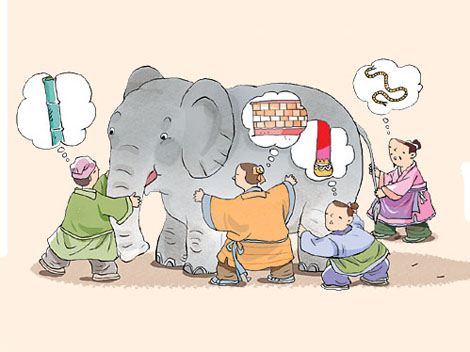
    What is important is seeing things in proper perspective and we must widen our outlook. So it is generally about the perspective, outlook and the way we look at things on which I wrote earlier. Similarly, there is a story about blind men and the Elephant. I took it from Wikipedia for the blog, however this story is very famous in India and we learnt this as kids. The story goes like this…


    A king has the blind men of the capital brought to the palace, where an elephant is brought in and they are asked to describe it.”When the blind men had each felt a part of the elephant, the king went to each of them and said to each: ‘Well, blind man, have you seen the elephant? Tell me, what sort of thing is an elephant?” The men assert the elephant is either like a pot (the blind man who felt the elephants’ head), a winnowing basket (ear), a plowshare (tusk), a plow (trunk), a granary (body), a pillar (foot), a mortar (back), a pestle (tail) or a brush (tip of the tail).

    I searched for books on blind men and the Elephant and found out that there are many books with this title for professionals are –
    Blind Men And The Elephant : Demystifying The Global It Services Industry
    The Blind Men And The Elephant: Mastering Project Work and
    on spirituality The Elephant And The Blind Men, Finding The Oneness Of God And Man you can check these books if you want to read them.

    Image source – http://history.cultural-china.com/en/38History960.html

  • The Machine that Changed the World


    I read this book recently “The Machine that Changed the World“. It is indeed a good book every businessman should read it. “The business is run on trust” or “the business will be run on trust”. When we hear this statement it seems odd, however it is true Trust is the factor. I wrote often about ‘interdependent co-arising‘ (Blog 1, Blog 2 and Blog 3). When I read this book I realized that it is practiced in Japan for many years. Toyota has substantial equity share in its suppliers and the suppliers of suppliers. This is a complete mesh of cross-locking equity structure. They trust each other decide a profit margins rather than hiding the cost structures. According to the book “…This system has replaced the vicious circle of MISTRUST into VIRTUOUS circle of COOPERATION…”.

    The cross linking equity structure goes to a deeper level and different competitors also own each others share. This shareholding pattern is to help each other raise funds. Reference to this is – “The Machine that Changed the World” page 194 perhaps it is edition 1.

    What I found interesting (page 151 of the book I think first edition) – when the volume of demand changes and assembler gives notice to the supplier and in case the volume (demand forecast) fluctuates “…The assembler will work with the supplier to look for other business…”. This is not only interesting but also a surprising and welcoming effort to build trust. One more thing I found very impressive and useful – “…we (suppliers) work without safety net, so we cannot afford to off the high wire…” and thus suppliers maintain the quality not only for their own sake but also for the assemblers.

    The other interesting fact is not just production but also product development is done in cooperation. We hear “crowd-sourcing” as a means for innovation however, a crude system has been used by Toyota for years now. New product development at Toyota involves the suppliers and major work of NPD is done by the suppliers.

    One more interesting factor I realized while reading the book. When we say “one customer at a time” and “managing customer relation in Marketing”, this concept was far more ingrained in the Lean system of sales even in 60s. So beyond Operations the Lean system has been a pioneer in Marketing and Sales too.

    Still after praising the book I am of the opinion that there would be some method which will change the game even further. The question to ask is when and how (which I contemplated earlier)?

  • Porters five forces


    Three or four years back when I was reading the book – Blog – Old path white clouds (Book – Old Path White Clouds), I started looking at businesses with a changed mindset. In India, there are small stalls on roadside. The stalls could be tea stall, paratha stall, idly dosa stall, Sandwich or others. What I observed was, at many places these stalls were near each other e.g. tea stall near the sandwich stall or the idly stall. This is so common that we overlook such arrangements of shops.

    What is the reason of them being next to each other? The reason is roughly 50% of the buyer of sandwich would buy a cup of tea or the other way round some people buying tea would order for a paratha. These offerings are seemingly different for the stall owners, they are selling a refreshing drink or a breakfast however, from the point of view of a customer it is a wholesome offering – tea with paratha/sandwich.

    Well the point I am trying to make with the example is one and the same. In terms of business Prof Mohan Sawhney (of Northwestern University) says ‘Metamarket’ and in Buddhism they called it interdependent co-arising.

    Representation of porters five forces
    In organized retail, there are two parties catering to the end customers. One the manufacturer and the other retailer. Here too, we would see the collaboration or the dependence of one on the other. If I relate the concept of interdependent co-arising further with the very basic management lessons – Porters Five Forces – we would observe few things. Earlier the manufacturers had power (suppliers power) and now the retailers are gaining power (buyers power), and this cat and mouse game would continue. This power would shift to the ultimate buyer – the customer – perhaps it will happen in the future.

    How can the forces be balanced? Well, when we look in the basics we would learn. The idea in any game theory based dilemma (Prisoners dilemma) is that when each one starts co-operating everyone wins. That would apply in long term. Net net – we would have to be on the basics – the concept of interdependent co-arising.

    Image source – http://www.smartcode.com/

  • A cup of tea


    I see at this cup of tea kept upon my table. Oh yes this cup is full of tea :)… I have to consume it… I have heard a tagline (Cafe Coffee Day an Indian Coffee chain) – “a lot can happen over coffee”. Let me replace Coffee with Tea.

    ‘A cup of tea’, it actually relates to many industries. The packaging industry, the cup/disposable cup manufacturing, tea company, tea farm, sugar (if added), Milk, Energy (utilized in making tea as well as manufacturing/processing other parts). Energy goes to a different tangent again – how produced, how transmitted etc. So this simple cup of tea kept on my table makes me think about so many things. Wait let me drink it, it is getting cold and horses of my mind are running unnecessarily. Whatever is the case this cup of tea has made me think of ‘interdependent co-arising’.

    ‘Interdependent co-arising’ is a concept in Buddhism. This concept states – everything in the world is dependent on other thing and things evolve together. [This is my understanding of the concept…]

    If we extend this concept to business – observe the value chain of any business. The cup of tea I was thinking about is a perfect example of Interdependent co-arising. I read a concept proposed by Prof Mohan Sawhney (of Northwestern University) – ‘metamarket’. Metamarket is a cluster of complementary product. The complementary product actually belong to diverse set of industries. This goes again to the cup of tea and a very basic as well as vital concept for each one of us to understand – interdependent co-arising.

  • The Business, the Buddha and both…


    The Business
    What is business? Trade is the underlying concept of business and exchange of one thing for the other is trade. Earlier trade was based on barter system. Later, with the introduction of the concept of money, more sophistication was added to trade e.g. business. Based on a very basic definition of business, I can say life is a business, you trade relations; in fact you trade pretty much everything in life. On a tangent, even the so called most emotional feeling a human being has e.g. love, seems like a trade in today’s depiction of art. Though, love is a sacred feeling which should not be a trade.

    The Buddha
    Here, I want to state I am neither a Buddhist nor supporting Buddhism (any -ims for that matter), I am just associating the business to the longest lasting systems (which are generally religion) in the world. I may write on Islamic banking in future or stories of Jesus. The idea is to keeping eyes and ears open to learn that is how I could relate to Business and the Buddha, and still learning. I found words of wisdom of the Buddha relating to many places in businesses be it Singapore, Western world, India or other places, and that is what Business to Buddha made sense to me.

    … And the business and the Buddha
    There is relationship between business and the Buddha, in future the businesses would be more evolved and we would have more than profits in our mind. I got to watch this Video of Money Control earlier and this is one such instance where we might see an evolution in corporate thinking process. I will take an example on ‘interdependent co-arising’ (a concept of Buddhism) in some future blog. This video is on “Business Sutra” broadcast on CNBC, the link of the same is here relates to the same concept. Indian Walmart – the Big Bazaar – has a dedicated Chief Belief Officer (Dr Devdutt Pattnaik), we might see more involvement of ‘perhaps not belief‘ but social causes in business e.g. CSR.

  • Next is what?


    I was reading a newspaper, the question came in mind – next is what? For a moment Samsung mobile advertisement came in my mind. So keep guessing, next is what for Samsung (off late for Nokia too)? Jokes apart, the question is serious, forward looking and for soul searching.

    The question is very natural, after completing graduation person asks him/herself – what next further education or a job? The question is still there and will always be there in our mind – thinking species.

    In terms of existence and growth of an organization this question is apparent. Organizations think of short term and long term strategies, I have heard some plan for next 25-50 years too and they do it sincerely every year. So, the question “Next is what?” is an eternal, perennial question.

    Next is what, was the question at the time of independence for India. Singapore became a part of bigger Malay nation in 1960’s with a vision of The Next. Though it failed, what makes us feel really great about Singapore is – the vision of Mr Lee Kuan Yew. He rose to the occasion and see where is Singapore in forty years of its independence. Singapore has emerged as an economic power and hub for Asia Pacific, I admire leadership skills of Mr Yew.

    Next is what? is the question currently for Egypt too. What we learnt in strategy planning is – scenario planning and what.. if analysis. Egypt needs an able leader one similar to Mr Yew of Singapore and make long term agile strategies and take short term actions to realize those plans.

    After Egypt, Algeria, Yemen and Bahrain are protesting, “Next is what?” for Egypt is the question to ask and this is equally pertinent for these other countries. We will see the results in coming time.

  • ‘Balancing act’


    This is one of the stories shared by Prof Mankad with me.

    Once on his tour, the Buddha was resting in the shade of a large pipal tree. Under a nearby tree a group of dancing girls was also resting. One of the apprentice musician girls asked the leader of the group, “How do I tune this string instrument?” The head of the group, a ravishing beauty of a dancing girl, obviously with limited virtue and ignominious fame said, “do not stretch it so much that it breaks and do not leave it so loose that it does not play”. Buddha hearing this went to her and bowed to her with respect. His disciples seeing him bow to a very infamous character were disturbed and intrigued. When they asked Buddha about his behavior, he said, she taught me a valuable lesson in life.

    This story tells us a very valuable lesson. The lesson of balancing act, I recalled the recent incident of Cricket test match between India and South Africa. In that match Indian player Sreesanth and South African player Graeme Smith had an altercation. For this incident Indian Cricket team captain M S Dhoni made a statement in press for Sreesanth – “…there is nothing called over aggression till you don’t cross the limit. There are guidelines which need to be followed. You need to be yourself but at the same time shouldn’t get into others’ space…”

    The balancing act also applies to businesses in terms of product portfolio, organizational behavior and a balance between business and social responsibility (triple bottom line). This also applies to individuals e.g. work-life balance.

    The other important lesson to learn from the story is – one can learn from wherever one wants to learn from and no one is old or young to learn from. This is what an earlier blog suggested – Learning… and possibility thinking.

  • Lost in translation


    I read some status messages on gtalk and other places – ‘lost in translation’.

    It is good that people get caught only in translation; there are chances when someone can be lost in words. Take an example – when I write business to Buddha, meaning is not limited to ‘business to Buddha’. Here Buddha relates to humanity, to the messages of the masters (prophets) and how message of the masters are applicable to businesses e.g. Islamic banking. In a more subtle sense what these prophets taught and which is applicable, in general, in businesses too.

    The problem with us today is not translation only; the problem is getting hold of words incorrectly and staying with them. When the words could mean much more than the only dictionary meaning they convey, that’s where we find problems in understanding poetries. I have heard that someone was reading out a poem written by a Noble laureate to an aristocrat. Suddenly, the aristocrat stopped the reader and said either the line you read just now is incorrect or there is some mismatch. The reader re-read the line with some change of words (resulting in grammatically incorrect sentence) and hearing to the incorrect line the aristocrat said it sounds good with the poem. Later, the reader informed the aristocrat, sir “I suggested the correction in that line! Poet was not willing to accept the correction but when I told him the GRAMATICAL mistake he accepted my argument”. Here the big question to ask is – whether the message is important or the words, meaning and beauty or the grammar is more important? [Here again it seems a fight between system and utility of system relating to my earlier blog on line of understanding]

    During his life time, the Buddha never accepted his bhikkus to translate his messages to any other language. Why? May be for the reason that ‘soul of the message would be lost’. After his enlightenment he did not utter a word for few days. Why? Because ‘words create a boundary to any expression or feeling’. I have seen mails floating on why for many feelings we not only stop speaking but also close our eyes for? Because words fail to explain some deeper feelings of life. However, in business that cannot be accepted, you have to speak and you have to express. Therefore, marketing heavily resort on visual advertisements. I was reading an article of Harvard Business Review. The strategy initiatives fail not because of improper strategy formulation. The initiatives fail because there could be one of the reasons: miscommunication and therefore problem in implementation. So, how are you going to tackle this challenge of translation?

    I understand it this way – make life simple. Keep your messages simple. Say what you do, do what you believe in and believe in what you are. In my opinion, organizations too have an identity and this identity is formed by behavior of management and the employee. Understanding and sticking to this identity would make life simpler for organization, employee and internal and external interactions amongst all stakeholders. This would help reduce the bewilderment of translating strategy in to actions. This does not require anyone to be being “grammatically correct” always.