Category: Business to Buddha

  • Give up Dominion


    Just imagine, there are only humans on the planet earth! I think that was what happened to the Dinosaurs. Perhaps they started killing other dinosaurs just to capture more land – territory – for their survival. They tried to prove their superiority and eventually got over powered by the universe with some meteoroid. Whatever the reality of dinosaurs was, try to see if there seems to be an analogy.

    We humans are almost doing what dinosaurs did. They were the kings of the planet, they tried to capture as much land from other species as well as their own species e.g. other dinosaurs. We are one step ahead – we are eating in the mind-share also.

    Wikipedia definition of mind-share – When people think of examples of a product type or category, they usually think of a limited number of brands. The aim of mind share is to establish a brand as being one of the best kinds of a given product or service, and to even have the brand name become a synonym for the product or service offered. For example – in India Colgate is Toothpaste, Maggi is instant noodle more recent across the world, searching something on net is – Google it!

    The mind-share in larger terms happens to be in many forms – Forbes creates a list of most rich, powerful, etc etc list. Recently, Economic Times published a list of 100 most power CEOs (business people) of India. Product or service as example given above, religion creates another different type of mind-share. But effectively, the problem with this kind of mind-share is – a complex of superiority. My brand is better, my religion is better, my company is better and I am most powerful etc.

    Here is another short video from the movie Instinct staring Anthony Hopkins and Cuba Gooding Jr. This is in continuation of the previous blog – We the takers!

    [youtube=http://www.youtube.com/watch?v=ZGriwjHA8bM]

    Here, Dr Powell ( character of Hopkins) says something interesting (source – script) –

    …We have only one thing to give up – our dominion. We don’t own the world. We’re not kings here, not gods. Can we give that up?

    Too precious!

    all that control? Too tempting, being a god?

    Dominion - source- http://eremozoic.files.wordpress.com/2013/04/ego-eco.jpg

    Actually, at times I feel that physical ownership can be given and taken easily. You own land and sell it to someone else, now the owner is changed. Tougher is mental ownership. I am a born Hindu, for me Hinduism becomes most sacred religion because I was taught this. Think of a Muslim or Christan child he was taught the same. We fight more wars based on our religious belief rather than anything else. Though I am a born Hindu (actually a Lingayat who do not consider themselves as Hindus as such) but I think the method of giving up this dominion is Yoga, Meditation, Prayers (any religious prayer without superiority complex) or Service (check Sikhism & the Art of Living).

    Why I put Yoga first because Patanjali has said first few very important steps to get rid of this mind problem. Why I specifically put Sikhism and Art of Living because I have seen Sikhs that way (go to a Gurudwara – the richest would be serving) and I have been involved with few service projects of Art of Living.

    Thank you Vijay you made me watch Instinct.

    Related blogs –

    Illusion of control, Ego, Forbidden word, Evolution

    When will we stop?, What more we need?, Cogito ergo sum

    Dichotomy of happiness, Cause, What difference will it make?

    Image source – http://eremozoic.files.wordpress.com/2013/04/ego-eco.jpg
  • We the takers!


    It was 2004 or earlier, one of my friends – Vijay Sharma, fond of watching Hollywood movies – gave me a CD. He told me – must watch. Being a rental CD I went home watched the movie without delay. This movie was Instinct staring Anthony Hopkins and Cuba Gooding Jr. Anthony Hopkins is playing an anthropologist – Dr Ethan Powell and Cub Gooding a Psychiatrist –  Dr. Theo Caulder. Ethan studies Gorillas in Africa and is lost in Jungles. After a couple of years caught, as he had murdered two people in Jungle.

    The movie starts with Hopkins leaving African jail to fly back to USA. While traveling from jail to the airbase, he is put in a closed enclosure vehicle with two ferocious doberman dogs. When the vehicle reaches airbase and guards open the enclosure, the guards find that the dogs are lovingly and peacefully sitting by Hopkins. What it means? Well, you should watch the movie to find it. But it is a subtle (well prominent) statement of what Dr Ethan Powell (Hopkins) is. After watching this movie way back, I started liking acting of Anthony Hopkins, a wonderful actor indeed. There are other wonderful clips in the movie on which I would write in future, here is one of the clips. You must watch the movie

    Between 10th and 11th minute in this clip, the gorilla is trying to open shoe lace of Dr Powell. Whatever the Director wanted to show, to me it was as if the gorilla is saying – “…leave your shackles… You are bound with your own stuff, do not be bound to what you have created. Just leave those jails of your own creation” The following is a dialog of the character Dr Powell (source – script)

    … ln there, deep in those forests, away from everything you know, everything you’ve ever been taught… by school or book or song or rhyme, you find peace, Juha, kinship, harmony, even safety. You’ll find more danger in one day in any city in the world… than you will ever find in those forests.

    Do you understand that?…

    In the end, of the clip Hopkins is calling humans as “takers”. We are the takers! We take stuff from others or nature and try to prove our ownership to it. In the movie clip above Cuba Gooding is a taker by asking for his time, saying “you are free, you can leave now”. In the overall movie he is taking Hopkin’s opinion  for his book, promotion and professional success. In Dr Powell’s words we have taken a lot from the nature and claiming it to be ours – for example the petroleum, land by deforestation etc. Apparently many problems such as depleting underground water is our creation, Uttarakhand flood to name a few.

    Lately, I have been working on a project related to sustainability. It was interesting that by chance, I watched the movie instinct once again. We are indeed takers. We have taken a lot from the nature, in many senses destroyed the ecology – natural calamity are results of that. We are the takers – we will die leaving everything here but still we boost our ownership!

    Related blogs

    Ego, Forbidden word, Evolution

    When will we stop?, What more we need?, Cogito ergo sum

    Dichotomy of happiness, Cause,

  • Interdependent co-arising intra-country example


    In previous blog “Coalgate…” I touched on the topic of Dutch Disease. The concept of Dutch disease rebounds me to the interdependent co-arising once again (interdependent co-arising means – we are all dependent on each other.). This concept of Buddhism is applicable in every walk of life. If we (each individual) do not understand it we are going to remain in the problems we face. Check previous blogs on the same below.

    Interdependent co-arising farmers example (ground level example) – this blog is about how interdependent co-arising relates to a smaller level of activity of one businessman / farmer. This could be you or me in our regular work environment.

    Interdependent co-arising macroeconomic example (world level example) – this blog is about how interdependent co-arising relates to macro-economics.

    This blog is a country level example of interdependent co-arising (Pali original concept – Pratītyasamutpāda – at Wikipedia).

    What is Dutch disease?

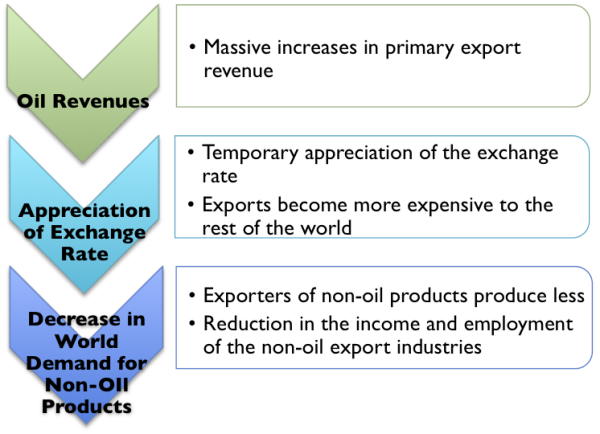
    The inflow of capital leads to an appreciation of the currency, making imports cheap and export expensive. The name comes from the Netherlands experience following the discovery of gas in the north sea. Natural gas sales drove Dutch currency up, seriously hurting the country’s other expdutch-diseaseort industries.

    In late 50’s Netherlands found huge source of natural gases. This resulted in 1. investments (largely foreign direct investments) in that sector 2. decline in other sectors e.g. one example could be people moving for jobs in that sector (consider Indian IT sector as reference) 3. investments (specially foreign investments) in that sector resulted in stronger currency. The excessive investment made Netherlands currency stronger resulting in making exports expensive eventually resulting in decline of export from Netherlands. Manufacturing suffered and thus jobs in manufacturing too go to step 2.

    This convoluted – action/reaction and impact at not so obvious industries – example again suggests to us that even if industries are not linked directly they are linked in some way. This link is interdependence. This interdependence should make one value the existence.

    The  “Dutch disease” should make us once again think about the invisible connections we share with each other.

    Image source – http://globalprosperity.wordpress.com/2010/08/19/oiling-africas-gears-for-democratic-change/

  • Interdependent co-arising – macro-economics example


    I hae written on Interdependent co-arising (older blogs at the link) earlier.  The concept simply means – we are all dependent on each other.

    Those who want to know the concept in layman term follow this blog – interdependent co-arising example of a farmer.

    Definintion of interdependent co-arising is below with a macro-economics example. In late 90’s the East Asian countries faced a very serious economic challenge of decades. The financial system came down like a house of cards. Dr Joseph Stiglitz – Economics Nobel Prize winner of 2001 – shares the concept of interdependent co-arising (dooming in otherwords) in his book  – “Globalization and its discontent“. On Page 106-107 he invariably – and inadvertently perhaps – explains what is interdependent co-arising. Hope economists would understand this lesson, if not from the Buddha then from Dr Stiglitz.

    Beggar-Thyself Policies

    Of all the mistakes the IMF committed as the East Asian crisis spread from one conuntry to another in 1997 and 1998, one of the hardest to fathom was the Fund’s failure to recognize the important interactions amont the policeis pursued in the different countries. Contractionary policies in one country not only deepened that country’s economy but had adverse effects on its neighbors. By continuing to advocate contractionary policies the IMF exacerbated the contagion, the spread of the downturn from one country to the next. As each country weakened, it reduced its imports from its neighbors, thereby pulling its neighbors down.

    The beggar-thy-neighbor policies of the 1930s are generally thought to have played an important role in the spread of the Great Depression. Each country hit by a downturn bolster its own economy by cutting back on exports and thus shifting consumer demands to its own products.A country would cut back on export by imposing tariffs and by making competitive devaluation of its currency, which made its own goods cheaper and others countries’ more expensive. Howeer, as each country cut back on imports it suceeded in “exporting” the economic downturn to its neighbors. Hence the term bagger-thy-neighbor.

    Solution to all these economic, social, personal, spiritual or other problems?

    Its interdependent co-arising itself. We all need to help each other grow – grow the pie and share it well, if not equally!

  • Border-less world


    Let us imagine, a border-less world. A world where

    Source - http://praditaastarina.files.wordpress.com/2011/08/170580815_bbdabc8038.jpg
    Border-less world

    1. people can move from one place to the other without Visas
    2. goods and services can be bought and sold without import/export duties
    3. education is free (at least basic education)
    4. people would be free to do what they want to do (not taking law in their hand though)

    I believe both the leading economic “-isms” and many spiritual/religious “-isms” have been trying to do that for years.

    The economic “-ism” are capitalism and socialism. Socialists want this by making a world a single big society where everyone is working for the society. Capitalists are trying to do it through Washington Consensus and IMF. Until now the results have been failure. Russia failed, China becoming a capitalist USA (being protectionist) walking on the way to become more socialistic. Seems There could be a middle path where both these -isms are together.

    Religious groups “-ism” are Christianity, Islam, Buddhism, Hinduism etc. Christianity wants the world to be Christan, Islam talks about Universal brotherhood. I am not sure about the other two asking people to convert to their religion though. However, Hinduism talks about Vasidhev Kutumbakam. Vasidhev Kutumbakam means one world family. But the idea all over the world is unity and unifying the world in different ways.

    All this is failing because – the ulterior motives are money or fan following (I mean increasing number of followers of the religion).  Since both they ways seem not working, what if we turn to something else, no politician, no economist and no religious group to lead. People leading the people’s movement!

    Take the following case – Social media for social service, crowd sourcing based funding (crowd funding) and initiatives such as Janlokpal (India), Occupy Wall Street (USA), Jasmin revolution (Tunisia) and Tahrir square (Egypt) etc. If people are empowered yet are asked not to encroach on others freedom. What if we really become an educated world, without politics, without divisions, without borders.

    This may happen if we remove ego and greed from our society!

    Image Source – http://praditaastarina.files.wordpress.com/2011/08/170580815_bbdabc8038.jpg (Apologies for delayed update, it was updated in the image description but not visible on view)

  • Segment of one & inclusive growth


    What are we? We are a society, made of communities, families and individuals. We are talking about growth on global scale. At times we are talking more about “saving” the world from financial melt down. I sometimes think – who has created it at the first place? That is for some other day though.

    When we see growth we talk on aggregate level – GDP of the country, GDP growth rate, reserve, unemployment rate etc. Have we ever thought that these numbers are “aggregate level” number for example – if I put my one hand in boiling water and another at minus thirty degrees [100+ (-30)], average temperature of my body is 35 degrees. But does that mean I am fine? No my one hand is burnt and other is numb. That is the reality of aggregate level measures.

    How do we resolve such inconsistencies? Let us start measuring things in terms of segments. As they call it in Marketing, Segmentation. On a very deeper level as segment of one. “Segment of one” means handling each individual as an individual (and not as any generic segment). Though is more of marketing and in my professional experience analytics gyan (which is not purpose of this blog) so I would come back to the point.

    Segment of oneIf we do that Marketing stuff of Segment (segment of one) in society and eventually to the individuals. We would realize that “inclusive growth” is only possible when we take growth stories to communities, at smaller level say villages, communities, to each family to each individual. I see that as the solution to a better reflection of growth. I better measure would emerge from there, upliftment of each individual.

    Writing this, I feel as if I’m a politicians, speak and no action! How to do that is the question. A very idealistic solution – what if we’ve unemployment benefits for everyone also encourage everyone to do what he/she wants to do – until found success, unemployment benefits would help these people. Word of caution – there may be free-riders one has to fix that challenge. Take an example of Venture Capitalists and Funders. They do the same but at a later stage – say when I found my calling, started working and kind of see a revenue model. This is truly a very impractical and idealistic solution, but can we build on this to devise a practical and applicable solution from it?

    Image source – http://www.dmnews.com/marketing-to-a-customer-segment-of-one/article/262747/

  • Wealth and Wisdom


    Wealth is the abundance of valuable resources or material possessions. Wealth in itself is of no value, someone owning it gives “it” some “value”.  Similarly Wisdom (Hinduism) is considered a state of mind and soul where a person achieves salvation. Again here salvation is achieved by “someone”. So salvation may not be anything in itself, right? Once you achieve it there is no “self”, that is another side of it though.

    The definition of wealth (or for being wealthy) in my opinion is – when you have no more desire to earn more possession – when you have complete disinterest for money – you are wealthy. Because there is no end to earning. There may be a possibility that you are the wealthiest person on earth in the list of Forbes. You may not be interested to say “enough is enough!” I don’t need more money.

    http://media-cache-ec3.pinterest.com/originals/af/fa/97/affa97f31778a0e75cb506d1e38f0f95.jpg

    According to me one is wealthy – if one decides doing things because he/she enjoys doing the work and therefore does his/her work just for the hack of it. Say if I go to office with a motive of Salary at the end of the month, I am not wealthy. But if I do the same work because I enjoy doing it, feel self-satisfied and content. so the salary is not the desire but the fulfillment I achieve makes me wealthy. The later becomes reality with wisdom.

    What if wealth and wisdom meet? The age old approach of the west (wealth) meets the even older approach for life of the east (wisdom). I do not think the world would remain the same, this world would become wealthy and wise. Largely we would stop running for growth, to bailout countries and to make more money. This would be the world where the Business would meet the Buddha and people would do their work as their duty rather than compulsion.

    Definition source – Wikipedia

    Image source – Pinterest

  • Self respect – Volunteer for a better India


    I see that poor people have very high self respect- they wont accept money even as a support in their plight. However, those who have the least self respect are asking for money (see the corruption/scams – politicians and babus).

    Remember Satyamev Jayate of last year? Remember Amir Khan talking about drought problem in India in the show? This blog relates to similar such incident close to 9 months after the airing of the show.

    On Thursday I came back home from work as usual – tired and just wanting to quickly have dinner and go off to bed. On dining table I heard this story – well a truth. This story ends (rather continues till today 25th Feb 13) at the Azad Maidan in Mumbai. A group of farmer from Solapur District in Maharashtra are sitting on Dharna for last3 weeks. The reason, what I understood with no maps and little understanding is below.

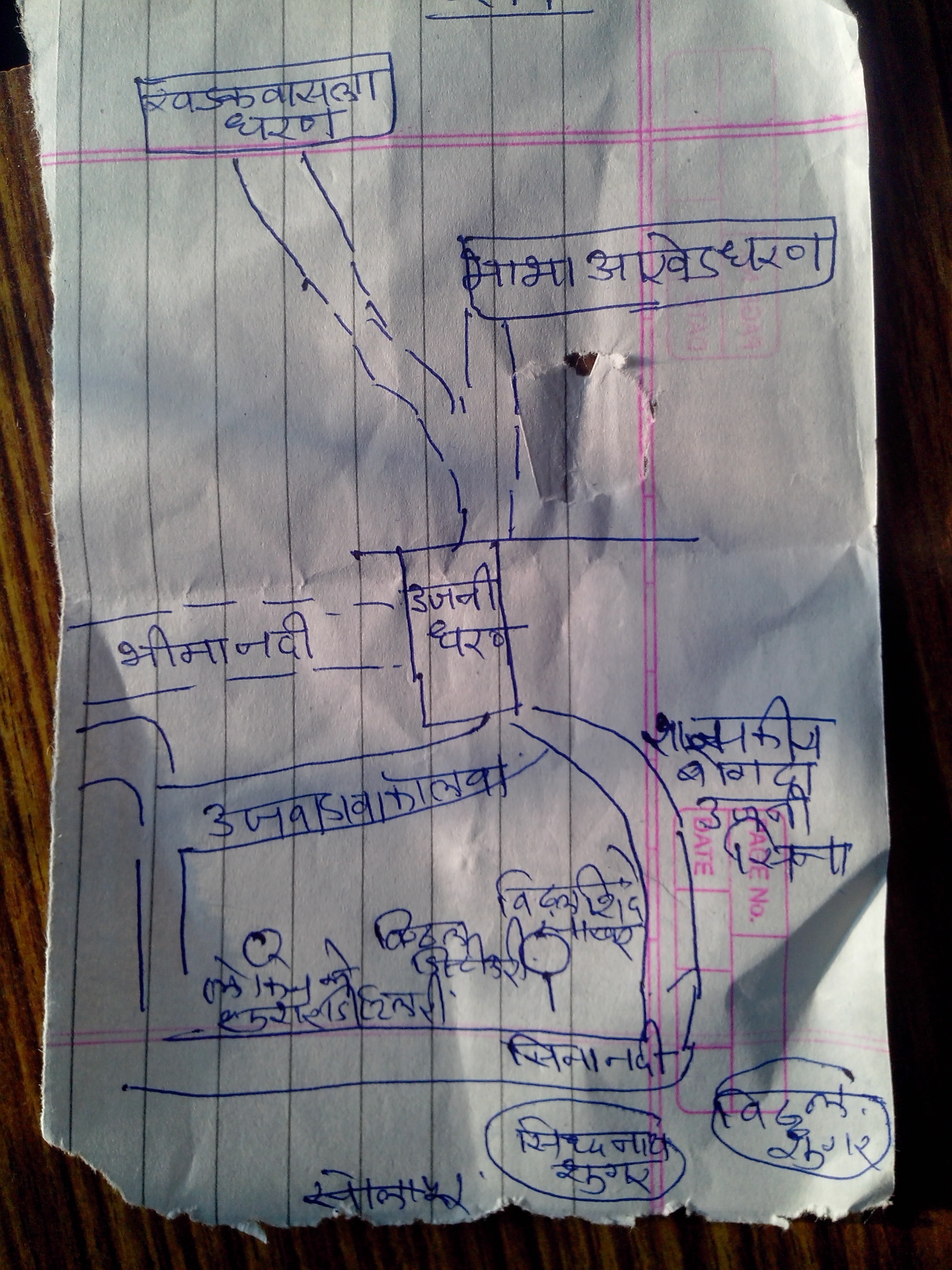
    There is a river Bhima in Maharashtra (Check Google maps for Ujani dam). On this river government of Maharashtra has made a dam (Ujani Dharan, in Marathi) and a canal (Ujava dava kalva). This canal was apparently created for providing irrigation support to the farmers in that area. Well the Government confiscated the land from farmers stating that this land acquisition is for making a canal for them. Check the handmade drawing and explanation of situation below.

    The canal is dried; water is released to the Sina River side for factories but not for the Villagers. Why? Sugar lobby! The stark reality I came to know is this –

    1. someone (at least one, possibility of more cannot be denied) died digging a well further (the well was already very deep)

    2. someone died digging a well even further because some poisonous gases emitted from the earth (dug so deep)

    3. someone fell (perhaps jumped) in the well and died

    The truth I came to know at my dinning table is this that The demonstrating farmers wanted to meet The Honorable CM of Maharashtra (Mr Prithivraj Chavan). They could meet him somehow (pushing their way in).

    Pritish Nandi (a respected person of India) tweeted some days back about Mr Chavan “he is a good fellow”. He may be, but the solution he gave to the farmers would shatter this statement of Mr Nandi. The solution he suggested to the Farmers is this – you would get water in the Ujava Dava Kalva, but promise me your would only use it for drinking. What? Are you insane? Boss – what would farmers “do” than? leave their villages and start working in, perhaps the Sugar mills? Where would the sugar mills get cane for making cane sugar? Honestly speaking – I have no doubt on what Mr Nandi had to say, Mr Chavan must be a good fellow, under pressure from somewhere to make this statement.

    Mr Chavan – I respect him because Mr Nandi said something good about him – is called ‘Baba’ amongst locals. these villagers are singing songs in the evening – “‘Baba’ pani dya…”. It sound like “Allah megh de, megh de pani de…”. ‘Baba’ can you please listen to these villagers?

    The villagers were sitting on Dharna at Azad Maidan, these people are surviving on Vada pao (in Mumbai Vada pao is the one of the cheapest food to survive). When I heard that situation I felt like crying. Yet crying would not solve the problem. I thought I would help them in whatever way I can, perhaps give them some money. However, I have seen – poor people have very high self-respect, they wont ask or take money. I feel that something has to be done because giving money once is not going to solve the problem. They wont even accept that money. Be a Volunteer for a Better India!

    At the same time Guruji (Sri Sri Ravishankar) is in Mumbai. In one public talk he said –

    1. do rain water harvesting, that seems a solution

    2. Volunteer for a better India

    Pictorial sketch of the Solapur district discussed above –

    Solapur Farmers plight - sketchThe central box is Ujani dam, left to it is Bhima river. From the Ujani dam there are two ways water flows. To your left there is Ujava dava Kalva and to your right a tunnel to Sina River (Govt also created this tunnel). At the bottom of this image there is Sina river. On the shores of Sina river, there are Sugar mills. Now you see a box has been created between Ujava dava Kalva and Sina river. People of these villages do not even have water to drink.

    By the way Sugar mills are supported by Government of India big time (check ET 25th Feb 13 for page 20) . Actually, Home Minister of India (Mr Sushil Kumar Shinde) belongs to Solapur District and the Agriculture Minister of India (Mr Sharad Pawar) is from that side. Also, many of the owners of these mills are sitting MLAs or MPs. I heard Guruji saying that the Sugar lobby is very strong in India.

  • Do what is right in perpetuity


    The class was nostalgic, remembering the last couple of days of sessions of Operations Management with Prof Moradian. Today we were attending his last session of Operations Management. We all enjoyed each session, the quick wits and learnt a lot. We were attending his last session and thus all that was coming to an end for Operations Management.

    That session was very special, I could still hear his one statement very clearly that – “…in your career whenever you have to take any decision, always do what is right for your company in long term…”.

    When I recollect those words from Prof Moradian – “… do what is (make decisions which are) right for the company in perpetuity…” that makes a lot of sense to me. That one statement made me speak couple of tough truths in my career, but it feels good when you consider big picture vis-a-vis to your personal interests.

    An organizations need to learn the art of balancing between the short term sustainability and the long term growth OR short term profit and long term uncertainty. In current economic scenario short term sustainability seems the way to survive, let alone long term growth or profit for that matter. Message seems clear to me – Do what is right for the company in perpetuity.

    Actually this statement equally applies to each individual in life too – we should do whatever is right for us and others – IN PERPETUITY.

    Related blogs –

    Balancing Act – Professor Mankad shared this story of Balancing act with me earlier.

    Fruit will arrive in its season

  • For Profit Businesses


    Businesses are made for profit making, is there a question in this assumption or argument? For the time being, I am assuming there is no doubt about the argument that business exist for making profit.

    I have been thinking about the topic of “measuring growth” I wrote recently. People may say there are businesses as “Not for Profit Businesses”. This concept of “Not for Profit” in many cases is about reinvesting profit in business rather than giving dividends to the shareholders/investors.

    There are other businesses which are “social enterprise”, I wrote on such businesses with reference to a book “I have a dream”. These are businesses which exist for making profit; however their primary reason of existence is social upliftment with moderate profits. I wanted to ask myself – why not all For Profit Business be like that?

    In my previous career engagement, a couple of times I had a chance to meet CMO of a big Mutual Fund house. In one interaction he told my boss – “you do X, Y and Z; Calculate your cost; add your 20% profit on that and charge me. I need this X, Y and Z done.” This statement was very liberal to hear. I had seen many organizations trying to squeeze their service provider. Thus the statement became a guide for me to think about such clarity and about fair co-existence. I relate the same to the previous post of “measuring growth”. When I tried understanding Islamic banking and asking the feasibility of the system, I saw contrary view points. I read somewhere Islamic banking does not call “interest” (on debt) as interest whereas terms it as profit sharing (say 20%). So there may be businesses so clear and there could be predictability in cost, profit and growth of business and economics.

    This kind of approach is very simple. However, the above case is very simplistic and everything (many things) would become very predictable – how would finance experts – involved in complex transactions and certificates  – would be able to manipulate market? There can still be demand and supply gap and market may run into a relatively predictable and stable equilibrium.