Tag: the middle path

  • Happy Dussehra

    We celebrate the festival of Dussehra as win of good over evil. The conflicts were between two different parties – be it Rama and Ravana, Durga and Mahishasura. We are taught these overt conflicts. There is a subtle / covert lesson in these conflicts – the duality of mind. Our contest is with us inside our mind.

    Ravana was very intelligent and capable ruler. As a kid, I watched Ramayana on TV. I used to ask this question to my siblings and parents – “how can a person have 10 heads?” To this I was told, it is symbolic. Ravana was so intelligent that he could have shashtrarth / serious discourse (discussions) with 10 different people simultaneously. Ravana was scholar of Shastras and Vedas, that’s the logic of saying 10 heads etc. Besides all this, Ravana was most respected devotees of Shiva. How can a devotee of the supreme lord be evil?

    Happy Dussehra

    Imagine, a person of such caliber, such profound knowledge and power be known for all the wrong reasons! There are a couple of reasons for that; one is power corrupts and absolute power corrupts absolutely. Further, we need to learn – “with great power comes great responsibilities”. As Uncle Parker says to Peter Parker in the Movie Spiderman.

    When, I look at these historical (for some people mythological) events, I see the easiest way to avoid such conflict is the eight fold path of Buddhism.

    1. Perfect Vision,
    2. Perfected Emotion,
    3. Right speech,
    4. Right action,
    5. Right livelihood,
    6. Right effort,
    7. Right mindfulness, and
    8. Right meditation / Samadhi

    These are the virtues that can be explained to our generation in different manner for example – right livelihood for the Buddha was dependent on begging. In current generation I believe everyone should be self-dependent for livelihood. When some scholars say Right resolve (in the above list it is replaced with emotion), they explain it as life of a hermit giving up the world. When the Buddha attained enlightened I remember reading in some text he said, “It is not necessary to leave the world, one can be enlightened being a family person”. He propounded the Middle path for the same.

    The real flight or contest is within, we can be the best in anything – as Ravana was. However, what matters is how we remained centered to be good. So, if we start taking these eight fold path doctrine in context of our generation, we can be as intelligent as Ravana and as good as Rama. The choice is always ours. This Dussehra I wish we all learn to fight our internal conflicts and Good wins over the evil within.

    Image source – Amar Ujala

  • Grass grows by itself


    For last couple of years, I have been buying stuff (mostly grocery and vegetables) from where I get a bill (invoice), even if I have to pay a bit more. Reason has been straightforward – I am fine paying more because presumably the one who gives me bill pays tax. It reduces burden on my tax and thus country can improve and prosper. Straightforward logic. However, another thought runs in mind – things are getting automated, be it agriculture or industries. Technology based jobs are likely to get automated too. This will create a scarcity of jobs. We should support roadside vendors otherwise how will they sustain their livelihood.

    Next level challenges for Governments and even for private sector will be job creation at grass root. The other thought says possibly there would not be a need of job creation. Things will happens automatically due to automation. On a philosophical level as Ramana uncle keeps on quoting – Sitting quietly, doing nothing, spring comes and the grass grows by itself. ~ Basho. This no one would require to do job, the same possibility suggested by Keynes.

    The world thus would be a kind of utopia, we hopefully wont require ruling over the other. It would be a time of soul searching, digging inside doing inner revolution. I strongly believe prosperity of each individual is the best way to reach the Utopian world. Economics, fails at such Utopian world, because where there is scarcity there is demand and supply. However, if everyone is prosperous probably no one will feel wealthy. Feeling of being wealthy at that time would be defined by some other measures – not necessarily by money. Currently too we are on the verge of redefining wealth, money is not what you have in your pockets or home is no more the only wealth. Wealth is – stocks you have, count of zeros in your accounts, may be in future we would look at bitcoins in your electronic wallets.

    Possibly, the Buddha was disillusioned by wealth – he was a prince after all, wealthiest of kingdom – when he saw a sick old man, a dead body etc. Likelihood of seeing a Buddha like person is far higher in prosperous economy. India was at peak of its economic, scientific and spiritual knowledge. The world now and in future needs to think about spirituality and economics in same plane. The world we are creating for our coming generations should have growth, livelihood, sustainability and spirituality together. This requires learning a couple of concepts of Buddha’s teachings deeper – i. interdependent co-arising ii. the middle path and iii. righteousness (speech, action, livelihood,efforts, mindfulness, concentration, view and resolve).

    I think we need to think beyond jobs creation, wealth, we need to think about a holistic development of human race because the grass grows by itself.

    Happy Buddha Purnima, may everyone become The One soon.

  • Distinctions


    prayer of frogI have been reading one or the other story of Father Anthony De Mello’s books – The Prayer Of The Frog Vol. I and Prayer of The Frog Vol. II and share the same here occasionally. The books have small and very interesting stories. One of the story I read was on a balancing act is here –

    …..or distinctions.

    A man was doing his Ph. D in philosophy. His wife realized how seriously he was taking his studies only on the day she said to him, “Why is it you love me so much?”

    Quick as a shot he replied, “When you say ‘so much’ are you referring to intensity, depth, frequency, quality or duration?”

    By dissecting her petals no one ever gathered in the beauty of the rose.

    At times you just need to live and not analyze your life – a big, very big lesson for me (perhaps many professionals) to learn.

  • Kanhaiya to Mallya why lessons from Buddha Prevail!


    Recently India saw two very poles apart events and both can make us learn – the Middle Path of the Buddha. One incident was of JNU – ultra leftist & anti establishment – and the other was bank NPAs (one example of Vijay Mallya) – ultra rightist & Crony Capitalistic. I did not write anti-national as those who read news or biased towards one side would find my opinion biased even before reading the post fully, so ‘anti-establishment’ was the word used.

    The backdrop of Javaharlal Nehru University row is this – students union of JNU requested for a cultural event. Well, for those who do not know JNU is a University in Capital city of India. JNU students union is a leftist union. This event turned sloganeering against India. The slogans – besides anti India – included supporting terrorist who (in rarest of rare capital punishment in India) was hung during previous Govt. The previous Govt was run by the  parties currently in opposition – including left front. In twists of the whole drama a hero emerged named Kanhaiya Kumar. When I searched and heard one Professor of JNU, I came to know more about left front. They seem to support the whole drama where slogans were raised against India. This support goes deep down in the intellectual class sitting in news channel studios in Delhi.

    Domestic helpThough anti-establishment word sounds weird because where was the class of Kanhaiya Kumar for last 10 years? Where were they when there were a lot of corruption cases? Suddenly that class is demanding Azadi (freedom), well freedom from whom and what? If you demand freedom from poverty – work! Isn’t it a better solution? Azadi from toot-phoot (breakup) – better you do not do it, isn’t it? Currently who is involved in toot-phoot (look at parts of India where Maoists are active & killing). Azadi from terrorism – better you support or join security forces isn’t it? Why were student’s slogan in support of Afzal Guru (a terrorist)? Azadi from Manuwad & Brahmanwad (it is related to caste system of India) – I too am against caste system. Would it be better to do something at a grass-root level instead of sloganeering ‘against India’? Azadi from suit boot (economically better off) – isn’t it good if you do any of the other things listed above you would get in suit boot? Perhaps someone else will raise voice against you! But does it mean you and the other economically better off should leave everything and become poor in support of you to have Azadi from suit boot? The logic of communism is at question here – to bring affluence or wealth to less privileged is a better approach rather than making everyone equally poor to bring equality. Isn’t it? Read about Aarti Amma here these people should learn from her.

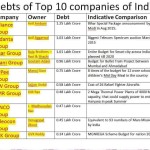
    Indian Big Corporations debtOn the other hand there is another class in India – capitalists. They are those who either mend rules or get rules created to favor themselves. According to some reports the amount of debt big corporate houses in India have goes in lacs of crores (of trillion INR). The example of top 10 debtors is below in image. These corporate houses are those who keep close relations with the law-makers (political parties – either in opposition or in power). So, these debtors enjoy the debt money lavishly. Once they kind of run out of money, they get debt restructured (happens to big companies only). There is a fancy word for that – Corporate Debt Restructuring. One such example in India is Dr Vijay Mallya of Kingfisher Airline. We’ve heard of his lavish birthday bashes and Calendars; he owes 7000 cr (70 Billion INR) to banks. His airline is defunct and he recently fled; banks has declared him willful defaulter a couple of months back.

    So in recent times, India has seen extremes of both the sides – failure of overly capitalistic system where crores of rupees are usurped by organizations without remorse and there are overly leftist those who want to overthrow the establishment itself. We have seen an example of USSR failing and we have seen repeated recession / bankruptcy. These examples teach us same the lessons again and again. There is a middle path that we need to follow, No left or no right. There has to be a balance.

    The solution? Once again it is the eight-fold path –

    1. Perfect Vision,
    2. Perfected Emotion,
    3. Right speech,
    4. Right action,
    5. Right livelihood,
    6. Right effort,
    7. Right mindfulness, and
    8. Right meditation

    All of these have to come from within, outside perspective will contaminate these. Meditation is a one single solution, it may provide each one of us from Kanhaiya to Mallya ‘tranquility’ that will help reduce the fascination to revolt or predilection to cheat. Because if we start following this eight-fold paths we would realize – ‘we all are connected’, ‘we all are interdependent‘ and if we want Azadi, this azadi would be from whom? If we want to cheat the banks, it is in turn cheating with someone who is a family of ours.

  • Truth is really something you do!


    I have been reading one or the other story of Father Anthony De Mello’s books – The Prayer Of The Frog Vol. I and Prayer of The Frog Vol. II and share the same here occasionally. The books have small and very interesting stories. One of the story I read was on a balancing act is here –

    ————

    Truth is really something you DO

    The disciples oprayer of frogf Baal Shem once said, “Tell us, dear Rabbi, how we should serve God.”

    He replied, “How should I know?”…then went on to tell them the following story:

    A king had two friends who were found guilty of crime and sentenced to death. Now even though the king loved them he dared not acquit them outright for fear of giving a bad example to the people. So this is the verdict he gave: A rope was to be stretched across a deep chasm and each of the two men was to walk over it—to safety and freedom or. if he fell, to his death. The first of the two got across safely. The other shouted to the first across the chasm, “Tell me, friend, how you managed it.” The first shouted back, “How should I know? All I did was this: When I found myself listing to one side. I leaned to the other.”

    You don’t learn to ride a bicycle in a classroom.

    ————

    Balance is what needs to be practiced by everyone and not one or the other only, that can bring harmony & peace in the whole world.

    Tolerance Vs Being True To Yourself was the title of this weeks LBC (Loose Bloggers Consortium) where currently eight of us are supposed to write on the same topic. I have written on tolerance earlier too when India was facing with media created debate of whether India is tolerant? As usual I write by changing the topic a bit, mostly go completely awry and write; hope mostly it connects with the topic. The seven other bloggers who are expected to write regularly are, in alphabetical order are AshokgaelikaaLin, Maxi, Padmum, Rummuser and Shackman. The title was suggested by Shackman. Do drop in on their blogs and see what their take is on this week’s topic. Since some of them may post late, or not at all this week, do give some allowance for that too!

  • Work is worship


    I was speaking with Fateh uncleji for more than 1/2 an hour. We were talking about many things from Indian politics to my work. When we were to conclude the talk after these long discussions, I told him I called you because I connect with you on spiritual level, I didn’t want to talk about Indian politics, corruption and my work.

    The voice from the other side said – “Work and spirituality live in the backyard of each other” The conviction in the voice was tremendous. I asked “seriously? Is that? It never happened to me.” (I was not sure if it had happened to me)

    When I blog on business to the Buddha – I see the relationship at a macro level. The daily struggles of activities does not make me realize if operationally it is happening.

    The conviction was tremendous. I was puzzled. It was already a long call so we concluded the call. But the resounding words were enough for me to lose my sleep. I felt is it really happening with people? I could not find the relationship at operational level. Am I missing something? Am I missing something in my daily execution? How do I achieve it? What do I do differently?

    As usual, I called Saxena Sir (Dr Anand Saxena, my Engineering college professor), in general and specially to discuss this one sentence – “Work and spirituality live in the backyard of each other”. I have always found that he adds a perspective on my questions; opinions that I never thought. He changes my paradigm of thinking, always.

    I called Saxena sir and told about my meeting with Fateh uncle and my telephonic conversation. When I said “Work and spirituality live in the backyard of each other”, and continued that it has never happened to me as such. He responded without a second’s delay – “Pravin, do you remember the logo of MITS?” [Madhav Institute of Technology and Science is my engineering college where I studied and Dr Saxena was HoD of my Department]

    MITSI responded – “yes of course.” I had the pictures in my mind, snakes and sun, water, it’s easy to remember pictures.

    He asked – “what is written on the logo?” I knew what is written on the logo. I got the drift, because until a second back I was thinking of the pictures on the logo but now I was thinking – “Work is worship.” I understand where he is going.

    It was a very small, straightforward and simple explanation. Saxena sir always surprises me. He makes things look easy, adds a perspective and takes me to a different plane.

    Perhaps, these discussions were very commonplace for you; however these two telephonic conversations made me unclutter myself a bit. There is still a lot of room to do that.

    Saxena sir and I concluded the call. And I questioned myself – am I making things complicated? Is it really too simple? Perhaps.

    That is where the real Business to the Buddha lies. Is not it look so simple? The Buddha also suggested that what he achieved could have been achieved without taking Sanyas. Perhaps that is why he proposed The Middle Path. What is your take?

    Did it occur to you – “Work and spirituality living in the backyard of each other?”

  • Not so trickling down!


    How would you define prosperity of a society?

    imf_sealThis is a question many have been asking for so many years. The answers to this question lies in not finding the average income of the society – the metric used globally is – income per capita. This very simplified measure is like saying – what Professor Moradian told us in class of operations management – putting one hand in boiling water (100 degrees) and other in freezing water (0 degrees) and saying I am at an average of 50 degrees and kinda ok! We see a widespread income inequality across the globe.

    The definition of prosperous society should be defined by meeting basic needs of the people of the country. Communication and Internet is one thing which has become a part of basic necessities now a days. Human development index the other measure. For a couple of years when I am writing about business and its relation with spirituality (my interest being the Eastern philosophies – teachings of the Buddha and Hinduism) I see a measure is contentment as well is a measure – What more you need?

    I was reading a recent news – Trickle down economics is wrong, says IMF of IMF research. This seems to be an interesting conclusion. We have been running behind capitalism during 1980’s now we are running on the other side in 2010’s. The research says – Trickle down economics reduces the GDP.

    What is Trickle down economy? Ronald Regan – President of US of A – coined this economics by providing special benefits to rich. The assumption of this theory is – if rich are provided tax benefits (reduced taxes) they would eventually invest in economy and growth will occur. In last 3 decades we have seen the impact of that economy.

    According to the said IMF report –

    A 1% increase in the income share of the bottom quintile results in a 0.38% increase in GDP. Meanwhile, a 1% increase in the income share of the top 20% results in a 0.08% decrease in GDP growth.

    There are a couple of take-aways –

    • Trickle down does not work, it does not mean tilt towards the socialist approach.
    • There has to be a balanced approach – as stated earlier – the Middle path
    • And yes – how would you measure prosperity? Well, by checking how content is each individual. That comes from within not outside. Remember the measure of contentment should not be like putting one hand in freezing water and other in boiling.

    Research document link – https://www.imf.org/external/pubs/ft/sdn/2015/sdn1513.pdf