Tag: The Buddha

  • Death is inevitable


    For Humans – Death is inevitable; there is no hiding from this truth. For Companies – Only the paranoids survive!

    Well, it was a coincident that my previous blog was on death and the season of Ganesha festival (an Indian festival) arrived.  This Ganesh festival I had seriously thought about the Indian culture, festivities and the small – often overlooked – lessons. In India every good work starts with invoking Lord Ganesh, even prayers, pooja etc starts with first invoking lord Ganesh and then the other “main” pooja’s.

    The festival of Ganesha is a period from Ganesh chaturthi to Ganesh Chaturdashi a ten day period often in September month. During this festival, families and societies bring idol of lord Ganesh, worship the idol and within a couple of days immerse the idol in water. Similar to what happens to us – we are born one day and would be cremated one day.
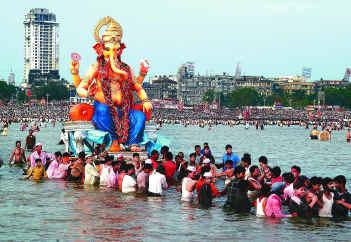
    (source - http://www.thehindubusinessline.in/2004/09/28/stories/2004092802271700.htm)
    Visarjan procession in Mumbai

    Every year we follow this cycle of birth and death with our God. A God revered so sincerely that every things starts with his name – Shri Ganeshay Namah. Hats-off to this culture which has this concept of death embedded in its roots so truthfully. I think we should understand that death is inevitable and learn some lessons. (The Buddha saw this once and started his quest.)

    I started looking beyond my grieving moments and towards businesses. What I realized is that ‘the reality‘ of death applies to even companies too! As innovation consultants we used to share statistics on survival of companies. Out of Fortunes list of 1920’s and 30’s many companies do not exist now. Take an example of Kodak – a very innovative company –  filed for chapter 11 recently. If we just take Kodak as an example – Xerox was born out of Kodak’s lab. Xerox created such brand image that Photocopy became synonyms to Xerox. HP with its printing challenged Xerox. So the cat and mouse run of companies is on. The conclusion I made was if companies do not reinvent themselves, those are likely to die over a period of time.

    Last weekend I was attending a course meant for board members or to make people capable to contribute to boards. In the course (Retd) Maj Gen Mhaisale shared some HBS and McKinsey reports about shrinking life time of companies. Earlier average life of companies used to be about 40 years now it has shrunk to 16 years (in some countries 6-10 years too). Take the same example life span of Kodak was about 100 years, Xerox about 40 or so (please don’t take these life span as sanctity numbers)!

    Interesting part is a contradiction that human life expectancy is increasing and average life span of a company is decreasing. There is a lesson to learn – either be paranoid (as Andrew S Grove said in his book – Only the paranoids survive) and keep on reinventing your company or – death is inevitable!

    Related blogs – Death

    Source – BMG India training material on innovation (created and referred as a trainer) and IoD training sessions

    Image source – Business Standard

  • Swasthay – dwelling in oneself


    “You have to move on from the posts, you dont hang around it – I was a post you have to move on now.” When Prof Lopez told me this in our last meeting at Dubai, I felt bad. He further added – “Once you pass standard 1st you move on to the 2nd and so on, right Pravin?” I had to complete my MBA and move on to a job an so on and so forth.  Slowly I moved on. Yet, recently I was going through the content of my MBA and came across some photos, class works etc and fallen back in time to relish my moment of that time. One of my friends commented on Facebbok – Movee oooooooooooonnnnnnnnnnnn! Instead of moving on, I remembered the last sentence Prof Lopez told me – “Pravin, you have to move on.” I had created this blog title – Move on… on Dec 1st 2010 and came back in the drafts to complete it now.

    The other reason to complete this blog was my recent meeting with Mr Ramana Rajgopaul my blogger friend and uncleji, he blogs at www.rummuser.com. He is reading a book – How Much Is Enough?: Money and the Good Life and we discussed economics and greediness  etc. Really the question is right. How much is enough? We think of buying a small apartment, when we own one, we think of bigger one and then a bungalow, villa, a farm house do we stop there? No! then we need something more a big car or something else. Where is the end? Take an example of corruption in India, what these politicians do not have? They have all they might need, but no! They want more.

    This “move on” is literally turning into running, running behind something, at time running away from the real problem. We have so many gadgets and even though we are connected with so many unknown people through social media, we dont know the neighbor. I personally felt that I spend more time on internet compared to talking with people. In bus I am on the net, in train I am on the net, at home I am on the net! So, are we facing our problems (personal or social) or we are just avoiding and moving on, running from one thing to the other just to save ourselves from facing those problems?

    When Angulimala met the Buddha. Angulimala screamed at the Buddha to stop because he wanted to cut fingers of the Buddha. The Buddha turned and told Angulimala that he, the Buddha, had already stopped. He had stopped killing and harming and now it was time for him, Angulimala, to stop.

    Now is the turn for us to stop. When I say we should stop it means a strange stop – our mind should stop running, time and space would move, our mind should be at peace, quiet. That is the definition of Swasthay (swa + sthith) – dwelling in one’s own self.

    Related blogs

    You cannot drive car looking at the rear view mirror

    When will we stop? (on the movie Salam Bombay)

    Dichotomy on happiness…

  • Collective Materialism – likely future of economy!


    I have written about socialistic capitalism or capitalistic socialism. When I say that I simply mean that we would move our economies and businesses in a direction where there would be a balance. It would be a kind of middle path where enterprise would exist at the same time there would be a concern for the society and social development. Take an example of corporate social responsibility (CSR), however the word CSR would become more of a practice than a statement in annaul reports. The reason for the same would be – we are all connected. If I do not earn how would bank generate savings? If banks do not generate saving how would they offer loan and so on. In terms of Buddhism it is similar to interdependent coarising.

    In more sophesticated words the tripple bottomline would be the corporate mantra in future enterprise. I thought of an example which could be the model for this concept of triple bottomline. I happen to read corporate philosophy of Sahara India Parivar – “Collective Materialism”. This company is very interesting and different – it calls itself a family and everyone is a worker first. According the the website of the company the philosophy of collective materialism is as follows –

    “In any human relationship, it becomes imperative to take into consideration the materialistic aspect of life – we do so but by giving it second priority.

    The first priority is given to emotional aspect and with perfect blending of materialism with emotionalism results in continuous collective growth for collective sharing and caring, that gives an impetus to our philosophy.”

    On a lighter note collective materialism is not what Government of India doing – filling pockets of few select few (so it is collective and materialism both) Sahara shree – Subrato Roy – deservers the credit for this philosophy.

    Related blogs

    The middle path

    Balancing act

    Cause…

  • Peace of mind


    I was wondering, peace of mind comes from owning something or being at peace is independent of owning anything? I was under and impression that peace of mind comes from achieving one’s goals for example owning a car. However, achieving one goal results in creation of another goal and so that may not be the answer. If we extend the example of owning a car as goal one, next goal could be owning a bigger or perhaps a personal jet.

    Another thought was peace of mind comes from doing what you enjoy doing, however after some time that doing something may become a routine and so on. So the series of question and answer was not ending with a specific answer. Recently, I came across a site and a possible solution. Why am I calling it a “possible solution” because mind accepts the solution however, practicing and living that solution would take some time.

    According to that site the Buddha concluded that everything in this physical world is marked by three characteristics – the Dharma Seals. These three characteristics of conditioned existence are Anatman, Anitva and Dukkha.

    According to those Dharma SealAnatman is the concept of self. The Buddha emphasised on the changing character of the soul. Anitva means that nothing is constant. All the things, feelings and experiences are inconsistent and impermanent. There is no such thing that lasts forever.  When we fail to grasp the first two conditions truly, we suffer and that suffering is known as Dukkha. We always crave for permanent satisfaction (in my thought process peace of mind), but forget that everything changes, not even satisfaction last forever.

    So, I concluded that peace of mind is not in achieving something in life. However, peace of mind is being at peace with our mind in the present. Because the more we think more we complicate life – life is, simple!

    Source of Dharma Seals – http://www.buddhist-tourism.com

  • …because there are only means!


    On Saturday I read a twitt of Paulo Coelho – renowned author – “A warrior of the light knows that the ends do not justify the means. Because there are no ends, there are only means”. I inferred from the statement that – means are values on which we base and live our life. Some time back I had written on integrity as one value for organization and individuals. Another article I glanced through in Outlook India – “How Not To Court The Law” by Uttam Sengupta. At the end of the article Mr Ranjan Mondal commented – “…where is our Ethics in law?”

    Recently, I happened to meet and discuss the same with Mr Abhaynath Mishra. He is a trainer, consultant and is extensively working on value system of individuals and organizations.  He said, sustainability of an organization is based on values and ethics it follows. In short run there may be loss but the long run success of an organization is assured by the belief and sticking to the values. Also, I had a few telecon with my MBA Professor Ms Mala Kapadia – we too discussed on Values and Business. Mala Ma’am suggested “…somewhere I feel interpretation of Bhagwat Gita too has been wrong, in saying that war for Dharma is justified.”

    I asked this question to myself – do ends justify means? and What are the values business follow, do the businesses really follow these, values? I stopped at a very good question – where is ethics? We seldom talk about it in debates, in our closed rooms and perhaps in boardrooms. Ethics are there in closed door – safe, not touched by anyone! In practice – well, we practice everything except ethics because for a long time we have imbibed lessons such as “ends justify the means.” Now is the time when we – as a community – are questioning the means used to achieve goals, ethics in business and values of individuals. The reason to ask such questions is the problems we face today – recession, political unrest and other personal problems. The biggest identified cause for these problems is  ‘greed’. The problems can be resolved when we learn what Paulo Coelho twitted recently – ends do not justify the means. Because there are no ends, there are only means. Be ethical …because there are only means!

  • What more you need?


    I was watching Padosan (Old Hindi Comedy movie). The movie is interesting and I came to know that it has been made in different Indian languages. In that movie the protagonist (Sunil Dutt) repeats a couple of times an ancient concept of Hindu culture.  The concept is Ashramas of human life. According to these Ashramas there are four stages of life each divided in roughly 25 years duration. These duration and our current life style made me think. I have always been wondering about what we want? We all have been running, some know why, some do not know why are we running? Many of those who know are running behind money, other few are behind fame and so on. Yes money is required to fill our stomach on a daily basis, is required for basic amenities. Beyond a certain point do we still need money? Yes!

    When we are not satisfied with what we have. We run behind something either closing our eyes or because we can not think of anything else.

    Rajat Gupta

    Whole life we have been running behind money, if one day at an age of 60 we are told – ‘stop it!’ For some time we would feel uncomfortable what to do? Then since whole life we have been doing just one thing we would start the race again. Unknowingly money becomes purpose of life, if this running around wont be there we wouldn’t have any reason to survive, right?

    Maslow’s Hierarchy of Needs

    With due respect to those who have made a lot of money, I was wondering about a recent case of insider trading, involving Mr Rajat Gupta. Mr Gupta made it big in the corporate world, proved how successful a person could be. Yet in a recent court case sentenced for 25 years imprisonment. The reason – an  inadvertent (probably) or wishful (probably) – sharing of boardroom discussion. I was seriously wondering what more a person needs? You are famous, you are rich and you have had a very successful life, what more?

    Maslow‘s needs need hierarchy theory seems to have failed us repeatedly. There seem to be no end to the level of ‘Esteem’. What more we need to move beyond Esteem to self-realization?

    Image source – Maslow’s need hierarchy – Wikipedia, Mr Rajat Gupta – The Hindu

  • Bhavachakra – the wheel of life


    On this buddha Poornima (Sunday 6th May), came across detailed explanation of Bhavchakra. I thought to share it on blog.

    Life seriously is a wheel, is not it? For individuals – Wheel of emotions, wheels of personal development and wheels of social interactions. For organizations and society too this wheel goes on – growth, development and destruction. Check any Indian Soap of prime time, you would come to know what we are surrounded with. It is up to us to learn about this wheel and help ourselves to get out of this – app dipo bhava (be a light unto yourself).

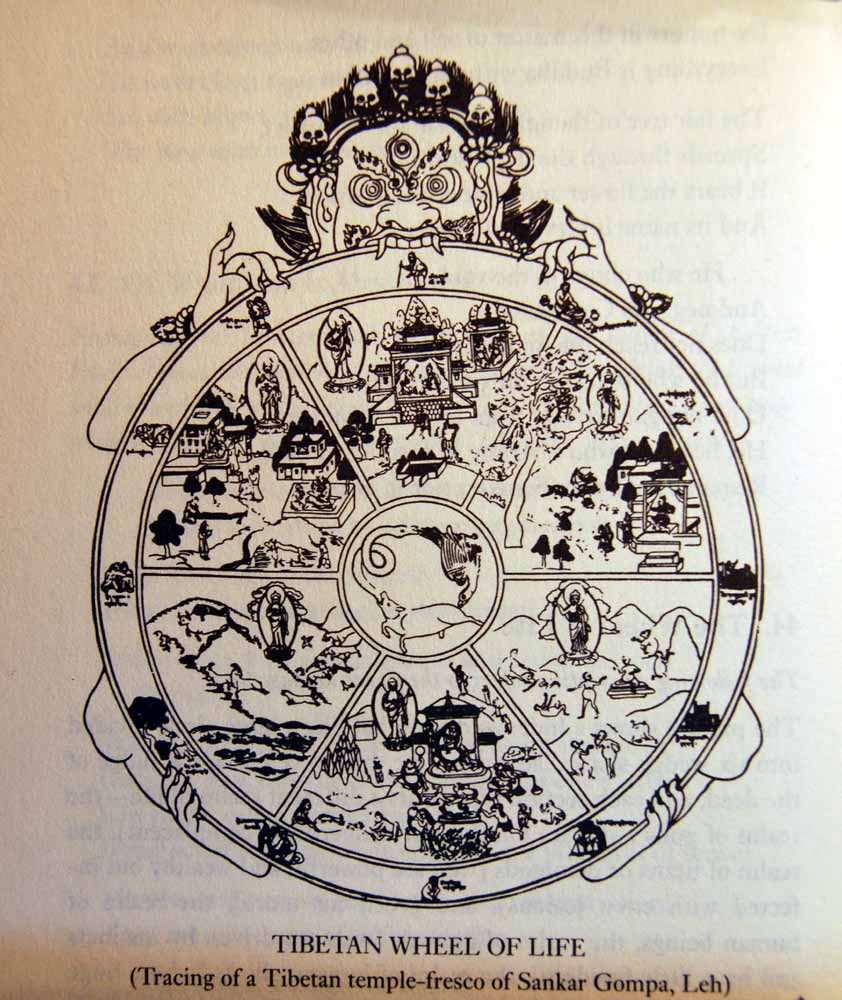
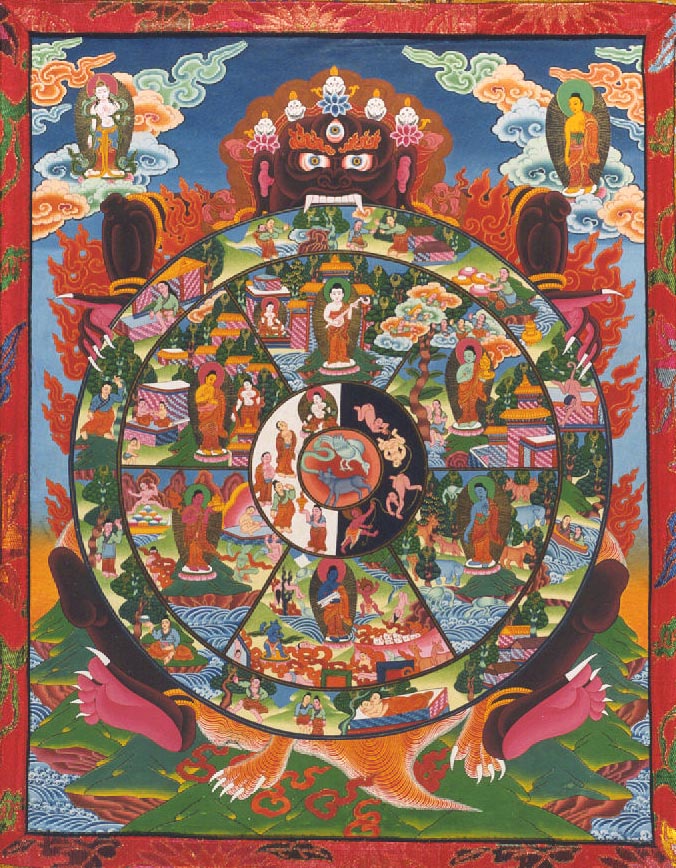
    The following content as well as image on bhavachakra is from this link, which explains it well.

    Bhavacakra or Wheel of Becoming/Wheel of Life is a form of a mandala or tanka (painted wall hanging), used primarily in Tibetan Buddhism.  The painting of a tanka is itself a form of mediation.  Its meaning is very complex, and can be read to represent at least three different realms of manifested effects ofkarmic actions.  It can be read as a diagram for the six different kinds of existence into which one may be born into during the middle rounds of samsara.  It can be read as symbolizing each of the different realms of human existence, lived out by certain kinds of people according to their karmic fortunes of personality type and socioeconomic status.  Or it can be read as a description of situations or states of consciousness that everybody passes through again and again in the course of a single day.

    Its iconographic meaning is correspondingly complex as well.

    In the background are varied Buddhist symbols, such as the moon, clouds in shape of swastika, and always a representation of at least one Buddha orBodhisattva, seen attempting to help sentient beings to find their way to Nirvana.

    The wheel is held by the jaws, hands and feet of the demon, Yama, the judge of the dead, who turns the wheel.  Yama represents the ignorance that comes from greed and “selfhood,” that keeps the wheel of suffering turning.

    The outer rim of the wheel is divided into twelve sections, called the Twelve Interdependent Causes and Effects – 1. ignorance, 2. volitional action or conditioning, 3. consciousness, 4. name and form, 5. six sensory organs (eye, ear, nose, tongue, body and mind), 6. contact or touch, 7. sensation, 8. desire, craving, thirst, 9. grasping, 10. becoming or existence, 11. birth, and 12. decay and death.

    The areas between the six spokes represent the six forms of unenlightened existence.

    There are six wedged-shaped sections, with each representing a different realm of life –

    1. realm of the Gods – Devas (who are blissful but dangerously complacent; always at the top of the wheel)

    2. the realm of the titans, demigods and fighting demons – Asuras (lowest rank of gods, who are powerful and wealthy but infected with envy, jealously, and greed for more; always in the upper half of the wheel)

    3. the realm of “human beings” (always in the upper half of the wheel)

    4. the realm of “animals” (sentient beings, less intellectually advanced than humans, driven by instincts and have little freedom, but can still experience suffering and project karma; always in the bottom half of the wheel; inclusive of birds, fish, and even a worm)

    5. the realm of “hungry ghosts” – Pretas (whose huge bellies but pinpoint mouths and eyes suggest insatiable craving; always in the bottom half of the wheel)

    6. the realm of “hell beings” (who are consumed with relentless rage; always at the bottom of the wheel; beings brought to hell for  past karma, but beings who can escape it through good deeds and reincarnation).

    At the center or hub of the circle is a smaller circle containing the Three Poisons, within a rim of binary demarcation of black and white. The black section represents the Dark Path on which sentient beings are moving downward to the hellish realms. The white section represents the Path of Bliss on which beings are moving upward to the Godly realms. The Three Poisons are personified as a rooster or fowl, a pig or boar, and a snake, chasing one another around and around. They symbolize the forces that keep people caught up in the samsaric round of existence: the rooster stands for greed, the pig for ignorance or delusion, and the snake for hatred.

    The wheel can thus hold distinct meanings, each speaking to different sensibilities.

  • Where is growth?


    The mobile was ringing, suddenly phone was picked and the statement – wait! Mumbai Indians needs only 5 runs to win in last 6 balls. I said ok Sir I will call you in five minutes. The turmoil of thoughts continued in my mind. What am I thinking, what are the questions in my mind, so many things how do I connect all these dots etc. Mumbai Indians eventually won, Prof Mankad informed me in next five minutes.

    We started talking – the market is steady, if not bull than not bear too. Indian Prime minister and Finance minister both are making statement that “We are going to grow at 6.9% if not at 8%”. Still, there is some uncomfortable feeling. I told Prof Mankad, “Sir I am not convinced. Further to it I said – news is Facebook is licensing the AOL patents – owned by Microsoft now – for close to 550 million. Next thing which I forgot to ask him was – news of bribing in Mexico by senior executive of Wal-Mart. Wal-Mart was running behind growth – sometimes in 90’s – and got in this trouble recently when the case was surfaced. I further added that Italy and Spain are showing -ve growth (to be precise signs of recession), where is growth?

    As always these questions were simple to answer for Prof Mankad. What he said very closely resembled to my thinking of inclusive growth. He said – hold your horses, the questions are right, this growth is notional and specific to IT and finance industry, largely to few services industries so to speak. The questions are pertinent, sir said. If I remember correctly he also informed me that Italy not only Spain has declared recession, French election would surely put more light on the already tough Euro crisis. Sarkozy is likely to lose, and then there are more elections coming up in Europe e.g. Germany etc. Political parties in Holland have agreed on austerity measures. Growth would happen and thus recession would be arrested only once we see growth in all the industries otherwise we are in a bad shape. It is not possible to say that we are growing at so and so rate when only one or two industries are showing signs of growth.

    This reminded me of my most loved theory of the Buddha – Interdependent Co-arising. I have written on this often and the current situation shows us yet once again that we are all connected, nothing can be isolated and growth is a collection of small growth in each industry. Each industry is a building block for the overall movement of the engine of economy world across (with few riders). No China can survive without US or Europe, no India or Philippines can grow its service industry until there is overall growth in the demand of service industry in developed nations.

    Where is growth? There would be growth when we all learn that we need to think about each other and help each other grow – we are all interdependent and we would successfully grow only when we grow together.

  • When the Buddha dies, the schools are born


    I wrote earlier about the business of religion, recently found an interesting story on the same and thought to share it here. This story is from a book – ‘The prayer of the Frog’ by Father Anthony de Mello, S.J.. This book has very interesting stories on religion, spirituality and human relations etc. The story I am referring here is from ‘The prayer of the Frog – Volume 1, Page 95, Part – Religion

    The resurrected philosopher
    An ancient philosopher, dead for many centuries, was told that his teachings were being misrepresented by his representatives. Being a compassionate and truth-loving individual, he managed, after much effort, to get the grace to come back to earth for a few days.

    It took him several days to convince his successors of his identity. Once that was established, they promptly lost all interest in what he had to say and begged him to disclose to them the secret of coming back to life from the grave.

    It was only after considerable exertion that he finally convinced them that there was no way he could impart this secret to them and that it was infinitely more important for the good of humanity that they restore his teaching to its original purity.

    A futile task! What they said to him was “Don’t you see that what is important is not what you taught but our interpretation of what you taught? After all, you are only a bird of passage whereas we reside here permanently.”

    When the Buddha dies, the schools are born.
    ***
    These small stories are so interesting that I would refer to them again in future.

    When I say business to the Buddha, I mean teachings applied in real life (including Businesses) and not interpreted/misinterpreted by someone (priest) for the common public.

  • A dancing elephant


    Louis Gerstner… Remember him? The legendary CEO of IBM and I crossed our paths this week when I decided to go through a book titled, Who Says Elephants Can’t Dance?. As chance would have it, it was also the time when I bought my new Lenovo laptop. For all those who have been disconnected from the world, Lenovo is the company that bought IBMs PC business some years ago. After using many renewed brands like Samsung, Dell, HCL, HP and compaq, selecting a new laptop should have been easy. It was, but not because I am more intelligent than 3 years ago. Only because the industry has consolidated a little bit.

    Is not it true with you too, that one factor for decision making is price – this holds true for me too. In first few chapters Lou says IBM had to do a price rationalization of its servers. This event of the book brings back memories of class of Prof Tomas Lopez and my long nights cracking the case with my buddies of MBA – Saurabh Deshmukh, Nikunj Pandya, Ashar and Chanchel Menon. How often have you made an opinion and written about a book even before completing it? I have made my opinion the book is very interesting and I am so impressed that I thought to write.

    IBM a gigantic and bureaucratic organization of 90s! If you are an Indian and have repeatedly circled tables of Govt offices and babus you would be able to understand what challenges Mr Gerstner must have gone through at IBM in first couple of months of his assignment. Honestly, only a few have to chance to lead such place and change this. However, seeing Indian bureaucratic system I believe there are a lot of opportunities for Indian Gerstners (Govt officers would read this blog). I can relate to IBM of early 90s (reminds me of one series of Asterix in which they have to clear a task of Greek Office). We in India say we are democratic country yet currently we are democratically fighting for Lokpal which is not heard by Govt.

    While reading that book I am asking myself – what is the purpose of existence for IBM (of 90s) and of Govt? Don’t you ask similar question to yourself – the purpose of our existence?

    Customers were last in the list at IBM (clearly not in the first few on the list) and in India Citizen are not the first priority (alas! it is democracy). Priorities are – Govt/political parties/bureaucracy, at IBM priorities were country heads/department etc. IBM was (not exactly though) out of touch with changes in IT industry Govt seem to have lost touch with masses. IBM was a big fat elephant so seems the Indian Govt system. “One has changed and is dancing now, will the other too?” is the question to ask.

    Also, I could relate to the teachings of the Buddha while I am reading the book. More on purpose of our existence and middle path later.

    Related blogs – Line of understanding, Lost in translation, Playing golf, work and meditation”…you have to swing naturally”