Tag: The Buddha

  • Cast(e)ing doubts – everyone’s tears are salty


    I am not an admirer of the caste system of Indian society. The special love affair for that (aversion) goes to the Lingayats (disclaimer – I am a born Lingayat). I am going to write a series (on and off) of blogs on – against – the caste system of India (include black skin for other parts of the world). Here is the first such blog. This story is from Chapter 43 of the book Old path white clouds by a Vietnamese monk Thich Nhat Hanh. The book is on the life of the Buddha.

    In brief – The Buddha accepted an untouchable named Sunita, to his Sangha (in India 2500 years ago). It created a lot of uproar in Kingdom of King Pasenadi (Kosala) who was a devoted follower of the Buddha.

    Everyone’s tears are salty
    When The Buddha and his bhikkus were passing by the river Ganga they saw an untouchable person – Sunita (a person carrying nightsoil). when the Buddha started walking towards him, he ran farther away from the Buddha. When Sunita could do no more, he kept the nightsoil buckets on one side and hid in the river.

    Sunita “Lord, I do not dare come closer. I am an untouchable.”
    Lord, I do not dare come closer, I am an untouchable

    The Buddha walked right up to the water’s edge and said, “My friend, please come closer so we may talk.”
    Sunita, joined his plams, protested, “Lord, I don’t dare!”
    The Buddha asked – “Why not?”
    Sunita replied – “I am an untouchable. I don’t want to pollute you and your monks.”
    The Buddha said – “On our path, we no longer distinguish between castes. You are a human being like the rest of us. We are not afraid we will be polluted. Only greed, hatred, and delusion can pollute us. A person as pleasant as yourself brings us nothing but happiness. What is your name?”
    Sunita said – “Lord, my name is Sunita.”
    The Buddha asked – “Sunita, would you like to become a bhikkhu like the rest of us?”
    Sunita said – “I couldn’t!”
    The Buddha – “Why not?”
    Sunita – “I’m an untouchable!”
    The buddha – “Sunita, I have already explained that on our path there is no caste. In the Way of Awakening, caste no longer exists. It is like the Ganga, Yamuno, Aciravati, Sarabhu, Mahi, and Rohini rivers. Once they empty into the sea, they no longer retain their separate identities. A person who leaves home to follow the Way leaves caste behind whether he was born a brahman, ksatriya, vaisya, sudra, or untouchable. Sunita, if you like, you can become a bhikkhu like the rest of us.”

    King Pasenadi was asked by his ministers to protest and reason for this act of the Buddha. The King visited the monastery, while walking in the monastery he saw a few monks sitting under a tree and one monk sharing the teachings of the Buddha. The King was impressed with the monk who was teaching. The monks face radiated great peace and wisdom. This sight was such that King stopped for a while to listen to the monk.

    The King was so impressed with the monk that first question he asked was who was the monk teaching under the tree? The Buddha replied – “Sunita, he was once an untouchable”. King was embarrassed, the Buddha continued – “In the Way of Liberation, there is no caste. To the eyes of an enlightened person, all people are equal. Every person’s blood is red. Every person’s tears are salty. We are all human beings. We must find a way for all people to be able to realize their full dignity and potential. That is why I welcomed Sunita into the sangha of bhikkhus.”

    Even after 2500 years, we still have widespread caste system. At that time there was only Hinduism now you have many religion in the world! Every religion has many sub-sub categories. You have color of skin to differentiate, what more you need?

    Related blogs –

    We the societies

    When Buddha dies schools are born

    Reference in the index of the book – Fo Pen Hing Tsi King (T. 190); Fang Kouang Ta Tchouang Yen King (T. 187); Lalitavistara.

    Image source Old path white clouds

  • Race – never ending


    I met Professor Arun Ramanathan a few months back (precisely in April). He taught us Corporate Governance and Business Ethics in our MBA. I told him a very practical daily situation I face. Whenever I walk, I am almost running, I notice that I walk very fast that I leave people behind as if there is a kind of competition happening. I am running to – say – win some competition.

    Courtesy Nilesh Yeram (my friend)
    Courtesy Nilesh Yeram (my friend)

    Why are we doing this? Am I alone in this kind of running (not just literal) without knowing where is the end or many professionals – like I do – are just running. Some running for money, some for a next bigger car or home, some others for a better position. Or is it that when people are young they just get in a race, a race no one knows who started but a race in which other peers are also equally involved (at least in the runners mind)? This is how ethics gets shelved in our personal and professional life. We are trying to be something. Is it of any consequence or what are the accolades related to that? It is of no interest in many cases. So the mentality is by hook or crook achieve the results.

    Two weeks back Rajagopaul uncleji shared a story with me. This perfectly relates to my discussion with Prof Ramanathan, so, sharing it here.

    Race

    I was jogging one day and I noticed a person in front of me, about 1/4 of mile. I could tell he was running a little slower than me and I thought, well, I shall try to catch him. I had about a mile to go my path before I needed to turn off. So I started running faster and faster. Every block, I was gaining on him just a little bit. After just a few minutes I was only about 100 yards behind him, so I really picked up the pace and push myself. You would have thought I was running in the last leg of London Marathon. I was determined to catch him.

    Finally, I did it! I caught and passed him by. On the inside I felt so good. “I beat him” of course, he didn’t even know we were racing. After I passed him, I realized I had been so focused on competing against him that I had missed my turn. I had gone nearly six blocks past it. I had to turn around and go all the way back.

    Isn’t that what happens in life when we focus on competing with co-workers, neighbors, friends, family, trying to outdo them or trying to prove that we are more successful or more important?

    We spend our time and energy running after them and we miss out on our own paths. The problem with competition is that it’s a never ending cycle. There will always be somebody ahead of you, someone with better job, nicer car, more money in the bank, more education, better behaved children, etc. But realize that “You can be the best that you can be; you are not competing with anyone.”

    Some people are insecure because they pay too much attention to what others are doing, where others are going. Take what has been given to you. Stays focused and live a healthy life. Run your own RACE and wish others WELL!!!

    Is not it a good thing to learn?

    Other related blogs

    Chinu and the pebbles

    Money worth earning

    Swasthay – dwelling in oneself

    What more you need?

    When will we stop?

    Why are you doing what are you doing?

  • I am that!


    Last weekend, I went for a haircut. In the big mirror of the barber, one of the rare things happened. I was staring at myself without my specks in the mirror and was surprised. I had never noticed that between my nose and eyes there is some bulge, which earlier was not there. I look at my face once again and asked myself – “is it me?” When I asked myself this question, I literally meant “the bulge” near top of my nose just below my eyes, which is mostly behind the frame. Or perhaps I never noticed.

    The question was specifically to that part of my body – the bulge – is this really me? Suddenly some different thoughts made me think even more about the “overall me”. What defines me? The body – the bulge- until past couple of years was not there it is now, when I will get older, this mass would be lost. I should not be defined by this. Earlier I wrote on a tender coconut and how nothing becomes something in this case – the bulge, and in previous blog’s case – a tender coconut. I have black hair, in few years these would be white, would I change? What is that, that defines me as me?

    Well on a philosophical level I may say that I am soul. But do I know it? This question about knowing the soul is like having information and not truly knowing the soul. These questions reminded what was suggested to me by a friend Ameet Murdeshwar a few years back. I often met Ameet while traveling to office during 2007-08. He told me read , a book “I am that” by Nisargdatta Maharaj.  This book is on Adwait Vedanta. I feel myself to be too immature to read that subject. Though I have a copy of the book, unfortunately never had a chance to read it. I am asking myself this question for a week now – am I that? I will read it now.

  • Miracles of life – are we sleeping?


    As usual, this story again comes from – ‘The prayer of the Frog’ by Father Anthony de Mello, S.J. The book has small stories and worth reading one at a time, sleep over the story and think what we can improve in our life?

    A man took his new hunting dog out on a trial hunt. He shot a duck that fell into the lake. The dog walked over the water, picked the duck up and brought it to his master.

    The man was flabbergasted! He shot another duck. Once again, while he rubbed his eyes in disbelief, the dog walked over the water and retrieved the duck.

    Hardly daring to believe what he had seen, he called his neighbor for a shoot the following day. Once again, each time he or his neighbor hit a bird the dog would walk over the water and bring the bird in. The man said nothing. Neither did his neighbor. Finally, unable to contain himself any longer, he blurted out, “Did you notice anything strange about that dog?”
    The neighbor rubbed his chin pensively. “Yes,” he finally said. “Come to think of it, I did! The son of a **** can’t swim!

    It isn’t as if life is not full of miracles. It’s more than that: it is miraculous, and anyone who stops taking it for granted will see it at once.

    At times I think the life itself is a miracle, we take it for granted. Naxals are killing, Terrorist are killing, in fact people are dying on pilgrimages to add to the trouble people are leaving ethics and morals to earn few bucks here and there (eventually we would leave everything here). I wonder if they would realize some time – life is a miracle live it, don’t kill anyone and be peaceful with what you have.

    Related blog – Don’t be empathetic

  • Don’t be empathetic


    Do an experiment – do not empathize with people. I mean try this, when you are talking to someone or listening to someone just do not empathize. Just listen as if the other person is talking to a stone.Be completely disinterested. Than once the person is through with his/her blabbering just reflect, reflect that the person is/was in this mood or that mood. Continue doing this experiment for few other people. You would realize that this other people or persons are in some mood. You are just “a third party” “an observer”. In some time you would realize that people fall in different mood segments. Our mood changes and therefore we move from one segments to other.

    I was doing this research on relationship between Indian Classical Music and Yoga. In that research I came across music therapy and color system’s relations with it. Each color reflects a different emotion, Ragas do the same. Each Swar of Indian classical Music is associated with a Chakra in human body. These chakra’s have an associated color too. This research made me connect a couple of things. Approach note here. Ragas are called Colors of life that is emotions.

    Each color reflect an emotion, each one of us reflects an emotion. When you observe people disinterestedly (here I have called it without empathy) you would observe people are reflecting a particular emotion or color.

    Now look back – before that person came to you, were things different? Things were same – air was flowing, sun was shining, perhaps it is/was raining, birds chirping.  The nature did not differentiate before that person came to you and after that. It is only you who (if empathize with other person) change your mood. Observe around you the world is same whatever you think, feel or do. That is being consistent (in Hindi – eksar). Related blog – Swasthay – dwelling in oneself.

    We are like a Prism. A “consistent” sunlight falls on it and it scatter the color components of sunlight.

    http://chipl.edublogs.org/files/2010/11/Reverse-light-spectrum-yy6cje.jpg

    We also scatter our mood in surrounding. Otherwise place (space) is consistent. The color can be a rage – red color or a serenity – blue color. We should strive to be a “combination Prism” which reflect light without scattering it. (Image source)

    I say – be empathetic but do not get rundown by the emotions of others. That would be being Swasthay – dwelling in oneself.

    Disclaimer –
    1. The Author does not endorse “being non-empathetic”. The author is trying to make a point “assuming” if we do not empathize for this experimental purpose we would be able to understand that nature does not change if we are in one mood or the other. Nature is consistent with itself (as Sunlight). We are the Prism which reflect particular color of the consistent sunlight.
    2. Most importantly – author does not preach and does not believe he is someone who should preach.

  • The circle, conflicts and avoiding conflicts


    Perform an experiment – a simple 2-minute experiment. Take a blank sheet of paper and a pen. At the center of the page, put a dot. What is it? A dot nothing else right? Now draw a big circle with the dot as the center of the circle. Now what is the dot? It is center of the circle, right? Everything on the page is around it “now”.

    The dot was nothing when there was no circular periphery. The dot was meaningless in itself. The periphery gave it a very powerful definition. It became the center of the existence e.g. the periphery. Now for a moment if you remove the dot (the center of the periphery), the periphery losses its definition. The periphery would not remain a circle without the dot “center”. This is interdependent co-arising in one sense for the center and the circle.

    Visualize the page you took is the universe and the dot represents you. We think that “I am” the center of the universe. This is the case with many of us – if not all. We are self centered. Everything is around me and everything should happen as per my desire. But there are more dots on the page with each one having its periphery, these periphery intersect which causes conflict. How to avoid the conflicts? I see there are three possible ways to avoid it –

    When I was searching for an image for this blog I found this image

    1. reduce the periphery such that only you remain in that periphery
    2. increase the periphery such that everything falls under it without intersection
    3. Make your periphery someone (only one) else with “full devotion”

    In Indian philosophical context first two could be path of meditation and third is path of devotion (Bhakti). Do you know any other? Please share.

    Image source – http://www.astronomyforum.net/blogs/astroval/106-where-center-universe.html

    A different perspective on dot – http://phataktejas.wordpress.com/2012/02/15/dot-hain-to-hot-hain/

  • Incentive to cheat – Problem with Democracy


    I read a book – Games Indians Play by Mr Raghunathan a Professor in IIM-A and CEO of GMR group. I have written on this book earlier too – Individually smart collectively dumb. The problems with Indian – supposedly sharp – minds is given below in story format.

    This story is from a book – ‘The prayer of the Frog’ by Father Anthony de Mello, S.J. This book has very interesting stories on religion, spirituality and human relations etc. The story precisely explains how we – Indians – think and act.

    A great festival was to be held in a village and each villager was asked to contribute by pouring a bottle of wine into a giant barrel.

    When the banquet began and the barrel was tapped what came out of it was water. One of the villagers had had this thought: “If I pour a bottle of water in that giant barrel, no one will notice the difference.” But it hadn’t occurred to him that everyone else in the village might have the same thought.

    This happens in Indian political system. Everyone thinks that yes there is corruption, but I am paid 100/- let me vote this corrupt politician. Others would not vote him… similar to the story above. Every poor person gets an incentive to cheat – that cheating is a responsibility of politician – development Vs one time benefit to voter – 100 rupee note or a quarter of alcohol etc.

    The interesting part is we Indians more complex yet cheat always. We think in two fashion. 1. the way story suggests above and 2. why should I do it when everyone else is cheating?

    Option two suggests that every Indian knows what others are going to do and thinks why should not I do the same?

  • Interdependent co-arising intra-country example


    In previous blog “Coalgate…” I touched on the topic of Dutch Disease. The concept of Dutch disease rebounds me to the interdependent co-arising once again (interdependent co-arising means – we are all dependent on each other.). This concept of Buddhism is applicable in every walk of life. If we (each individual) do not understand it we are going to remain in the problems we face. Check previous blogs on the same below.

    Interdependent co-arising farmers example (ground level example) – this blog is about how interdependent co-arising relates to a smaller level of activity of one businessman / farmer. This could be you or me in our regular work environment.

    Interdependent co-arising macroeconomic example (world level example) – this blog is about how interdependent co-arising relates to macro-economics.

    This blog is a country level example of interdependent co-arising (Pali original concept – Pratītyasamutpāda – at Wikipedia).

    What is Dutch disease?

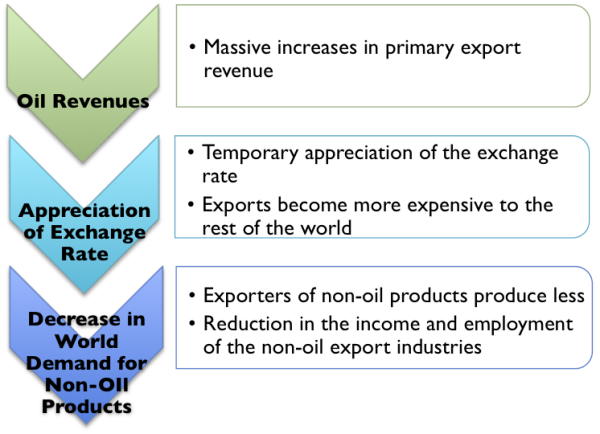
    The inflow of capital leads to an appreciation of the currency, making imports cheap and export expensive. The name comes from the Netherlands experience following the discovery of gas in the north sea. Natural gas sales drove Dutch currency up, seriously hurting the country’s other expdutch-diseaseort industries.

    In late 50’s Netherlands found huge source of natural gases. This resulted in 1. investments (largely foreign direct investments) in that sector 2. decline in other sectors e.g. one example could be people moving for jobs in that sector (consider Indian IT sector as reference) 3. investments (specially foreign investments) in that sector resulted in stronger currency. The excessive investment made Netherlands currency stronger resulting in making exports expensive eventually resulting in decline of export from Netherlands. Manufacturing suffered and thus jobs in manufacturing too go to step 2.

    This convoluted – action/reaction and impact at not so obvious industries – example again suggests to us that even if industries are not linked directly they are linked in some way. This link is interdependence. This interdependence should make one value the existence.

    The  “Dutch disease” should make us once again think about the invisible connections we share with each other.

    Image source – http://globalprosperity.wordpress.com/2010/08/19/oiling-africas-gears-for-democratic-change/

  • Interdependent co-arising – macro-economics example


    I hae written on Interdependent co-arising (older blogs at the link) earlier.  The concept simply means – we are all dependent on each other.

    Those who want to know the concept in layman term follow this blog – interdependent co-arising example of a farmer.

    Definintion of interdependent co-arising is below with a macro-economics example. In late 90’s the East Asian countries faced a very serious economic challenge of decades. The financial system came down like a house of cards. Dr Joseph Stiglitz – Economics Nobel Prize winner of 2001 – shares the concept of interdependent co-arising (dooming in otherwords) in his book  – “Globalization and its discontent“. On Page 106-107 he invariably – and inadvertently perhaps – explains what is interdependent co-arising. Hope economists would understand this lesson, if not from the Buddha then from Dr Stiglitz.

    Beggar-Thyself Policies

    Of all the mistakes the IMF committed as the East Asian crisis spread from one conuntry to another in 1997 and 1998, one of the hardest to fathom was the Fund’s failure to recognize the important interactions amont the policeis pursued in the different countries. Contractionary policies in one country not only deepened that country’s economy but had adverse effects on its neighbors. By continuing to advocate contractionary policies the IMF exacerbated the contagion, the spread of the downturn from one country to the next. As each country weakened, it reduced its imports from its neighbors, thereby pulling its neighbors down.

    The beggar-thy-neighbor policies of the 1930s are generally thought to have played an important role in the spread of the Great Depression. Each country hit by a downturn bolster its own economy by cutting back on exports and thus shifting consumer demands to its own products.A country would cut back on export by imposing tariffs and by making competitive devaluation of its currency, which made its own goods cheaper and others countries’ more expensive. Howeer, as each country cut back on imports it suceeded in “exporting” the economic downturn to its neighbors. Hence the term bagger-thy-neighbor.

    Solution to all these economic, social, personal, spiritual or other problems?

    Its interdependent co-arising itself. We all need to help each other grow – grow the pie and share it well, if not equally!

  • Wealth and Wisdom


    Wealth is the abundance of valuable resources or material possessions. Wealth in itself is of no value, someone owning it gives “it” some “value”.  Similarly Wisdom (Hinduism) is considered a state of mind and soul where a person achieves salvation. Again here salvation is achieved by “someone”. So salvation may not be anything in itself, right? Once you achieve it there is no “self”, that is another side of it though.

    The definition of wealth (or for being wealthy) in my opinion is – when you have no more desire to earn more possession – when you have complete disinterest for money – you are wealthy. Because there is no end to earning. There may be a possibility that you are the wealthiest person on earth in the list of Forbes. You may not be interested to say “enough is enough!” I don’t need more money.

    http://media-cache-ec3.pinterest.com/originals/af/fa/97/affa97f31778a0e75cb506d1e38f0f95.jpg

    According to me one is wealthy – if one decides doing things because he/she enjoys doing the work and therefore does his/her work just for the hack of it. Say if I go to office with a motive of Salary at the end of the month, I am not wealthy. But if I do the same work because I enjoy doing it, feel self-satisfied and content. so the salary is not the desire but the fulfillment I achieve makes me wealthy. The later becomes reality with wisdom.

    What if wealth and wisdom meet? The age old approach of the west (wealth) meets the even older approach for life of the east (wisdom). I do not think the world would remain the same, this world would become wealthy and wise. Largely we would stop running for growth, to bailout countries and to make more money. This would be the world where the Business would meet the Buddha and people would do their work as their duty rather than compulsion.

    Definition source – Wikipedia

    Image source – Pinterest