Tag: The Buddha

  • Interdependent co-arising in Ecosystem


    As I have been writing a lot about interdependent co-arising, I came across this video and thought to share it without delay on my blog.

    If you can understand this video you can understand the concept of Buddhism on interdependent co-arising. Please watch this small <5 min video a wonderful experiment. According to the description of the video – When wolves were reintroduced to Yellowstone National Park in the United States after being absent nearly 70 years, the most remarkable “trophic cascade” occurred. What is a trophic cascade and how exactly do wolves change rivers?

    “When we try to pick out anything by itself, we find it hitched to everything else in the Universe.” – John Muir

    An interesting way to explain interdependence. Hope we learn this sooner rather than later that ecology has to be balanced, political, social and religious ideas should also be balanced because perhaps nothing is perfect! I think therefore Mahavir used the concept of Syadvada (doctorine of postulation) and the Buddha middle path.

    Source – Youtube channel Sustainable Human http://www.youtube.com/channel/UCYv_csqWJTSfQK3vOZDJKQw

  • Did Keynes fail in Japan?


    It all started in 1990s when Japan took the step to deflate its economy – Yen devaluation, lower interest rate, money supply etc. The effect is observed till today and in fact we may get into another slowdown in 2015-16. Actually, that’s what is the fear. Some experts are forcing Euro-zone not to make the same mistake Japan made in 1990s. If one sees debt of the developed countries one may be forced to conclude – we are sitting around next slowdown. Take Japan – about 250% debt to GDP ratio! Surprising right? Nope, situation is not better in US either, USA is also at 100% debt to GDP. Many are already blaming Quantitative Easing for the next likely downfall.

    I happened to read a news last month on Keynes failing Japanese economy. Well, I agree with the concept of Keynesian economics; you may even call me anti-capitalistic – though I am not. I am more in the league of following the middle path. May be Japanese have become too devoted of Keynes’ concept – so I started questioning myself on many fronts i. Is Keynesian economics the problem? ii. Did Japan over do it? iii. How things work around here? Etc These questions may be comforting to those who are against the Keynesian economic theory.
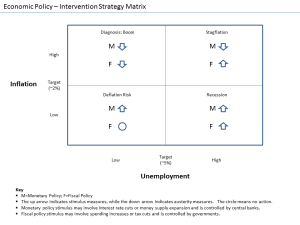
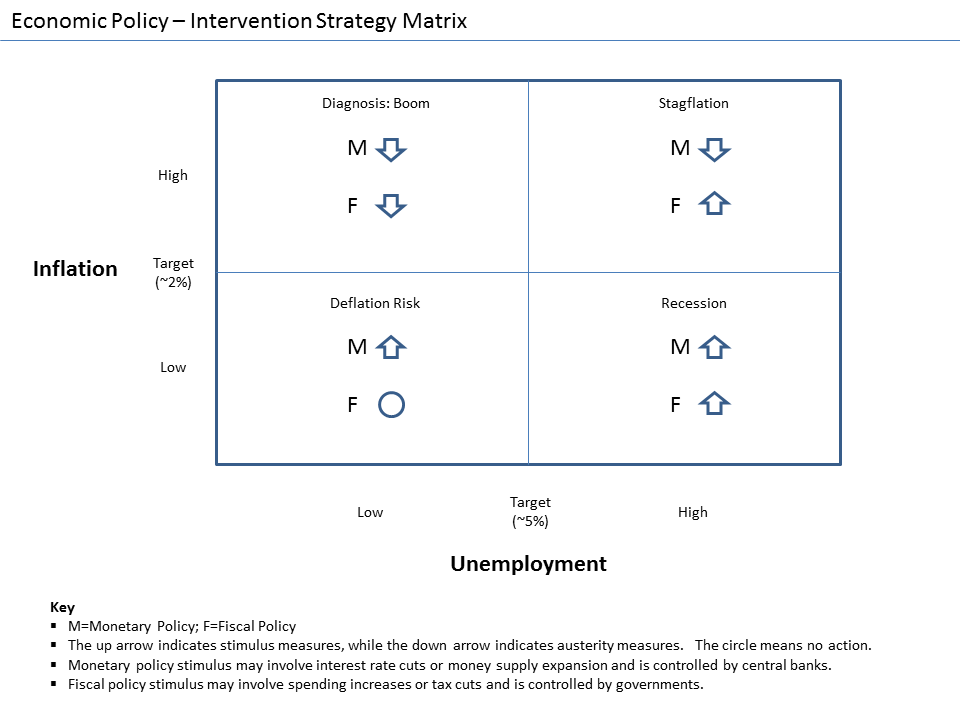
    Economic_Policy_-_Intervention_Strategy_MatrixSince, Keynesian economics had worked in relatively less connected world of 1930s I dismissed the question 1 for future blog. Japan’s overdoing it and how the system works were somewhat related questions. So, that question became central in my very tiny analysis.

    The question I had was – how does Govt issue bonds and how does it get circulated in the market? Well, that is done through the banks and the bankers. Aha! did I hear bankers? Those bankers who went to the President (USA) and said – “we would buy Jet for our executives?” Ok! If those who still blame Keynes, would you ask with each slow down who makes the most money? Is not it the same – bankers? At least the Govt is putting money in the system in the hopes that this method will work to keep the economy afloat. I was checking Wikipedia article on Economy of Japan. An external states that – Japan possesses 13.7% of the world’s private financial assets (the second largest in the world) at an estimated $14.6 trillion [2010 data]. This data states that – Keynesian economics is doing more services to the Capitalism than otherwise!

    [Tweet “Japan has 13.7% of the world’s private financial assets! #Keynesian #economics does more service to #Capitalism than otherwise”]

    Who is playing with the hopes and cheating the system? I am little too critical when I say “cheat” because some people are in the profession of making investment decision and those decision at times counter intuitively work against the basic premise (hope) on which at the first place Govt had put money in the system. I think a solution for the problem of Japan or for that matter world economy (likely next economic burst) lies in answer to the question(s) – who has actually hoarded the money? How to make amend for this workaround of Keynesian method of boosting economy?

    I asked Prof Mankad about his opinion on Japan. He shared this – “One of the real reasons for Japanese stagnation through the last decade of twentieth century had little to with Japanese policy. It was caused by two important external forces viz., depreciation of dollar (and hence default appreciation of Yen) and rise of ‘low cost’ China which deprived Japan of its traditional export markets. The fault of Japanese policy makers was absence of policy response to the changing situation and rise of China.”

    So there is seemingly an emotional explanation [which questions the other side] from my side. There is another more analytical, logical and thoughtful explanation from Prof Mankad. Whichever you want to ponder upon – Keynes did not seem to have failed Japan.

    Yet at the same time, every generation needs a revised look at things & our generation too! Keynesian Economics was successful when the world was not that connect, now QE of USA is invested in India/China which did not happen in 1930s.

    Image source – http://upload.wikimedia.org/wikipedia/en/a/a7/Economic_Policy_-_Intervention_Strategy_Matrix.png

  • Random Act of Kindness


    I have started watching a SitCom – Dharma and Greg. In one episode Dharma (a strangely spiritual women), does Random Act of Kindness. She gets into trouble as a Policeman fines her. Well, I shall write on the serial sometime later. I thought to take up this point of “Random Act of Kindness” in this blog. I have written on Can money buy Happiness? earlier, however here is another take. Though, upto an extent yes Money can buy you happiness, yet beyond that threshold “value of money” does not add any “value” to one’s happiness – point of diminishing returns.

    Related blog – Just do it… ok try it

    I received this video from my brother on WhatsApp. I am sharing this video here, do watch, if you like do share as well. After watching this video you may say why do such thing? People will be “tempted to find such person” on daily basis! Just watch the video and feel free to share it, like it and write your opinion on the comments box below.

    If you want to check this video in Youtube

    It is my birthday today – 26th Sept. So instead of waiting till weekend (starting tomorrow), I thought that let me share this blog on my Birthday. Will you share some Random Act of Kindness with anyone? May be today? Not necessarily me [jokes apart].  Anyone who is in need.

  • Spirituality & Business


    It was winter of 2012, Sujoy was getting married. I traveled to Pune to attend his wedding function. There I met one of my very old College mate – Anurag Tambe.

    Anurag is smart guy, thoughtful and practical. We discussed many things, including my faSteve_Jobsvorite topic – purpose of what we do? This topic eventually boils down to spirituality. Anurag told me about Steve Jobs and what his experience was about India and spirituality. His visit to India made him go back to the US and keep doing his work as good as he could. [Anurag’s reference to the book on Steve Jobs]

    Here is an interesting story from Father Antony De Mellow, book – Prayer of the Frog Volume 1 and Prayer of the Frog Volume 2 on similar concept.

    A cobbler met a Rabbi and said. “Tell me what to do about my morning prayer. My custo­mers are poor men who have only one pair of shoes. I pick up their prayer of frogshoes late in the evening and work on them most of the night; at dawn there is still work to be done if the men are to have their shoes ready before they go to work. Now my ques­tion is: What should I do about my morning prayer?”

    “What have you been doing till now?” the Rabbi asked.

    “Sometimes I rush through the prayer quickly and get back to my work—but then I feet bad about it At other times I let the hour of prayer go by Then too I feel a sense of loss and every now and then, as f raise my hammer from the shoes, I can almost hear my heart sigh. “What an unlucky man I am that I am not able to make my morning prayer.”

    Said the Rabbi. “If I were God I would value that more than the prayer.”

    Steve Jobs, I think, did what the Rabbi suggests in the story.

  • Freemium – business model


    The Buddha shared his knowledge for free, you know these universities charge so much for the degrees!

    One argument could be – 1. That time was different. 2. The Buddha asked for bigger fee – leave all material possession, family, even ‘self’. What fee are you talking about? But yes, what the Buddha taught was priceless and of course for free.

    The second is – Well you have a MOOC (Massive Open Online Courses) – Coursera, EdX etc. These MOOC are based on a freemium Business Model.

    “Freemium” is a coined word; it is made using two words – free and premium. A business model which is based on this term “freemium” offers products/services free as well as paid. What is so great about it? Well, in this business approach few basic functionality of product/service are free and advanced features are premium. An example is LinkedIn. This business model is possible in cases where marginal cost of distribution and production are low – most commonly internet and software businesses. Advantage? It can offer huge scale for premium access. How? Once responded to free and limited period premium content business can expect to convert higher % of free users to premium users. LinkedIn has been doing this successfully.

    I liked this idea. It relates to offering your services – though limited – to everyone. Here everyone means – meaningful target audience which needs it. The business offering such service is not creating a complete monopoly – by asking users to first PAY and then USE. It gels with the concept of Business and the Buddha as well.

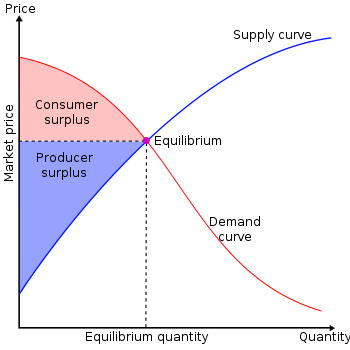
    Well, a word of caution – fremium can be wicked as well – when pricing is done to squeeze “consumer surplus”#. That is where it may not be what “Business to the Buddha” would apply. At the end of the day – there is no limit to squeezing the consumer, isnt it?

    An interesting business concept I have seen in Singapore [searched on net they are in India too!]. There is a restaurant near China Town MRT station – Annalaxmi. There you can have lunch and pay as much as you want, Sing $ 0 or even 100. There is no cashier. The amount such collected goes in running this not for profit restaurant and rest is utilized in organizing cultural activities.

    Whatever said, freemium seems to (should) be the way to go!

    Image source – Consumer surplus – Wikipedia


    consumer surplusesConsumer surplus – it is a term used in microeconomics in demand and supply analysis. Though the author is not a PhD in economics, still in his simple words – consumer surplus is what a few consumer “can” pay to avail the service but would not pay as company selling the offer keeps the price lower so that the company can reach scale.

  • As you sow, so shall you reap


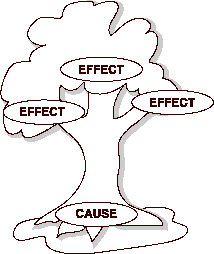
    In Science we have studied – every action has equal and opposite reaction. We never take that seriously for life, that if we hurt someone that may be compensated. Here is an interesting idiom in English language (many other languages as well) – As you sow, so shall you reap.

    Long before science could establish this fact as “the fact”, The Buddha and Hinduism had given the concept of Karma. Well, I cannot vouch for rebirth so here is what I have written earlier –cause_fx

    Heaven and Hell are ‘here and now’
    The way you pass each moment
    You define whether you are in Heaven or a Hell. Blog here

    Don’t rely on next birth, do good in this life time itself.

    Heaven and Hell are ‘here and now’
    The way you pass each moment
    You define whether you are in Heaven or a Hell. – See more at: http://business2buddha.com/2011/07/21/this-is-how-i-remember-it/#sthash.Aykwean2.dpuf
    Heaven and Hell are ‘here and now’
    The way you pass each moment
    You define whether you are in Heaven or a Hell. – See more at: http://business2buddha.com/2011/07/21/this-is-how-i-remember-it/#sthash.Aykwean2.dpuf

    This blog post is less inspired by the concept of Karma and the English idiom but is inspired by a SitCom I have watched long back – “How I met your mother“. This is/was a series just like previous famous sit-com “Friends”. In How I met your mother (HIMYM) there are five characters – Ted (lead character, who is telling this story to his kids), Barney, Marshal, Marshal’s girl friend (later wife) Lily and Robin (confusing to describe her – she is friend – with each one. She is girl friend of Barney and Ted in some series. She is wife of Barney once and in the end she marries Ted). In one particular episode season 2 Episode 15 – Lucky Penny, the concept of cause and effect is described with ease.

    Ted finds a penny and in the 22 minute episode, everyone is involved with the penny and the associated event result in Ted missing a flight to Chicago. In Hindi there is a saying – बात निकलेगी तो दूर तलक जाएगी it means – “If we start this discussion, it will go long back in the history”. Just to give you a perspective we may conclude on this question – “Why did Adam eat the Apple?” You know what I am saying?

    You must watch that 22 min episode of How I Met Your Mother to know in brief how causation might work?

    The Author does not claim any rights on the Youtube link and video. This link is attached here for reference and does not make the author liable for any copyrights violations. It is advised to the reader that if you want to watch the series please purchase it from any retailer where the media drives are available such as FlipKart Link.

    Image source – Cause and Effect – http://fcit.usf.edu/florida/lessons/railrd/cause_fx.gif

  • At the master’s door


    prayer of frogI have been reading one or the other story of Father Anthony De Mello’s books – The Prayer Of The Frog Vol. I and Prayer of The Frog Vol. II. The books have interesting stories, many a times half page. One of the story I read was on a seeker going to a master’s abode. I’m tweaking this story (I would want to claim the copyrights!), here it is –

    At the master’s door

    A spiritual seeker was almost at the door of one of the masters. Sensing the abode as the best place to find his prey, a devil made his permanent residence there. When the devil saw the seeker enter the house of the Master, devil determined to do everything in his power to turn him back from his quest for Truth.

    The devil tried giving this seeker all the possible temptations. His list of temptations included every possible means – women, wealth, fame, power and prestige even wisdom (perhaps false sense of it). However, our protagonist was too committed a seeker. He fought all these baits and stood his ground.

    The devil was almost lost, he was about to let go of the seeker. Suddenly, an idea cropped up in the mind of the devil. He tried it. The devil said – I shall give you all spiritual knowledge you seek, come with me!

    This time our protagonist could not resist his temptation – he followed the devil.

    Now if you understood the story and the BOLD copyright part (of mine above), you may laugh at it! You may learn few lessons – including me claiming ownership of the story. However, I know “You only lose what you cling to“.

    Even the desire to be spiritual is a temptation!


    Related

    Miracles of life

    When the Buddha dies, the schools are born

    Ideas Vs reality

    The dog and the fox

    Incentive to cheat

    Ideas Vs reality
    When the Buddha dies, the schools are born
    Miracles of life – are we sleeping?
    Miracles of life – are we sleeping?

  • Faith


    “Gamblers are the biggest believers!” Prof Mankad told this to me. He asked “who do you think are the biggest believers? They have faith, next time… if not this time one more time, next time fortune will be mine. They believe that one next time; they have faith.”

    When I heard this, I promised Professor Mankad that I’ll learn the games played in gambling. This is seemingly contrary to what we have heard – gambling is not a good thing! On the other hand gamblers can be the biggest believers in the world! I wonder if there is a God he must be sitting in some casino and helping someone make fortune! Isn’t it?

    I had been thinking of writing a blog on our that small piece of chat, and I received this small story – modified a bit.

    FaithBar

    There was a town; often visited by many traders and nearby villagers during the weeks for all sorts of trade. In that town there was a church, but no bars. A person saw an opportunity seeing many visitor in town but bar. Hoping that after a tiring day people would come and just chill in the bar; so quenching thrust with booze was huge business case! However, this person could find a place only opposite the lone church of the town! He started his business there.

    Church

    People from all walks of life visited his bar, not only after a tiring day in the market but also after their prayers and other casual visits to the Church. Earlier only Church used to a common meeting place for town dwellers as well as for villagers from far and wide. Now the bar had taken over. The church was a serious matter and bars were for fun and frolic. Even for heart broken people it was a place to forget the pains. The heart broken had route as – message to Gods in the church with emotional stories, after the painful saga go to the Bar for comforting oneself. The church authorities were pained with this challenge from a competitor just under the nose. They prayed daily against the bar. As fate could have it, the prayers were heard sooner rather than later – the bar was struck by lightning and caught fire.

    Bar owner sued the church for the cause, as an action by their prayer. The church authorities denied all responsibility!

    So, the judge commented – “…its difficult to decide the case because here we have a bar owner who believes in the power of prayer and an entire church that doesn’t believe in it.!!!”

    At times you find somethings at the most unexpected place!

    Disclaimer & sources – The author does not intend to hurt any sentiments, and does not question the authority of the churches [he has his STRONG opinions though]. The author does not want to claim any Intellectual Property Rights – Copyright – to the story [even though he has modified the story].

    Images [used for purpose of representation only] source

    Church – http://upload.wikimedia.org/wikipedia/commons/f/fa/St._Andrew%27s_Forane_Church_of_Arthunkal.jpg

    Bar – http://i1.ytimg.com/vi/NfRrEUz62Lw/hqdefault.jpg

  • Content marketing – A hedonic treadmill!


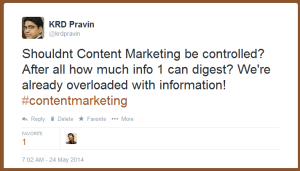
    I while back I wrote a tweet. This tweet was about content marketing. Content marketing is becoming so widespread and a demand for digital marketing that everyone is writing something “important” for getting a gaze of the prospective client. How does it work?

    Content Marketing
    Content Marketing

    Say I write on Social Media Marketing, I keep on bombarding my content on Slideshare, LinkedIn, Facebook, Twitter, post blogs, infographics, case studies and Quora (there seems to be no end to the list) etc etc just to get Google/Yahoo/Bing notice me and my content. Whenever a prospect searches for “Social Media Marketing” my name should figure out in the results in say first page.

    It seems this is becoming a race to remain relevant. To be more precise an exercise to just remain where we actually are! Over time, we would realize that we are not at the driver’s seat in “content marketing” type of exercise. The algorithms of Google/Yahoo/Bing are driving us. Instead of we doing what we want to, we are driven by the “outer factors” to take action!

    Let us take an example of a treadmill, the treadmill moves irrespective of man walking – yet goes no where. Who is driving that treadmill? Not the man walking on it. I have written earlier about this blind race we all are running, but have we ever thought where are we going? Are we actually seeing or just blindly running on a Hedonic treadmill?

    I think – like anything else – content marketing is going to follow laws of diminishing returns – we’re on a treadmill (of content marketing), we don’t know how to stop it. We don’t know when will we get satisfied. But it’s for sure we are on the path of diminishing returns having more of something doesn’t make us happy (content).

    Hedonic treadmill is a concept for our daily life just came across this interesting article on Jumping off the hedonic treadmill here

    Related – 1. Why are you doing what are you doing? 2. What more you need? 3. Entanglement of a langot 4. Race – never ending

    Related – 1. Why are you doing what are you doing? 2. What more you need? 3. Entanglement of a langot 4. Race – never ending – See more at: http://business2buddha.com/#sthash.9eIArC2R.dpuf
    Related – 1. Why are you doing what are you doing? 2. What more you need? 3. Entanglement of a langot 4. Race – never ending – See more at: http://business2buddha.com/#sthash.9eIArC2R.dpuf

  • Why not define smaller things?


    Last month I met Prof Mankad. I always think whenever I meet him I should record our conversation. He is indeed a library of knowledge in himself. We discussed about our education system besides many other things (blogs written last weeks) Purpose of education and Showjumping. Dr Mankad told me – “one of the real problems with our daily life is our weird definitions e.g. success. We define success as owning that BMW. Until we get that BMW we don’t feel content. Thus, we avoid being satisfied, we do not live a fulfilling life. Though as an individual we can, but the weird definition makes us estranged from many small things.”

    Vada Pav
    Vada Pav

    He further shared an experience. One of his friends landed in India from the US (at about 12:00 AM or 2:00 AM). Next day 6:00 AM he was at Prof Mankad’s home, and asked to just accompany him. They drew to Karjat had some special Vadapav of that place and drove back to Mumbai.

    Well, all this made me question few very basic things we generally overlook. We do not think much about basics of life, but still have some preconceived notion about those things. As Dr Mankad shared example of success, another example is beauty. I watched this video in my MBA Marketing class. Our definition of beauty is weird watch this <2 min ad of Dove, to understand how our perceptions are defined; at times created. Many girls want to be fair, those who have curly hair want straight and vice versa!

    How often have we thought on these seemingly simple, stupid, strange yet serious questions. What is the meaning of Success (for me or you)? Does our definition of success change over time? what is the purpose of life? Why are we studying (at least when in college)? How will I/you know when I/you reach the target (a 100,000 INR or 10,00,00,000 INR), the goal is always a moving one! What is the benchmark? I think we need to just pause at times, and think how we want to shape our life, what is important for ourselves at least that instance, isn’t it? I think that is what enlightened masters call “living in present”

    Related – 1. Why are you doing what are you doing? 2. What more you need? 3. Entanglement of a langot 4. Race – never ending

    Race – never ending
    Why are you doing what are you doing?
    Why are you doing what are you doing?