Tag: Prof Arun Ramanathan

  • My Favorite Fictional Character


    Have you ever thought about fiction and reality? Fiction is something untrue, made-up or imaginary. How can I say that the Buddha or Krishna or Jesus was someone who actually walked the face of earth. Is it a possibility that these were imagination of someone? This thought puts me to another thought, what if I myself am is some imagination and a reality is somewhere, something else.

    Have you ever had a dream, Neo, that you were so sure was real? What if you were unable to wake from that dream? How would you know the difference between the dream world and the real world? Morpheus The Matrix

    What makes something real? Is it because I think, see, feel (perhaps smell or hear) and my mind makes me feel that this is something real because I can sense it? Or something is real because it exist without someone’s ability to sense it or no. Take an example of light – we cannot see light beyond a certain frequency range. Does it make the light non-existent?

    These questions remind me of a very interesting movie – The Matrix.

    “…The Matrix is everywhere. It is all around us. Even now, in this very room. You can see it when you look out your window or when you turn on your television. You can feel it when you go to work… when you go to church… when you pay your taxes. It is the world that has been pulled over your eyes to blind you from the truth…”

    I have had a couple of Morpheus in my life to teach me. I have written about almost everyone on this blog. I would want to be Morpheus too, for someone or few in future. I love the character of Morpheus from The Matrix the most. Morpheus is a believer, he courageous. The best part is, the kind of confidence Morpheus has in Neo, it makes me feel that I want to be Neo too. Laurence Fishburne played the role so well that I keep on watching his teachings (dialogs) whenever I feel I should. There are a lot of learnings in those dialogs – “Do not think you are, KNOW you are.” I have written on the movie (red pill) earlier too. I was so fascinated with the movie that I used to tell people that I am fine being a spot-boy for the movie – alas I am in India :(. The movie is so philosophical and spiritual to me that I repeatedly watch it.

    Instead of me talking (writing), I would want to share some videos of the movie (Youtube), not sure about the copyright permissions there.

    I see many of my teachers in Morpheus – they are indeed my Favorite (they are real) human beings, this blog post is dedicated to all of them. This was the title of this weeks Friday Loose Bloggers Consortium. Con You can read other LBC bloggers thoughts here – Rummuser and Shackman.


  • Inclusive growth


    We’ve seen that socialism had it’s problem, capitalism is no less culprit. I’ve been thinking about both together and have written about it. Regularly I asked this questions of how to two of my MBA professors – Prof Harkant Mankad and Prof Arun Ramanathan. Prof Ramanathan suggested me to read functioning of Nordic countries – heavy tax but less social security. Once I shared this logic –

    Socialism & CapitalismIf we look at both simultaneously we see some good and some not so good practices. Socialism had social benefit at center but execution sucked. On the other hand capitalism has profit at center and execution is better, and also capitalism largely never considered social good as one of the concerns.

    The very bird-eye-view (yes MBAs use this kind of jargon) solution could be – What is we bring social benefit and profit together at center and use execution efficiencies of capitalism around? The profit does not necessarily become – extracting whatever available consumer surplus is there with consumer. Take an example of social entrepreneurship, that is one good approach. Here, I do not intend to say every business should be like that. Also, yesterday I tweeted and updated on LinkedIn – If you want to be social entrepreneur, remember funder of social enterprise has impact in mind+heart & investing in head, so impact weighs higher! those kind of initiative can help in inclusive growth.

    I see that PPP – Public Private Partnership – can also be great boon for inclusive growth. However, greed has created more problem in the Indian context than giving us Inclusive Growth.

    Take an example of MNREGA, it has been failing, benefits are not reaching where they should. How can political parties be kept away from execution? Politicians asking for bribe in such cases is nothing but extortion. How about giving the executioner tax benefits to get involved in it and ask for accountability? Audit Done periodically by people (an independent body monitoring). The people affected and benefited can vote for continuation or stopping that company from involvement. So this can be kind of election on performance of NREGA.

    What I think is – people want a respectable life and not bread thrown at them condescendingly. Inclusive growth is possible when we think more like a combination of socialistic -capitalistic society.

    This way we’d be capitalist but in a socialist manner where besides profit, social uplifting would be a core of philosophy and growth.

  • Race – never ending


    I met Professor Arun Ramanathan a few months back (precisely in April). He taught us Corporate Governance and Business Ethics in our MBA. I told him a very practical daily situation I face. Whenever I walk, I am almost running, I notice that I walk very fast that I leave people behind as if there is a kind of competition happening. I am running to – say – win some competition.

    Courtesy Nilesh Yeram (my friend)
    Courtesy Nilesh Yeram (my friend)

    Why are we doing this? Am I alone in this kind of running (not just literal) without knowing where is the end or many professionals – like I do – are just running. Some running for money, some for a next bigger car or home, some others for a better position. Or is it that when people are young they just get in a race, a race no one knows who started but a race in which other peers are also equally involved (at least in the runners mind)? This is how ethics gets shelved in our personal and professional life. We are trying to be something. Is it of any consequence or what are the accolades related to that? It is of no interest in many cases. So the mentality is by hook or crook achieve the results.

    Two weeks back Rajagopaul uncleji shared a story with me. This perfectly relates to my discussion with Prof Ramanathan, so, sharing it here.

    Race

    I was jogging one day and I noticed a person in front of me, about 1/4 of mile. I could tell he was running a little slower than me and I thought, well, I shall try to catch him. I had about a mile to go my path before I needed to turn off. So I started running faster and faster. Every block, I was gaining on him just a little bit. After just a few minutes I was only about 100 yards behind him, so I really picked up the pace and push myself. You would have thought I was running in the last leg of London Marathon. I was determined to catch him.

    Finally, I did it! I caught and passed him by. On the inside I felt so good. “I beat him” of course, he didn’t even know we were racing. After I passed him, I realized I had been so focused on competing against him that I had missed my turn. I had gone nearly six blocks past it. I had to turn around and go all the way back.

    Isn’t that what happens in life when we focus on competing with co-workers, neighbors, friends, family, trying to outdo them or trying to prove that we are more successful or more important?

    We spend our time and energy running after them and we miss out on our own paths. The problem with competition is that it’s a never ending cycle. There will always be somebody ahead of you, someone with better job, nicer car, more money in the bank, more education, better behaved children, etc. But realize that “You can be the best that you can be; you are not competing with anyone.”

    Some people are insecure because they pay too much attention to what others are doing, where others are going. Take what has been given to you. Stays focused and live a healthy life. Run your own RACE and wish others WELL!!!

    Is not it a good thing to learn?

    Other related blogs

    Chinu and the pebbles

    Money worth earning

    Swasthay – dwelling in oneself

    What more you need?

    When will we stop?

    Why are you doing what are you doing?

  • Leadership and education


    Election results of couple of Indian states are out and largely there are clear mandates in all states. So, there are not many permutations and combinations happening for forming governments. I was wondering about the elections, results and post results – five years. The long term thoughts (five years after results) were hampered by a news of rabble rousing activities in UP. Does the confidence of victory create so much defiance that people do not mind taking law in their hands or crossing the limits?

    This question lets me ask myself – what do we need? Politicians or leaders? Are politicians really leaders? I was thinking about this and on LinkedIn I read a question. IF YOU HAVE GOOD STRATEGY, DO YOU STILL NEED A LEADER?

    Can a good strategy create a leader or leaders can create effective strategies? My answer is leaders can create effective strategies. Also, I heard someone say – An army of sheep led by a lion are more to be feared than an army of lions led by a sheep.

    I was talking to Prof Ramanathan, he told me “…Pravin I see there is a lack of leadership at various levels, be it corporate or others…”

    The fact of the matter is the crisis is wide spread are we creating leaders? Are we creating excel, power point and ivory tower experts of solutions? When I read the book – I have a dream I realized that there are people who took initiatives, who rolled their sleeves and got down to work. There may be many more not covered in the book, yet how many of us have become leaders after studying at Ivy league?

    Recently, I met Prof Mankad, we discussed Greek crisis and the visible solutions to it. He made a good observation on the economic power of China that made me think – having and managing power requires a sense of responsibility and ability to be fair. This ability requires courage and confidence to say – ‘yes I erred’ when one did commit mistake. Does our education teach kids to have these qualities?

  • Individually smart, collectively dumb!


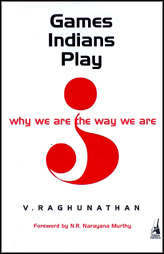
    Book Games Indians Play cover
    Games Indians Play
    Have you read Games Indians Play! by Dr Raghunathan? Very interesting book with pertinent examples of issues we face, many a times overlook and are facing worldwide. In that book he says – “We are individually very smart but collectively dumb”. I think we are collectively dumb and therefore we are in the economy-related mess we have created.

    I did not know that I would be referring to my new year blog so early in this year. Newspapers of 3-Feb-2012 made me do so. The news was about the 2G scam which had been under scrutiny for a long time now. In my opinion the verdict clearly stated that power corrupts and it gives you confidence that you can get away with murders too (many such cases pending in India)!

    I thought hard – really very hard – to find a solution. I think I will go back to TRIZ (theory of Inventive Problem Solving) to decide conflicts and resolving them. Until I find a one size fit all ‘man made’ solution, I could think of only one possibility. This solution is self restraint, and owning responsibility to make sure we are morally correct.

    This word ‘Moral’ reminds me of my economics and business ethics class of MBA where we discussed moral hazards with Prof Mankad and Prof Arun Ramanathan. I was reading this article on Moral hazards at Wharton. The article talks about authorities and new stringent rules. This regulatory authority will tomorrow need another (other set of rules) and so on and so forth. How long will we create such authorities? Moral hazards would end very easily when each one takes responsibility and become accountable for his/her action. This accountability has to come on each level and for all the actions. The problem lies with a reality that – ‘We are individually very smart but collectively dumb’. This ‘being individually smart’ begets moral hazard. The solution for this problem is one’s own self. Take responsibility own it and be accountable. Perhaps initially we (as individual) will fail but collectively we will start succeeding.

    I am hopeful that once we start from ourselves (individually), each one of us would be able to avoid situations where we would talk about Newspapers of 3-Feb-12 (2G Scam), other scams and the bad shape of world economy. Hoping that we would save our energy to concentrate on something constructive.