Tag: Operations Management

  • Cost of poor quality

    Cost of poor quality (CoPQ)

    In operations improvement, Cost of poor quality is a common management term. Sum total of all the costs that are generated due to defective material produced by a system is CoPQ. There are various costs defined in management systems for this. You can read more about CoPQ at iSixSigma.

    A naive example
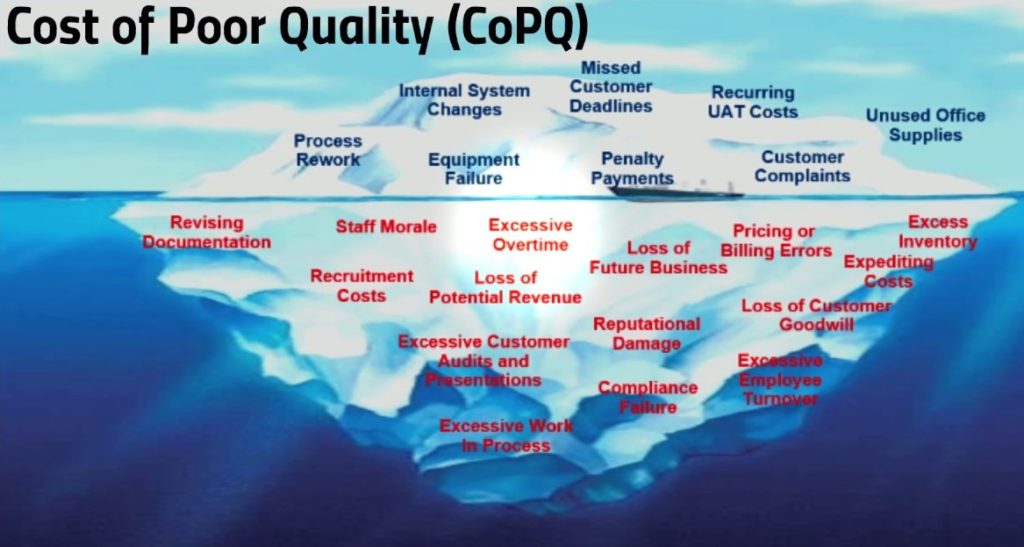
    cost-of-poor-quality

    Since, management example for CoPQ can be complicated by jargon. So, I am taking liberty of making it very layman with few variations in explanation. The context is very India-centric here. There is lot of corruption in road construction projects in Indian cities. Almost every year during rain (otherwise too at some places), these roads are full with potholes. Some people say – you need to search road within the potholes. Why go to any other city – Mumbai is a living example of the same. These roads result in – untoward events (possible serious accidents), high cost of vehicle maintenance and repairs, poor vehicle mileage and at times backache to the travelers even with good quality shock-absorbers of the vehicle.

    The evident cost, in case of Mumbai roads alone, is repairing same patch of road in single season at least 3 times.

    Example of CoPQ In life

    Terrorists – they are an example of CoPQ to society, they waste their life as well as killing other people. Say one of the person’s killed is an educated, married person with a child in his 30s. Death of this person is a loss to the Society, a talent who added to the GDP. The loss to the GDP is for about 20+ years the person could do. Family and child lost a support system. This loss of support could eventually result in inability to blossom and become a better contributor to the society. Society can be better off if a terrorist commits suicide without causing any other damage. Though it is a loss again to the society that a person is dead without adding any value to the society, however it is better than the trouble that person could be to the world.

    Depression of an individual is CoPQ for self and society. The society is losing time and skills of this depressed person. Actually, interdependent co-arising plays an important role in our society. CoPQ can be derived from interdependent co-arising too. If we understand the concept of interdependent co-arising society can reduce terrorists and depression patience.

    How to reduce CoPQ for society?

    When I was thinking about what we humans ban do to reduce the cost, I came back to the same old point – meditation, spirituality and teachings of Buddha and Jain Thirthankars. Both Jainism and Buddhism emphasis on concepts such as non-violence, non-stealing, fidelity etc. Corruption is a type of stealing and terrorism is violence. If one gives proper heed to the virtues, roads will be of good quality and if one meditates regularly his quality of live will improve multi-fold. In essence, practicing these principles the Cost of poor quality can be reduced drastically.

    Image source – Cost of Poor Quality – pt4 youtube video
  • Why-Analysis – Karma


    In operations consulting we used to do why-why analysis. It is a method to identify cause of an occurrence. There are other methods also available for doing such analysis. The objective of such different methods is be to find the root cause of some occurrence.

    Why this happened? Because of that. Why that happened? because of something else.This why question is asked on the answer of previous question until an actionable cause is identified. Mostly a root cause is reached in maximum of 5 why’s. It is a very commonly used cause and effect analysis tool in operations management.

    I watched this video and could relate to karma, our entanglement to karma (Maya) and that root cause analysis technique mentioned above. The lesson here is, one must try to find “The cause of cause”.

    Guruji (Sri Sri Ravi Shankar) is saying in this video that when you stick at one or lower levels of the cause attribution you do not get to the real cause. On the contrary that entangles you, in Karma, even more.

    If we do not perform Why-Why analysis correctly, we get frustrated and the operations do not get improved. Thus, properly performing this analysis will get to the root cause – mostly management. How and why a decision was made which resulted in the issue say for example high inventory or poor quality output. Thus that can help improve operations of the organization.

    Similarly when we analyze karma we would reach to the ultimate – the cause of all the causes. Guruji calls it – Shiv tatva in this video.

    Karma plays a role everywhere, be it spiritual life or professional. However, doing a why-why analysis on operations is easy on the contrary doing a why-analysis on “the cause of all the causes” is easier said than done.

  • Do what is right in perpetuity


    The class was nostalgic, remembering the last couple of days of sessions of Operations Management with Prof Moradian. Today we were attending his last session of Operations Management. We all enjoyed each session, the quick wits and learnt a lot. We were attending his last session and thus all that was coming to an end for Operations Management.

    That session was very special, I could still hear his one statement very clearly that – “…in your career whenever you have to take any decision, always do what is right for your company in long term…”.

    When I recollect those words from Prof Moradian – “… do what is (make decisions which are) right for the company in perpetuity…” that makes a lot of sense to me. That one statement made me speak couple of tough truths in my career, but it feels good when you consider big picture vis-a-vis to your personal interests.

    An organizations need to learn the art of balancing between the short term sustainability and the long term growth OR short term profit and long term uncertainty. In current economic scenario short term sustainability seems the way to survive, let alone long term growth or profit for that matter. Message seems clear to me – Do what is right for the company in perpetuity.

    Actually this statement equally applies to each individual in life too – we should do whatever is right for us and others – IN PERPETUITY.

    Related blogs –

    Balancing Act – Professor Mankad shared this story of Balancing act with me earlier.

    Fruit will arrive in its season

  • Conflict of interest


    Disclaimer – Author himself is an MBA in Marketing (has been and is in the business of – kind of – selling dreams) and has worked as operations management consultant (has been and was/is/has been facing the challenges faced by operations department)

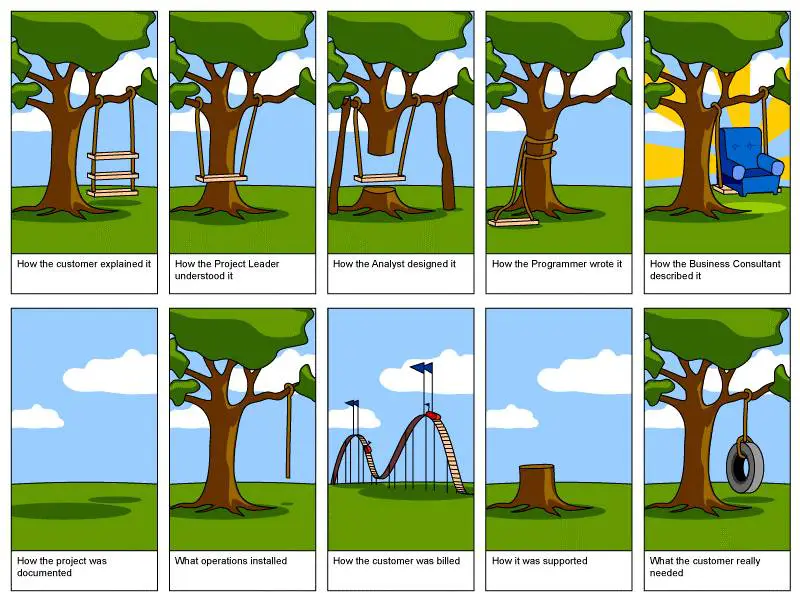
    I was comparing ourselves as an organization. I am an organization in myself, so are you and Ms Y. I was wondering about the departments Marketing and Operations. Marketing is selling dreams and Operations is capabilities. What I dream to be, could be the job of marketing department and what my capabilities are is the reality of operations.

    There is nothing wrong in dreaming, in fact it is good. At the same time knowing the capabilities is also important, that would help us realize the true potential and opportunities of improvements. Though, how often we dream then review our current potential and then think of building future capabilities to achieve potential? That’s where I think Marketing and Operations Department lock horns.

    An incident reminded me of a lecture of Prof Moradian, long term Vs short term and conflict between Marketing and Operations departments. I started seeing more reasons for conflicts between Marketing department and Operations Department.

    Marketing and Operations lock horns with each others. Because generally Marketing team communicates moon, Sales team sells the idea of “reaching the moon as a reality” to prospect and Operations finds it difficult to do that. Why? Because Operations had the capabilities and was supposed to put the prospect in the sky (not necessarily on moon). Thus, challenges faced by operations and promises made by marketing are different.

    The second issue is Marketing and Sales team lives on quarter on quarter (Q-o-Q). They have to show the revenue which is the goal for any organization. On the contrary Operations team cannot take decision for one quarter. For example – operations may not say we need infrastructure for one quarter and not in other quarter and thus make huge investment in one quarter and sell those equipment back in next.

    A branding expert told us that marketing managers (brand manager) want to start new brand building exercise (to gain in short term for writing on their resume – ‘I started this initiative’) and move to next level. New manager comes he/she too does the same. Short term gains are there for the marketing manager; yet for long term the brand is diluted perhaps no one knows what would the brand stand for in future.

    This was/is the case of 2008 melt down. Decisions were made on short term with one phrase in each agreement – “systemic risk”. BFSI industry created various certificates (CDR) etc to sell junk to make big buck in short term. Dreams were sold without real fundamentals. In other words, operations did not have the capabilities of generating the kind of returns promised – with a rider of systemic risk – to prospects.

    This is what is conflict of interest for us as individuals – our dreams Vs our realities. The same is true with Organizations – their marketing Vs operations. This is also true for us as economy – our dreams Vs the reality of systemic risk and capacity of economy to fulfill the dreams.

    Image source – http://www.cravingtech.com/blog/wp-content/uploads/2007/11/project.jpg