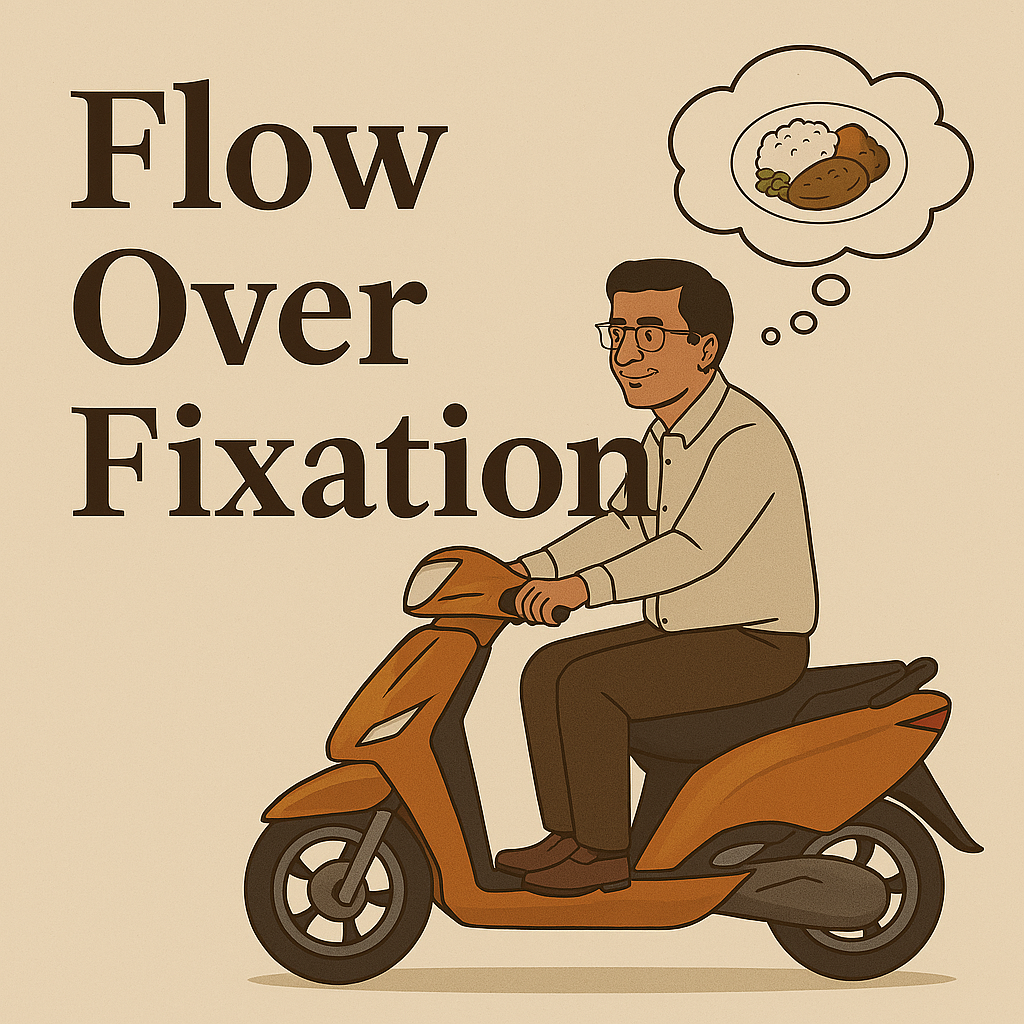
Mind’s chatter rarely stops. On that fateful day more than a year ago, even though I was riding my two-wheeler, mind was rambling, 9:05 am I will reach home. We will have breakfast, by 10:00 am or so we will take a stroll in the society. By that time Adviti will be back from her dance class. We would get ready by 11:00 am spend some time at home and start for social gathering followed by lunch.
It was about 9:00 but my mind had already reached lunch time. They say plans are useless but planning is important. I was preparing this plan in my head and in three minutes I was on the ground! Met with a minor accident, or that is what I thought it was. At the hospital I realized it was not a small accident.
That one thing changed me to a great extent. I make plans, of course I worry for many things too however, I know now that in next second things may change completely. This incident reminded me of my Senior Division NCC days. I was Senior Under Officer of my company 3MP CTI. It was one of the best learning experiences as a leader. I had heard many adventurous stories shared by our trainers and Commanding Officers. One insight stayed with me: even when a plan is thoroughly prepared for field operations, the leader must remain flexible. The officer in command understands that about 70% of the plan is predetermined. The remaining 30% must be adapted based on the situation at hand. So even after planning they keep room for improvisation and course correction.
If in a life and death situation they can keep their plans fluid, in our day today professional and personal life too we should have that wiggle room for change. However, in our daily rut we miss out on this kind of small yet very important lesson. Take an example, when you go to office on a daily basis, do you change your route often? I recall, I had to fill my car and in the self-chatter while driving I completely missed this small yet very useful thing. We become so mechanical that we miss out on things.
That two-wheeler ride turned out to be more than just a commute – it became a quiet lesson. In that one moment, life shook me out of the mechanical rhythm we all fall into. Buddhist practice often speaks of mindfulness – being in the now, not being dragged into what’s ahead or behind. That morning, my mind had already reached lunchtime, while my body was still dodging traffic at 9:00 AM.
We make plans, and we should. But we must also remind ourselves: plans aren’t permanent. I remember my NCC days – our commanding officers always said, “Plan for 70%, keep 30% flexible.” It wasn’t just about military drills; it was deeper. Whether in business strategy or daily life, that 30% flexibility is vital. It’s space for awareness, for course correction, for growth.
As professionals, as leaders, and even as commuters, the lesson is the same: don’t get locked into habit. That minor looking accident taught me something major – presence matters. Even an ordinary ride can turn into an extraordinary insight, if we’re tuned in.
We must live with awareness. Not just by the clock or calendar, but by being present to what is.
I lived in Dhar, a small district headquarters in Madhya Pradesh. It is a small city or say a town. It is a peaceful city with low crime rates. I hope it is still like that. This small place taught me how to handle your fears, it does not include the Fear of the God. Those days there was no fear kidnapping or children lost in the city. So, we kids used to go from one place to the other alone unquestioned.
Dog of our area
In Dhar, like any other city in India, you could see domestic animals on road. Stray dogs were no surprise either. There was a stray dog in our area. We walked that place multiple times daily. This dog was tough to handle. It used to bark, run behind, fight with other dogs, and occasionally bite. We kids were scared to cross the place when we learnt about the dog. In fact, we were “dog fearing”.
We could not stop going to school because of the dog. We devised a plan, we started keeping stones in our hands. Whenever we saw the dog, we threw stones at him and ran away from that area. This dog-fear gave us a solution to scare the dog away rather than be scared.
But why am I telling this story to you? This story has a very nasty relation and question to you – How can you “respect” someone as scary as a mad dog? I know when you read further you may hate me or be disappointed because I am questioning your beliefs. But I must pose this question to you. How can you be “God fearing”? If God is such fearful entity, it must be called a demon, isn’t it? If God is good, we should have a healthy relation with him/her and not a fearful one.
God fearing
If you have followed my blog for past few years you must have read about my marriage alliances. In my matrimony profile I had written “I am spiritual but not necessarily religious”. Some of the prospective alliances confused it with “religious”. So, prospective bride or bride’s family told multiple types of stories around their being religious.
At some of the interactions I smiled and explained to a few that I rarely go to a traditional temple. I may call few places as places for my worship such as my art of living center where I go for weekly sadhana or meditation practices.
After a few attempts, I started ignoring it – spirituality does not necessarily mean religious. I had lost interest to explain it to people. Why? Because I met about two dozen families or alliances for the alliance discussion.
Once, I heard a very interesting new term. “I am god fearing”. I had never heard it earlier, I was impressed and surprised too. Probably I was less educated about religion. I had to ask around what does this mean? Is it “religious?”
Spiritual not necessarily religious
Fortunately, I have some great mentors, one is Ramana uncleji. I shared this profile with him and asked him what does “God fearing” mean?
Uncleji told me – “None of the Indian religion teaches you fear. In fact, none teaches you fearing from God in specifics.”
I added – yes, I understand – Krishna is embodiment of love.
Uncleji continued – “Yes, the concept of fear of God is from Abrahamic religion (religions that started from the Central Asia). The girl is from a convent school.”
I was shocked, how could he figure it out? He was correct, though the profile did not have specifics of primary education. He said I understand it because mostly this is where you may learn the concept of fear from the Gods. Regular Indian family may hardly teach “Fear the Gods” at home.
He further added, the concept of fear from the God works when you must keep people in check and let them follow you “unquestionably”. Indian religions (Hinduism, Buddhism, Jainism etc) hardly force you to follow the diktat without questioning.
I further mumbled – that’s correct, Arjuna asks questions to Krishna in Bhagvad Geeta. Vashishtha answers to Rama in Yog Vashishtha. In Ashtavakra Geeta, Ashtavakra discusses with Janaka and Shiva Sutra is full of questions from Parvati. We Indians have argued with almost every God.
Spiritual vs religious the difference
I have met many people who keep on bowing whenever they see a temple. It happens at times when the closing of eyes and folding of hands looks like an involuntary action. Involuntary action means something that happens without your conscious choice; examples are breathing, digestion and closing of eye in case of sudden light.
Namaste on the back
If you are just folding your hands without even your knowledge or without any deeper respect in your heart what is the meaning? It is like you closed your eyes when you saw a danger.
The idea of bowing down is not necessarily incorrect. Devotion makes you bow. This comes out of reverence and not fear. Bowing down can be a great mindful act and not an involuntary action, isn’t it?
Rarely, I saw that bowing down out of devotion or reverence. Mostly people bow down crossing any place of worship because of two reasons either they have some demand, or they are scared.
Fearing the God
In fact, I am amazed, the convent educated are a step ahead in the confusion. I saw these convent educated to make a cross on their face (similar to a Christian would do while crossing a church). I asked to one – what is that? She said we passed by the temple.
I smiled and said shouldn’t you be folding your hand?
I further inquired, why did you do that? The response was – it has become a habit. Really? A habit? Did you not learn something known as “respect”?
Fear created this habit. It is like an involuntary action, as a kid we used to keep stone when we saw fearsome dog in Dhar. How can you be a God-fearing person? How can you call yourself religious if you fear God?
At best the creature who gives you fear can be a fearsome villain, a monster or demon, if I say in Hindi an Asur or Rakshasa. You can fear a stray dog not the God. If you fear the God, it simply means you are taught incorrectly, there is likely a problem in your religious learning.
Next time, when you bow down remember – the temple or the Murti in the temple is just a representation. The God is omnipresent, omniscient and omnipotent. You would know soon if you are religious – as conditioned in childhood – or spiritual. It is better the bowing down happens due to reverence and mindfulness rather than fear and involuntary.
It was year 2000, I was doing my Engineering away from home. This session was stressful; I had never failed in any academic exam until that year. I failed in one subject of my engineering. The result was about 5% for that subject for our batch – across the university. There were various discussions on the results in University, colleges and among students. Some toppers or top 10% student have also failed in the exam. Disclaimer: I was not a topper during Engineering. Once, professor who taught, set paper and evaluated the subject had openly said in classroom – “I had passed few students because I knew their parents!” It was a shock to many.
The above mentioned was kind of first of my academic failure. Though one was inability to make it to IIT, however it was mixed feeling that time, as I had made it to State Pre-Engineering test (with rank). There are shocks and failures that teach you biggest lessons in life than any success.
Single word sentence that changed me
With the grievance, I went and spoke with a professor of our department. He was also aware about the whole incident of this particular subject, exam, teacher and batch. I was immature, outspoken and outraged. When you are away from home, no family support and just crossing your teens, you may become very aggressive or meek. The young age also gives you extra bit of adrenaline. With full of anger, I spoke with him– “<a lot of story>. Does the institute want me to ask my parents to come and network with professors? They are also teachers; they too have responsibility of teaching students to make their future. I never failed, had been a bright student academically, who is responsible for this result? How can I secure only 22 marks when my mathematical equation based solution worth 20 marks was correct? Who is responsible for this?” I was venting out like anything!
He heard me carefully, looked at me patiently, and responded
– “Situations!” This one word sentence I don’t know how, made an immense impact
on me. Probably, the reason was not that one sentence alone, it was the countenance,
the manner, care and concern. It was said with compassion that made the
difference. That one word resonated with me for a long time. Perhaps, it is
difficult to understand what I am saying, however this interaction left a mark
on me.
Lesson for life
We get carried away by results, we many a times, consider ourselves something probably we are not. In this particular case – I thought of myself as a failure, though I was not. There were circumstances where someone fail, that does not prove that the person is a failure. It is like seeing a steam of water flowing. You be an observer, water keeps on flowing, as Lao Tzu said – “…grass grows by itself.” Our life situations are like this, most of the times we get carried away, the way I was. We get wet in the stream of water. However, when we become an observer, our perspective and paradigm changes for many things.
Our problem is that we get carried away by people,
situations, results and many things around us. These things make us vulnerable.
When we become an observer life changes multifold. My professor’s answer “situation”
somehow changed my paradigm of thinking. It was difficult to understand what
has changed within at that time, now when I look back I realized that one
answer changed me and involuntarily made me an observer, that time I had not
practiced any meditation either, that one word somehow moved me towards
spirituality.
I did not apply for revaluation; I had lost faith in the examination
system – where a teacher wanted my parents to network, rather than me study or
teacher doing his duty diligently. Next semester I passed the subject, which
had to happen anyway. The biggest positive for me was I became mindful,
spiritual and aware.
This blog from business to the Buddha was started when I was completing my MBA. Few of the sessions on economics, marketing, Organizational behavior and supply chain made me realize that there is more common to business, economics, management and spirituality; in particular concepts of Buddhism than what we think. Though I used to feel it since I moved to Mumbai a decade back in 2006. This thought moved into a wordpress blog – business2buddha.wordpress.com because MBA gave me not only a formal education in management but also time to think about the relationship. At that time, I never thought that this choice of writing can be such that I keep on writing for 7 long years. Of course there was a hiatus in 2017 due to some other personal commitments. My thoughts have always been on finding out relationship between business / economics concept to spirituality (in particular Buddhism). The fascination makes me feel that we are on a path of moving from “me” to an “us” society. A society from competition to co-existence, from Business to the Buddha. I wish this comes out to be true.
Off late I am hearing a lot about “mindfulness”. Some months back Harvard Business Review wrote about it. Initially it made me happy. I was thinking that mainstream is accepting the concept which I had been writing about for some time. Occasionally, I feel that this “mindfulness” thing has become more of a buzzword than a real practice. Hope it does not end up being – six sigma, innovation, analytics and big data type hype. The purpose of mindfulness is for “self”, in effect helping organization and society. Hope mindfulness does not end up like the other buzzword of management jargon; hope people do not end up making it a business and “whats in it for ‘business‘” alone and keep it more practical and individual practice than a corrupt practice of survival of business.
The contradiction here has been the approach. I have moved from Business to the Buddha. The movement from business to the self and self realization and coexistence. The approach of management jargon seems to be the other way round. Making business out of the mindfulness or possibly trying to get “competitive advantage” or some sort of “benefit” for business from the path.
I am optimistic about the move from business to the Buddha. In fact when I realized that I might be making a mistake of showing or possibly thinking of a movement from Business to Buddha I bought a domain – www.SaintInSuit.com though I am yet to write on that. I am thinking that I will let people write on the website – their experiences, their relationship between business, management and spirituality. The idea is not to restrict to the Buddha alone. There are other methods, thoughts, concepts and teachings on the path of spirituality that have strong affinity to business. Though I personally can recount more examples on business and spirituality with Buddhism than other religion.
The concept of Saint In Suit is a thought of middle path, the method that says one can be spiritual without renouncing. One can do business without negatively affecting his/her personal choice of following spirituality. We (predominantly in India) think that there is a constraint between business and spirituality, however we miss out – Saint Kabir was a businessman, so were many others just few examples Gora Kumbhar or even the worst you can think of Kanhopatra was a prostitute. Even the Buddha at a later stage of his life accepted that – one does not necessarily renounce to self-realize.
There is neither contradiction nor constraint of being a saint yet a businessman. Though, I am worried if people make business of mindfulness specially when it is a showoff than for real change.
Constraints was a topic for LBC in Sept 2017, as usual I changed the topic a bit and wrote on it well past the week when it was due. You can see what the other writers of the LBC have to say in their respective blogs. Maria, Ramanna Uncle ji, Ashok and Shackman.
Image source – first image my creation and second image – Image source – http://www.bravefury.com/six-reasons-men-should-do-yoga/