Tag: middle path

  • Finding Balance: Between Focus and Flow

    The past few months have been intensely demanding. Even when I wanted to write or reflect, I simply didn’t have the time. Ironically, the only quiet moments came while taking a bath—and during those moments, I often wished for a wireless connection to my brain, just to download my thoughts directly.

    This constant “busy-ness” wasn’t just professional; it touched every part of my life – personal, familial, and work-related. Of the three, my professional commitments were the most overwhelming, often pushing me to the edge and sidelining everything else.

    I found myself caught in a strange conundrum: needing to focus deeply on one task while simultaneously juggling dozens of minor issues. It felt like trying to stretch myself across too many roles, while still hoping to give each one my full energy. It was exhausting – and, honestly, it felt impossible.

    In moments of reflection, I kept thinking of one person: my eldest sister. A retired defense officer, she managed a high-pressure career that took her across almost every state in India, yet she remained deeply rooted in spirituality. No wonder she was an academic and extra-curricular superstar. It was she who introduced me to the Art of Living. Throughout her career, she displayed a rare ability: to fully engage with the task at hand, while somehow managing multiple responsibilities with grace and presence.

    Last week, during our weekly Art of Living follow-up session, something profound happened. Our teacher concluded the session by reading a knowledge sheet from Guruji. One line from it struck a deep chord in me:
    “The balance between the focused mind and expanded consciousness brings perfection.”

    That single sentence felt like an answer to what I’d been grappling with for months. I’ve been struggling to maintain focus – constantly pulled from one meeting or deliverable to the next. Each time I start concentrating, I get interrupted. And when I finally return to the task, it feels just out of reach. Then I jump to the next priority. It’s a frustrating, never-ending loop.

    Thinking back, I remembered how my sister once pushed me – literally from Kolkata – to enroll in the Art of Living course. She was persistent, calling me multiple times to register. Yet, even with her packed days, she handled her responsibilities with calm and focus. She meditated regularly and gave herself space to unwind.

    It’s like threading a needle – you focus intensely, get the thread through, and then move on. You don’t hold on to the needle, praising yourself endlessly for a job well done. You complete the task, then flow into the next.

    That’s the kind of balance our work and life demand: focus when needed, detachment when the task is done.

    Of course, this is easier said than done. I’ve only experienced this state of balance when I’ve been truly present. But in a world of competing priorities and endless to-do lists, staying present isn’t easy. Each demand pulls at us, scattering our attention. Still, I know this balance – this dance between focus and flow – is possible. I’ve seen it in others. I’ve felt it briefly myself.

    I hope to return to it with more ease. And maybe, this time, I’ll stay there a little longer.

  • Data as a narrative

    I listen to even the data driven opinions with a pinch of salt now. I did it unwillingly and learnt it one can present data to please bosses even if the findings are unfavorable. It happened with a client of ours. They’d invested about 8 Cr rupee in their Above The Line (ATL) marketing. We used to do offer data analytics solution to them. So, we were told measure the impact. We found out, there was almost no impact – statistically, even if you take p-values and seasonality and market condition etc etc. The 8 Cr had gone in drain. However, we’d to help our manager at client’s office “look smart”. We’d to make a presentation that look and feel sound, statistically such that the branding efforts have had a positive impact. We somehow did it, against my wish. I quit the organization soon after, due to various reasons.

    Actually we had conveniently changed the goalpost for the client. Our clients objective of the ATL was generating investments, however the presentation of the data was done completely for branding. All the communication for the ATL was regarding “invest with us”. The presentation was not about the impact of that in terms of call to action “investment” as such. Human being are smart, we create our own narrative from what we see, hear and observe.

    You-see-what-you-want-to-see

    So, one must take data and findings with open eyes and willingness and honesty to question. I’ve been favoring capitalism over socialism (or some sort of communism), the data suggests that capitalism is somewhat better than socialism. We have many examples – South America going through the upheaval North America is better off, USSR broke down, India moved to more open economy after 1993. Mass production or mass anything is great for economy of scale and businesses. I happened to stumble upon the episode of “Last week tonight” by John Oliver on Amazon or warehouses. John Oliver presents concepts interestingly. He adds humor with numbers and in 20 minutes drive home his point and makes you accept the conclusion.

    After watching this episode of Last week tonight, I thought of writing on this. However, as I said, I have started taking data with pinch of salt. I asked myself, are these the only few stories about work condition at Amazon? Why other such stories not coming out? Should one get to see other perspective instead of believing only one side? I came across similar thought published in NYT, so I made up my mind to type it down. My opinion still stays – the quantum can be more or less, presentation may make the statistic look appalling.

    The NYT article touches what John Oliver is talking about in his show – work conditions at Amazon. In fact Amazon is forcing competitors to match its standards, which affects lives of employees. I wonder if we really need that toilet paper at lightening fast speed, as John Oliver talked about in his show. Are we sure we want such competitive and capitalistic world? I wish no. Mass production results in unwelcome competition and possible corrupt practices example – using fertilizers for farm produce affecting the soil quality or destroying work life balance of employees for quality of service that may not be the demand of customer.

    I’d not envisioned capitalism of this kind to win over socialism – where there is no trickling down as expected by economists however not happening on ground as recently economists found out. If we do not improve our capitalist approach to be more inclusive we will surely pay a huge price of inequality – as Prof Joseph Stiglitz had pointed out in his book by same name.

    We need a world that is more balanced, the competition of capitalism can eat into mental peace of individual. Socialism as we know it, tries to make everyone equally poor that bad too, we need balance – the middle path. Few months back when I visited a village, I saw how Modi govt’s socialistic approach of govt worked. I see promise in such approach where there is a balance – in Govt trying to balance socialistic giving and encouraging competitiveness. Though currently, according to data the economy of India is not doing that great. Also some time back GDP calculation method was changed. Should we trust data that can be manipulated to suit narrative? Before trusting anything, should not we ask questions on validity of data and representative-ness of the same?

    Image source – https://www.skepticink.com/

  • Businessman Buddha

    I was extrapolating to get into a mind. The mind of a person – who left everything and went to the Himalayas. What changed for him, how his mind responded to the alone-ness. What was going on in there – in the mind? Why he left the society and went to the hills? What conspired? How he changed there? Would he be the same changed person when – in case – he comes back to the society?

    Middle-Path

    Can one have the same mindset of a hermit of Himalaya, in the concrete jungles? Can one balance being a hermit in the concrete jungle? Is it true that people find peace of mind in Himalayas? What is different there and here in the worldly city?

    My recent experience of Art of living‘s Anand Utsav course has given me few more questions and dimensions. Last week I wrote about listening to the tik-tik of wall clock. My wife entered the room switched on the fan, I missed the tik-tik. This is what happens with us in our daily highly demanding and at times stressful professional life. We miss very many things in the noises of becoming someone, owning valuable things, money, designation etc.

    The long and short of all this is balancing the life with awareness and becoming a saint in a professional life. Do we really need to be a monk to be spiritual? Most of us are running to be someone or to achieve something. There is no problem in having ambition and goals; the point is ,it make one restless. Why to be restless and anxious? Is not it a possibility that a person can be centred and yet ambitious? Is not it a possibility of a person being spiritual, professional and successful? These questions have become easier for me to have a perspective after the Anand Utsav course. I would certainly repeat more courses of Art of living.

    Just-be

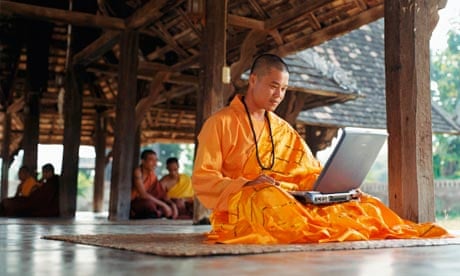
    One can follow the middle path of being an enlightened master without leaving everything. One can be an enlightened master without leaving family. I see future enlightened masters will be successful professionals. These future generation enlightened master would / may not even talk about high flying esoteric spirituality. They will do their work as any worldly person does. These masters will not leave everything for the Himalayas, they may not sell their Ferrari. I think that is what is the lesson of the Buddha – Middle path. I think that is why current generation enlightened master’s are bringing spirituality to masses and to the day to day life.

    As Osho said long back, many of the masters will be like the Zorba. Zorba the Buddha (Osho’s book) – “… Zobra is Love and Buddha is Awareness… when you are Zorba the Buddha, you have attained the greatest height that is possible in existence…”

    Image source of monk https://www.theguardian.com/technology/2011/apr/17/untangling-web-aleks-krotoski-religion

  • Socialism the right way

    Recently I wrote on why socialism fails? The article may sound a complete no-no to socialism. I believe any concept is inherently not flawed. The flaw is mostly in the execution – be it capitalism, socialism or any other “-ism. So, what can possibly be socialism the right way? I am sure many would know Venezuela going through hyperinflation and complete chaos – that is one gift that socialism may give you.

    In economics many of the rules are written in some assumption or concept like – “everything else being constant…” the concept will work like this or like that. For an example – demand curve or supply curve. These curves are belied by the prices in some cases such as – price of oil or price of diamond.

    Similar is the case of assumption in the underlying concept of socialism. The assumption is – no one will try to game the system. If I take the same example of Sarla or Kishore of the previous blog any Sarla or Kishore with average intelligence will stop working or will try to get a certificate that proves (s)he is the bottom 20% of Indian population to get the benefits of NYAY scheme announced by the Congress Party in its election manifesto.

    In India, Amitabh Bachchan got a certificate of being a farmer long back. So, it is not difficult for people to get a certificate to the race to the bottom. Though, off late Mr Bachchan has paid off loans of many farmers in UP. The way a farmer’s certificate was easy to obtain for Mr Bachchan it is easy to get a BPL certificate too. What the scheme Nyay is most likely trying to do is – make youth and many Indians lazy or to game the system. This is how Socialism fails.

    There is another example of similar scheme running in India – MGNREGA. I have heard of cases where there is immense corruption in this scheme. People are getting part of the allocated fund per person just for signing a document (rest goes to the chain of officials). Thus, the unskilled people for whom it was an employment guarantee, get money for free. If one wants to get the same work done by someone, the wages asked are higher. It results in increase in inflation.

    With schemes like MGNREGA or Nyay, does not the leaders of the political parties implying that they do not have any idea for – 1. how to create more jobs (run the economy) and 2. how to increase skill level of the citizens so that citizen can do something for themselves rather than depending on others. It looks like these politicians have not heard the idiom – “Teach a man to fish and you feed him for life”. By the way, MGNREGA was started by one of the most renowned economists of the world!

    If I recall 2009 farm loan waiver of Manmohan Government – again a Congress government – more socialistic in its letter and spirit that did not augur well to our economy. The impact of that according to Bank of America Merrill Lynch the farm loan waiver will cost 2% to the GDP of India by 2019. At times educated economists try to fix a problem at the wrong place. Possibly the Modi Government GDP numbers could have been 2% higher!

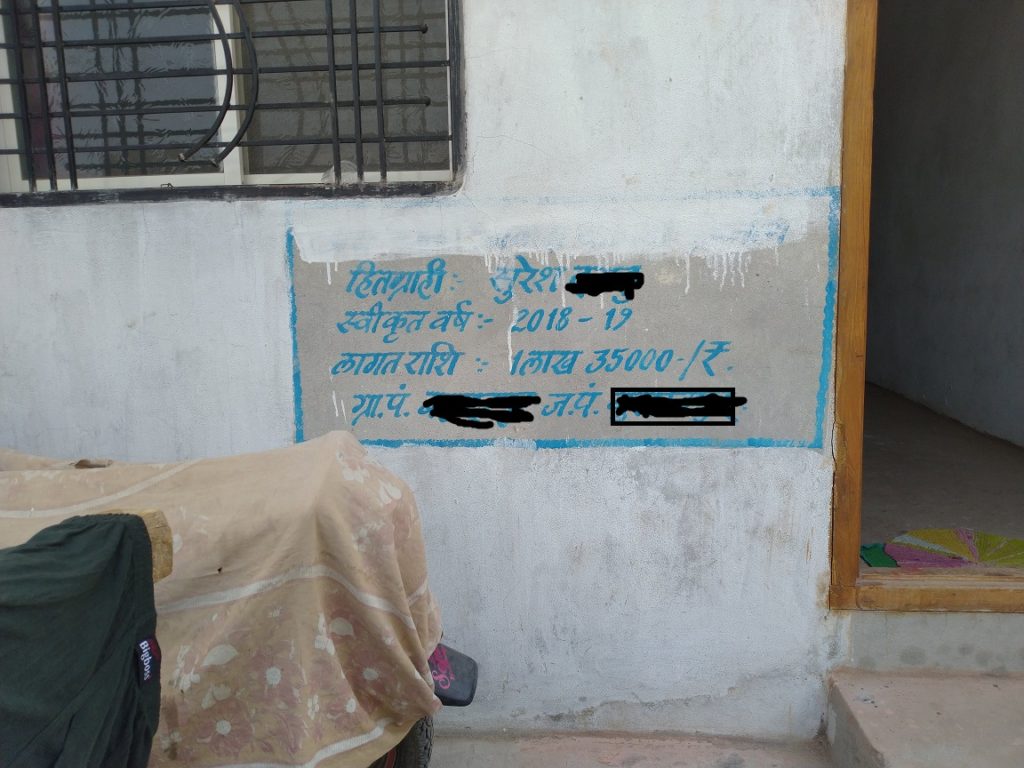
    No doubt the basic principles of the right to food, shelter, water, education, and healthcare is considered given in today’s capitalistic economies and countries – example Obama care in the USA or Ayushman Bharat Health Scheme in India. There is a universal education program running in India Education for all (Sarva Shiksha Abhiyan). When I started looking at quick implementations of government’s schemes such as Pradhan Mantri Awas Yojana I feel current Indian Prime Minister Narendra Modi is more socialistic than the Socialists / Marxists in India. In fact, recently I went to a village (about 500 KM from Mumbai), and I first hand saw – took some photos too shown here – the scheme being used by the villagers effectively.

    However, good the intentions to keep everyone at an equal level, humans do not seem to have found a way for equality. Possibly in the ant world, socialism is practically depicted to a better extent. Why USSR failed and communism of China is not worth appreciating, why Venezuela failed? Because there is no incentive to work or there is no ownership (common ownership) involved. Further, the move from capitalism to socialism follows communism as a midway stop. Communism gives power to the few, who – like any other human being – would not want to relinquish their power? The result – communism does not seem to end ever.

    Socialism (to some extent any -ism) can only work if we create a different scale for all of us – human beings. A different scale for success, survival, and growth. Many times greed and wish to control – people, things and systems – makes way and thus the Marx intermediary (read communism) from capitalism to socialism remains never-ending. Why can not we have a good execution, social good, and profit together? We can have it, provided we look at some new scale to measure ourselves.

    If any form of socialism needs to survive it has to be a middle path – a mix of different approach to economics, policy making and system. A system where we reward work, we provide essentials at appropriate cost or subsidy or for free and let people benefit from their work. At the same time, all the world political, social, economic and cultural systems must include teaching spiritual practices, trust and fairness – example is concepts of Jainism – Ahinsa (non-violence), Asteya (non stealing), Aparigraha (non-attachment) and concepts of Buddhism – meditation, interdependent co-arising. These concepts are essentially from different philosophy of Hinduism.

  • Trust, PNBFraud and Cryptocurrency


    It was a monthly routine of some of my friends of our engineering days that can explain one Professor Mankad’s statement – “Money is what is accepted as money”. Some of my friends, used to be penniless for last one week to ten days every month. Possibly it is a common phenomenon of current generation students. So for about last ten days these friends of ours used to borrow from us. A couple of times I gave, returns used to be few and far between. I and few other “venture capitalists” stopped lending these friends. In these trying times, the borrower friends came up with an idea – whenever the received a cheque (rarely demand draft) – from home it used to take three or more days to realize those – they used to borrow against it.

    Let me try to explain it with example, say Neerav got a cheque of INR 2500 from home, he will show that and borrow money (say INR 1000) from Yogesh and possibly INR 1500 from Pravin and another INR 1000 from Prateek. Now Neerav has borrowed INR 3500 against a cheque of 2500. All of the lenders used to be under an impression that within next five days or so we will get our money back as Neerav has got INR 2500. We used to accept that cheque as guarantee of timely return. “We” accepted cheque in “Neerav’s name” as a money. Thankfully none of the Neerav’s defaulted on our outstanding.

    We have been living in a very nicely woven cobweb of currency and economy for at least last two centuries. Currency and thus “money” is the biggest fraud happening around us. Be the gold standard (relatively better method of “value”) to fiat currency. What is money? The question Professor Mankad asked us in our MBA class about 8 years back is still very relevant and I have been revisiting it time and again. When he asked such question, we started answering coin, currency notes etc etc. His one line response was – “Money is what is accepted as money”. Yes that is true, money is what is accepted as money, as we used to accept cheque without known Neerav has kind of pleaded same cheque to 5 different lenders!

    Bitcoin logoEarlier, I wrote on trust as a foundation – Currency for the future. QUOTE from there Let us flip the coin and say “Trust” is the currency. What would happen? Those who have hoards of currency may be the most bankrupt people on the earth. Perhaps, a business of trading of trust would start (Bomday Trust Exchange or National Trust Exchange). Would the world be a different place then when currency would be mutual trust (well not necessarily Mutual such as DLF and Robert Vadra. UNQUOTE. This I wrote in 2012, at that time Cryptocurrency (example bitcoin) was not commonplace – well even I did not know about it. I had a different measure and calculation for the currency – money what is it?

    However, lesser than the intangible concept of Trust that I thought, we have a better believable system evolving these days – cryptocurrency. If we keep on seeing the meltdown of 2008, NPA frauds of India and many other such scams from the politicians and their accomplice etc. we will soon accept the bitcoin or other such more reliable systems for transactions. Crypto is putting pressure because administrations and regulatory authorities will lose control on the economy. With the control also they are not making any good; at least if we see India – a former FM and his son facing trial but our system is unable to conclude the trial or many scammers settling out of India.

    I am bit hopeful on blockchain, it is more reliable (difficult to fudge) and open as against the lenders like Punjab National Bank who can decide on their fancy on the money of other depositors. Blockchain is the way for not only currencies but for many other things including contracts and agreements. Hopefully then we will have a more balanced society and “trust” as digital money. Only fear is these “connected” bureaucrats, politicians and their page 3 friends, clique will first get their ill gotten money put in these digital currencies and probably try to make it murky too.

    Disclaimer – story of engineering days is authentic, names of my friends are changed, I didn’t have any batchmate in Engineering named Nirav.

  • Paris attacks – Solution please!


    PeaceHow would the Buddha look at the scenario of Paris attack? Or any other terrorist attack? I was wondering with the same sadness and anger as any other person. I twitted also regarding the Paris attack. However, there came an afterthought, what would the Buddha do? How would the Buddha react to such incidents? Well, I cannot think as the Buddha may think. So I started thinking on the basic lessons of the Buddha. There are four noble truths –

    1. There is suffering,
    2. There is a cause of suffering,
    3. There is an end to suffering, and
    4. Sufferings can end if one follows eight fold path

    Everyone agrees, there is a problem of terrorism (suffering). What I think is – The Buddha will approach the problem of terrorism by analyzing it – what is the cause of this suffering. No doubt if there is suffering we can safely assuming there could be an end to it. In this case I believe the Buddha would try to analyze the problem and suggest a solution (as he suggested eight fold path).

    So, I tried searching for possible reasons for Syria issue (I am not touching the terrorist activities of Taliban and Pakistan sponsored terrorist activities for this blog). There were various impacts I tried analyzing such as – why ISIS came into existence? A first level answer to it was Iraq war. Is it really an issue of 2003 Iraq war? Then I read this – You Can’t Understand ISIS If You Don’t Know the History of Wahhabism in Saudi Arabia so I started questioning on the very purpose of existence of ISIS? I started creating analogy of creation of Taliban (by USA) to fight former USSR and ISIS as one sub-section of Saudi Arabia. I may be completely wrong in the analogy however who gains if the ideology of ISIS gains more ground worldwide? Is it a problem of religious supremacy or political and power struggle? Perhaps it is both – I could not conclude on that with fair bit of confidence. I left the question aside for some time.

    The other side I heard of Syria crisis is power struggle of Shia and Sunni faith of Islam which is contesting of supremacy. Sunni Muslims of Saudi Vs Shia Muslims of Iran are fueling the fight in a third country Syria. So, it is getting more garbled within the religion itself.

    I moved to analyze the other thing – what is the impact of refugees fleeing to Europe? Does Europe need to show that much mercy to the fighting clans? Is Europe responsible for the mess and therefore it is moral responsibility of Europe to provide shelter to the refugees? Or it is economical requirement of Europe to have working hands for its economy? If these 500,000+ refugees are coming to Europe would it impact the religious balance of Europe? I think the growth rate of European Muslim population is already alarming. So, what is the impact? If the impact of this is intolerance and terrorist attack by fanatics, Europe may close the doors to refugees who knows?

    Many refugees are coming to save their lives and other for improved standard of living. The – currently unknown – leaders sitting in their offices / mansions are letting people die (whether a Christian, Jew, Hindu, Sikh or a Muslim) to have a last laugh. All these are “craving” in the opinion of the Buddha. Method for working on these craving can be same (eight fold path) however for each type of craving the approach may differ.

    The question is – would the leaders, refugees and the terrorists follow the path of the Buddha?

    1. Perfect Vision,
    2. Perfected Emotion,
    3. Right speech,
    4. Right action,
    5. Right livelihood,
    6. Right effort,
    7. Right mindfulness, and
    8. Right meditation

    If the answer is even a 1% “NO”, this is what an after thought could be –

    Related Terrorist meets The Buddha.

  • Left Vs Right economics


    [Tweet “The problem with economic analysis is – it is always dependent on me Vs you or internal vs external. Would we be able to see a view where the analysis is done on a single monolith?”]

    https://images.duckduckgo.com/iur/?f=1&image_host=http%3A%2F%2Fcarolynbaana.files.wordpress.com%2F2011%2F06%2Fbalance_scale.jpg&u=https://carolynbaana.files.wordpress.com/2011/06/balance_scale.jpgI was reading an article which states that leading economists are now tilting towards left centric economic practices. Just to give you a perspective – There was a time when governments tried to reduced its control on many fronts such as reduced taxes, regulations and privatization et al. This resulted in perceived Free-Market and growth. At times I wonder growth for what? And growth towards where?

    [Tweet “At times I wonder growth for what? And growth towards where?”]

    Flashback to 2005-2008 – When these activities went berserk we saw financial crisis one after the other, we can blame that some were more created than “systemic risk” as the “experts” call it. Recession of last decade was an example of the same. Until things were going great everyone was saying it works, suddenly something went wrong and everything crumbled. Alan Greenspan who was at the center of last decades recession stated this – “You know, that’s precisely the reason I was shocked, because I have been going for 40 years or more with very considerable evidence that it was working exceptionally well.” He further said – “I really didn’t get it until very late”.

    Fast forward to 2012 onwards – we are seeing economists are talking about left centric economic practices.

    The problem with economic analysis is – it is always dependent on me Vs you or internal vs external. Would we be able to see a view where the analysis is done on a single monolith?

    If we do the same mistake (of leaning too much towards the left) which was done in 80’s (leaning too much towards the right) when more laissez-faire capitalism was proposed, these activities of leaning far right to far left will end up being into a pendulum kind of moment. We would see more recession or other social challenges.

    My opinion of Economics is – learning about the sentiments, action and effects of individuals (micro-economics) and groups (macro-economics) to create theories. These theories will replicate how the world is likely to behave. In proposing some theories we state – “everything being equal”, “rest of the things being constant” etc. However as we move on the irrationality of human / group activities take place. These irrationalities will always be there when economic theories of complete left or complete right are applied. The irrationalities will be more troublesome (as the case we saw in last few decades) if one sided approach of economics are utilized. The irrationalities can be reduced (managed) by approaching the economics in more centralist way – The middle path.

    Should there be a way to reduce the causes of irrationality?

    What I wrote earlier here [blog – cause…]- The macro problems I wrote above, can be solved when we start solving micro problems, it is collective wisdom which would play a major role when we are individually wise.
    Image source – http://carolynbaana.com/2012/05/01/defining-balance/ searched via http://duckduckgo.com

  • Interdependent co-arising in Ecosystem


    As I have been writing a lot about interdependent co-arising, I came across this video and thought to share it without delay on my blog.

    If you can understand this video you can understand the concept of Buddhism on interdependent co-arising. Please watch this small <5 min video a wonderful experiment. According to the description of the video – When wolves were reintroduced to Yellowstone National Park in the United States after being absent nearly 70 years, the most remarkable “trophic cascade” occurred. What is a trophic cascade and how exactly do wolves change rivers?

    “When we try to pick out anything by itself, we find it hitched to everything else in the Universe.” – John Muir

    An interesting way to explain interdependence. Hope we learn this sooner rather than later that ecology has to be balanced, political, social and religious ideas should also be balanced because perhaps nothing is perfect! I think therefore Mahavir used the concept of Syadvada (doctorine of postulation) and the Buddha middle path.

    Source – Youtube channel Sustainable Human http://www.youtube.com/channel/UCYv_csqWJTSfQK3vOZDJKQw

  • Moral markets!


    Do markets have morals? When I read Mr Rajeev Mantri’s article “The morality of markets” (Link) in the Livemint, I asked this simple question to myself.

    Various things came to my mind – i. financial meltdown(s) there are numerous examples of past; namesake recent one in 2008 ii. real estate bubble (again namesake – Mumbai, I have read of similar bubble in China) iii. stock market speculations (working on scrips – I think in India markets traders call it scrip चलाना) iv. crony capitalism*. All these thought made me think the title of the article itself is an oxymoron.

    I am not against free market economy, I am neither a leftist or socialist. When it comes to economics (and politics) I prefer to take the middle path. Just to give you a perspective on why I am not completely agreeing to the point of view of Mr Mantri, watch the following video (reference – my Oct 2013 blog – The Price of Inequality) –

    [youtube=http://www.youtube.com/watch?v=QPKKQnijnsM]

    Capitalism has its own’s problems, and morality is questioned more often in those economies – be it environmental damages, besides few points I raised above. I believe we should not assume development that happened in the US/Europe as the only way to grow and to prosperity. In fact, we have written records of prosperous India even before anyone knew of USA. We have history of Utopia – Ram rajya. How was it achieved? Do not you think we should try to study that as well? There are more ways than the Left and Right approach we take.

    Coming back to the article of Mr Mantri – he concludes with India having billions of dreams. I do not doubt but here my difference with our own culture comes as a stumbling block. I do not appreciate the Caste divide and therefore disagree with Mr Mantri there – there seems not to be many diverse dreams. For ages we stifled dreams by asking kids to follow a craft or business of his family caste system of old days. These things are bringing me to some circular logic – where I suggest to study old Indian economics and refute social Caste system. What is circular logic? Listen to this song you would understand – (apologies those who dont understand Hindi, it is in Hindi) –

    [youtube=https://www.youtube.com/watch?v=mchDikR-AAw]

    paisa kamane ke liye fir paisa chahiye.

    Paisa kamane ke liye fir paisa chahiye – Golmaal hai bhai sab golmaal hai…

    An English translation of this song in some future blog.

    Note – * Crony Capitalism – “Gas wars” a recent book in controversies is in my reading list.

  • Why wait?


    Last week I wrote on being at a crossroad. Generally, we are all making some or the other decision. I specially like entrepreneurs who need to be constantly analyzing situations their business and survival + growth. Life becomes very interesting, challenging and driven by passion. One has to balance between Guts, Analysis and if possible one can work on instinct with the help of awareness. Follow my one tweet recently.

    I am no expert, yet feel there has to be a balance in life. Balance between extremes. Whether its about love or hate, passion or dispassion, emotions and logic or Socialism and Capitalism. The balance (which we professionals) generally is restricted to something such as Work-Life balance. Balance goes beyond that limited definition. Yet for the time being assume balance as work-life balance. I want share a news few months back.

    Founder of Hexaware, Mr Atul Nishar sold off his stakes in the company and the news was that he wanted to go for a 10 day Vipassana meditation. Read the news here – After selling Hexaware, Atul Nishar longs for ‘nothingness’. I am no one to comment on a very successful businessmen yet in the news one point made me think.

    QUOTE – “I have been constantly working for more than last 30 years and never took a break. This is a great opportunity for me to take a pause and feel nothingness,” says Nishar… UNQUOTE

    I was thinking that there are two options – 1. learn from this statement and start bringing balance in life now or 2. struggle tirelessly and – may be and may be – one day we’d be next Mr Nishar to experience “Nothingness”. Question is, why wait? concurrently why go on any extreme? Grow as businessman/professional and spiritually together?

    Related blogs – “Balance”

    The Middle path, Balancing Act, Irony, Dichotomy on happiness…