Tag: Learning

  • Education, religion and spirituality

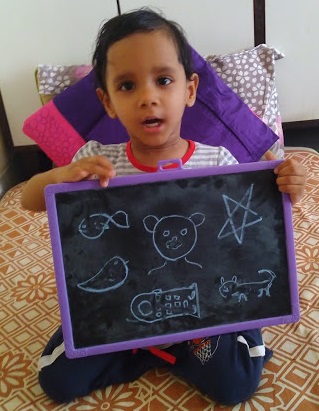
    Adviti showing sketch

    Adviti is attending school now, this started off with thoughts on education, religion, and spirituality. She is three years and we opted for online schooling finally. We avoided it initially, but the Chinese virus (Covid-19) gave us no option of formal school for her. It has been only two weeks. This time around the questions were more than just why do we educate kids? and also the race we start with our kid’s schooling.

    During our primary education, we read this story in our syllabus. This is apt for our life in general and I take a parallel from this story in religion and spirituality as well. Let me first narrate the story to you.

    Hunter and the parrots

    A jungle was famous for its species of parrots. One day a hunter crossed by this jungle. He was mighty impressed with these different types and colors of parrots. The hunter put his net and no wonder he could catch a lot of parrots. He sold those in the market and made a lot of money. He started visiting this jungle often.

    Brighter-day

    A sage lived in this jungle too. He observed that the number of parrots was drastically reducing. Sage being sage, compassionate, and friendly to every animal of the jungle, started teaching these parrots.

    The sage taught these parrots –

    The hunter comes, spreads his net,
    puts some grains, we should avoid this trap

    The exact words we learnt in the Hindi version was 

    शिकारी आता है. जाल फैलता है.
    दाना डालता है. हमें जाल में नहीं फ़सना चाहिए।

    The parrots learned it quickly. They started singing it all the time. When the hunter came he was taken aback. He was fearful now he won’t get these parrots. With a heavy heart, he put his net again. To his surprise, all the parrots were in the net and singing the same song

    The hunter comes, spreads his net,
    puts some grains, we should avoid this trap

    With immense pleasure, he took his prized possession. This time he had value-added parrots – parrots who spoke language!

    When the hunter crossed sage’s hut, sage was smiling. He saw all the parrots singing the song inside the trap that they had to avoid.

    The moral of the story

    We must learn instead of rote memorization. we must learn instead so that conceptual learning can be applied in many walks of life.

    Additionally, there are chances that someone says one thing but does another. We must learn two things – first, we must walk the talk, and second, identify people who do not walk the talk and be cautious.

    Education

    When Adiviti sits for her school sessions, I sit with her. Initially, I was frustrated (at times now too) with her slow response. She knows the things but does not respond, at times she does not understand – because she predominantly understands Marathi and Hindi and not English. She does not follow instructions.

    We learn a lot of very basic and important things in our schools. How much do we apply in our life? Be it learning instead of rote method or the basics – do not steal, do not tell lie, etc.

    Religion

    Another thought triggered in my mind. We learn almost all the ten commandments of Abrahamic religions in School, isn’t it? Most of the religion teach such basic things in our life. If this is the only lesson of religion our school or syllabus of school education is no less than a religious book. In fact, in this case, the schools and education are much more than many of the religions of the world.

    Though I know I have made this comparison on a very high level. In whatever case, what more the religions teach? Follow what is taught, in some cases do not use your brain. Do not question the authority, isn’t it?

    Religions that do not allow questioning is far lesser than school education. At least school education allows asking questions!

    I am a born Hindu (a Lingayat), I have questioned almost everyone and everything religious since childhood. When I was unconvinced I stopped going to temples. When I started understanding few things about Hinduism and started reading few scriptures, I realized many scriptures are dialogs. On the battlefield, Arjun asked questions, Janaka asked questions to Ashtavakra, and Vashisth and Rama discussed multiple things. When someone wrote Upnishad no one asked to believe those by force.

    The Buddha or Mahavir (and other Tirthankaras of Jainism) also gave the point of view without forcing others to accept those as gospel truth.

    Spirituality

    I have written on religion vs spirituality earlier. In that blog, I had given an analogy between religion and spirituality to sex and love. Since now I am looking at education, I created another analogy between education and learning to religion and spirituality. You can learn without formal education. I have heard of a past CM of Maharashtra – Vasant Dada Patil He was educated to only 4th grade. However, he was the harbinger of the robust canal and irrigation system of Maharashtra.

    If we look at multiple definitions of spirituality what best comes to my mind is – “search for meaning in life”. I can connect to the Indic religion (Buddhism, Jainism, and Hinduism) to a large extent. Spirituality is beyond any geography, religious rituals, and believing in a single book alone. Spirituality includes every living being – I can write more on that however that is for some other day.

    In fact, if I take the freedom to extrapolate the story, the hunter (शिकारी) is our false sense of self, net (जाल) greed, lust, ego etc and the grains – bait – (दाना) is our false sense of satisfaction or pleasure. We should not get in the net (जाल), here WE is the SELF.

    Education, religion, and spirituality

    What I have observed is that education and religion are like parrots in the cage. They know what they are saying but they do not understand the meaning of what they are saying. It is with many people and religions worldwide. In fact just because of that either we see terrorism or atheism in the world. People have either lost trust in religion or they are so faithful that they see killing those who do not comply with the point of view of the killer.

    At the same time, learning and spirituality are conceptualizing, synthesizing, and questioning, and exploring. Learning involves a sense of experience similar to spirituality. Look at religion you would get a lot of people who can reiterate books word by word without knowing and experiencing. This is what differentiates religion and spirituality.

    I saw a tweet from Elon Musk once – “I hate when people confuse education with intelligence, you can have a bachelor’s degree and still be an idiot.”
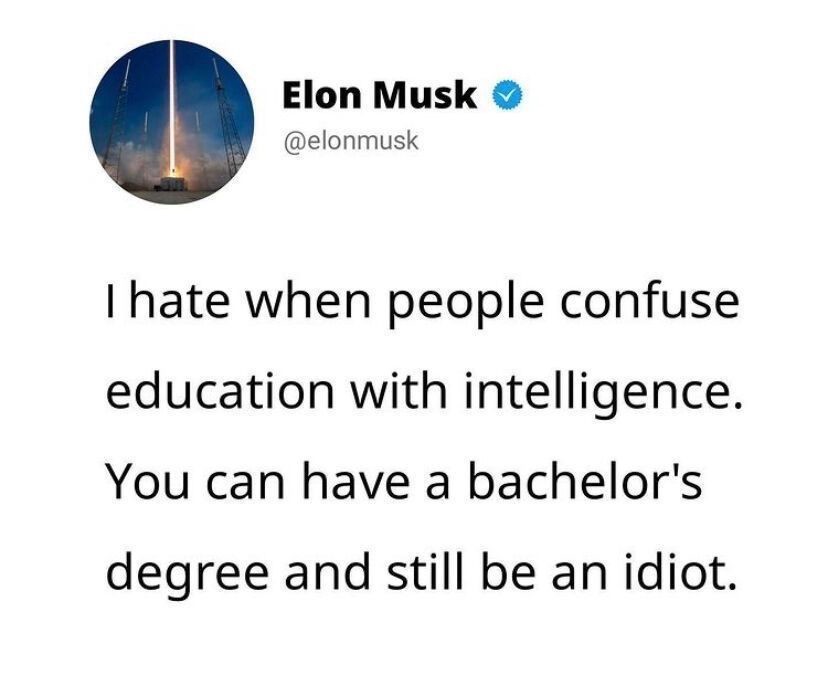
    Education, intelligence Elon Musk tweet

    The corollary, in this case, is – one can be known for religion and religious knowledge without actually being a spiritual master. Whereas Spiritual masters many times are against the dogmas and are more practical and clear about what they say, do, and mean.

    Adviti’s schooling is a learning experience for me. I have to get off the showjumping thing we have observed. I have to let her learn at her own pace. What matters is how intelligent she becomes with the education not how much she scores in school. What is more important is she becomes a virtuous person who walks the talk – not like the parrots who are in the cage reiterating the lesson –

    The hunter comes, spreads his net,
    puts some grains, we should avoid this trap

    The exact words we learnt in the Hindi version was 

    शिकारी आता है. जाल फैलता है.
    दाना डालता है. हमें जाल में नहीं फ़सना चाहिए।

  • Half knowledge

    We learn things slowly. Slow learning is ok, however continuous learning is important otherwise the knowledge becomes half knowledge. The baby steps we take make us learn, yet at the same time, if we stick to the only what is written in the book without using our brain, we may get constricted and end up knowing only what we read – result – half knowledge. It is detrimental.

    Half knowledge is lie goat eating a piece of paper
    Source Flickr

    Half knowledge is equivalent to goat eating a piece of paper that had information. Goat would digest the paper but not the knowledge on that paper. I will share some examples.

    H for Hen ‘and much more’

    My daughter – Adviti – is learning alphabets – both Hindi and English. She has difficulty in saying ‘R’ and few other Hindi alphabets so she mixes up few things. In alphabets, she says E for Hathi. Because she knows the photo and she knows the name of the animal in Hindi. She used to say H for Tap tap (for horse). She found pronouncing Horse difficult so she said tap tap because horse runs with that kind of sound. We found it funny, but we wanted to correct it. Now we teach her H for Hen. Once we were teaching her and for something I said Hand. She got confused H for Hand or H for Hen! This is a learning process, we slowly understand that H for Hen was just for us to learn the alphabet H. H has many more alphabets be it a noun or otherwise. Imagine Adviti restricting herself to H for Hen alone! She will miss a multitude of things in life (more than 33000 words starting with H included). Half knowledge can restrict one’s horizons.

    Knowing book by page number is not knowledge

    The second incident is about half-knowledge but knowing some stuff to the T. I loved Chemistry subject, in standard 12, and especially a textbook ‘Comprehensive Chemistry’ the most. My special liking was Organic chemistry. I read the book multiple times such that I remembered the page number, the image of the page, and the content of the pages. Even after a year, when someone asked me a question, I responded – open Comprehensive Chemistry, go to page 236, it is on the left side of the book, in the center, there is a picture just below the picture read 2nd para (say the last para) you will get the concept. The answer to your question is – “XYZ”. Do not search for the book and pages now – I am talking about 1998, many things might have changed by now in the textbook :).

    Knowing such details of the book (One book precisely) did not make me an expert in Chemistry for sure. Because all that was mostly bookish knowledge with few experiments in Chemistry lab of School. At best, I had a photographic memory – not expertise in Chemistry, isn’t it? Even a Ph.D. may not say (s)he knows the fundamental subject line Chemistry / Physics completely.

    Hathiphant

    The other incident happened with my cousin brother and my eldest sister. They were talking about the education system of India. My cousin brother said there are downsides to teaching kids a medium (language) that is not the mother tongue. He recalled a neighbor who used to call an elephant – ‘Hathiphant’. This coined word is a mix of two words; Hathi a Hindi word for Elephant and part of Elephant – Phant. Merge these words and you will get Hathiphant. This confused toddler learned both words at home and in confusion made the Elephant a Hathiphant. Half knowledge can make one jumble multiple things and make a conclusion that may be incorrect.

    This has happened to me too when I was a student. We learned something and later that something became another thing (Hathi to Elephant). Let me tell you how can q kid get confused. I learned – I live in Dhar (a small city in India). Later, I learned- I live in Madhya Pradesh, lastly, I learned- I live in India. How is that possible? A 6-year-old cannot understand why and how can one person be in three different places? Later it was clear what living in three docent paves meant?. In 3rd we had nine planets, later Pluto was removed from the list, funny isn’t it?

    Half-knowledge

    Well, no it is not funny. We keep on learning. If we stop learning and improving our knowledge becomes half knowledge. This half-knowledge is harmful. Our learning makes us understand that our knowledge is limited and we are consistently adding to our body of knowledge. Alas! Some people, knowing one book, feel as if they’ve known everything. Reciting few books by page number and chapter plus paragraph didn’t make us intelligent or omniscient.

    I had a photographic memory of the Chemistry book, but I wasn’t fully aware of the field of Chemistry, isn’t it? Well, but why am I talking about it here? This applies to spirituality too, have you heard people reciting verses from books? Do they have the knowledge, mostly no? They at best have a photographic memory to vomit words from a reference book. Knowledge and experience on the spiritual path are pristine, once you hear those enlightened masters you quickly get connected. I have met a few of such masters in person, I have that first-hand experience of witnessing the presence.

    Similarly, in businesses too, not all business grads become successful managers or entrepreneurs. Becoming a successful business person requires more than the degree, knowledge, isn’t it?

    The point is, be it the path of spirituality or business, or a toddler learning language, we keep on learning and experiencing new things. Every experience is unique and thus, if we assume that photographic memory of any certain book is the knowing everything; it is – in effect – detrimental to not just one person but everyone around. On the path of spirituality and religion it a disaster for sure.

    Every situation demands a unique set of tools. I think that is why Krishna was needed on Pandavas’s side during the Mahabharat war. Yudhisthir – and all Pandava brothers were – (was) predictable. They went by the book, defeating Pandava’s won’t have been tough for Kaurava’s because they knew Pandava’s would go by the books all the time, besides having a bigger army. That is where unpredictability and Krishna’s intelligence came in handy. Experience of bending the rules could play in the hands of those who understand the situation and learn from experience. Those who learn from and are ready to learn from the experiences do not have half the knowledge. Be ready for learning, implementing, experiencing, and continuing it lifelong.

    Image source – Flickr

  • A conversation


    My friend called me and said I want to talk to you. I said go ahead we can speak. He asked for specific time as his conversation was likely to be a longer one. So, we decided to speak after office hours on a Friday evening.

    He called me and said – “You know what? I always took your opinions constructively and learnt from it. Whenever you spoke with me and at times when you badgered me for my naivety or mistakes it was learning. Now when I recently had a very bad such opinion from someone, I felt like getting buried in sand.”

    I was surprised. I am bit harsh some times, however I never knew that I am pursued like this by someone. Yes, intentions were most of the times for helping the person. So, I asked for more details of the recent incident. He obliged and gave me a detailed account of what has just happened with him.

    My friend was visibly upset. I knew he was kind enough not to give as good as he had got. Possibly he was not upto it, or he was not in such position. I sensed he was unhappy and this recent incident was depressing. So, I shared the following story with him –

    ———————

    Happiness

    Traveller; “What kind of weather are we going to have today?”
    Shepherd: “The kind of weather I like.”
    “How do you know it will be the kind of weather you like?”
    “Having found out, sir, that I cannot always get what I like, I have learnt always to like what I get. So I am quite sure we will have the kind of weather I like.”

    Happiness and unhappiness are in the way we meet events, not in the nature of those events themselves.

    ————————

    We concluded the call, I said lets try to look at brighter side you learnt something. So, he himself concluded few points. One point was – next time if something goes beyond the agenda of discussion, I would bring it on agenda or I will stop digression. This is a common problem with many of us today. The digression was the culprit for my friend predicament. Not just digression but also little attention span. Well, I have to learn a lot before becoming such a coach to someone. My friend was kind enough to think I can be of any assistance.

    Story sourcePrayer of the frog book by Fr Antony DeMello, the book is available in two volumes Volume 1 and Volume 2.

  • Why not define smaller things?


    Last month I met Prof Mankad. I always think whenever I meet him I should record our conversation. He is indeed a library of knowledge in himself. We discussed about our education system besides many other things (blogs written last weeks) Purpose of education and Showjumping. Dr Mankad told me – “one of the real problems with our daily life is our weird definitions e.g. success. We define success as owning that BMW. Until we get that BMW we don’t feel content. Thus, we avoid being satisfied, we do not live a fulfilling life. Though as an individual we can, but the weird definition makes us estranged from many small things.”

    Vada Pav
    Vada Pav

    He further shared an experience. One of his friends landed in India from the US (at about 12:00 AM or 2:00 AM). Next day 6:00 AM he was at Prof Mankad’s home, and asked to just accompany him. They drew to Karjat had some special Vadapav of that place and drove back to Mumbai.

    Well, all this made me question few very basic things we generally overlook. We do not think much about basics of life, but still have some preconceived notion about those things. As Dr Mankad shared example of success, another example is beauty. I watched this video in my MBA Marketing class. Our definition of beauty is weird watch this <2 min ad of Dove, to understand how our perceptions are defined; at times created. Many girls want to be fair, those who have curly hair want straight and vice versa!

    How often have we thought on these seemingly simple, stupid, strange yet serious questions. What is the meaning of Success (for me or you)? Does our definition of success change over time? what is the purpose of life? Why are we studying (at least when in college)? How will I/you know when I/you reach the target (a 100,000 INR or 10,00,00,000 INR), the goal is always a moving one! What is the benchmark? I think we need to just pause at times, and think how we want to shape our life, what is important for ourselves at least that instance, isn’t it? I think that is what enlightened masters call “living in present”

    Related – 1. Why are you doing what are you doing? 2. What more you need? 3. Entanglement of a langot 4. Race – never ending

    Race – never ending
    Why are you doing what are you doing?
    Why are you doing what are you doing?

  • Why do we educate our kids?


    Rat raceWhen I visited my sister last time, I asked her this question – What is the purpose of education? She is a teacher, she was the best person to ask this question.

    I felt pity on my nieces, so I asked this question. My nieces (one just 4.5 years other 10 years) go to school even in April! I went there to spend some time with them and they went to schools! This is their age to try new things – painting, playing different sports, learning some music. Let them find what they enjoy doing rather than forcing them to sit in the classroom in the summers.

    My sister’s answer reminded me of Prof Mankad’s Macroeconomics class of my MBA. His exams used to be unique (not disclosing it though). His reasoning for such unique exam was- Information is accessible now a days; I want you to think, I want you to cultivate abilities to connect the dots of various subject matters you come across and develop ability to make decisions, opinion and inferences. These theories should not be crammed. You can make these graphs / search them any day / any time while you work. Practice of using these theories in making your opinions etc is what I want you to develop.

    Surprisingly, many Google search terms “Exam paper of Professor Mankad” and “Exam paper of Prof Boman Moradian” have ended up on my blog post. Here I never wrote about what they ask in their exams. I feel strange some students search such things also!

    So my sister – who teaches Science – answered – “I want students to see things for themselves, to experimeReady to Racent; science is something which will help them develop analytical skills”. My sister and Prof Mankas’s answers were not what I see the approach of marketing any school – B-School to Medical School to the Public school for K-12 levels. Our B-Schools & Tech-Schools talk about post education Salaries as benchmark for success! In fact, IVY league guys went to jails because of bigger crimes e.g. insider trading; and if not in jails they caused more troubles to an average human being than a pickpocket who also goes to jail for small crimes for troubling one average human being at a time.
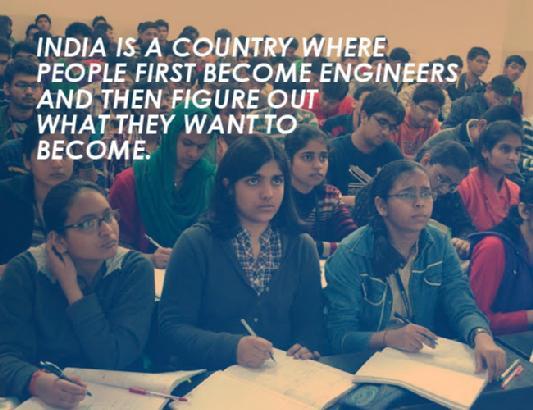
    Why should we educate kids? Don’t you think that the purpose of education be set first. At least we have been doing this for executing businesses well. At least ask the kid what he/she wants to do – after a certain age – instead of making everyone an Engineers or Doctor?

    Related blogs – Showjumping, Race – never ending, Entanglement of an undergarment, Neeraj in Kabir’s style

    Image source – Alka Arya’s article http://hillpost.in/2012/04/revised-rate-race/44257/

    Here is what I found on LinkedIn – Engineers in India

  • Change is the only constant!


    Long back, I was thinking about the common wealth games (CWG), the news around that and what can I learn from that. I generally don’t want to comment on politics; nevertheless I learnt from these events and therefore I am trying to put my opinion on the same.

    When the news of corruption in CWG preparation started surfacing the Prime minister’s office (PMO) took control of the situation. The following events taught me few lessons such as be patient and do what makes most sense.

    The decision of the PMO was to tackle the core issue at a later stage, and therefore the management of CWG was not changed immediately. Delaying the decision is the best way of tackling certain situations. Therefore the business was moved from incapable hands to those hands which could complete the project on war footing basis. This transition was smooth and the event was successful. This was the best example of change of management, in recent past, in a dire situation.

    I was talking to my friend Romit Gupta and he suddenly made a statement – “Change cannot be given to you every time. You have to bring your own change”. This statement made perfect sense to me. Yes! If you need change, YOU have to be the catalyst for the same. In business either you change the rules of the game or the competitor changes it, better you change it before anyone does.

    The statement was made by a BEST bus conductor in a bus in which Romit was travelling long time back. Romit heard it passively yet he could not forget. He restated the same verbatim almost 6 years later. Why, because if someone is willing to learn he/she can learn from anywhere and anytime. My learning from this blog has been multi-fold – I am seeing dots being connected and changes being made. The dots are my earlier post on – ‘game changers’ and ‘Learning… and possibility thinking’. I took these cues and have decided to change the design of my blog. You see! Change is the only constant.

  • Learning… and possibility thinking


    Today, after a long time I was watching Television, the channel was Fox History and program – building the ultimate: roller coaster. This program was a story of development of roller coasters, a very good and informative program. What struck to me was one development which was taken from the world war II German defense system. This system was a breakthrough in material for the wheel of the coaster. I started wondering, how these roller coaster designers took one thing (about 20 years old) from one place to different place and with some success. My take from this is – we can learn from anywhere; only basic need is willingness to learn and being open to possibilities. I heard some author earlier used a term – ‘possibility thinking’. This concept has been reinforced often to me. I have worked on TRIZ– the theory of inventive problem solving – and have worked on application of TRIZ (a very engineering based problem solving method) to social sector innovation and medical science etc. The concept of TRIZ is similar and very structured.

    Half full, half empty, possibility thinking, optimism, pessimism
    Possibility thinking
    Let me give one analogy – a glass is half-full. An optimist says – the glass is half full, a pessimist says – the glass is half empty and the possibility thinker says there is room for more water in the glass. Going one step further – what if the glass is not there? Some would say – Glass IS (many possibilities). In my opinion this is possibility thinking; when you say Glass IS, you open opportunities to think more and more about what can be? The challenge is to switch back and forth from structured to more creative thinking.

    Coming back to the point of learning, the idea I want to reinforce is – we can learn from anywhere; only basic need is willingness to learn and being open to possibilities. The idea of this blog – Business to the Buddha was similar concept.

    References –
    1. Fox history schedule – http://www.foxhistory.com/Schedule/Daily.aspx
    2. Glass half full – http://www.zazzle.com/glass_half_full_23_poster-228602679415734701