Tag: Inequality

  • Inclusive growth, How?


    There is income inequality. Agree? If no check this – IMF Publication

    …increasing the income share of the poor and the middle class actually increases growth while a rising income share of the top 20 percent results in lower growth—that is, when the rich get richer, benefits do not trickle down…

    If businesses want to earn good profits in long term; businesses need to improve purchasing power of poor. Why? When people will have enough money to buy products/services, then only profits will increase at a better rate. Isn’t it? The simple explanation to this is – once poorer population gets resources (buying power) market size for companies increase multiple times. The increase would not be for one company but for every company in the market. One example of that could be involvement in CSR activity wherein poor can get good basic facilities and opportunities to earn. Once the poor can earn, they can spend too! Of course a caution here is – CSR is not charity, it should not become charity where it may lose its meaning.

    If this logic is clear – shouldn’t business be investing in making people prosperous? Once we do this we would solve a big problem – poverty. Hopefully, we will be able to not only grow the businesses but also grow every strata of society. Isn’t it? This is interdependent co-arising.

    Let me share a store, a very old & cliche, but I think that can drive home the point.
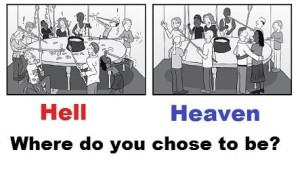
    Heaven HellLong ago a person wanted to see how heaven and hell were. An angle obliged and granted the wish. Person was blindfold and was sent to hell first.

    When the blindfold was removed, person was standing at the entrance to a great dining hall, full of round tables piled high with delicious foods of all kinds.

    The person noticed that, people seated around those round tables but their bodies were thin, and faces gaunt and creased with frustration. Each person sitting on dinning table held a spoon though their arms had no elbows and the spoons were four feet long. These people could reach the food on those platters, but could not get the food back to their mouths.

    Next the person was sent to the heaven. In the heaven the entrance to the dining hall was big, it too had round tables with piles of lavish feast as hell had. Here too people did not have elbows in arms and they were holding long spoons about same length as the hell. The person noticed that the people in heaven were plump and happy, the dinning hall was full of joy and laughter. Situation in both – Heaven and Hell were similar, however there was difference in the milieu, the reason?

    The difference between heaven and hell was – the people in heaven were using those long spoons to feed others so effectively everyone was full, plump & happy.

    Source of the story is AnomalyBeta and LinkedIn

    So, if we take the concept of interdependent co-arising as the core of growth, capitalism or communism or any economic structure we follow we will surely have inclusive growth. The catch here will be – value of money will decline, and exclusivity (as marketing or demand / supply concepts of economics) will play in different fashion. In whatever case at least the basic necessities hopefully be fulfilled.

    Other blogs on inequality – The Price of InequalityNot so trickling down!, Economics concepts and equality and Has the time for this idea come? and Inclusive growth

  • Not so trickling down!


    How would you define prosperity of a society?

    imf_sealThis is a question many have been asking for so many years. The answers to this question lies in not finding the average income of the society – the metric used globally is – income per capita. This very simplified measure is like saying – what Professor Moradian told us in class of operations management – putting one hand in boiling water (100 degrees) and other in freezing water (0 degrees) and saying I am at an average of 50 degrees and kinda ok! We see a widespread income inequality across the globe.

    The definition of prosperous society should be defined by meeting basic needs of the people of the country. Communication and Internet is one thing which has become a part of basic necessities now a days. Human development index the other measure. For a couple of years when I am writing about business and its relation with spirituality (my interest being the Eastern philosophies – teachings of the Buddha and Hinduism) I see a measure is contentment as well is a measure – What more you need?

    I was reading a recent news – Trickle down economics is wrong, says IMF of IMF research. This seems to be an interesting conclusion. We have been running behind capitalism during 1980’s now we are running on the other side in 2010’s. The research says – Trickle down economics reduces the GDP.

    What is Trickle down economy? Ronald Regan – President of US of A – coined this economics by providing special benefits to rich. The assumption of this theory is – if rich are provided tax benefits (reduced taxes) they would eventually invest in economy and growth will occur. In last 3 decades we have seen the impact of that economy.

    According to the said IMF report –

    A 1% increase in the income share of the bottom quintile results in a 0.38% increase in GDP. Meanwhile, a 1% increase in the income share of the top 20% results in a 0.08% decrease in GDP growth.

    There are a couple of take-aways –

    • Trickle down does not work, it does not mean tilt towards the socialist approach.
    • There has to be a balanced approach – as stated earlier – the Middle path
    • And yes – how would you measure prosperity? Well, by checking how content is each individual. That comes from within not outside. Remember the measure of contentment should not be like putting one hand in freezing water and other in boiling.

    Research document link – https://www.imf.org/external/pubs/ft/sdn/2015/sdn1513.pdf

  • Reservations! No, it’s about Inequality


    One of my friends commented on Facebook as priority #1 for New Govt of India – Abolish Reservation! Here are my 2 cents on reservation (e.g. reservation in Govt jobs, education et al) and how it should change.

    Indian reservations system is grossly misused, people assume it to be “entitlement”. An entitlement for even those whose parents have become somebody e.g. IAS from nobody.

    Reservation system was brought in to reduce inequality. This inequality at olden days was among caste based divided Indian citizen. In last so many years division is somewhat reduced however now the divide is evident among those oppressed communities as well for whom primarily the system was created.  The system needs to be rationalized. Just to give you an example – Devyani Khobragade is from reserved category. She became an IFS with the same reservation system – why was she given reservation when her father was also an IAS officer? The purpose of reservation was to uplift lives of the oppressed, now few of the oppressed have become oppressors as well! Any class 1 officers son or daughter shouldn’t be considered for reservation.

    Two different stories where I dont deny reservation –

    Budia Damor was my classmate in 11th – of course he was from reserved category – he did not have books. He was from a village named “Gram Aali” on Mandav road near Dhar. A village with population of about 300 (in 1995), yes in India there are villages as small as that. He was committed and he needed help. Besides Govt scholarship and reservation – I thought what best I could do was to give him some of my books, I did it. There are many such people. They need helping hand.
    I also remember Shaku Bai – our maid. Very committed, hardworking and responsible person. She had 5 kids, 2 or 3 of her kids were studying in a govt school in some tribal area, living in Govt hostel. The biggest asset for her in that hostel was – at least the kids are not starving! Yes this is the situation in many parts of India.

    building bridgesShe lived in a hut (what you just can imagine in photos, drawing only). She was expecting her 6th child- my mother helped her a lot. After delivery 2nd day she was at home to do work, baby with her with only few cloths my mom gave her. My Mom, didnt allow her to do anything, gave cloths for the baby and gave her gyan on family planning et al. I must say she was very committed, hardworking and responsible, may be I don’t have more words for her appreciation. We need to help them. Not Devyani Khobragade for becoming an IFS on the entitlement of Shaku Bai or Budia Damor.

    I see reservation for bridging gap of inequality – so if a Brahmin boy is very poor a chance for his upliftment should also be considered. Keywords are – upliftment and bridging the gap of inequality – Not scoring political brownie point.

    Though when I’m writing Brahmin I personally have serious objections with Indian caste system.

  • Moral markets!


    Do markets have morals? When I read Mr Rajeev Mantri’s article “The morality of markets” (Link) in the Livemint, I asked this simple question to myself.

    Various things came to my mind – i. financial meltdown(s) there are numerous examples of past; namesake recent one in 2008 ii. real estate bubble (again namesake – Mumbai, I have read of similar bubble in China) iii. stock market speculations (working on scrips – I think in India markets traders call it scrip चलाना) iv. crony capitalism*. All these thought made me think the title of the article itself is an oxymoron.

    I am not against free market economy, I am neither a leftist or socialist. When it comes to economics (and politics) I prefer to take the middle path. Just to give you a perspective on why I am not completely agreeing to the point of view of Mr Mantri, watch the following video (reference – my Oct 2013 blog – The Price of Inequality) –

    [youtube=http://www.youtube.com/watch?v=QPKKQnijnsM]

    Capitalism has its own’s problems, and morality is questioned more often in those economies – be it environmental damages, besides few points I raised above. I believe we should not assume development that happened in the US/Europe as the only way to grow and to prosperity. In fact, we have written records of prosperous India even before anyone knew of USA. We have history of Utopia – Ram rajya. How was it achieved? Do not you think we should try to study that as well? There are more ways than the Left and Right approach we take.

    Coming back to the article of Mr Mantri – he concludes with India having billions of dreams. I do not doubt but here my difference with our own culture comes as a stumbling block. I do not appreciate the Caste divide and therefore disagree with Mr Mantri there – there seems not to be many diverse dreams. For ages we stifled dreams by asking kids to follow a craft or business of his family caste system of old days. These things are bringing me to some circular logic – where I suggest to study old Indian economics and refute social Caste system. What is circular logic? Listen to this song you would understand – (apologies those who dont understand Hindi, it is in Hindi) –

    [youtube=https://www.youtube.com/watch?v=mchDikR-AAw]

    paisa kamane ke liye fir paisa chahiye.

    Paisa kamane ke liye fir paisa chahiye – Golmaal hai bhai sab golmaal hai…

    An English translation of this song in some future blog.

    Note – * Crony Capitalism – “Gas wars” a recent book in controversies is in my reading list.