Tag: economics

  • Not so trickling down!


    How would you define prosperity of a society?
    imf_sealThis is a question many have been asking for so many years. The answers to this question lies in not finding the average income of the society – the metric used globally is – income per capita. This very simplified measure is like saying – what Professor Moradian told us in class of operations management – putting one hand in boiling water (100 degrees) and other in freezing water (0 degrees) and saying I am at an average of 50 degrees and kinda ok! We see a widespread income inequality across the globe.

    The definition of prosperous society should be defined by meeting basic needs of the people of the country. Communication and Internet is one thing which has become a part of basic necessities now a days. Human development index the other measure. For a couple of years when I am writing about business and its relation with spirituality (my interest being the Eastern philosophies – teachings of the Buddha and Hinduism) I see a measure is contentment as well is a measure – What more you need?

    I was reading a recent news – Trickle down economics is wrong, says IMF of IMF research. This seems to be an interesting conclusion. We have been running behind capitalism during 1980’s now we are running on the other side in 2010’s. The research says – Trickle down economics reduces the GDP.

    What is Trickle down economy? Ronald Regan – President of US of A – coined this economics by providing special benefits to rich. The assumption of this theory is – if rich are provided tax benefits (reduced taxes) they would eventually invest in economy and growth will occur. In last 3 decades we have seen the impact of that economy.

    According to the said IMF report –

    A 1% increase in the income share of the bottom quintile results in a 0.38% increase in GDP. Meanwhile, a 1% increase in the income share of the top 20% results in a 0.08% decrease in GDP growth.

    There are a couple of take-aways –

    • Trickle down does not work, it does not mean tilt towards the socialist approach.
    • There has to be a balanced approach – as stated earlier – the Middle path
    • And yes – how would you measure prosperity? Well, by checking how content is each individual. That comes from within not outside. Remember the measure of contentment should not be like putting one hand in freezing water and other in boiling.

    Research document link – https://www.imf.org/external/pubs/ft/sdn/2015/sdn1513.pdf

  • Left Vs Right economics


    [Tweet “The problem with economic analysis is – it is always dependent on me Vs you or internal vs external. Would we be able to see a view where the analysis is done on a single monolith?”]

    https://images.duckduckgo.com/iur/?f=1&image_host=http%3A%2F%2Fcarolynbaana.files.wordpress.com%2F2011%2F06%2Fbalance_scale.jpg&u=https://carolynbaana.files.wordpress.com/2011/06/balance_scale.jpgI was reading an article which states that leading economists are now tilting towards left centric economic practices. Just to give you a perspective – There was a time when governments tried to reduced its control on many fronts such as reduced taxes, regulations and privatization et al. This resulted in perceived Free-Market and growth. At times I wonder growth for what? And growth towards where?
    [Tweet “At times I wonder growth for what? And growth towards where?”]

    Flashback to 2005-2008 – When these activities went berserk we saw financial crisis one after the other, we can blame that some were more created than “systemic risk” as the “experts” call it. Recession of last decade was an example of the same. Until things were going great everyone was saying it works, suddenly something went wrong and everything crumbled. Alan Greenspan who was at the center of last decades recession stated this – “You know, that’s precisely the reason I was shocked, because I have been going for 40 years or more with very considerable evidence that it was working exceptionally well.” He further said – “I really didn’t get it until very late”.

    Fast forward to 2012 onwards – we are seeing economists are talking about left centric economic practices.

    The problem with economic analysis is – it is always dependent on me Vs you or internal vs external. Would we be able to see a view where the analysis is done on a single monolith?

    If we do the same mistake (of leaning too much towards the left) which was done in 80’s (leaning too much towards the right) when more laissez-faire capitalism was proposed, these activities of leaning far right to far left will end up being into a pendulum kind of moment. We would see more recession or other social challenges.

    My opinion of Economics is – learning about the sentiments, action and effects of individuals (micro-economics) and groups (macro-economics) to create theories. These theories will replicate how the world is likely to behave. In proposing some theories we state – “everything being equal”, “rest of the things being constant” etc. However as we move on the irrationality of human / group activities take place. These irrationalities will always be there when economic theories of complete left or complete right are applied. The irrationalities will be more troublesome (as the case we saw in last few decades) if one sided approach of economics are utilized. The irrationalities can be reduced (managed) by approaching the economics in more centralist way – The middle path.

    Should there be a way to reduce the causes of irrationality?

    What I wrote earlier here [blog – cause…]- The macro problems I wrote above, can be solved when we start solving micro problems, it is collective wisdom which would play a major role when we are individually wise.
    Image source – http://carolynbaana.com/2012/05/01/defining-balance/ searched via http://duckduckgo.com

  • Economics concepts and equality


    I was thinking about this strange experiment. What is we conclude end of day today that, everyone is given a new currency DMV (Digital Monetary Value) 2000. Any currency anyone has in his /her account is NULL except DMV 2000 after end of day today. Any other assets whatsoever are also NULL.

    maxresdefaultThis will bring everyone on the same economic level.Socialists want that, right? Next day onwards everyone has to work in DMV equivalents only. What would happen? Would we see equal socio-economic status of the world in say 20 years? Because everyone started off afresh with same amount of currency? Would the world be same as it is today (without DMV), after 20 years? The inequality will creep-in. Socialism seems to miss something in that sense of the world? The inequality in the world is not only because of the madness human-beings are involved with, but also because of the way soft things are build. The lobbying would continue, even after the DMV, and citizen’s representatives will make laws to favor few. Education will also make an impact the inequality generated. Relationships will play another role in creating the difference. Result? We would end up with the same The Price of Inequality.

    Capitalists will disagree to the starting point of the experiment itself. However, if capitalists understand the basic flaw of socialists approach they can understand last three sentences of the previous paragraph.

    I noticed on the net that If there is any religion that could cope with modern scientific needs it would be Buddhism. [Tweet “Albert Einstein said – If there is any religion that could cope with modern scientific needs it would be #Buddhism”] Though my opinion is – one must not even accept everything in Buddhism also as  panacea. I would suggest two point if not anything else of Buddhism – 1. compassion & knowing interdependent co-arising and 2. meditation.

    The problem is the way we think, we need to change the way we think (what we think we become) [Tweet “what we think we become”]. Here is an example – Asian shares climb after dismal U.S. jobs report. This is the situation when one side of the world is in trouble the other half enjoys and makes profit. Are we going to understand the true meaning of equality? Forget meditation for some time, are we going to learn – interdependent co-arising?

    Image source – http://i.ytimg.com/vi/hdr6vSYZXGo/maxresdefault.jpg

  • Free market, corporate espionage & Government


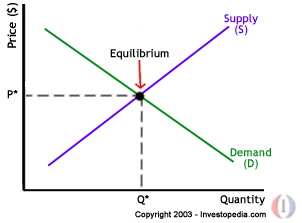
    What is free market? A very straightforward definition of free market is – a market system where prices of goods and services are set freely by consent of sellers and consumers.

    In very simple words – I have an apartment and want to sell it – I quote (asking rate) price of USD 100,000. If a buyer or buyers are willing to buy the apartment at my asking rate that can be put as the market rate for similar kind of apartments in that given area. In the same simple language if no one comes forward to buy the apartment at USD 100,000 I may decide to reduce price to say USD 80,000. So on and so forth. The logic can work in reverse direction as well If there are more than one buyer I may increase my asking rate to sat USD 125,000.

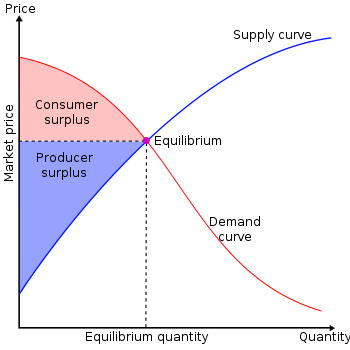
    Demand Supply economicsThis concept of free market introduces a very interesting and important Basic Economics principle of “Demand and Supply”. If demand is more compared to supply prices may go up and vice versa.

    However, I have been asking a question to myself and have this to many educated economists or free market experts. Have you ever questioned the same logic of demand supply and free market in scenario of Mumbai reality? Have you not wondered about hoarding? How often the free market is really a free market?

    I have been searching for an apartment for last couple of months. In fact since 2008 I am hearing that Mumbai housing prices will be under pressure. In 2009-2010 when economy worldwide was struggling it was heard that the housing bubble of Mumbai will burst. Did it happen? I have my doubts. Recently, I received a call from a firm regarding buying a flat (apartment) in some areas in Mumbai. I – instead of responding to the questions – asked the caller –

    1. Tell me how many projects in Mumbai are stalled by construction companies because of lack of funds?
    2. How many projects have been almost complete but have unsold apartments?
    3. How many projects are rescheduled for possession date/month/year?
    4. How many properties are unsold?

    The caller responded with a number in lacs of sq ft. I could not hear the answer properly but that turns out to be almost (perhaps more than) 100,000 apartment in Mumbai. [Please do not quote it has a accurate statistic it was an approximation of the caller]

    Are we really talking about free market? Or is it really a created bubble of price.

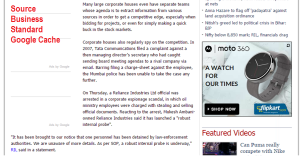
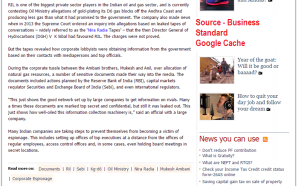
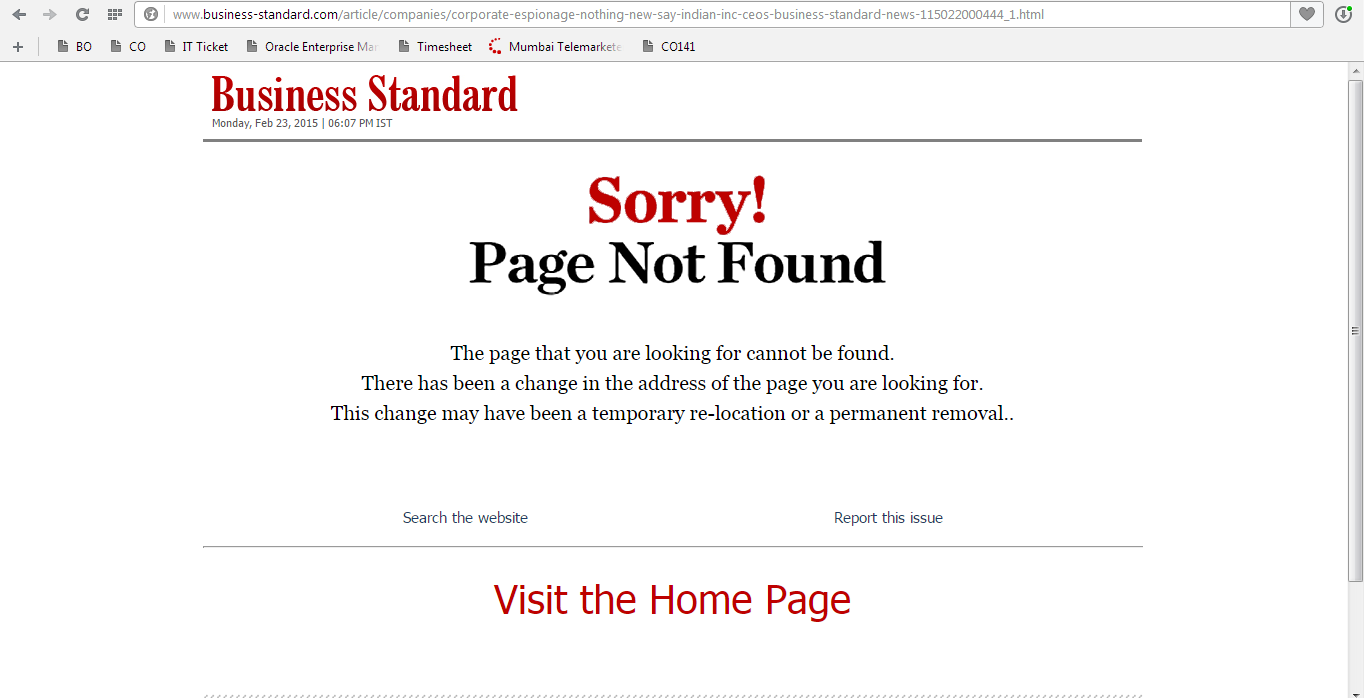
    These questions roll on to the question of leaking Govt. In free market we speak about Government’s role of regulation. Have you heard of crony capitalism or the recent corporate espionage case in India. In one online news it was stated that many CEOs say that there is nothing new with corporate espionage. The article was published in Business Standard but that has been removed by the company now! Check the screenshots attached.

    I rememberr this Hindi idiom when Govt is not functioning or driven by the private businesses instead of public good.

    जब बागड़ ही बाग खाने लगे तो बगिया का क्या होगा?

    Addendum – The article is up again (as of 17th March) http://www.business-standard.com/article/companies/corporate-espionage-is-not-new-to-india-inc-say-ceos-115022000432_1.html

    1

    2


    3

    4


    Source

    1. Demand Supply Curve – Investopedia
    2. Image 2 to 5 from Business Standard Google Cache screenshot. Original article not available on the link Image 4

  • Freemium – business model


    The Buddha shared his knowledge for free, you know these universities charge so much for the degrees!

    One argument could be – 1. That time was different. 2. The Buddha asked for bigger fee – leave all material possession, family, even ‘self’. What fee are you talking about? But yes, what the Buddha taught was priceless and of course for free.

    The second is – Well you have a MOOC (Massive Open Online Courses) – Coursera, EdX etc. These MOOC are based on a freemium Business Model.

    “Freemium” is a coined word; it is made using two words – free and premium. A business model which is based on this term “freemium” offers products/services free as well as paid. What is so great about it? Well, in this business approach few basic functionality of product/service are free and advanced features are premium. An example is LinkedIn. This business model is possible in cases where marginal cost of distribution and production are low – most commonly internet and software businesses. Advantage? It can offer huge scale for premium access. How? Once responded to free and limited period premium content business can expect to convert higher % of free users to premium users. LinkedIn has been doing this successfully.

    I liked this idea. It relates to offering your services – though limited – to everyone. Here everyone means – meaningful target audience which needs it. The business offering such service is not creating a complete monopoly – by asking users to first PAY and then USE. It gels with the concept of Business and the Buddha as well.

    Well, a word of caution – fremium can be wicked as well – when pricing is done to squeeze “consumer surplus”#. That is where it may not be what “Business to the Buddha” would apply. At the end of the day – there is no limit to squeezing the consumer, isnt it?

    An interesting business concept I have seen in Singapore [searched on net they are in India too!]. There is a restaurant near China Town MRT station – Annalaxmi. There you can have lunch and pay as much as you want, Sing $ 0 or even 100. There is no cashier. The amount such collected goes in running this not for profit restaurant and rest is utilized in organizing cultural activities.

    Whatever said, freemium seems to (should) be the way to go!

    Image source – Consumer surplus – Wikipedia


    consumer surplusesConsumer surplus – it is a term used in microeconomics in demand and supply analysis. Though the author is not a PhD in economics, still in his simple words – consumer surplus is what a few consumer “can” pay to avail the service but would not pay as company selling the offer keeps the price lower so that the company can reach scale.

  • Special situation needs special solution


    Crisis unites, for how long? I was thinking about Quantitative Easing of Fed in the US. While thinking undoubtedly read G20 communique of 2009 e.g. London Summit here. A prologue about this communique. In 2008, US financial market collapsed. This resulted in domino effect across geographies. Every country, its financial system and thus citizen of the country were adversely affected. Do not ask me – what happened to those who were responsible for this collapse? Many of them made huge money and (almost) vanished! as – according to the books – they earned legitimately. Coming back to the point – otherwise a competitive world became a co-operative world. The mindset changed like this –

    “…We will conduct all our economic policies cooperatively and responsibly with regard to the impact on other countries and will refrain from competitive…” (source – London Summit communique para 12).

    I am forced to think – do we need crisis to unite the world and people?

    The thought is in the mind because now, when things seem to be fine with the US economy or may be just because US Fed wants to reduce burden on its balance sheet they came up with a solution of QE and rest of the world feels US is renaging the agreement/communique.

    I assume, we may go in another set of moderate crisis in coming time, we have not come out of the crisis completely. However, perhaps, this time world would have lesser belief on Govts, financial system and the cooperation as agreed by the leaders, economists and Financial Organizations.

    The trust deficit we live in – or we will live in – requires special measure. A special situation demand a special solution. Since, I am more of an spiritual person I feel the solution is moving towards spirituality. This can be done two ways – bringing spiritual lessons in corporate life or making corporate values resonate, implemented and executed spiritual life. Signing a document does not solve problem in long term – we are seeing that happen through tapering of quantitative easing by USA.

    Disclaimer – Author doesn’t intent to criticize QE, author is of the opinion of looking at the basics of the problem – Greed. Author has written few blogs on Greed earlier here.

  • #CoalGate, corruption, politics & economics


    A few days back I completed this book Globalization and is discontent by Dr Stiglitz, a nobel laureate. I wrote on that recently – Interdependent co-arising a macroeconoics example. Besides this macroeconomics example, I had this intra-country example of the same concept of interdependent co-arising. Stiglitz has written so many things more than 10 years back which are happening in India currently. However, here I am just interested in quoting a small part of the book which relates to the corruption of coal mine allocation in present day India. This example is from page 71 of the book –

    There is more to the list of legitimate Complaints against Foreign Direct Investment (FDI). Such investments often flourish only because of special privileges extracted from the govt. While standard economics focuses on the distortion of incentives that result from such privileges,  there is a far more insidious aspect: often those privileges are the result of corruption the bribery of govt officials. The Foreign Direct Investment comes only at the price of undermining domestic processes. This is particularly true for investments in much oil and other natural resources where foreigners have a real incentive to obtain the conversation at low prices.

    Moreover such investment have other adverse effect- and often so not promote growth.  The income that mining conversation brings can be invaluable but Development is a transformation of society. An investment in mine – say in a remote area of a country – does little to assist the development transformation, beyond the resources it generates. It can help create a dual economy, an economy in which there are pocket of wealth. But this duel economy is not a developed economy. Indeed, the inflow of resources can sometimes actually impede development, through a process that is called “Dutch disease”

    So effectively, what Stiglitz said was bribing of officials for mining in developing / undeveloped countries. Further, the dual economy this FDI may create is not best for country to develop. I would take this example of Dutch disease in my next post – “Business to the Buddha”.

    Here what I want to highlight is this – the current issue in India – #CoalGate scam is a clear example of what Stiglitz wrote more than 10 years back. Indian Prime Minister – Dr Manmohan Singh – being an economist might have been aware about this and perhaps therefore kept Coal Ministry with him. This is just an extrapolation. Otherwise why would Law ministry and Law minster would want to change parts of report? According to the Supreme Court of India, the changes are Heart of the report.

    After reading the book – Globalization and its discontents – I realized that Stiglitz is not against Globalization but against the way Globalization is happening. So, when you read the above part, you should not infer that Stiglitz is against Globalization.

  • For Profit Businesses


    Businesses are made for profit making, is there a question in this assumption or argument? For the time being, I am assuming there is no doubt about the argument that business exist for making profit.

    I have been thinking about the topic of “measuring growth” I wrote recently. People may say there are businesses as “Not for Profit Businesses”. This concept of “Not for Profit” in many cases is about reinvesting profit in business rather than giving dividends to the shareholders/investors.

    There are other businesses which are “social enterprise”, I wrote on such businesses with reference to a book “I have a dream”. These are businesses which exist for making profit; however their primary reason of existence is social upliftment with moderate profits. I wanted to ask myself – why not all For Profit Business be like that?

    In my previous career engagement, a couple of times I had a chance to meet CMO of a big Mutual Fund house. In one interaction he told my boss – “you do X, Y and Z; Calculate your cost; add your 20% profit on that and charge me. I need this X, Y and Z done.” This statement was very liberal to hear. I had seen many organizations trying to squeeze their service provider. Thus the statement became a guide for me to think about such clarity and about fair co-existence. I relate the same to the previous post of “measuring growth”. When I tried understanding Islamic banking and asking the feasibility of the system, I saw contrary view points. I read somewhere Islamic banking does not call “interest” (on debt) as interest whereas terms it as profit sharing (say 20%). So there may be businesses so clear and there could be predictability in cost, profit and growth of business and economics.

    This kind of approach is very simple. However, the above case is very simplistic and everything (many things) would become very predictable – how would finance experts – involved in complex transactions and certificates  – would be able to manipulate market? There can still be demand and supply gap and market may run into a relatively predictable and stable equilibrium.

  • Swasthay – dwelling in oneself


    “You have to move on from the posts, you dont hang around it – I was a post you have to move on now.” When Prof Lopez told me this in our last meeting at Dubai, I felt bad. He further added – “Once you pass standard 1st you move on to the 2nd and so on, right Pravin?” I had to complete my MBA and move on to a job an so on and so forth.  Slowly I moved on. Yet, recently I was going through the content of my MBA and came across some photos, class works etc and fallen back in time to relish my moment of that time. One of my friends commented on Facebbok – Movee oooooooooooonnnnnnnnnnnn! Instead of moving on, I remembered the last sentence Prof Lopez told me – “Pravin, you have to move on.” I had created this blog title – Move on… on Dec 1st 2010 and came back in the drafts to complete it now.

    The other reason to complete this blog was my recent meeting with Mr Ramana Rajgopaul my blogger friend and uncleji, he blogs at www.rummuser.com. He is reading a book – How Much Is Enough?: Money and the Good Life and we discussed economics and greediness  etc. Really the question is right. How much is enough? We think of buying a small apartment, when we own one, we think of bigger one and then a bungalow, villa, a farm house do we stop there? No! then we need something more a big car or something else. Where is the end? Take an example of corruption in India, what these politicians do not have? They have all they might need, but no! They want more.

    This “move on” is literally turning into running, running behind something, at time running away from the real problem. We have so many gadgets and even though we are connected with so many unknown people through social media, we dont know the neighbor. I personally felt that I spend more time on internet compared to talking with people. In bus I am on the net, in train I am on the net, at home I am on the net! So, are we facing our problems (personal or social) or we are just avoiding and moving on, running from one thing to the other just to save ourselves from facing those problems?

    When Angulimala met the Buddha. Angulimala screamed at the Buddha to stop because he wanted to cut fingers of the Buddha. The Buddha turned and told Angulimala that he, the Buddha, had already stopped. He had stopped killing and harming and now it was time for him, Angulimala, to stop.

    Now is the turn for us to stop. When I say we should stop it means a strange stop – our mind should stop running, time and space would move, our mind should be at peace, quiet. That is the definition of Swasthay (swa + sthith) – dwelling in one’s own self.

    Related blogs

    You cannot drive car looking at the rear view mirror

    When will we stop? (on the movie Salam Bombay)

    Dichotomy on happiness…

  • How long will we live in the world of $! from ‘Network’


    The following are few dialogs (curtsey – www.imdb.com)… It is interesting so sharing on my blog. ‘How long will we live in the world of $!’

    The concept of movie is based on how a news channel management and one of its anchor share relations and What happens in an apparent conflict. This movie was released in 1976 (after the oil crisis – perhaps ’70s- , before the economic crisis in US – early ’80s). So effectively, we have been like that and we will remain the same, provided we learn a lesson this time around. The time is here and now, to learn – we would have an economic crisis again in 3 years and I wonder how long it will take to get back to normalcy. This movie was made 30+ years back, world saw 1910’s (World war), 1920’s (Great depression), 1930’s-1940’s (world war and after effect) and then 1970’s (oil crisis) and 1980’s (economic slow down). When did we have a peaceful time? There has to be some sense in the world – we need to learn, we have to learn – how long will we live in the world of $? Life also exist beyond the turmoil of $.

    The dialogs are below –
    Arthur Jensen (owner of the channel): [bellowing] You have meddled with the primal forces of nature, Mr. Beale (the anchor), and I won’t have it! Is that clear? … The Arabs have taken billions of dollars out of this country, and now they must put it back! It is ebb and flow, tidal gravity! It is ecological balance! You are an old man who thinks in terms of nations and peoples. There are no nations. There are no peoples. There are no Russians. There are no Arabs. There are no third worlds. There is no West. There is only one holistic system of systems, one vast and immense, interwoven, interacting, multivariate, multinational dominion of dollars. Petro-dollars, electro-dollars, multi-dollars, reichmarks, rins, rubles, pounds, and shekels. (I wonder why we do not understand interdependent co-arising only in terms of dollar) It is the international system of currency which determines the totality of life on this planet. That is the natural order of things today. That is the atomic and subatomic and galactic structure of things today! And YOU have meddled with the primal forces of nature, and YOU… WILL… ATONE!

    Arthur Jensen: [calmly] Am I getting through to you, Mr. Beale? You get up on your little twenty-one inch screen and howl about America and democracy. There is no America. There is no democracy. There is only IBM, and ITT, and AT&T, and DuPont, Dow, Union Carbide, and Exxon. Those *are* the nations of the world today. What do you think the Russians talk about in their councils of state, Karl Marx? They get out their linear programming charts, statistical decision theories, minimax solutions, and compute the price-cost probabilities of their transactions and investments, just like we do. We no longer live in a world of nations and ideologies, Mr. Beale. The world is a college of corporations, inexorably determined by the immutable bylaws of business. The world is a business, (in my opinion – world is more than *JUST* business or in other words everything is a business) Mr. Beale. It has been since man crawled out of the slime. And our children will live, Mr. Beale, to see that… perfect world… in which there’s no war or famine, oppression or brutality. One vast and ecumenical holding company, for whom all men will work to serve a common profit, in which all men will hold a share of stock. All necessities provided, all anxieties tranquilized, all boredom amused.

    Howard Beale: [ascending the stage] So, you listen to me. Listen to me: Television is not the truth! Television is a God-damned amusement park! Television is a circus, a carnival, a traveling troupe of acrobats, storytellers, dancers, singers, jugglers, side-show freaks, lion tamers, and football players. We’re in the boredom-killing business! So if you want the truth… Go to God! Go to your gurus! Go to yourselves! Because that’s the only place you’re ever going to find any real truth.

    [youtube=http://www.youtube.com/watch?v=7sySuIXG_IM]