Tag: Business to the Buddha

  • Businessman Buddha

    I was extrapolating to get into a mind. The mind of a person – who left everything and went to the Himalayas. What changed for him, how his mind responded to the alone-ness. What was going on in there – in the mind? Why he left the society and went to the hills? What conspired? How he changed there? Would he be the same changed person when – in case – he comes back to the society?

    Middle-Path

    Can one have the same mindset of a hermit of Himalaya, in the concrete jungles? Can one balance being a hermit in the concrete jungle? Is it true that people find peace of mind in Himalayas? What is different there and here in the worldly city?

    My recent experience of Art of living‘s Anand Utsav course has given me few more questions and dimensions. Last week I wrote about listening to the tik-tik of wall clock. My wife entered the room switched on the fan, I missed the tik-tik. This is what happens with us in our daily highly demanding and at times stressful professional life. We miss very many things in the noises of becoming someone, owning valuable things, money, designation etc.

    The long and short of all this is balancing the life with awareness and becoming a saint in a professional life. Do we really need to be a monk to be spiritual? Most of us are running to be someone or to achieve something. There is no problem in having ambition and goals; the point is ,it make one restless. Why to be restless and anxious? Is not it a possibility that a person can be centred and yet ambitious? Is not it a possibility of a person being spiritual, professional and successful? These questions have become easier for me to have a perspective after the Anand Utsav course. I would certainly repeat more courses of Art of living.

    Just-be

    One can follow the middle path of being an enlightened master without leaving everything. One can be an enlightened master without leaving family. I see future enlightened masters will be successful professionals. These future generation enlightened master would / may not even talk about high flying esoteric spirituality. They will do their work as any worldly person does. These masters will not leave everything for the Himalayas, they may not sell their Ferrari. I think that is what is the lesson of the Buddha – Middle path. I think that is why current generation enlightened master’s are bringing spirituality to masses and to the day to day life.

    As Osho said long back, many of the masters will be like the Zorba. Zorba the Buddha (Osho’s book) – “… Zobra is Love and Buddha is Awareness… when you are Zorba the Buddha, you have attained the greatest height that is possible in existence…”

    Image source of monk https://www.theguardian.com/technology/2011/apr/17/untangling-web-aleks-krotoski-religion

  • At times capitalism it is!


    CD of Jane Fonda can be more useful for you to learn Yoga – an Indian physical, mental and spiritual practice. When you watch her video you are likely to feel as if she is a native to this art, have you ever thought why? It is not a case of go Yoga alone that many Indians would neither know nor will be able to practice such things well. It is the case with practice of meditation – an eastern method of consciousness – too. Would not you be impressed with many foreigners not only talking seriously about meditation but also practicing meditation religiously and needless to say better than many Indians.

    Have you ever wondered why? What happened that we have relegated such a unique knowledge to either books or only to religious institution? At the same time how the Western world has been taken to these practices with ease and are excelling in it? It would not be surprised that in next 100 years there would be more spiritual readers from the Western world than from India or South East Asia.

    There was a time when India was prosperous. Prosperity makes one question the significance of life, after life and whys of existence. It is unlikely for a hungry stomach to think beyond food. It is difficult for a person in danger to think about higher purpose of life; not impossible but difficult for sure. I remember my professor Dr Anand Saxenasaxena-sir-25dec12 told me –

    गो धन, गज धन, काज धन, सबे रतन धन ख़ान|
    जब आवे संतोष धन, ये सब धुरी समान||

    Go dhan, gaj dhan, kaaj dhan sabe ratan dhan khan
    Jab aave santosh dhan ye sab dhuri saman.

    Meaning:

    It is true that owning cattle, jewels or kingdoms is mine of wealth
    But when you own wealth of contentment (satisfaction) those mines (cattle, jewels etc) of wealth become worthless (like dust)


    I love capitalism because it gives an individual the possibility to be prosperous. Prosperity, at least once, can give a person a chance to raise questions on existence. I believe capitalism and what follows, for example wealth, well-being, abundance etc may make one question – why and how of cycle of life. That is why probably Jane Fonda is a better practitioner of Yoga and many in West are turning towards meditation.

    When a person goes beyond food, shelter and social standing one can think of bigger purpose in life. It has been story of many warriors in India – Mahavir or Buddha. Shashi Throor in one of his famous speech said before Britisher’s arrived in India, India had 23% of the world GDP. That is as much as if not more than current GDP of USA’s proportional GDP to the world. When a society is prosperous that is when it starts or tend to move inwards – at times capitalism it is that provides opportunity to dig deeper within. It seems very counter-intuitive though but that is how the logic of Business to the Buddha; that is how the journey for within may start for the West.

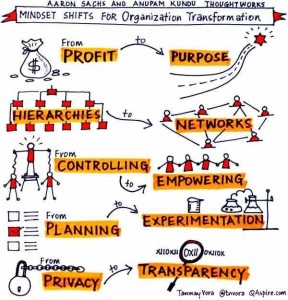
  • Profit to Purpose


    Since long when I started blogging on Business to the Buddha; I had this in mind – we are all connected (Interdependent co-arising in Buddhism). Therefore, if the whole world wants to look at development, it can only happen if all grow, not at the cost of ‘other’. I have written about 260+ blogs in last 5+ years, recently, I found a perfect way this concept was presented by Tanmay Vora. It’s perfectly said that a picture says a thousand words, Tanmay has proved it right here.

    I requested Tanmay to let me share the drawing on my blog, and he was kind enough to let me do this. You can read his thoughts on Mindset shift here.

    Profit Purpose Saint in SuitThis is the idea of my thoughts on being Saint in Suit. We all need to grow as professionals and as individuals. We have to be saints in business and personal life both this will be profit with purpose.

    To read more of Tanmay’s thoughts go to – http://qaspire.com/

  • Saint in Suit


    It was Feb or March of 2011. We were just completing our MBA and as would be the case with any other B-school companies were visiting campus for recruitment. A big company was scheduled to visit one day. One of my friends – Jaydutt – was among the most likely candidates to be selected. However, he did not even attend the presentation of the company. Everyone was curious, why?

    I – besides others – was shocked it! I went to his room and asked him, why did not you attend the presentation itself forget the recruitment process?

    He said – “I know the company well, and I have firsthand experienced working there. Pravin, as confident you were, other friends too were confident and I was under pressure to make a decision, it was a enormous confusion I was also not able to make a choice. So, yesterday night when I was about to go to bed, I asked myself this question – ‘if I join them, would I be happy getting up every day in the morning and going to office? Would I enjoy working there? I would invest at least 8 hours per day there, which is 33% of my daily life or close to 50% of my hours awake in a day, am I really keen to go there?’ My conscience told me NO! I decided to skip the company.”

    MeditationThis small conversation with Jaydutt made me think – those points were such that even after full 5 years I still remember the discussion. I recalled that small discussion with Jaydutt when I planned another of my journey from Business to the Buddha to Saint in Suit. I realized whenever I say Business to the Buddha, there seems to be a gap between Business and the Buddha. There seems to be a movement from one place to the other. It requires separate effort or action.

    When I met Fateh uncle recently, I realized that it is not going from one place to the other. It is “being” that. He is a successful businessman and a spiritual person. The title Saint in Suit actually came in my mind when we met once and he was wearing a suit! Now or in future we’ll have to be professionals with the spiritual connect. We need to be saints in the form of professionals. That awareness will either sprout or if does not, we need it to be developed. Though, unfortunately currently I don’t have time to commit to this and keep writing regularly there besides keeping my pace here too.

    Saint in Suit concept is spirituality and business are together. In this concept the plan is to write about how business works (or should work) on spiritual practices, how it can work on spiritual practices, sharing any model related spirituality and business, sharing or defining model related to spirituality and business in any business function e.g. Board level to line executive from marketing to HR to suppliers etc.

    I’m hoping to bring like minded people on this platform to start writing about being saint in suits. your contributions are welcome there create your login.

    Image source – http://www.bravefury.com/six-reasons-men-should-do-yoga/

  • Left Vs Right economics


    [Tweet “The problem with economic analysis is – it is always dependent on me Vs you or internal vs external. Would we be able to see a view where the analysis is done on a single monolith?”]

    https://images.duckduckgo.com/iur/?f=1&image_host=http%3A%2F%2Fcarolynbaana.files.wordpress.com%2F2011%2F06%2Fbalance_scale.jpg&u=https://carolynbaana.files.wordpress.com/2011/06/balance_scale.jpgI was reading an article which states that leading economists are now tilting towards left centric economic practices. Just to give you a perspective – There was a time when governments tried to reduced its control on many fronts such as reduced taxes, regulations and privatization et al. This resulted in perceived Free-Market and growth. At times I wonder growth for what? And growth towards where?


    [Tweet “At times I wonder growth for what? And growth towards where?”]

    Flashback to 2005-2008 – When these activities went berserk we saw financial crisis one after the other, we can blame that some were more created than “systemic risk” as the “experts” call it. Recession of last decade was an example of the same. Until things were going great everyone was saying it works, suddenly something went wrong and everything crumbled. Alan Greenspan who was at the center of last decades recession stated this – “You know, that’s precisely the reason I was shocked, because I have been going for 40 years or more with very considerable evidence that it was working exceptionally well.” He further said – “I really didn’t get it until very late”.

    Fast forward to 2012 onwards – we are seeing economists are talking about left centric economic practices.

    The problem with economic analysis is – it is always dependent on me Vs you or internal vs external. Would we be able to see a view where the analysis is done on a single monolith?

    If we do the same mistake (of leaning too much towards the left) which was done in 80’s (leaning too much towards the right) when more laissez-faire capitalism was proposed, these activities of leaning far right to far left will end up being into a pendulum kind of moment. We would see more recession or other social challenges.

    My opinion of Economics is – learning about the sentiments, action and effects of individuals (micro-economics) and groups (macro-economics) to create theories. These theories will replicate how the world is likely to behave. In proposing some theories we state – “everything being equal”, “rest of the things being constant” etc. However as we move on the irrationality of human / group activities take place. These irrationalities will always be there when economic theories of complete left or complete right are applied. The irrationalities will be more troublesome (as the case we saw in last few decades) if one sided approach of economics are utilized. The irrationalities can be reduced (managed) by approaching the economics in more centralist way – The middle path.

    Should there be a way to reduce the causes of irrationality?

    What I wrote earlier here [blog – cause…]- The macro problems I wrote above, can be solved when we start solving micro problems, it is collective wisdom which would play a major role when we are individually wise.
    Image source – http://carolynbaana.com/2012/05/01/defining-balance/ searched via http://duckduckgo.com

  • Three Avocados


    You may argue with Management professionals that investors invest because they want better returns. An investor weighs his investment options, considers his risks profile et al and make a decision of investment expecting certain returns, right? But I think we are living in a time when many of us are thinking and should think about what bigger return based investment we can make and how can we reduce risk. Risk of the society!

    Three Avocados
    Three Avocados Logo

    A couple of months back a twitter handle @nonprofitcoffee followed me. It sounded strange, so I visited the handle, eventually the website. I was impressed and thought to write a blog on the same.

    Three avocados is a Non for profit company operating out of Uganda. Their product is coffee, order from here. Avocados and coffee does not gel well together, right? The company is named so because a destitute widow gifted three avocados, the only possession she had, to the founders of this company when they visited a village.

    This business has a purpose, not the cliche – to increase “shareholder” value. The purpose is different than many other businesses. They want to help Central African country – Uganda – with clean water. Young girls and women have a responsibility in their homes, the responsibility is to collect water for their daily chores. Well this is the story of many Indian villages as well. So can we think of such an initiative in India or other parts of the world? There are many social issues to handle e.g. women security in Delhi (just an example).

  • Measuring growth


    I had been asking myself a very naive question. How do we measure growth? Well the answers is not “the GDP” etc. What if I sell things very expensive? GDP might grow, right? So, I zeroed down to interest rate as one vehicle to measure growth.

    Well, let me be more fairer in providing one more reason for taking debt as a metric. I had been wondering about 2008 crisis and the fancy word – Corporate Debt Restructuring. When we look at these and other special purpose instruments we would realize that humans try to fool themselves or fool others. Therefore I considered  Debt as one metric to measure growth. I noticed Kingfisher drowning  recently – I mean the airline in India. We all have witnessed crisis of 2008. In the enthusiasm and to show fat books banks start providing loans to people; once a person is not able to repay the debt banks auction those properties. These two big cases and the housing bubble, all these things are examples of our assumption based “Growth” of economy. Here we assumed growth is represented by the ability of people/organizations to take loan. Interest rate of loans would become a representative of metric of growth.

    We all are in this mess of economic slowdown because of the concept of debt. The ability of big, smart and mighty people and organizations to restructure these debts. When I was doing a course on Independent Directors with Institute of Directors I was wondering in one session – “What if  we don’t have this concept of Debt?” In Islamic banking there is no concept of debt. We may say that Islamic banking has a more refined concept (debt), it is called as profit sharing.

    I am not a scholar of Islamic Banking and therefore whatever I am writing here is with reference to what I was told by one of my colleague and friend (Abdullah Pijvi). He too suggested to me that he is speaking from his experience (he had taken some loan) and therefore he knows that there is no straightforward concept of Debt/loan. It was interesting to know that concept however I had a question in my mind – if Islamic banks don’t have the concept of debt how do they grow? And I started defining metric of growth as – debt and interest rate!

    Related blogs – Where is growth?, What else you need? and Abundance of scarcity

    Disclaimer – 1. In this blog technicalities of economics were not considered very seriously. So readers are warned to do their research in formulating their arguments for/against such thoughts. 2. More thoughts on Islamic banking in future blogs