Tag: Bhakti

  • Choices

    My daughter, Adviti is growing up. She has started asserting her liking and choices gradually. She decides what she wants to eat when she wants to change the song, and what she wants to wear. It is turning out to be a fascinating life lesson for me.

    We start making choices since childhood. I remember spending time with my niece Chinu when she started making choices. She liked watching Kung Fu Panda (movie) I enjoyed watching Kung Fu Panda with her, she also collected pebbles as I did as a kid.
    Smiling-Baby

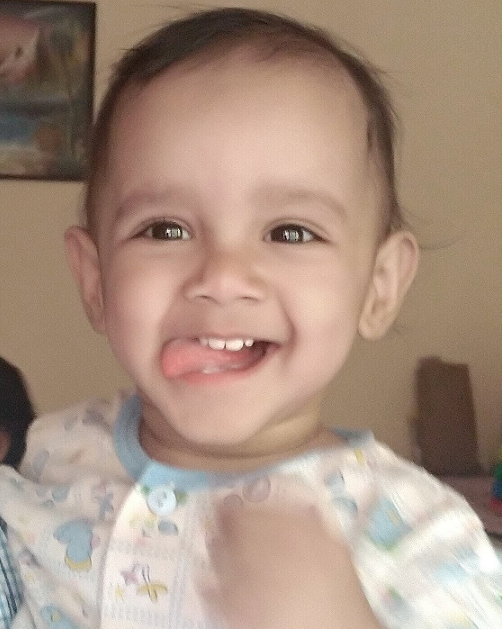
    I believe some of our choices are involuntary, and some are self-made. Let me take an example – Adviti likes us chanting of Bhojan Mantra (video below) before meals because she has seen us doing it for as much as the last six months. I wonder if she understands it, or whether the rendition is clear. However, she loves it, and if we start eating our meal without the chanting, she forces us to chant the mantra. Possibly this is what Sanskar is. I’d call it an involuntary choice – I may be wrong though, she may be forcing us because she understands! When she changes the Youtube video – it is most likely a self-made choice.

    Choices, Liking and Love

    Though I found time now to write about it, however, I had been thinking about Adviti’s likes, dislikes, and choices for a while. Those who know me know that for my arrange marriage I met two dozen girls. Many rejected me, I rejected some. In these discussions, some accused me of – you are not proceeding further “because I am fat”; “because I am darker shade” etc. I had to respond to these because these were genuinely not the reasons. I will share few arguments that I shared with these prospective alliances.

    One, on complexion, I said, let’s assume I get to marry the fairest girl in the world. Every evening I come from the office. and we start fighting on a trifling matter. In that case, what is the value of the “fairness” to me? It is said that beauty is skin deep, isn’t it?

    Two, on complexion and shape, I said, let’s assume I get married to someone, she met with an accident, or I met with an accident resulting in a body deformity. Would the other person leave the better half who met with an accident? I had to take this example because one alliance had such an incident. I had to tell her that such things are possible after marriage too. A bad example but I took such an example.

    Lastly, on the shape, I said who is going to remain like this forever? With age, we all will be out of shape. why worry about it from now? One must be fit for a healthier life but one should not take serious decisions giving one-factor full weightage.

    Those long discussions (or at times long-distance discussions), in some cases the contest of mind vs heart, for alliances made me look at likes and dislikes little objectively. I asked myself – if I love someone because of face or shape or behavior (or family – yes Indian marriages are not just two people it is their family and extended family too) what if one parameter changes in the same person? In the end, I came to realize – choices are made (or someone or something is loved) because of the whole and not because of the parts. Check this section of an Indian movie – Nayak the real hero – where protagonist is explaining his “dream girl” and what that turns out to be by his father who is a cartoonist.

    If I love someone or something – I love that because of the uniqueness. The uniqueness includes possible flaws. If I had to respond to “why I love someone or something” what would my response be? If my response is because of X, Y, Z and A, B, C, etc. There may be more people with those same qualities. Would it be possible to love those others too? This question helped me realize the lower strata of love. This stratum is for love, liking, or choices we make in the material world. The spiritual world has compassionate affection – of the Buddha – for everyone or full devotion – Bhakti – for the loved one.

    The realization was that we make choices in the whole and start intellectualizing the choices part by part for bringing balance between heart and mind. This justification brings reasoning of “why” and “because of”. Most likely Adviti makes her self-made choices on the whole, once she grows older she too will start intellectualizing the choices to justify her liking.
  • Bhakti


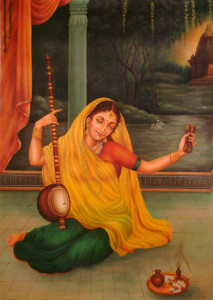
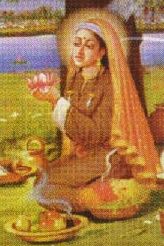
    The Buddha only spoke about scientific path of liberation – Meditation. According to Indian philosophy there are more ways, one is Bhakti or devotion. Remember Meera bai, Meera bai followed Bhakti path?in_union_with_krishna_oq05

    I was speaking with someone. I said I recite Hanuman Chalisa but find it very strange. Hanuman Chalisa is a prayer/song/devotional hymn for Lord Hanuman (Foreigners know Hanuman as Monkey god of Ramayana’s time).

    According to Hanuman Chalisa, Hanumanji suggested Vibhishan (brother of King Ravana) to go to lord Ram, thus Vibhishan became king of Lanka after Rama defeated Ravana.

    तुम्हरो मन्त्र बिभीषन माना।
    लंकेश्वर भए सब जग जाना॥

    I never liked this part of the Hanuman Chalisa (statement). What I know is – Vibhishan suggested Ravana that Ravana has done wrong and Ravana should make amend. Ravana does not listen to Vibhishan and ostracize him. Vibhishan knew what is right and wrong. He made his choice to be on the side of Rama in the war. I dislike Tulsidas (author of Hanuman Chalisa) giving credit to lord Hanuman for Vibhishan’s choice and decision. I would not question on Sugriva‘s anointment though.

    At times, I have reservations with these prayers where we keep on praising the lord with a result in mind. “Please give me this thing or that thing.” Effectively we are making a business deal with them an example is Ganesha’s aarti – http://greenmesg.org/mantras_slokas/sri_ganesha-jai_ganesh_jai_ganesh_aarti.php which seems more of a business than a loving relationship.

    My this hesitation was broken by one Art of Living Bhajans. I had seen (almost met) Guruji – Sri Sri Ravishankar – in 2003. But I did not do the course for 1.5 years because I felt “My Guru will have time for me, he (Sri Sri) has a lot of followers.” My sister forced me into the course. Besides the interesting method – Sudarshan Kriya – I learnt in the course, what I loved was this bhajan, link below. It has “no demand”, it has “no praise” either. It just repeats one name of lord Krishna.

    This is real Bhakti in my definition. I love this bhajan – no request, no appeal, no begging and no demand. This is Bhakti – whatever you want to confer, confer; it is your wish/will. I am reciting your name no matter what, no matter in what situation you keep me. That is the other path for liberation according to Indian spirituality.

    Hari Hari || Chitra Roy Art Of Living Bhajans

    Image source – http://3.bp.blogspot.com/_Pvuexh7J1Cs/S–9pMcpNaI/AAAAAAAACUU/7c7rmt5eIbY/s1600/in_union_with_krishna_oq05.jpg

  • Kashmiri Saint – Lalla


    I was listening to Osho’s discourse and in one discourse he was referring to a Kashmiri woman Saint – Lalleshwari. I was impressed with the first verse I read from her. Thought to share it here for many others to read –

    Whatever work I did became worship of the Lord;Lalla
    Whatever word I uttered became a prayer;
    Whatever this body of mine experienced became
    the sadhana of Saiva Tantra
    illumining my path to Parmasiva. -138

    So wonderful, profound meaningful and to the point. I plan to read more of her writings.

    Read this – The Hindu Article – Mystic insights

    Image source – Poet Seers

  • The circle, conflicts and avoiding conflicts


    Perform an experiment – a simple 2-minute experiment. Take a blank sheet of paper and a pen. At the center of the page, put a dot. What is it? A dot nothing else right? Now draw a big circle with the dot as the center of the circle. Now what is the dot? It is center of the circle, right? Everything on the page is around it “now”.

    The dot was nothing when there was no circular periphery. The dot was meaningless in itself. The periphery gave it a very powerful definition. It became the center of the existence e.g. the periphery. Now for a moment if you remove the dot (the center of the periphery), the periphery losses its definition. The periphery would not remain a circle without the dot “center”. This is interdependent co-arising in one sense for the center and the circle.

    Visualize the page you took is the universe and the dot represents you. We think that “I am” the center of the universe. This is the case with many of us – if not all. We are self centered. Everything is around me and everything should happen as per my desire. But there are more dots on the page with each one having its periphery, these periphery intersect which causes conflict. How to avoid the conflicts? I see there are three possible ways to avoid it –

    When I was searching for an image for this blog I found this image

    1. reduce the periphery such that only you remain in that periphery
    2. increase the periphery such that everything falls under it without intersection
    3. Make your periphery someone (only one) else with “full devotion”

    In Indian philosophical context first two could be path of meditation and third is path of devotion (Bhakti). Do you know any other? Please share.

    Image source – http://www.astronomyforum.net/blogs/astroval/106-where-center-universe.html

    A different perspective on dot – http://phataktejas.wordpress.com/2012/02/15/dot-hain-to-hot-hain/

  • Why I like Jab we Met


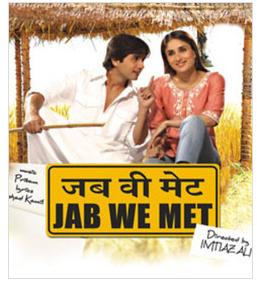
    I recently re-watched the movie – Jab We Met. I enjoy watching this movie and specially the characters. One a bubbly, lovely and risk (risk without any calculation) taking girl who lives in present. And the boy who learns a lot from her.

    This girl is (I am not talking about Kareena Kapoor, I am talking about the character played by her) is like a child, who does not know, does not want to think and does not care for tomorrow. She “lives in the present” as the Art of Living teaches. She believes in love and lives life for the love. Love is very close to a path of spirituality in Indian philosophy – Bhakti (Devotion). When she says – “…pyar me kuch sahi galat nahi hota” (there is nothing right or wrong in love), it reminds me of the divine love people have talked about in Bhakti marg (the path of devotion). As the song of this movie says – “Ye ishq haye baithe bhithai jannat dikhaye…” (when in love a person is in heaven without any desire, longing or work). I believe heaven is here and now. The way we live we define “what is heaven?”

    On the other hand, we have a boy whose girlfriend is marrying someone else. I define love in different ways – the love of Bhakti gives freedom to the loved one, whereas the love we show, talk and depict (in movies and largely assume in our life) is largely a jail or for that matter only lust. The reason for calling it jail is – when a person becomes possessive for the loved one, the person may not like few things about the other (for example talking to someone – specially the opposite sex). Or at times asking the loved one not to do A or B or C, this condition is not freedom, perhaps it is not love at all – it is a jail, am I right?.

    The best part is learning of the boy. He learns and starts loving his work too. This is the other premise in which I strongly believe. One should do what he/she enjoys doing, then work does not stay a burden. Lastly, the song which I like the most is – ‘…Na hai ye pana, no khona hi hai…’ (it is neither owning nor losing). This song largely states that love is not possession, love is being in a state of mind where you are free, happy and do things which you feel are right (of course not harming anyone).