Category: Business

  • Collective Materialism – likely future of economy!


    I have written about socialistic capitalism or capitalistic socialism. When I say that I simply mean that we would move our economies and businesses in a direction where there would be a balance. It would be a kind of middle path where enterprise would exist at the same time there would be a concern for the society and social development. Take an example of corporate social responsibility (CSR), however the word CSR would become more of a practice than a statement in annaul reports. The reason for the same would be – we are all connected. If I do not earn how would bank generate savings? If banks do not generate saving how would they offer loan and so on. In terms of Buddhism it is similar to interdependent coarising.

    In more sophesticated words the tripple bottomline would be the corporate mantra in future enterprise. I thought of an example which could be the model for this concept of triple bottomline. I happen to read corporate philosophy of Sahara India Parivar – “Collective Materialism”. This company is very interesting and different – it calls itself a family and everyone is a worker first. According the the website of the company the philosophy of collective materialism is as follows –

    “In any human relationship, it becomes imperative to take into consideration the materialistic aspect of life – we do so but by giving it second priority.

    The first priority is given to emotional aspect and with perfect blending of materialism with emotionalism results in continuous collective growth for collective sharing and caring, that gives an impetus to our philosophy.”

    On a lighter note collective materialism is not what Government of India doing – filling pockets of few select few (so it is collective and materialism both) Sahara shree – Subrato Roy – deservers the credit for this philosophy.

    Related blogs

    The middle path

    Balancing act

    Cause…

  • “Social Strategy” – a step in the future!


    A couple of days back I was on Facebook. Yes it happens when you are too occupied with work and commitments are such that you are socially cut-off – even if you do not want to. I checked Facebook update of one of my friends – Nishant Jain, a Supply Chain specialist with HCL – “Outsourcing is dead. Co-sourcing is the only way to go” by Vineet Nayar. This comment of Mr Nayar and subsequently sharing the statement by Nishant makes an statement that we are going to grow together, there is no other way out! I wrote on this earlier – Collaboration in logistics… What we call competition or what we see as “servicing clients” is actually helping client perform their duty better and there needs to be more ‘open-ness’ and involvement in what service/product we are offering. I started writing my blogs with the same concept (Refer – Why this title?).

    …“When Ferrari and Honda run on the racing track competing for the first spot, they are not eying at the first spot, they are racing to offer best product to their customers.” The Buddha’s teaching on ‘Dependent co-arising’ teaches me this. “Each one of us is a rung of a ladder to the other and vice versa, hence for self development and moving higher up, one’s ladder should be strong enough, even one’s competitors.” I believe this will be the extension of P&G’s present approach of Connect & Develop in future; working on various fronts with the competitors such as IPR – strategically innovating – besides others…

    I requested Nishant that would it be fine if I refer you in the blog? He is kind enough to say yes. Around the same time, when I was drafting this blog I happened to read an article in McKinsey Quarterly – The social side of strategy.  This article, Nishant’s facebook update and my owns earlier blog connected all the dots. I could see the relationship between Business and the Buddha in another dimension yet again.

    According to the McKinsey article companies are trying their hands on social strategy. Further it states that such strategy planning efforts would be more inclusive, action oriented, detailed and of course measurable. The other advantage of such efforts would be enthusiasm people would have; it would provide ownership to the execution. The reason for these strategic initiatives to be far more measurable is that these would increase accountability. Everyone in the organization would review progress of each initiative resulting in improved quality.

    Effectively, we are moving toward a more inclusive society and more inclusive organizations. Caution – the idea of open strategy or social strategy is to provide a platform to the organization for brainstorming, yet the whole idea is not yet completely evolved. So, companies need to open up slowly in some regards such as intellectual property.

    As Indian philosophy states – Vasudhev Kutumbakam (one-world family), I sincerely hope to see that happening.

    I would continue this in future blogs, too. Until then thank you for reading.

  • Where is growth?


    The mobile was ringing, suddenly phone was picked and the statement – wait! Mumbai Indians needs only 5 runs to win in last 6 balls. I said ok Sir I will call you in five minutes. The turmoil of thoughts continued in my mind. What am I thinking, what are the questions in my mind, so many things how do I connect all these dots etc. Mumbai Indians eventually won, Prof Mankad informed me in next five minutes.

    We started talking – the market is steady, if not bull than not bear too. Indian Prime minister and Finance minister both are making statement that “We are going to grow at 6.9% if not at 8%”. Still, there is some uncomfortable feeling. I told Prof Mankad, “Sir I am not convinced. Further to it I said – news is Facebook is licensing the AOL patents – owned by Microsoft now – for close to 550 million. Next thing which I forgot to ask him was – news of bribing in Mexico by senior executive of Wal-Mart. Wal-Mart was running behind growth – sometimes in 90’s – and got in this trouble recently when the case was surfaced. I further added that Italy and Spain are showing -ve growth (to be precise signs of recession), where is growth?

    As always these questions were simple to answer for Prof Mankad. What he said very closely resembled to my thinking of inclusive growth. He said – hold your horses, the questions are right, this growth is notional and specific to IT and finance industry, largely to few services industries so to speak. The questions are pertinent, sir said. If I remember correctly he also informed me that Italy not only Spain has declared recession, French election would surely put more light on the already tough Euro crisis. Sarkozy is likely to lose, and then there are more elections coming up in Europe e.g. Germany etc. Political parties in Holland have agreed on austerity measures. Growth would happen and thus recession would be arrested only once we see growth in all the industries otherwise we are in a bad shape. It is not possible to say that we are growing at so and so rate when only one or two industries are showing signs of growth.

    This reminded me of my most loved theory of the Buddha – Interdependent Co-arising. I have written on this often and the current situation shows us yet once again that we are all connected, nothing can be isolated and growth is a collection of small growth in each industry. Each industry is a building block for the overall movement of the engine of economy world across (with few riders). No China can survive without US or Europe, no India or Philippines can grow its service industry until there is overall growth in the demand of service industry in developed nations.

    Where is growth? There would be growth when we all learn that we need to think about each other and help each other grow – we are all interdependent and we would successfully grow only when we grow together.

  • When the Buddha dies, the schools are born


    I wrote earlier about the business of religion, recently found an interesting story on the same and thought to share it here. This story is from a book – ‘The prayer of the Frog’ by Father Anthony de Mello, S.J.. This book has very interesting stories on religion, spirituality and human relations etc. The story I am referring here is from ‘The prayer of the Frog – Volume 1, Page 95, Part – Religion

    The resurrected philosopher
    An ancient philosopher, dead for many centuries, was told that his teachings were being misrepresented by his representatives. Being a compassionate and truth-loving individual, he managed, after much effort, to get the grace to come back to earth for a few days.

    It took him several days to convince his successors of his identity. Once that was established, they promptly lost all interest in what he had to say and begged him to disclose to them the secret of coming back to life from the grave.

    It was only after considerable exertion that he finally convinced them that there was no way he could impart this secret to them and that it was infinitely more important for the good of humanity that they restore his teaching to its original purity.

    A futile task! What they said to him was “Don’t you see that what is important is not what you taught but our interpretation of what you taught? After all, you are only a bird of passage whereas we reside here permanently.”

    When the Buddha dies, the schools are born.
    ***
    These small stories are so interesting that I would refer to them again in future.

    When I say business to the Buddha, I mean teachings applied in real life (including Businesses) and not interpreted/misinterpreted by someone (priest) for the common public.

  • Microsoft plans to make its Operating System Open Source!*


    With Ashar and Vineet

    Microsoft is considering making its operating system (OS) business open source. Microsoft started it operations in 1975 and had become formidable in desktop computers operating system market between late 90’s and the first decade of 21st century. During that time it captured more than 80% market share of operating systems. Microsoft is one of the companies which has fought maximum number of patent infringement cases over last two decades. Microsoft’s last five years strategy also suggests that this move could have been decided in 201I when it started allocating its resources of OS business to other lucrative business propositions.

    The plan of Microsoft is motivated on various factors, including but not limited to – reducing popularity of the OS amongst the partner companies such as Dell, Lenovo and HP reducing market share of Microsoft in OS worldwide, reduction in profits from OS businesses due to huge investments in patent infringement cases and availability of other more lucrative businesses opportunities.

    Over the years Dell, Lenovo, HP and others have started providing different options to purchasers. This has caused huge dent in the market penetration of Microsoft. With the advent of Cloud Computing in late 2000’s, it was evident that there are going to be large scale changes in the OS and OS businesses worldwide. The shift started with the Google’s OS Chrome and other electronic devices such as mobiles, iPad and Kindle. In late 2000’s many mobiles and other devices started replacing Desktop and laptop for day today office and personal applications. Internet on the move and office applications on mobiles created tough competition for Microsoft. The smaller competition from Linux based Open Sources was another trouble for Microsoft. Different flavor of Linux and Android based OS has already taken substantial lead in different parts of the world.

    Microsoft has fought many patent infringement cases in past each causing almost 300 million dollars to the profits of Microsoft. The numbers grew slowly from none in 1997 to more than 40 in ten year and this growth of number of patent infringement cases continued resulting in expenditure of over 12 billion in late 2000’s. This statistics forced Microsoft to look back at its strategy which eventually happened in 201I, now slowly Microsoft is moving away from the USPTO and other patent offices for few of its software products.

    Analysts suggest that this move of Microsoft will cause immense turmoil not only in IT industry but also in software patent (IP protection) industry. Other IT companies producing identical software would not be able to protect their IP eventually they may also follow the suit and the domino effect will eat up the software patent industry.

    Microsoft has already redeployed its resources towards development of other products. It is also considering development of more entertainment based product under the leadership of new CEO Donald Murphy, who largely has been involved with games and other entertainment based products for a long time of his career. Additionally, the money not pumped in the patent infringement cases would be used to sustain its open source development and the Bill & Melinda Gates foundations.

    *WELL THIS WAS A 1st APRIL BLOG… Do not take it to your heart. Some numbers are facts as per 2005-10 however this blog is a work of fiction. The year 201I is no year as such. 201 is number whereas last digit is ‘capital-i’. Name of the CEO ‘Donald Murphy’ is also a work of fiction – Donald from Disney’s character Donald (relating to Games and Entertainment) and Murphy (character from Happy Feet – movie on Penguins. Penguins which is related to Linux).

    What if this becomes a reality?

  • Humans are social animals


    Have you ever asked a question to yourself – why? Why am I doing it? Why am I running from pillars to posts either aimlessly or with an aim. Once the aim is achieved – what next? Every strategic question stems a WHY in the mind of management also, right?

    So the question, why? Leads organizations as well as individuals. This question has led me to think about far in the future how we (individually, socially and economically) might evolve, as well as how I see things should/could happen. This is where I see the collaboration would play a bigger role. Look at crowd sourcing, look at open source. My assumption is – in a given day – maximum downloads in the world are happening from Android market place. That is again a collaboration – a freemium service (free+paid).

    *If I talk about some more technical stuff – at times companies make their intellectual properties ‘public’ without a patent, for example SQL. It was invented at IBM however was kept open (not patented, of course you may argue on the possibility of software patent in 1970s etc etc). Also you may argue that it was a mistake.*

    A couple of years back I wrote articles on format wars and the failure of Betamax (and of HD DVD). Have you ever seen there are times when you have to stop fighting and start working together? There may be times when a company has to collaborate because of its dependence or loss in the market place. The fact of the matter is – at times collaboration is forced and in other cases by choice. Yesterday I read a news article on The Hindu that RIM (manufacturer of Black Berry) introduced its new operating system (OS) for its BlackBerry PlayBook tablets with additional functionalities, including the ability to run Android-based applications. Nokia with Windows, Blu-ray with content providers and manufacturers, VHS with OEM. I am confident the future businesses would be built on Collaboration, association and aggregation.

    …And as the cliche is – humans are social animals – we would remain social animals and collaboration would be the name of the game. So, for business some “business rules” would go on shelf and some new rules would evolve.

    * Readers are warned that the IBM and SQL part is not a professional advice as a registered patent agent, the example is used as representation of authors thoughts about the future.

  • Business of politics


    “Religion-based quota won’t divide our people. Google will. That’s our Government’s logic.”
    – Chetan Bhagat, Author

    My friend Tejas Phatak (T Gates) recently wrote a blog – ‘Dot hai to Hot hai!’ I was thinking about the democracy, elections for couple of days and honestly laughing on the kind of stories and promises we hear from politicians. Specially during the election season.

    With due respect to the ‘business’ of politicians, I do not see many changes QUOTED/STATED (I am not using words such as done and made) by them and work done often falls way behind the promises. Look outside your window you would ‘see’ examples. I remember a statement of Collector of Indore (somewhere in 1997-2000) – Mr Manoj Shrivastava – in Nai Dunia (Very famous news paper in MP specially in Indore) that “reason for development of Indore is the people – not the politicians – of the city“. This applies to any city in India I believe.

    When we talk about ‘business’ of politicians, we hear categorical statements of religious bias too. During the seasons of elections you see ‘business of religion’ and ‘business of politics’ meet. I wonder according to the constitution of India where does religion get special status? I think in India every religion is given equal rights. Referring to the Wiki article Population statistics of India by religion I am wondering why we talk about religion based quota? If religion should be the basic Jains and Buddhists should get quota; is that happening? The very fundamental issue is – we want quota everywhere. I recall Lokpal debate everyone wanted quota there too.

    There are responsible positions where we need people who are capable – irrespective of their caste, religion or region (specially we have seen my Prime Ministers from UP!). I understand the prime reason for quota system is to bring equality in society, should we consider other methods of bringing equality – creating entrepreneurs for example.

    Tejas – voting in Mumbai has not been very encouraging. I think the reason for apathy in Mumbai is – people live here on a daily basis, we care more for our survival. How many politicians are solving problems of daily basis. I heard Arnab Goswami saying yesterday – ‘reason of Shiv Sena winning here could be the grass route work of the workers. They are available when there is a need’. Secondly, in Mumbai perhaps maximum jobs are in private sector where Quota statement does not make much sense for voting.

    I support quality work irrespective of political affiliation. So the ‘business of politics’ and ‘business of religion’ should talk about the kind of work and developments happening for the guys next door like you and me!

  • Interdependent co-arising – a farmer’s example


    Recently Dr Raghunathan shared a link of his interview with Wharton with me We are individually very smart but collectively dumb. The very first paragraph of the interview has an example of a farmer. A farmer whose corn won top awards year after year. When a reporter asked about the secret of his success, the farmer attributed it to the fact that he shared his corn with his neighbors. Why, the reporter wondered, would the farmer want to share his seed when those neighbors also competed with him for the prize? The farmer’s reply was, “The wind picks up pollen from the ripening corn and swirls it from field to field. If my neighbors grew inferior corn, cross-pollination would steadily degrade the quality of my corn. If I am to grow good corn, I must help my neighbors do the same.”

    I am writing time and again on interdependent co-arising and how it applies to businesses, I think this small story on BUSINESS – a winning business – states a lot about ‘interdependent co-arising’. This example applies beyond India, the long term gain for world economy would be working on the concepts of interdependent co-arising.

    Related blogs on interdependent co-arising

  • Individually smart, collectively dumb!


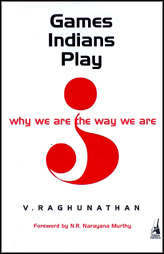
    Book Games Indians Play cover
    Games Indians Play
    Have you read Games Indians Play! by Dr Raghunathan? Very interesting book with pertinent examples of issues we face, many a times overlook and are facing worldwide. In that book he says – “We are individually very smart but collectively dumb”. I think we are collectively dumb and therefore we are in the economy-related mess we have created.

    I did not know that I would be referring to my new year blog so early in this year. Newspapers of 3-Feb-2012 made me do so. The news was about the 2G scam which had been under scrutiny for a long time now. In my opinion the verdict clearly stated that power corrupts and it gives you confidence that you can get away with murders too (many such cases pending in India)!

    I thought hard – really very hard – to find a solution. I think I will go back to TRIZ (theory of Inventive Problem Solving) to decide conflicts and resolving them. Until I find a one size fit all ‘man made’ solution, I could think of only one possibility. This solution is self restraint, and owning responsibility to make sure we are morally correct.

    This word ‘Moral’ reminds me of my economics and business ethics class of MBA where we discussed moral hazards with Prof Mankad and Prof Arun Ramanathan. I was reading this article on Moral hazards at Wharton. The article talks about authorities and new stringent rules. This regulatory authority will tomorrow need another (other set of rules) and so on and so forth. How long will we create such authorities? Moral hazards would end very easily when each one takes responsibility and become accountable for his/her action. This accountability has to come on each level and for all the actions. The problem lies with a reality that – ‘We are individually very smart but collectively dumb’. This ‘being individually smart’ begets moral hazard. The solution for this problem is one’s own self. Take responsibility own it and be accountable. Perhaps initially we (as individual) will fail but collectively we will start succeeding.

    I am hopeful that once we start from ourselves (individually), each one of us would be able to avoid situations where we would talk about Newspapers of 3-Feb-12 (2G Scam), other scams and the bad shape of world economy. Hoping that we would save our energy to concentrate on something constructive.

  • I have a dream!


    Related blog – Why this title?
    Have you read the book – “I have a dream” by Rashmi Bansal? One of my friends gave me this book and said – ‘it might change your life, read it.’ It is on social entrepreneurship. I am reading the book nowadays, and found ‘author’s note’ very interesting, I am putting the note here.

    QUOTE
    There are two kinds of people in the world. Those who think, and those who feel. The ‘thinkers’ see a child begging on the street and say to themselves ‘that’s not my problem.’ Those who feel, however, will give that child something, if not a coin, at least a moment of compassion. Thinkers believe the world is a neat place, with boundaries. ‘My house’, ‘My family’, ‘My community’, ‘My welfare’ that’s where there the boundary ends.

    But those who feel see the entire world as One. Beggar and bourgeois, sinner and saint. We are all interconnected in ways we cannot understand. And Hence, in serving another, we are only serving ourselves.

    For too long now we – the ‘middle class’ of India – have chosen to be thinkers. We have deadened our hearts and our minds to the poor, the hungry and the homeless and the hopeless. Because that problem is really not ‘ours’.

    And the small minority who feels, it’s doing the best it can. But it is never enough! I see now, a new breed of people. Thinking-feeling individuals who look a problem in the eye and declare war. These people think like entrepreneurs but feels and work for the cause of society. And hence, they are ‘social entrepreneurs’. These are people like you and me, not Mother Teresa. They are using the principles of business, to create a better world. A world where profit does not equal greed. Where people come together for a greater common cause. A world where ‘I’ does not mean crushing ‘them’. Because the bank balance you have here on earth will remain, when you depart. Your Karma you carry forward.

    So no matter what your problem in life is, spare a moment for someone else.

    Spread love, laughter and goodwill.

    The more you give, the more you will get back.
    UNQUOTE

    I see a connection between teachings of the Buddha, these entrepreneurs and what Rashmi is saying – i) greater common cause ii) a world where profit is not equal to greed iii) we are all interconnected and iv) we are ONE world.

    I too have a dream – to see all of us – business men/women – as compassionate and thinking in the lines we – as a single world. This for sure would ensure peace, harmony and economically stable world.