Category: Buddha

  • From Wish Lists to World Peace

    From Wish Lists to World Peace

    I had the privilege of visiting several temples in Tamil Nadu last month, including the iconic Rameshwaram, one of the Char-Dhams for Hindus. It was an eye-opening experience that stirred memories of my younger days in Dhar, Madhya Pradesh, where I visited temples more frequently.

    Over time, however, my visits had become less frequent. The reasons were a plenty. Two that I feel important to discuss include first there is “no conversation” and second mostly I provide my “wish list” to the deity and leave. I’d ask for personal favors such as success in exams. Even if I go repeatedly to the same temple, I have no visibility of “fulfilment”.

    As I reflect on those early years, I find myself chuckling at the simplicity and short-term nature of those requests. It feels almost childish now. But there was another, subtler reason for my growing distance from temples: the lack of conversation.

    When I was in engineering, I started asking deeper questions about life: What is my purpose? What will I do 40 years from now, after retirement? What is the purpose of life? Is there anything that we are missing in our mundane life? There was confusion, there were questions in mind, no clarity who will answer and my point of not checking in temples was clear. Though, in hindsight, I wish I had tried asking few people in there.

    These existential questions expanded into a spiritual search. I felt a profound confusion, unsure of where to turn for answers. While I distanced myself from temples, I started reading different books (those days internet was just in its nascent stage). I was fortunate in my younger days that I came across some good people to guide me (my Engineering college professor Dr Anand Saxena was my first guide), help me and later on I joined The Art of Living foundation, which helped address many of my questions (My Art of Living teacher Dr Shrikant Agashe was a great help). Some were answered, some new added too.

    Slowly, the internal debate of why to go to a temple subsided. Though, I am talking about a journey of 20+ years here – 1997 till 2022. As I moved to Bangalore recently, my perspective has shifted. Whenever I visited a temple nearby (which is still a rarity), it no longer feels like a place to simply make personal demands. Instead, it began to feel like a sanctuary for service – an opportunity to give back and help those in need, rather than merely asking for favors. Slowly, I noticed a shift in my own approach to prayer. When I found myself asking for something, the request went beyond me and my immediate family. My thoughts began to expand, and I started wishing for the well-being of everyone—neighbors, society, and humanity as a whole.

    This growing understanding reminded me of a Sanskrit shloka I had learned in school:

    सर्वे भवन्तु सुखिनः, सर्वे सन्तु निरामयाः |
    Om Sarve Bhavantu Sukhinah, Sarve Santu Niraamayaah
    सर्वे भद्राणि पश्यन्तु, मा कश्चित् दुःख भाग्भवेत्
    Sarve Bhadraanni Pashyantu, Maa Kashcid-Duhkha-Bhaag-Bhavet
    शान्तिः शान्तिः शान्तिः॥
    Om Shaantih Shaantih Shaantih

    In childhood, it was not as clear to me, now when I look at the deeper meaning and see my own’s prayers going in the same direction, I realize the futility of “The wish list” One’s prayer must call for universal happiness, health, and auspiciousness, extending beyond personal desires. The Shloka states exactly the same. I realize how important it is to move from asking for individual blessings to seeking blessings for the entire world.

    This shift in mindset became even clearer when I thought about recent global events—COVID-19, wars, and countless challenges faced by humanity. It’s more important than ever to pray for the collective good of society. When you step into a temple, it’s not just about you.

    So, next time you visit a temple, remember that it’s not about the wish list you carry with you. It’s a space for self-reflection, for expanding your consciousness, and for sending out your prayers not only for your own needs but for the well-being of all. It’s a place for peace – peace within, and peace for the world.

    The experience of going to Rameshwaram was unique, at the same time, it gave me many additional clarities be it prayer or be it running to Temples.

    Image source: freepik

  • The Beggar’s Bowl and the Broken Bone

    Many a times, one thought triggers another and one goes on a long trip sitting at one place. My travel recently had been the same. The collarbone fracture that is still healing has taken me on many trips, here is one where I ended up questioning myself – is it self respect or ego?

    Our return train journey from my sister’s home was turning into an unexpected adventure. We did not get a reservation, forcing me to snag whatever last-minute Tatkal ticket offered. My daughter was with me, she had rejected sleeping alone on a berth. So, with a grimace, I booked whatever I could get – not ideal for my recently fractured collarbone and a daughter averse to solo slumber. Whatever you call it, I got a three tier side upper berth. I could not leave Adviti alone on upper seat, I cannot go up with my fractured hand either. One-handed (thanks to the sling), I wrestled with luggage, my limitations a constant reminder.

    At least we had a ticket. But as the train inspector checked it, my hopes of a restful journey plummeted. “This berth belongs to the next conductor boarding at Coimbatore,” he announced. I thought, I can manage it the TC would be kind enough. We settled in for a bumpy night.

    At 11 pm we reached Coimbatore, and with it, arrived a surprise. When the TC duty changed at Coimbatore, two conductors came for their berth – The berth where I and my my 6 year old were sleeping. My request for a lower bunk was met with a dismissive, “The previous inspector should have sorted this.” Exhausted and frustrated, I stood there, my daughter clinging to me, and the sling as a beacon of vulnerability. One conductor, thankfully, seemed to sense my predicament. He disappeared into the carriage, returning with a solution – a new berth, blessedly lower down.

    Relief washed over me, but a knot of discomfort remained. The conductor’s pity stung. This wasn’t the first time. The sling had become a conversation starter, often eliciting sympathetic looks and inquiries about my surgery. While I appreciated the concern, the undercurrent of pity rankled.

    I realized it was a pity. I felt embarrassed and very bad for myself. I don’t want someone to look at me with such an eye. I wished I was fit. Here I was, trying to navigate this temporary setback with my dignity intact, and all I saw were some eyes filled with a kind of sorrowful voyeurism.

    This experience sparked a question: was it ego or self-respect that smarted when people saw me with pity, especially the condescending kind?

    I started introspecting. The discomfort of pitiful eyes, made me take another long trip. This time the trip took me 2500 years back. I asked myself – “Did the Buddha, in giving his disciples begging bowls, equip them to walk the tightrope between self-respect and the chasm of ego?

  • Mindful or Involuntary action, are you spiritual or religious?

    Mindful or Involuntary action, are you spiritual or religious?

    I lived in Dhar, a small district headquarters in Madhya Pradesh. It is a small city or say a town. It is a peaceful city with low crime rates. I hope it is still like that. This small place taught me how to handle your fears, it does not include the Fear of the God. Those days there was no fear kidnapping or children lost in the city. So, we kids used to go from one place to the other alone unquestioned.

    Dog of our area

    In Dhar, like any other city in India, you could see domestic animals on road. Stray dogs were no surprise either. There was a stray dog in our area. We walked that place multiple times daily. This dog was tough to handle. It used to bark, run behind, fight with other dogs, and occasionally bite. We kids were scared to cross the place when we learnt about the dog. In fact, we were “dog fearing”.

    Fear of dog

    We could not stop going to school because of the dog. We devised a plan, we started keeping stones in our hands. Whenever we saw the dog, we threw stones at him and ran away from that area. This dog-fear gave us a solution to scare the dog away rather than be scared.

    But why am I telling this story to you? This story has a very nasty relation and question to you – How can you “respect” someone as scary as a mad dog? I know when you read further you may hate me or be disappointed because I am questioning your beliefs. But I must pose this question to you. How can you be “God fearing”? If God is such fearful entity, it must be called a demon, isn’t it? If God is good, we should have a healthy relation with him/her and not a fearful one.

    God fearing

    If you have followed my blog for past few years you must have read about my marriage alliances. In my matrimony profile I had written “I am spiritual but not necessarily religious”. Some of the prospective alliances confused it with “religious”. So, prospective bride or bride’s family told multiple types of stories around their being religious.

    At some of the interactions I smiled and explained to a few that I rarely go to a traditional temple. I may call few places as places for my worship such as my art of living center where I go for weekly sadhana or meditation practices.

    After a few attempts, I started ignoring it – spirituality does not necessarily mean religious. I had lost interest to explain it to people. Why? Because I met about two dozen families or alliances for the alliance discussion.

    Once, I heard a very interesting new term. “I am god fearing”. I had never heard it earlier, I was impressed and surprised too. Probably I was less educated about religion. I had to ask around what does this mean? Is it “religious?”

    Spiritual not necessarily religious

    Fortunately, I have some great mentors, one is Ramana uncleji. I shared this profile with him and asked him what does “God fearing” mean?

    Uncleji told me – “None of the Indian religion teaches you fear. In fact, none teaches you fearing from God in specifics.”

    I added – yes, I understand – Krishna is embodiment of love.

    Spiritual mindful lotus

    Uncleji continued – “Yes, the concept of fear of God is from Abrahamic religion (religions that started from the Central Asia). The girl is from a convent school.”

    I was shocked, how could he figure it out? He was correct, though the profile did not have specifics of primary education. He said I understand it because mostly this is where you may learn the concept of fear from the Gods. Regular Indian family may hardly teach “Fear the Gods” at home.

    He further added, the concept of fear from the God works when you must keep people in check and let them follow you “unquestionably”. Indian religions (Hinduism, Buddhism, Jainism etc) hardly force you to follow the diktat without questioning.

    I further mumbled – that’s correct, Arjuna asks questions to Krishna in Bhagvad Geeta. Vashishtha answers to Rama in Yog Vashishtha. In Ashtavakra Geeta, Ashtavakra discusses with Janaka and Shiva Sutra is full of questions from Parvati. We Indians have argued with almost every God.

    Spiritual vs religious the difference

    I have met many people who keep on bowing whenever they see a temple. It happens at times when the closing of eyes and folding of hands looks like an involuntary action. Involuntary action means something that happens without your conscious choice; examples are breathing, digestion and closing of eye in case of sudden light.

    Namaste on the back

    If you are just folding your hands without even your knowledge or without any deeper respect in your heart what is the meaning? It is like you closed your eyes when you saw a danger.

    The idea of bowing down is not necessarily incorrect. Devotion makes you bow. This comes out of reverence and not fear. Bowing down can be a great mindful act and not an involuntary action, isn’t it?

    Rarely, I saw that bowing down out of devotion or reverence. Mostly people bow down crossing any place of worship because of two reasons either they have some demand, or they are scared.

    Fearing the God

    In fact, I am amazed, the convent educated are a step ahead in the confusion. I saw these convent educated to make a cross on their face (similar to a Christian would do while crossing a church). I asked to one – what is that? She said we passed by the temple.

    I smiled and said shouldn’t you be folding your hand?

    Fear of the God

    I further inquired, why did you do that? The response was – it has become a habit. Really? A habit? Did you not learn something known as “respect”?

    Fear created this habit. It is like an involuntary action, as a kid we used to keep stone when we saw fearsome dog in Dhar. How can you be a God-fearing person? How can you call yourself religious if you fear God?

    At best the creature who gives you fear can be a fearsome villain, a monster or demon, if I say in Hindi an Asur or Rakshasa. You can fear a stray dog not the God. If you fear the God, it simply means you are taught incorrectly, there is likely a problem in your religious learning.

    Next time, when you bow down remember – the temple or the Murti in the temple is just a representation. The God is omnipresent, omniscient and omnipotent. You would know soon if you are religious – as conditioned in childhood – or spiritual. It is better the bowing down happens due to reverence and mindfulness rather than fear and involuntary.

    Image source – Husky dog by Ilya Shishikhin on Unsplash, Lotus by Jay Castor on Unsplash, Yoga pose by Avrielle Suleiman on Unsplash, Love and fear quote frame by Priscilla Du Preez on Unsplash

  • Education, religion and spirituality

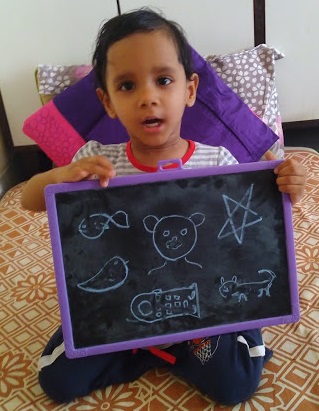
    Adviti showing sketch

    Adviti is attending school now, this started off with thoughts on education, religion, and spirituality. She is three years and we opted for online schooling finally. We avoided it initially, but the Chinese virus (Covid-19) gave us no option of formal school for her. It has been only two weeks. This time around the questions were more than just why do we educate kids? and also the race we start with our kid’s schooling.

    During our primary education, we read this story in our syllabus. This is apt for our life in general and I take a parallel from this story in religion and spirituality as well. Let me first narrate the story to you.

    Hunter and the parrots

    A jungle was famous for its species of parrots. One day a hunter crossed by this jungle. He was mighty impressed with these different types and colors of parrots. The hunter put his net and no wonder he could catch a lot of parrots. He sold those in the market and made a lot of money. He started visiting this jungle often.

    Brighter-day

    A sage lived in this jungle too. He observed that the number of parrots was drastically reducing. Sage being sage, compassionate, and friendly to every animal of the jungle, started teaching these parrots.

    The sage taught these parrots –

    The hunter comes, spreads his net,
    puts some grains, we should avoid this trap

    The exact words we learnt in the Hindi version was 

    शिकारी आता है. जाल फैलता है.
    दाना डालता है. हमें जाल में नहीं फ़सना चाहिए।

    The parrots learned it quickly. They started singing it all the time. When the hunter came he was taken aback. He was fearful now he won’t get these parrots. With a heavy heart, he put his net again. To his surprise, all the parrots were in the net and singing the same song

    The hunter comes, spreads his net,
    puts some grains, we should avoid this trap

    With immense pleasure, he took his prized possession. This time he had value-added parrots – parrots who spoke language!

    When the hunter crossed sage’s hut, sage was smiling. He saw all the parrots singing the song inside the trap that they had to avoid.

    The moral of the story

    We must learn instead of rote memorization. we must learn instead so that conceptual learning can be applied in many walks of life.

    Additionally, there are chances that someone says one thing but does another. We must learn two things – first, we must walk the talk, and second, identify people who do not walk the talk and be cautious.

    Education

    When Adiviti sits for her school sessions, I sit with her. Initially, I was frustrated (at times now too) with her slow response. She knows the things but does not respond, at times she does not understand – because she predominantly understands Marathi and Hindi and not English. She does not follow instructions.

    We learn a lot of very basic and important things in our schools. How much do we apply in our life? Be it learning instead of rote method or the basics – do not steal, do not tell lie, etc.

    Religion

    Another thought triggered in my mind. We learn almost all the ten commandments of Abrahamic religions in School, isn’t it? Most of the religion teach such basic things in our life. If this is the only lesson of religion our school or syllabus of school education is no less than a religious book. In fact, in this case, the schools and education are much more than many of the religions of the world.

    Though I know I have made this comparison on a very high level. In whatever case, what more the religions teach? Follow what is taught, in some cases do not use your brain. Do not question the authority, isn’t it?

    Religions that do not allow questioning is far lesser than school education. At least school education allows asking questions!

    I am a born Hindu (a Lingayat), I have questioned almost everyone and everything religious since childhood. When I was unconvinced I stopped going to temples. When I started understanding few things about Hinduism and started reading few scriptures, I realized many scriptures are dialogs. On the battlefield, Arjun asked questions, Janaka asked questions to Ashtavakra, and Vashisth and Rama discussed multiple things. When someone wrote Upnishad no one asked to believe those by force.

    The Buddha or Mahavir (and other Tirthankaras of Jainism) also gave the point of view without forcing others to accept those as gospel truth.

    Spirituality

    I have written on religion vs spirituality earlier. In that blog, I had given an analogy between religion and spirituality to sex and love. Since now I am looking at education, I created another analogy between education and learning to religion and spirituality. You can learn without formal education. I have heard of a past CM of Maharashtra – Vasant Dada Patil He was educated to only 4th grade. However, he was the harbinger of the robust canal and irrigation system of Maharashtra.

    If we look at multiple definitions of spirituality what best comes to my mind is – “search for meaning in life”. I can connect to the Indic religion (Buddhism, Jainism, and Hinduism) to a large extent. Spirituality is beyond any geography, religious rituals, and believing in a single book alone. Spirituality includes every living being – I can write more on that however that is for some other day.

    In fact, if I take the freedom to extrapolate the story, the hunter (शिकारी) is our false sense of self, net (जाल) greed, lust, ego etc and the grains – bait – (दाना) is our false sense of satisfaction or pleasure. We should not get in the net (जाल), here WE is the SELF.

    Education, religion, and spirituality

    What I have observed is that education and religion are like parrots in the cage. They know what they are saying but they do not understand the meaning of what they are saying. It is with many people and religions worldwide. In fact just because of that either we see terrorism or atheism in the world. People have either lost trust in religion or they are so faithful that they see killing those who do not comply with the point of view of the killer.

    At the same time, learning and spirituality are conceptualizing, synthesizing, and questioning, and exploring. Learning involves a sense of experience similar to spirituality. Look at religion you would get a lot of people who can reiterate books word by word without knowing and experiencing. This is what differentiates religion and spirituality.

    I saw a tweet from Elon Musk once – “I hate when people confuse education with intelligence, you can have a bachelor’s degree and still be an idiot.”

    Education, intelligence Elon Musk tweet

    The corollary, in this case, is – one can be known for religion and religious knowledge without actually being a spiritual master. Whereas Spiritual masters many times are against the dogmas and are more practical and clear about what they say, do, and mean.

    Adviti’s schooling is a learning experience for me. I have to get off the showjumping thing we have observed. I have to let her learn at her own pace. What matters is how intelligent she becomes with the education not how much she scores in school. What is more important is she becomes a virtuous person who walks the talk – not like the parrots who are in the cage reiterating the lesson –

    The hunter comes, spreads his net,
    puts some grains, we should avoid this trap

    The exact words we learnt in the Hindi version was 

    शिकारी आता है. जाल फैलता है.
    दाना डालता है. हमें जाल में नहीं फ़सना चाहिए।

  • Behind our eyebrows

    The world that we see is not outside, it is behind our eyebrows unless we can qualify what we see accurately. Many times, what we see may not be the reality, it is a reflection of what we think we are seeing. Ashtavakra’s explanation is “the rope on the ground is seen as a snake because your mind thinks it is a snake”.

    Shut the mind off

    Mumbai has hardly any winter. This was Feb thankfully we were not sweating after our bath – as we do now in Apr. Thus, we feel good in whatever winter Mumbai has. As usual, this morning also I was doing my daily morning Sadhana (meditation practice). My daughter – Adviti – had just learned to enjoy a toy that moves, throws light, and plays song alongside. She had this toy with her for over a year. When we tried it a year back, she got frightened with the light, sound, and movement of this toy. However, off late, she accepted the toy, and now she keeps on playing with it. A drawback with this toy is – it does not have a volume control option.

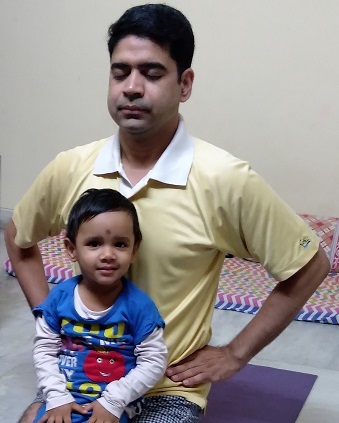
    Adviti-with-me-Pranayam

    I was meditating and she was dancing around with the noise of the toy. After a while, I felt that I should go and stop the toy so that I can peacefully practice today’s Sadhana. Meditation aside, this thought followed up with others. First, it was a noise for me, music for her. She was unaware – as my wife and parents were too – that the sound was uncomfortable for me. The toy was the world for her, she was enjoying it with her heart and soul dancing around it, giggling, and inviting her mother and grandparents to join her. Generally, you feel elated when your child or grandchild is happy. My wife and parents were also engrossed in Adviti’s joy. At the same time for me, meditation was my world. In the same room, we were in two different worlds.

    This happened for a couple of days with me. Somehow, I could keep on continuing my practice without asking for stopping the toy. Within few days, I realized my meditation is my practice, it should not be impacted by external factors. If our mind feels something is a problem we can analyze it with disinterested reasoning or shut the mind off because it creates unnecessary noises behind our eyebrows that we do not even realize.

    The summer has set-in in Mumbai, now after the bath, we start sweating. We do not complain, we cannot change it. Every Mumbaikar has a response for summer of Mumbai – “accept it” – either put an AC at home or apply deodorant.

    Behind our eyebrows

    It happens with all of us. We end up creating our own problems. The mind makes us feel or believe something that may not necessarily be correct. Before assuming something or making a perception a verification can help.

    In March, someone accused me of a thing that neither I intended nor I did. In fact, I had no role in what was going on in this gentleman’s mind! The bigger surprise is – “I was not even the actor in what he though Mr X did, but I was the accused!” I was literally a third party, Mr X, the gentleman and I (one who had no active or passive role in actions of Mr X). I tried justifying myself to him. When I realized the mindset of the other person; I stopped defending myself. Since I had just learned a lesson with Advity’s playing with the toy I could relate the learning. I moved on thinking “if your mind is corrupted, you would be responsible for the words, actions, and consequences. How can someone help you until you are open to listening?”

    Actually, the thought in Hindi was this – “Agar tumhare dimag me bhusa bhara hai to aag bhi dimag me hi lagegi, koi aur uske liye kya kare?” अगर तुम्हारे दिमाग में भूसा भरा है तो आग भी तुम्हारे दिमाग में ही लगेगी, कोई और उसके लिए क्या करे? It would be great if someone can help me translate this effectively in English.

    Everyone lives in his own world. This world is made up of what we live in our minds. What we see is not ahead of our eyes, it is behind our eyebrows.

    After writing the blog, I searched if some enlightened master’s comment is available on these thoughts, I found a pertinent one from Sadhguru.

  • The space

    Last week I went to a salon to take a haircut. All this resulted in in lot of thoughts. The thoughts started from body, to space to the consciousness. For simplicity I believe until we end the contest of God let us call the God or consciousness as space. Coming back to the thoughts, the barber put a cloth around me and sprayed water on my head. In winters, water becomes cold. I was surprised by this sudden spray of water. A couple of thoughts ran my mind. Had I drunk this water, this water would have become part of me. In fact, for the world, it would have lost its existence; for the world, it would be simply Pravin no more water as an entity. At the same time, for me – or say my body – it would not have been the surprise experience of sprayed cold water.

    The barber started trimming my hair. Some hair fell on the cloth that was covering me. A thought struck me again – “my hair”. The moment I thought of my hair. I realized it is no more “my hair” it is just “hair”. We start identifying things with possession – my car, my mobile, his chair, and so on. In reality, this possession is very superficial.

    We breathe in and out every few seconds. The moment we inhale; the air becomes “my breath”; after we breathe out, it is again simply air! How ignorant we are about every tiny content, visible or invisible. We inherit it from the earth, and we will leave it here, but we start identifying it with ourselves and ownerships.

    The space

    Slowly, I have started looking at things differently. Last time, I wrote about science and spirituality. In that blog, I tried connecting the dots of space and consciousness. We have space within us and space is everywhere. Similarly, Consciousness is everywhere – some call it God.

    I was talking to my wife about it. When I told her about space within us – I went to the level of atoms. Every atom has space between the nucleus and the orbit of each electron. This space is bigger than the size of the nucleus and the electrons. I tried explaining consciousness and space relation to her. Let us say you go to the water purifier and fill your water bottle with water. Next, I go and do the same. We start saying this water in the bottle as “my water”. On one note, if someone takes water from the purifier and deep freeze it – the same water becomes ice. Our, body is like the ice, we see it separate from everything. It is part of the same whole as the ice is from the water purifier. We become from nothing and end in nothing. As I wrote in a previous blog – tender coconut. What remains with us? We start calling water “my water” or my body – in my analogy. Does it remain with us forever? No. It is the other way round – we leave the body here. We do not take anything with us. We end up in the space. When I say “we” – what is that we? It is not the body.

    The essence

    The haircut connected me to the consciousness once again. This haircut was very profound, it gave me a lot of thoughts and ways to connect multiple dots. We are not just this limited manifestation – as this Autumn leaf states. We are the past, present, and future of humankind. Every generation gain from the predecessors and leave for successors. Additionally, everything around us – the space – is conscious enough. We make an impact long after we have left a place. Our whole family has been reciting Bhojan Mantra twice daily, at mealtime. The meaning of the Mantra is very profound. The Bhojan mantra explains everything very profoundly – everything comes into existence from the Brahman and goes back to the Brahman.

  • Spirituality and Science

    Mahavir – the Jain Tirthankar – was traveling – walking – for his rainy season retreat (Chaumasa). As is the case with any enlightened master in India, Mahavir too had followers traveling with him. One of his followers – named Gaushalak – was mischievous and wanted to have Proof of his enlightenment.

    While they were crossing a rivulet. Gaushalak asked Mahavir, do you see that plant? Mahavir responded in the affirmative. He further asked Mahavir, would this plant grow into a tree? You know all, you can see the future, and you are enlightened can you please confirm this?

    It is said that enlightened people can talk to even the non-living, or in other words, they can understand beyond the perceived too. In fact, someone told me that in Indian Ayurveda, Rishi’s came to know about some of the herbs when they asked the plant for a cure.

    So, Mahavir reached to the plant, apparently, he asked the plant would you grow into a tree? The plant responded to Mahavir in a Yes. Only Mahavir was at the consciousness level to hear the plant, none of the others. He continued his walk and responded in another affirmative to this follower.

    As this follower wanted to test Mahavir, he went to the plant, pulled it off the ground, and threw it aside. Further, he said – I have removed the plant; I am proving you wrong right now itself. Mahavir continued his walk.

    The rain retreat was over. Mahavir and his followers walked back, cross the same rivulet. Mahavir pointed to a plant and told Gaushalak – do you see the plant? This is the same one, it has not only found another ground but also grown within the past few months. Gaushalak was ashamed of his deeds and doubting the master.

    If I related this story to us as professionals, it is the will to cross the hurdles and blossom in adversities when you have been uprooted.

    My experience

    What makes enlightened masters different than the others? They have a consciousness level of super-consciousness. Super-consciousness can be defined as omniscient, omnipresent, and omnipotent. It may sound a bit off from the spirituality where God is not a matter of discussion. The Buddha did not answer the question of the existence of God. Consciousness has a higher level that is beyond the manifested world.

    I attended a meditation silence retreat of the art of living foundation during the new year’s weekend. It was a wonderful experience. It helped me to understand and experience some unique things. Many experiences cannot be expressed in words. However, the concept of spirituality connected to present-day physics (quantum mechanics) was very easy to grasp and experience. We are all wave functions. Hinduism states that we are made of five elements – Earth, Air, Water, Fire, and Space. Space is omnipresent. All the other elements according to the Mass Energy equation of Einstein are interchangeable to mass (I would call it manifestation) to energy and vice versa.

    The Indian sages have achieved multiple manifestations and changes of form. Read Autobiography of a yogi or At the 11th hour for some examples. Basically, we believe in things that we can comprehend or think are possible. We call things as miracles that are incomprehensible or beyond our perception “as possible”. Slowly science and spirituality seem to be merging. Now our experience can connect the dots to scientific proofs. Slowly our perception of miracle, manifest and unmanifest will be even more blur.

    Two miracles

    In a place named Agar Malwa in MP, there is a Samadhi of Swami Jaynarayan Ji Upadhyay. He was a lawyer and a meditation practitioner. It is an incident of July 1931. Once he was in deep meditation (Samadhi) and missed attending the final hearing of one of his clients. When he came out of meditation, he ran to the court. There he came to know that his final arguments were unbeatable, and his client is acquitted. He was physically in meditation at a temple and there he was in the court too. He knew he missed the session. People say that after hearing this about himself, he left everything and became a monk. Recently, in the same city a law college started and it is named after him.

    Similarly, there is another incident of Guru Nanak dev’s manifestation. It is said that when Guru Nanak dev Ji died, His mortal remains turned into flowers. There was a dispute about his last rites. His Muslim followers wanted to bury, Hindu and Sikh devotees wanted to cremate the remains. Guru Nanak dev Ji avoided this dispute by suggesting the followers bring flowers and keep the same on either side of his. Whichever side’s flowers remain fresh, that sect’s custom should be followed with mortal remains. After his death, only flowers remained, the body could not be found. It is documented as well.

    Spirituality and science

    Some things are beyond comprehension – at least as of now. However, those things can be possible. Science is able to provide an explanation for some, during and after the silence meditation retreat course, I could connect some dots relate to some experiences. Earlier I used to dismiss such stories as fiction. Now, I feel that there is something unexplained for science – call it the ether or Space element – that can be experienced with deeper meditations.

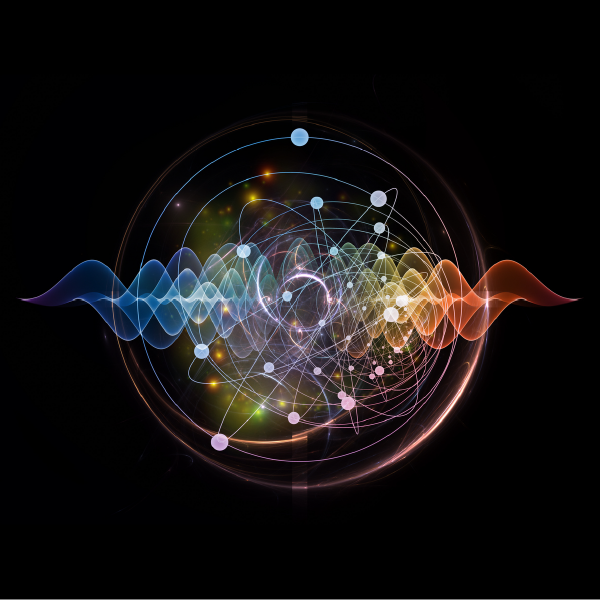
    The point I want to drive home is, we are spiritual beings in physical forms. The idea is not to discuss miracles but the possibilities. Finally, each one is a wave function condensed into a manifestation. In some cases those who are evolved can make change manifestation too. Probably, the self-realization spirituality talks about is the realization and experience of the wave function – that is the omniscient, omnipresent, and omnipotent.

    Image source – https://letstalkscience.ca/educational-resources/stem-in-context/introduction-quantum-mechanics

  • Autumn Leaf

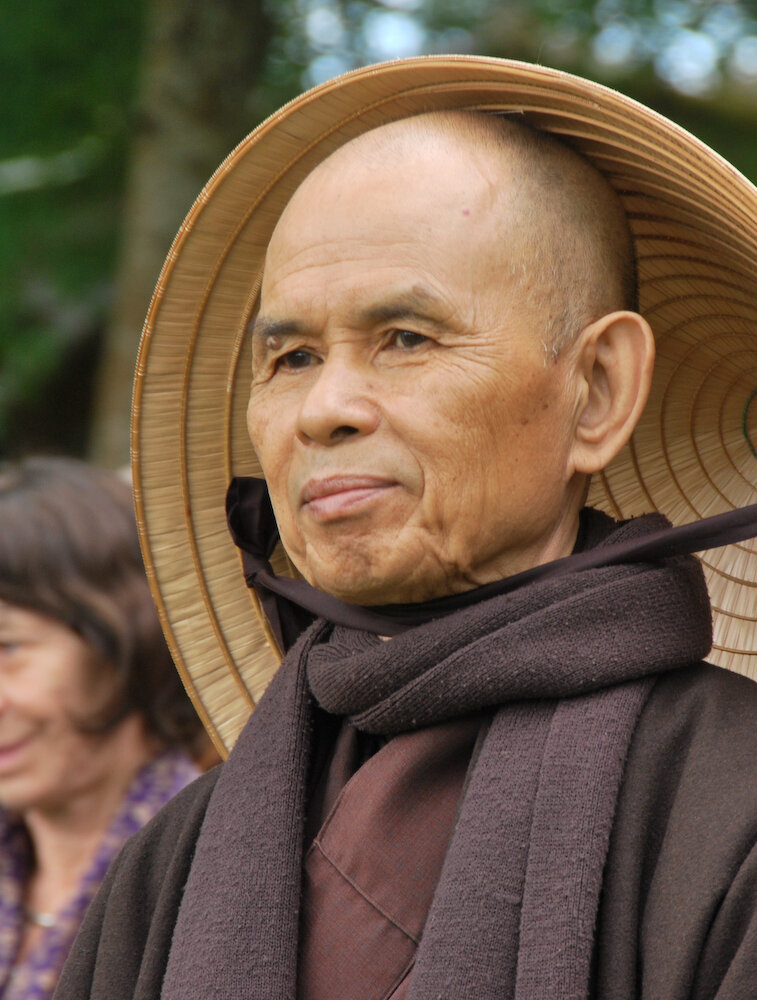
    I received this story Autumn leaf on WhatsApp from my sister. According to the message this is by venerable Thich Nhat Hanh. He is a very famous Buddhist monk from Vietnam. In fact my blog is inspired by his book Old path white clouds. Without any further ado, here is the story.

    Thich Nhat Hanh

    Autumn leaf

    I asked the Autumn leaf if it was frightened because it was autumn and the other leaves were falling.

    The leaf answered, “No. During the whole spring and summer I was completely alive. I worked hard to help nourish the tree, and now much of me is in the tree.

    I am not limited by this form. I am also the whole tree, and when I go back to the soil, I will continue to nourish the tree. So I don’t worry at all.

    As I leave this branch and float to the ground, I will wave to the tree and tell her, ‘I will see you again very soon’.”

    That day a wind came blowing, and a while later, I saw the leaf leave the branch and float down to the soil, dancing joyfully, because as it floated it saw itself already there in the tree.

    It was so happy. I bowed my head, knowing that I have a lot to learn from the leaf.

  • Remember! We’ve to leave the elevator

    Sigmund Freud is one of the authorities on the interpretations of dreams. He wrote a very famous book “The Interpretation of Dreams”. One of his quotes is “Dreams are never concerned with trivia.” I rarely dream or perhaps I dream but forget them before I wake up. If we give some serious thoughts to our dreams, few can teach a lesson or two. The lesson that I learned from a recent dream was – “remember we’ve to leave the elevator”.

    My dream

    Remember! We've to leave the elevator

    Two weeks back I had a dream. This dream was a bit unusual. I was coming out of an elevator. I came out and saw a family – Husband, wife, and two of their children – one infant and one toddler waiting for the elevator. In this building, we had the provision of a room and kitchen for domestic help. This was a family of one such domestic help. I asked him – what happened Ram where are you going with so much luggage? He responded – we are going to our village. Due to Covid we are exhausted with our limited resources and have better chances in the village.

    I held the door of the elevator so that the family can get in. Ram kept luggage and his wife took the kids in. Before I could leave the door for them to proceed, I noticed, Ram was arranging his stuff in the small place as if he has to put his kids to sleep here.

    Before closing the door, out of curiosity, I asked him what are you doing? You will reach ground within a min or so, why are you arranging your stuff here as if you have to live here forever? Before Ram could answer this question, my sleep was interrupted; I woke up.

    Food for thought

    It was good food for thought. We keep on “arranging” things in life, parents ask children to “settle down”. Settling down is a euphemism in India for getting married and having a family. American research suggested that 1 in 8 Americans die in their sleep. We are unsure of waking up the next morning but we prepare life long to arrange things and settling. On a lighter note, “we are very optimistic, to be in the other 7”.

    My point is, instead of being satisfied, which is here and now, and worth earning we become feverish and keep on running endlessly. In some cases, rather than being feverish, some activities become necessary because of other entanglements. It is complex to understand my previous sentence, so to understand the point I am making read this story of the entanglement of a Langot (undergarment).

    Remember! We’ve to leave the elevator

    We must pause and introspect some time. I had written about introspection about a decade back with this question – Why are you doing what are you doing? We must strive for goals and ambitions. At the same time, we must be mindful too. The point is, we must live life to the fullest, enjoy it, and make it comfortable for ourselves and those around us. After all this, we must remember – we are not going to stay here forever – we have to leave the elevator some time – however beautiful it is. The Ram within woke up to say – Ram, you have to leave the elevator sooner or later so watch your actions.

    Image source – https://charterelevator.com/modernization/modernize-you-cab-image/

  • Endless trip of the mind

    Over thinking can cause a lot of damage. This endless trip of mind creates two worlds within our mind. It is difficult to tame the monkey mind. An easy solution is meditation. My personal experience is Art of living part Happiness Program helps in multiple ways.

    Meditation helps in more than one ways. I shall share a recent incident some time in future. Until I get time to write my experience, here is a wonderful story from the book I have referred multiple times on my blog post – Prayers of the frog.

    Our one mind creates so much of trouble, understand Ravana had ten and the disaster it caused. Better to have a head over shoulders that is balanced, isn’t it? Wish you a very Happy Dussehra and I leave you with these thoughts of bringing peace.

    Endless trip of the mind

    Samuel was down in the dumps and who could blame him? His landlord had ordered him out of the apartment and he had nowhere to go. Suddenly the light dawned. He could live with his good friend Moshe. The thought brought Samuel much comfort until it was assailed by another thought. Samuel thought “what makes you so sure that Moshe will put you up at his place?” “Why wouldn’t he?” Came another question in his mind. He said to himself sharply “After all it is I who found him the place he is living in now; and it was I who advanced him the money to pay his rent for the first six months. Surely the least he could do is put me up for a week or so when I am in trouble.”

    That settled the matter in Samuel’s mind, until after dinner. After dinner, his mind again took a trip of thoughts; “Suppose Moshe were to refuse?” “Refuse?” Samuel again reasoned in his mind; “Why in God’s name would he refuse?” The man owes me everything he has. It is I who got him the job, it is I who introduced him to that lovely wife who has borne him the three sons he glories in. Will he grudge me a room for a week? Impossible.”

    Once again, Samuel’s mind settled until he go to the bed. He could not sleep as the thoughts came back “But just suppose Moshe were to refuse. What then?” This was too much for Samuel. His mind was on an endless trip, the thoughts continued “How the hell could he refuse?” Samuel was losing his temper in thoughts itself. His mind continued the chain of thoughts “If the man is alive today it is because of me. I saved him from drowning when he was a kid. Will he be so ungrateful as to turn me out into the streets in the middle of winter?”

    This mental exercise continued in Samuel’s mind; “Just suppose…”. Poor Samuel struggled with it as long as he could. Finally, he got out of the bed around 2 AM in the morning, went over to Moshe’s home, and kept ringing the doorbell until Moshe, half-asleep, opened the door and said in astonishment, “Samuel! What is it? What brings you here in the middle of the night?” Samuel was so angry by now he could not keep himself from yelling, “I’ll tell you what brings me here at this hour of the mind! If you think I’m going to ask you to put me up even for a single day, you’re mistaken. I don’t want to have anything to do with you, your house, your wife, or your family. To hell with you all!” With that, he turned on his heel and walked away.

    How to get over it

    Before your mind or relationships explode like Samuel’s did, my experience based suggestion would be – register for a course mostly happening online during Covid or reach out to me I shall try to connect you with someone who can help you attend an upcoming course.