Search results for: “lingayat”

  • Family – Lingayats

    “Vasudhev Kutumbakam” is a concept in Indian (Hindu philosophy) culture. It means “one world family” that is – whole world irrespective of caste, color, creed or belief system is one family. I received this message recently on whatsapp –

    I crossed my street ?, they asked my caste
    Crossed my district/town???, they asked my city
    Crossed my state ???, they asked my native language
    And I became an Indian ?? only after I crossed my country ✈!

    These things sound different but are related. It may have been true with many, but I had another experience recently. Basaveshwara – poor fellow – died this time in similar sounding country – Canada – than the Kannada where he belonged 800 years back. I feel bad to write “poor fellow” to refer to the saint. I wrote that because of the community he created – Lingayats. I belong to the same and it has missed his thoughts completely.

    I am in Canada and went to attend an event recently. In that event, people generally asked me where are you from where do you work, where do your parents live (as I am from India and others are also Indians). It was all fine to me until one young lady (I will call her Ima) asked me the same questions. I made her name as Ima for Ila’s Mother. I was playing with this 4 year old baby for a while and to hide the identities of these people I have changed the names.

    I said I work in Mumbai, my parents live in MP. Ima said ‘so you are from MP?’ I said yes, I am born in MP but basically I am a Kannadiga.

    Ima probed – Ok where in Karnataka?

    I said our forefathers migrated long back we belonged to Gulbarga.Lingayatism Wiki

    Ima took little more interest this time and further asked – What community are you?

    “I am a Lingayat of Karnataka. Are you aware about the community?” I asked.

    Ima said – “Yes I am a lingayat too, do you worship the ling?”

    The worship she was referring to is a fundamental practice of Lingayats. I was told this by my father, and at times he did it, I said no to her question on the worship.

    “So what kind of lingayat are you?” Was a very blunt statement she made.

    I said except eating rice I am a North Indian.

    The next thing she said was – “You know in Lingayats there are various divisions?”

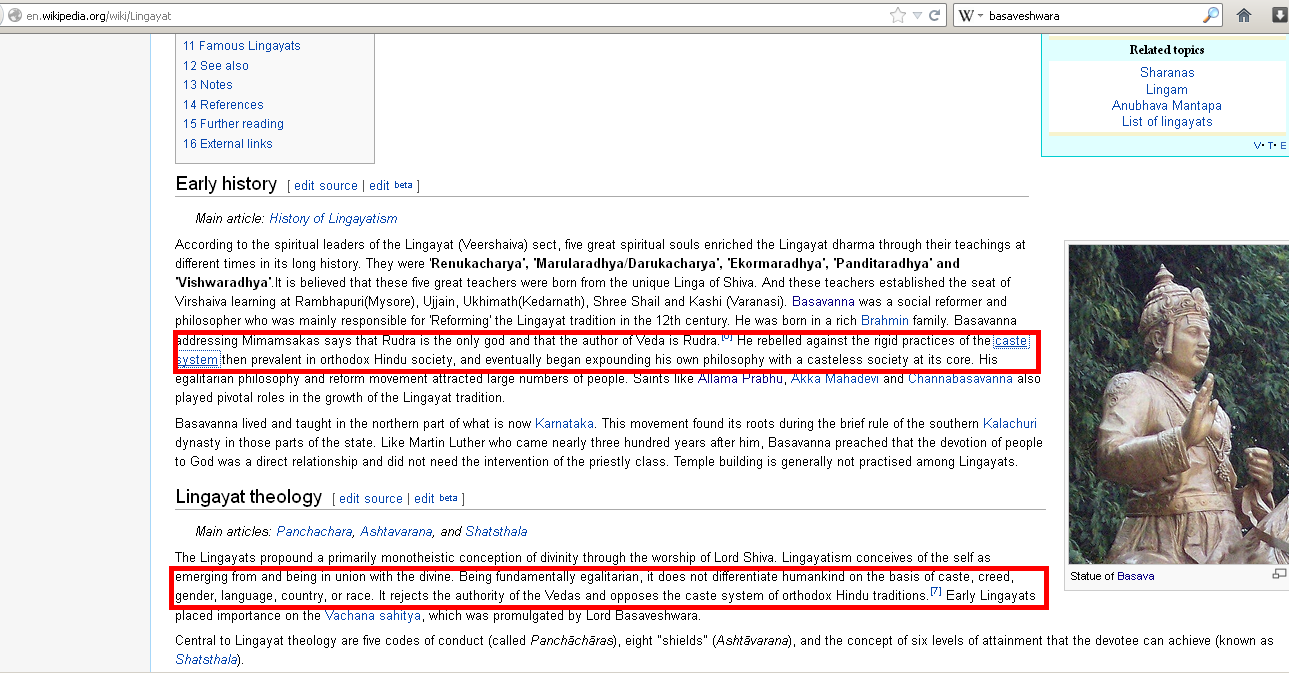
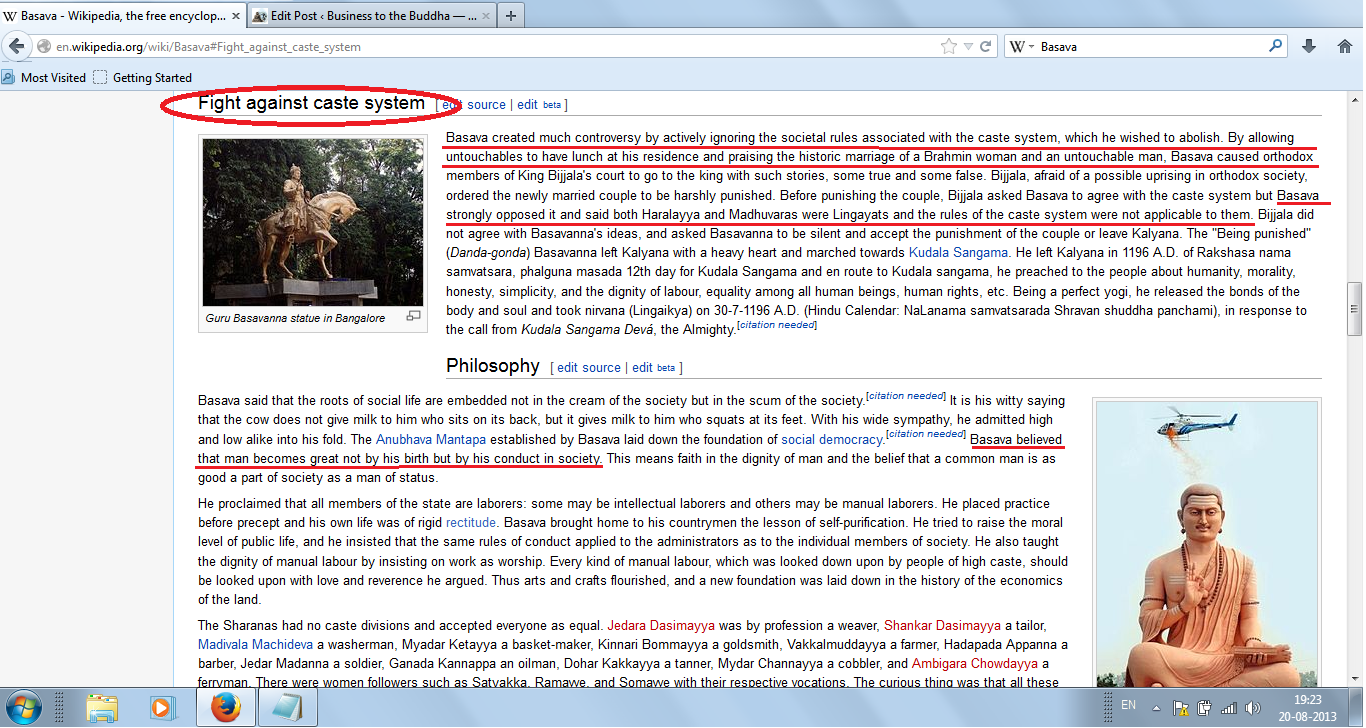
    This lady knows me as a Lingayat in last two sentences not more! The first question was about the ritual and second was about Caste! According to my knowledge When Basava formed Lingayatism he created it because he disagreed with the caste system. Check image.

    I told Ima – “You know what? Basveshwara formed or say resurrected Lingayatism on a concept of – all humans are born equal, and a person is known from his deeds and not his birth. This is what I have read on wikipedia.”

    Ima did not speak with me after that. Yes that is true, I was sitting there for next 5 minute, in fact I was playing with her 4 year old daughter Ila also. On the other side of the hemisphere Basvershwara died once again (after 800 years). Not in Kannada speaking place but a place which sounds similar – Canada. This is how the Families we have created in India. Are we becoming hypocrite? We talk about one world family and then we ask about caste perhaps the sub-caste!

    I feel very good when I connect with one of the Indian concept – “Vasudhev Kutumbakam”. Vasudhev Kutumbakam means one world family. Art of living foundation promotes the same, unfortunately I met Ima in an Art of Living event in Canada.

    Wish the statement of Whatsapp becomes a reality beyond the country point too – Vasudhev Kutumbakam.

    The topic of LBC Family (Generally, I change these topics a bit) suggested by Maria for the weekly Friday Loose Bloggers Consortium where currently eight of us are supposed to write on the same topic every Friday. The seven other bloggers who are expected to write regularly are, in alphabetical order, AshokgaelikaaLin, Maxi, Padmum, Rummuser and Shackman. Do drop in on their blogs and see what their take is on this week’s topic. Since some of them may post late, or not at all this week, do give some allowance for that too!

    Related Blog on Lingayatism.
  • Cast(e)ing doubt – Lingayats!

    This blog is in the series of blogs on – against – the caste system of India. I wish some day we would value people on their

    • Capabilities and not Caste
    • Action and not Ancestry
    • Character and not on Color of skin

    That we all connected there is no two (non-duality) no big vs small no higher vs lower. So let us first understand what is one of the challenges before we reach there.

    First thing first – I have a special love affair for Lingayats (a community in India), let me put a disclaimer – “I am a born Lingayat… (well as per the current Liangayat followers …not practicing Lingayat though.”) It might have been an accident that I am born in this community, but it is all logic and belief that I am beyond the so call Lingayatism.

    A brief history of Lingayatism. It was found (or resurrected) by Basaveshwara in Karanataka. When Basav Anna founded the basic premise was “no-caste system” or in larger perspective – All Humans Are Born Equal. The hypocrisy of this seemingly one of the youngest religion is – it has more than 16-17 different sub-castes. Check Wiki for more details and before someone reads about the Hypocrisy of Lingayats and deletes the reference here is an image from Wiki –

    Fight against caste systemlingayatism-wiki


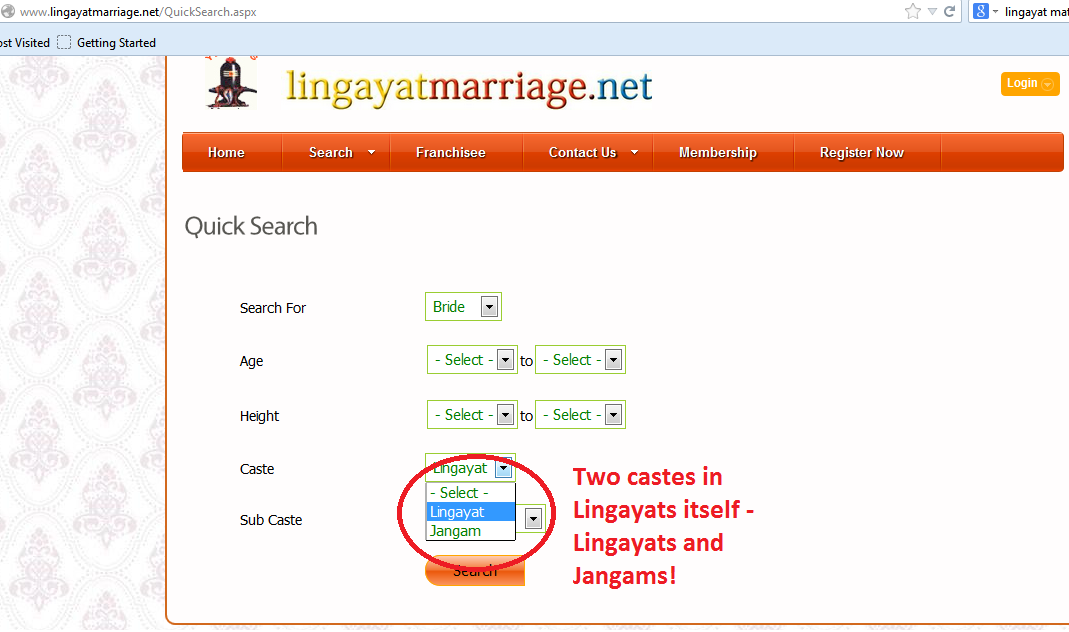
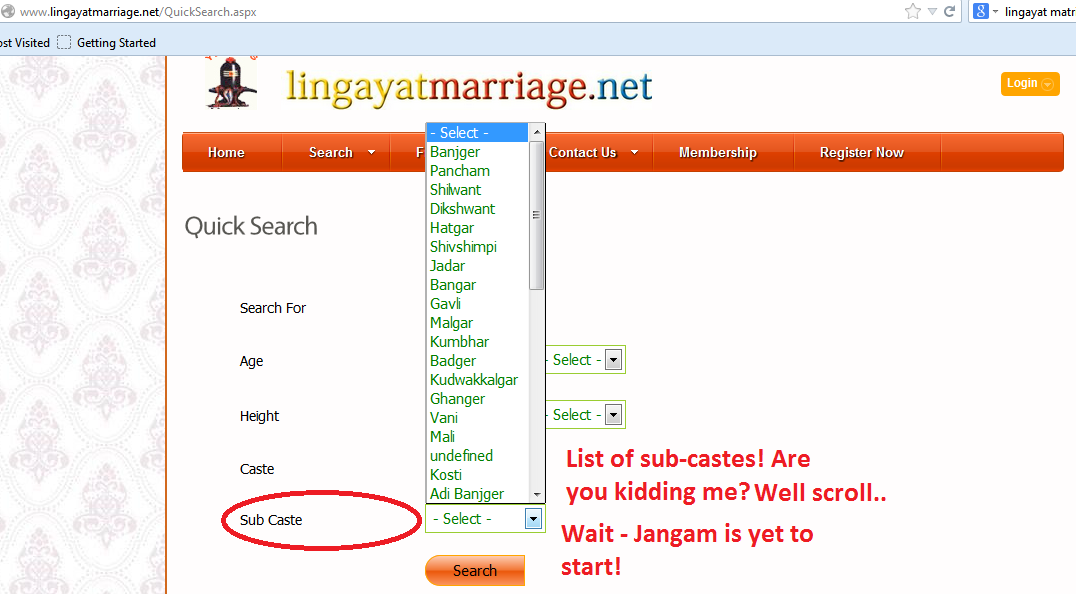
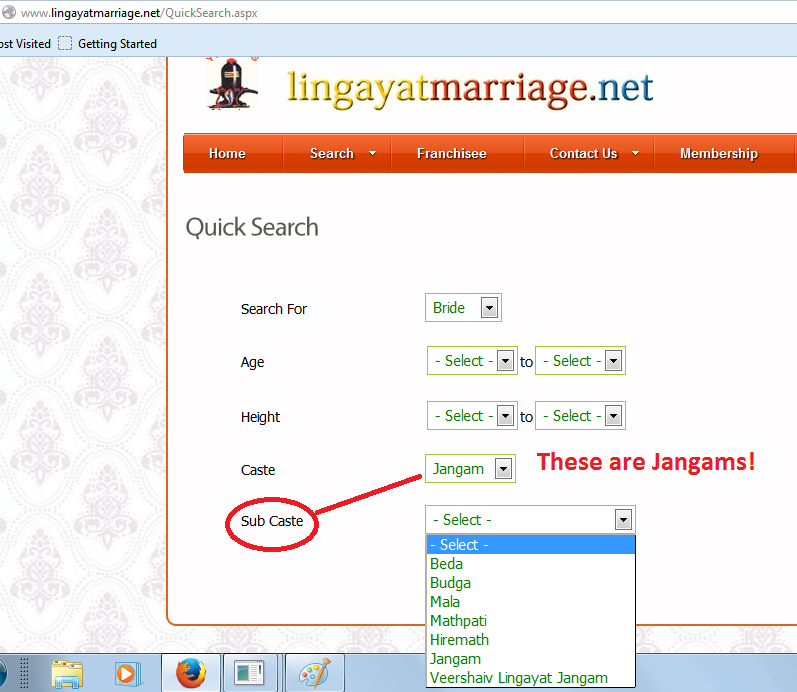
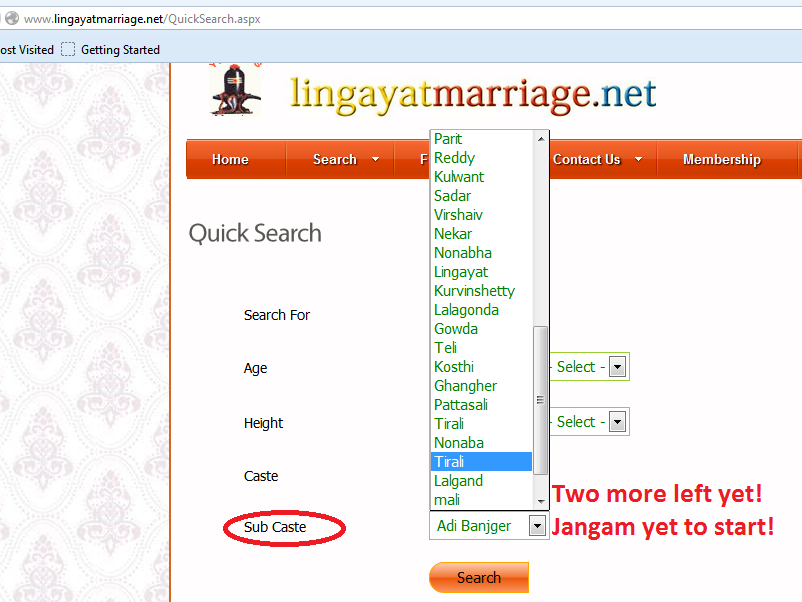
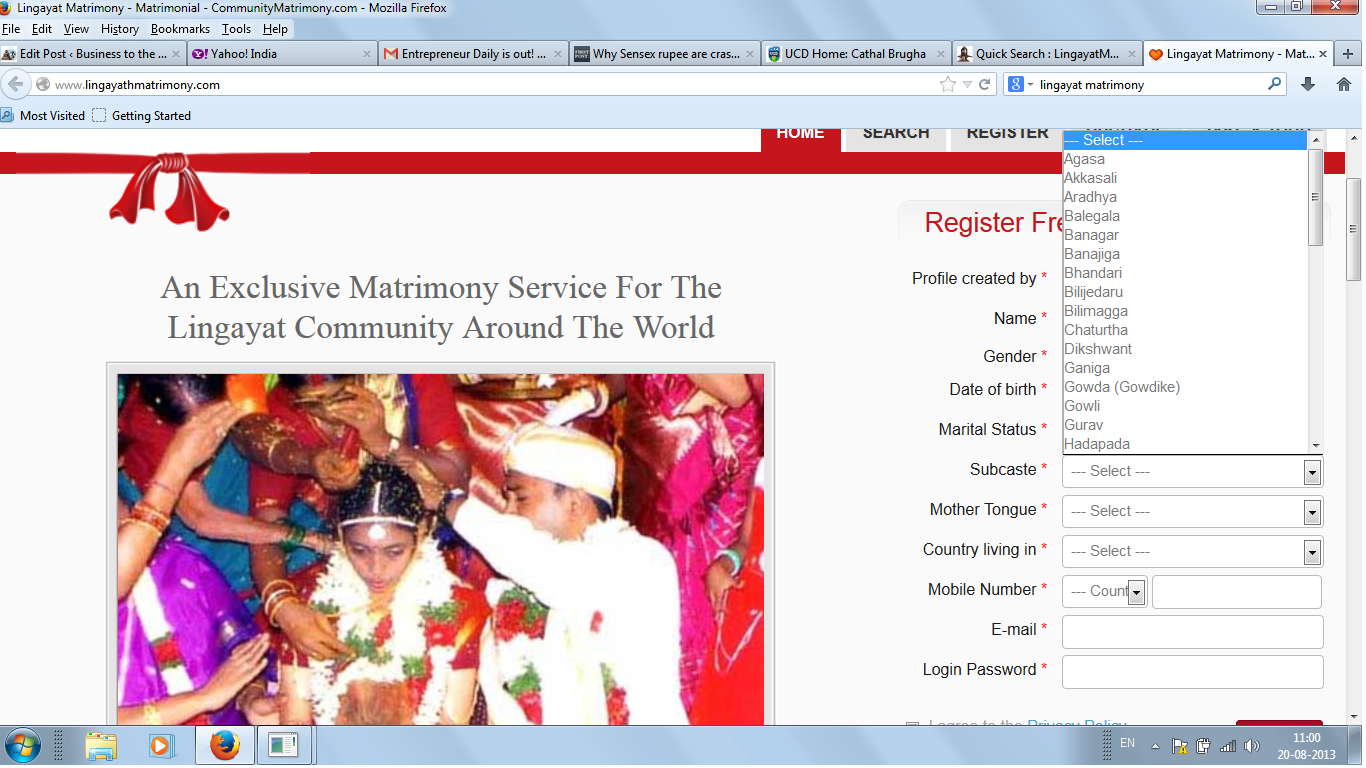
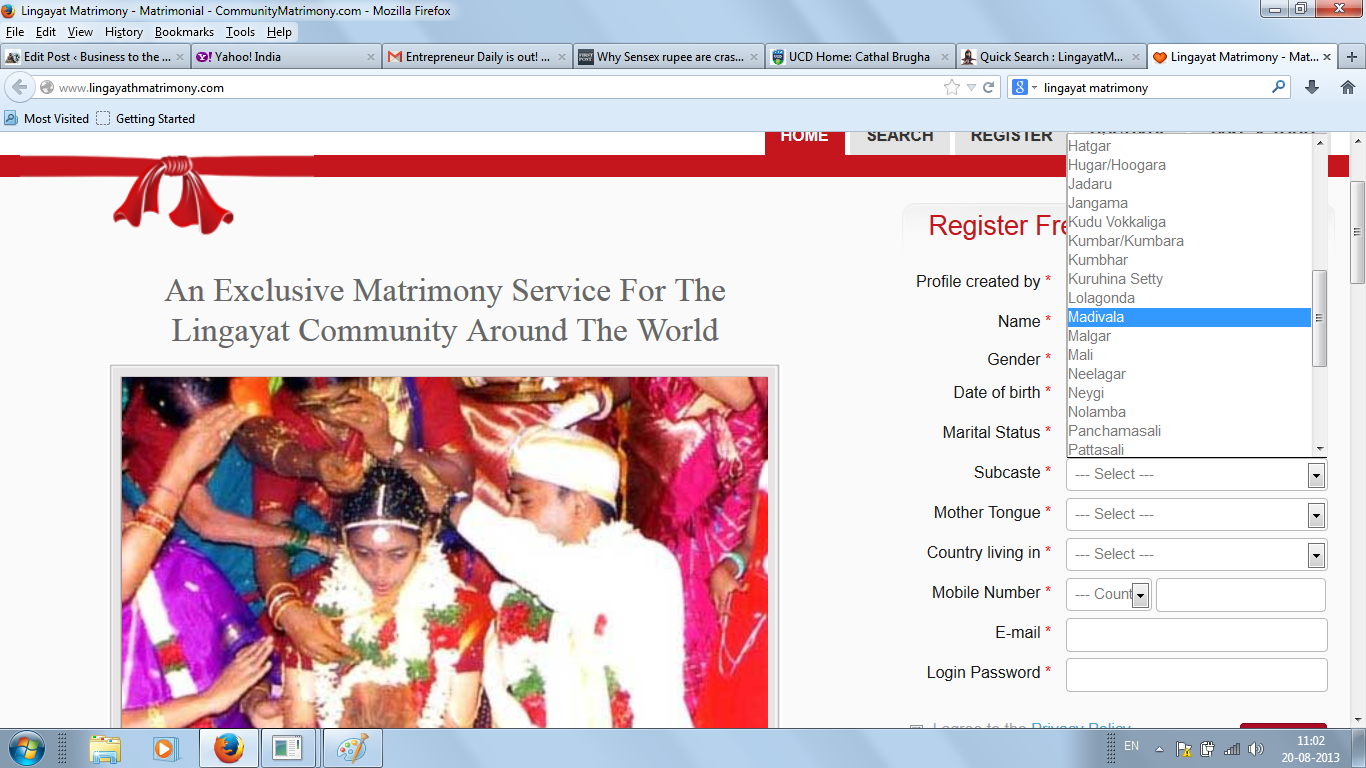
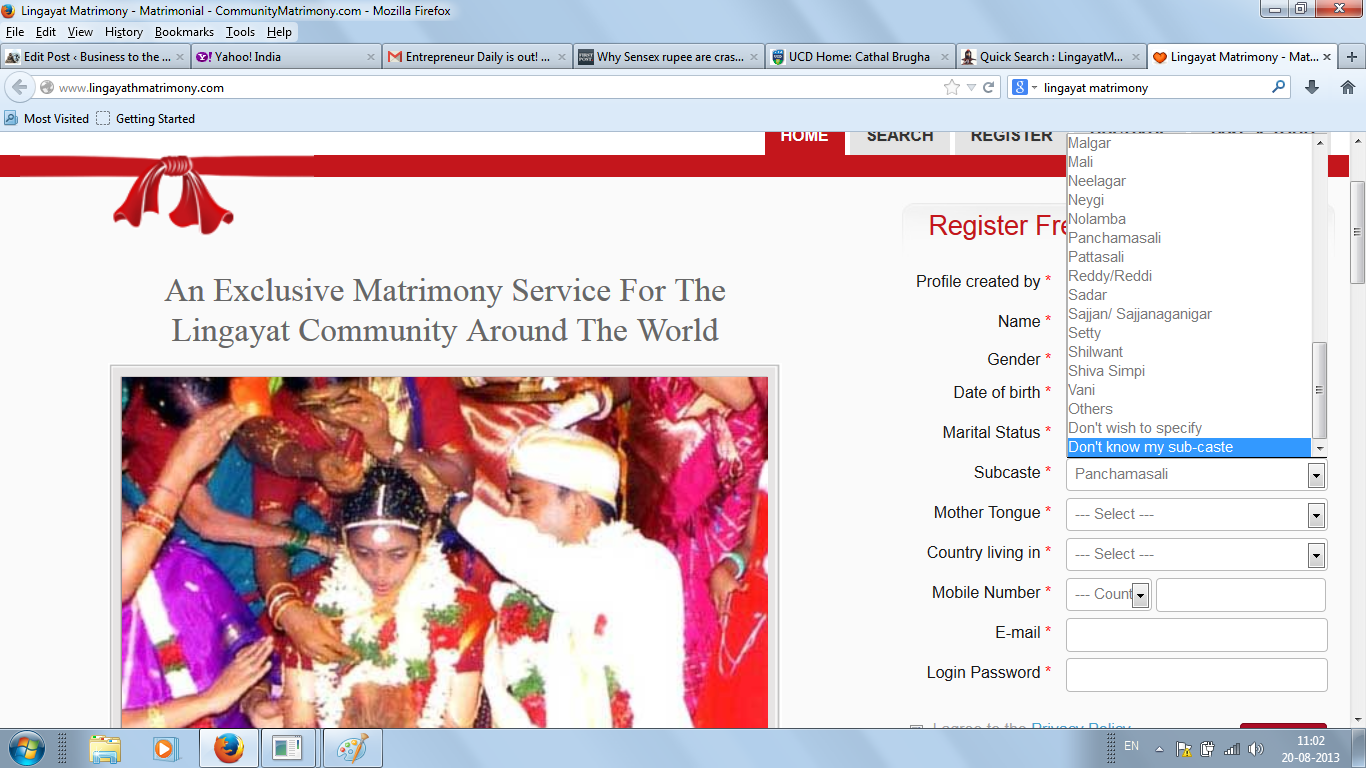
    So Basava fought caste system. It all started by the story of marriage of a Brahmin and an untouchables. Now look at the so call matrimonial sites of Lingayats (image thumbnail below, click to enlarge). Basava must be crying in his grave for such blatant contempt of his fight. Poor fellow fought his fight for eqaility and against caste system (apparently by calling a marriage among Brahmin & untouchable) and here Lingayats have first division as Lingayats and Jangams. Within those two factions they have more division.

    When people ask “What Lingayat are you?” I feel Basava’s fight has gone in vain. No meaning of him having a community which has completely shattered its own foundation of existence. Now read Wiki article on Lingayatism as well you would understand what actually I mean and what is practiced.


    Image sources – Wikipedia, www.lingayatmarriage.net and http://www.lingayathmatrimony.com/

    Lingayat Matrimonial site imagesLingayat Marriage  2Lingayat Marriage  4Lingayat Marriage  3 Lingayat Matrimony - Bharat Matrimony 1 Lingayat Matrimony - Bharat Matrimony 2

    Lingayat Matrimony - Bharat Matrimony 3

    Related blogs

    Cast(e)ing doubts – Narendra Dabholkar

    Cast(e)ing doubt – What’s your (last) name?

    Cast(e)ing doubt –  everyone’s tears are salty

    We the societies

  • Mindful or Involuntary action, are you spiritual or religious?

    Mindful or Involuntary action, are you spiritual or religious?

    I lived in Dhar, a small district headquarters in Madhya Pradesh. It is a small city or say a town. It is a peaceful city with low crime rates. I hope it is still like that. This small place taught me how to handle your fears, it does not include the Fear of the God. Those days there was no fear kidnapping or children lost in the city. So, we kids used to go from one place to the other alone unquestioned.

    Dog of our area

    In Dhar, like any other city in India, you could see domestic animals on road. Stray dogs were no surprise either. There was a stray dog in our area. We walked that place multiple times daily. This dog was tough to handle. It used to bark, run behind, fight with other dogs, and occasionally bite. We kids were scared to cross the place when we learnt about the dog. In fact, we were “dog fearing”.

    Fear of dog

    We could not stop going to school because of the dog. We devised a plan, we started keeping stones in our hands. Whenever we saw the dog, we threw stones at him and ran away from that area. This dog-fear gave us a solution to scare the dog away rather than be scared.

    But why am I telling this story to you? This story has a very nasty relation and question to you – How can you “respect” someone as scary as a mad dog? I know when you read further you may hate me or be disappointed because I am questioning your beliefs. But I must pose this question to you. How can you be “God fearing”? If God is such fearful entity, it must be called a demon, isn’t it? If God is good, we should have a healthy relation with him/her and not a fearful one.

    God fearing

    If you have followed my blog for past few years you must have read about my marriage alliances. In my matrimony profile I had written “I am spiritual but not necessarily religious”. Some of the prospective alliances confused it with “religious”. So, prospective bride or bride’s family told multiple types of stories around their being religious.

    At some of the interactions I smiled and explained to a few that I rarely go to a traditional temple. I may call few places as places for my worship such as my art of living center where I go for weekly sadhana or meditation practices.

    After a few attempts, I started ignoring it – spirituality does not necessarily mean religious. I had lost interest to explain it to people. Why? Because I met about two dozen families or alliances for the alliance discussion.

    Once, I heard a very interesting new term. “I am god fearing”. I had never heard it earlier, I was impressed and surprised too. Probably I was less educated about religion. I had to ask around what does this mean? Is it “religious?”

    Spiritual not necessarily religious

    Fortunately, I have some great mentors, one is Ramana uncleji. I shared this profile with him and asked him what does “God fearing” mean?

    Uncleji told me – “None of the Indian religion teaches you fear. In fact, none teaches you fearing from God in specifics.”

    I added – yes, I understand – Krishna is embodiment of love.

    Spiritual mindful lotus

    Uncleji continued – “Yes, the concept of fear of God is from Abrahamic religion (religions that started from the Central Asia). The girl is from a convent school.”

    I was shocked, how could he figure it out? He was correct, though the profile did not have specifics of primary education. He said I understand it because mostly this is where you may learn the concept of fear from the Gods. Regular Indian family may hardly teach “Fear the Gods” at home.

    He further added, the concept of fear from the God works when you must keep people in check and let them follow you “unquestionably”. Indian religions (Hinduism, Buddhism, Jainism etc) hardly force you to follow the diktat without questioning.

    I further mumbled – that’s correct, Arjuna asks questions to Krishna in Bhagvad Geeta. Vashishtha answers to Rama in Yog Vashishtha. In Ashtavakra Geeta, Ashtavakra discusses with Janaka and Shiva Sutra is full of questions from Parvati. We Indians have argued with almost every God.

    Spiritual vs religious the difference

    I have met many people who keep on bowing whenever they see a temple. It happens at times when the closing of eyes and folding of hands looks like an involuntary action. Involuntary action means something that happens without your conscious choice; examples are breathing, digestion and closing of eye in case of sudden light.

    Namaste on the back

    If you are just folding your hands without even your knowledge or without any deeper respect in your heart what is the meaning? It is like you closed your eyes when you saw a danger.

    The idea of bowing down is not necessarily incorrect. Devotion makes you bow. This comes out of reverence and not fear. Bowing down can be a great mindful act and not an involuntary action, isn’t it?

    Rarely, I saw that bowing down out of devotion or reverence. Mostly people bow down crossing any place of worship because of two reasons either they have some demand, or they are scared.

    Fearing the God

    In fact, I am amazed, the convent educated are a step ahead in the confusion. I saw these convent educated to make a cross on their face (similar to a Christian would do while crossing a church). I asked to one – what is that? She said we passed by the temple.

    I smiled and said shouldn’t you be folding your hand?

    Fear of the God

    I further inquired, why did you do that? The response was – it has become a habit. Really? A habit? Did you not learn something known as “respect”?

    Fear created this habit. It is like an involuntary action, as a kid we used to keep stone when we saw fearsome dog in Dhar. How can you be a God-fearing person? How can you call yourself religious if you fear God?

    At best the creature who gives you fear can be a fearsome villain, a monster or demon, if I say in Hindi an Asur or Rakshasa. You can fear a stray dog not the God. If you fear the God, it simply means you are taught incorrectly, there is likely a problem in your religious learning.

    Next time, when you bow down remember – the temple or the Murti in the temple is just a representation. The God is omnipresent, omniscient and omnipotent. You would know soon if you are religious – as conditioned in childhood – or spiritual. It is better the bowing down happens due to reverence and mindfulness rather than fear and involuntary.

    Image source – Husky dog by Ilya Shishikhin on Unsplash, Lotus by Jay Castor on Unsplash, Yoga pose by Avrielle Suleiman on Unsplash, Love and fear quote frame by Priscilla Du Preez on Unsplash

  • Education, religion and spirituality

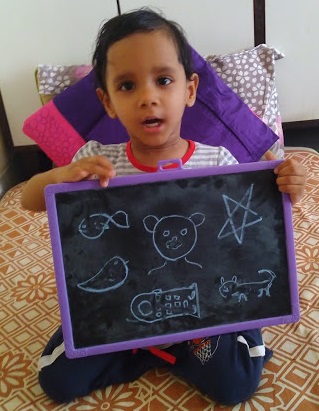
    Adviti showing sketch

    Adviti is attending school now, this started off with thoughts on education, religion, and spirituality. She is three years and we opted for online schooling finally. We avoided it initially, but the Chinese virus (Covid-19) gave us no option of formal school for her. It has been only two weeks. This time around the questions were more than just why do we educate kids? and also the race we start with our kid’s schooling.

    During our primary education, we read this story in our syllabus. This is apt for our life in general and I take a parallel from this story in religion and spirituality as well. Let me first narrate the story to you.

    Hunter and the parrots

    A jungle was famous for its species of parrots. One day a hunter crossed by this jungle. He was mighty impressed with these different types and colors of parrots. The hunter put his net and no wonder he could catch a lot of parrots. He sold those in the market and made a lot of money. He started visiting this jungle often.

    Brighter-day

    A sage lived in this jungle too. He observed that the number of parrots was drastically reducing. Sage being sage, compassionate, and friendly to every animal of the jungle, started teaching these parrots.

    The sage taught these parrots –

    The hunter comes, spreads his net,
    puts some grains, we should avoid this trap

    The exact words we learnt in the Hindi version was 

    शिकारी आता है. जाल फैलता है.
    दाना डालता है. हमें जाल में नहीं फ़सना चाहिए।

    The parrots learned it quickly. They started singing it all the time. When the hunter came he was taken aback. He was fearful now he won’t get these parrots. With a heavy heart, he put his net again. To his surprise, all the parrots were in the net and singing the same song

    The hunter comes, spreads his net,
    puts some grains, we should avoid this trap

    With immense pleasure, he took his prized possession. This time he had value-added parrots – parrots who spoke language!

    When the hunter crossed sage’s hut, sage was smiling. He saw all the parrots singing the song inside the trap that they had to avoid.

    The moral of the story

    We must learn instead of rote memorization. we must learn instead so that conceptual learning can be applied in many walks of life.

    Additionally, there are chances that someone says one thing but does another. We must learn two things – first, we must walk the talk, and second, identify people who do not walk the talk and be cautious.

    Education

    When Adiviti sits for her school sessions, I sit with her. Initially, I was frustrated (at times now too) with her slow response. She knows the things but does not respond, at times she does not understand – because she predominantly understands Marathi and Hindi and not English. She does not follow instructions.

    We learn a lot of very basic and important things in our schools. How much do we apply in our life? Be it learning instead of rote method or the basics – do not steal, do not tell lie, etc.

    Religion

    Another thought triggered in my mind. We learn almost all the ten commandments of Abrahamic religions in School, isn’t it? Most of the religion teach such basic things in our life. If this is the only lesson of religion our school or syllabus of school education is no less than a religious book. In fact, in this case, the schools and education are much more than many of the religions of the world.

    Though I know I have made this comparison on a very high level. In whatever case, what more the religions teach? Follow what is taught, in some cases do not use your brain. Do not question the authority, isn’t it?

    Religions that do not allow questioning is far lesser than school education. At least school education allows asking questions!

    I am a born Hindu (a Lingayat), I have questioned almost everyone and everything religious since childhood. When I was unconvinced I stopped going to temples. When I started understanding few things about Hinduism and started reading few scriptures, I realized many scriptures are dialogs. On the battlefield, Arjun asked questions, Janaka asked questions to Ashtavakra, and Vashisth and Rama discussed multiple things. When someone wrote Upnishad no one asked to believe those by force.

    The Buddha or Mahavir (and other Tirthankaras of Jainism) also gave the point of view without forcing others to accept those as gospel truth.

    Spirituality

    I have written on religion vs spirituality earlier. In that blog, I had given an analogy between religion and spirituality to sex and love. Since now I am looking at education, I created another analogy between education and learning to religion and spirituality. You can learn without formal education. I have heard of a past CM of Maharashtra – Vasant Dada Patil He was educated to only 4th grade. However, he was the harbinger of the robust canal and irrigation system of Maharashtra.

    If we look at multiple definitions of spirituality what best comes to my mind is – “search for meaning in life”. I can connect to the Indic religion (Buddhism, Jainism, and Hinduism) to a large extent. Spirituality is beyond any geography, religious rituals, and believing in a single book alone. Spirituality includes every living being – I can write more on that however that is for some other day.

    In fact, if I take the freedom to extrapolate the story, the hunter (शिकारी) is our false sense of self, net (जाल) greed, lust, ego etc and the grains – bait – (दाना) is our false sense of satisfaction or pleasure. We should not get in the net (जाल), here WE is the SELF.

    Education, religion, and spirituality

    What I have observed is that education and religion are like parrots in the cage. They know what they are saying but they do not understand the meaning of what they are saying. It is with many people and religions worldwide. In fact just because of that either we see terrorism or atheism in the world. People have either lost trust in religion or they are so faithful that they see killing those who do not comply with the point of view of the killer.

    At the same time, learning and spirituality are conceptualizing, synthesizing, and questioning, and exploring. Learning involves a sense of experience similar to spirituality. Look at religion you would get a lot of people who can reiterate books word by word without knowing and experiencing. This is what differentiates religion and spirituality.

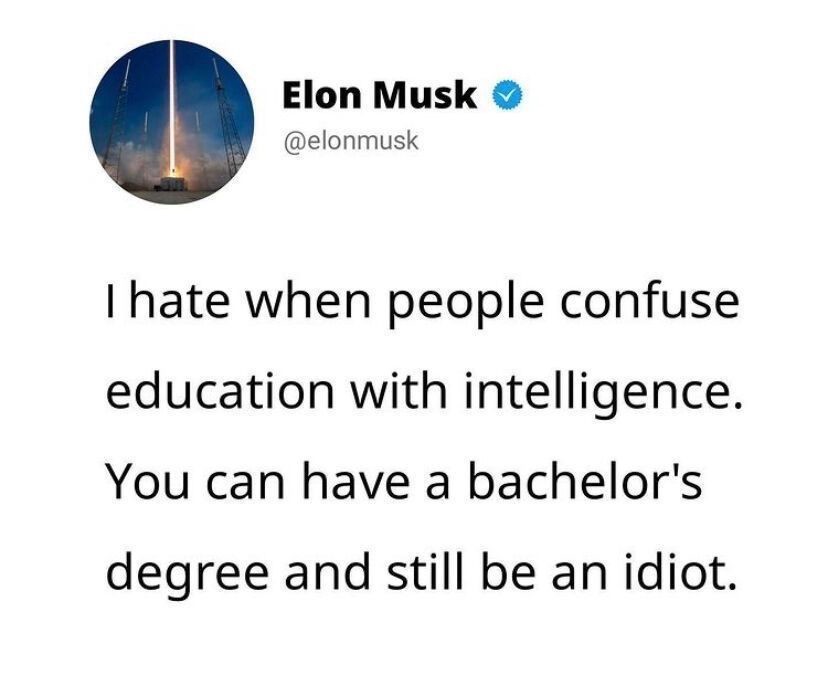
    I saw a tweet from Elon Musk once – “I hate when people confuse education with intelligence, you can have a bachelor’s degree and still be an idiot.”

    Education, intelligence Elon Musk tweet

    The corollary, in this case, is – one can be known for religion and religious knowledge without actually being a spiritual master. Whereas Spiritual masters many times are against the dogmas and are more practical and clear about what they say, do, and mean.

    Adviti’s schooling is a learning experience for me. I have to get off the showjumping thing we have observed. I have to let her learn at her own pace. What matters is how intelligent she becomes with the education not how much she scores in school. What is more important is she becomes a virtuous person who walks the talk – not like the parrots who are in the cage reiterating the lesson –

    The hunter comes, spreads his net,
    puts some grains, we should avoid this trap

    The exact words we learnt in the Hindi version was 

    शिकारी आता है. जाल फैलता है.
    दाना डालता है. हमें जाल में नहीं फ़सना चाहिए।

  • Adviti and perspective change

    Adviti is growing up, she has started turning and every now and then she turns. When feeding her, she turns that makes putting food in mouth difficult. It was surprising initially to feed her used to be irritating that she is turning in no time. Once, I was talking to a relative, she said – Adviti will keep on doing it because it provides her a different perspective to the world. As an infant, how good and easy for them to change perspective – make it exactly 180 degree and enjoy. How difficult for us to change our perspective?

    This change in perspective gave me an opportunity to question my own opinions. So, first was marriage in particular caste. The other apparent Indian customs such as – girls parents to not step in her home once girl is married! Yes that I have heard in conservative families. I don’t know how much is it followed now. So, when I badgered Lingayat community for disrespectful behavior on marriage issues, today I try to look at another perspective.

    perspectiveOne of the possible reason for people looking at their own community or professional background could be that a girl grown up in similar environment may find it easy to settle in new family with similar customs or work requirements. If a farmer marries a goldsmith’s daughter would not it be very difficult for her to get accustomed to the new way of living?

    Second, when society used to say not to go to girl’s home after her marriage, the possible reason could be – avoiding conflicts. Indian soap opera’s show it often. Additionally, olden days, it used to be a wish that girl is married in a family of economically higher standing. So, possible that girl or her parents should not feel uncomfortable, or should not be named for their out of place demeanor by the boy’s family. My small mind could think of only these possible reasons.

    Lastly, eastern religion – all have concept of rebirth and karma. Personally, I not only follow but also believe in these concepts. A different paradigm from these seemingly good concept is here. If you tell a student that you’re not good at mathematics because in last life time you moneylender and did mischievous calculations to let the borrowers keep on paying you unnecessarily, that is a bad perspective on the concept.

    There are many wars, fights and arguments due to perspectives. Be it capitalism vs socialism, one religion vs the other or political biases. We can be passionate about our perspective yet should be compassionate to listen to others view too. Otherwise there will always be wars, fights and arguments.

    Adviti is teaching me a lot of things with her growing up. The recent one is changing perspective and looking at the other side, even if it seems incorrect prima-facie. This is a difficult task, I am trying to learn though, she changes her perspective by 180 degree easily at this age. Are we as adults going to learn something from our next generation?

    Image source – https://commons.wikimedia.org/wiki/File:Point_of_view_bias.jpg

  • Dalits in India, Dividing work, birth or none?

    Perhaps in middle school (6th to 8th), we learnt a lesson on why crows are our best friends and what we can learn from them. They eat dead animals and therefore keep our surrounding clean. We need to learn from them that whenever they see something to eat they always invite their fellow crows and all of them eat it together – what camaraderie, isnt it? But alas! as we grow we forget these small things we learnt as kids.

    Perhaps Krishna knew it all, he suggested Draupadi (Panchali) to reject Karna and thus Panchali said – Karna is a son of lower caste and I wont accept him as my husband. This – for my readers who have not heard of Mahabharat or know the context – was an India where girl (if not all, at least daughters of Kings), had the freedom to decide who she wants to marry. This was called Swayamvar – or a competition – where husband was selected by his capabilities by the girl. This kind of Swayamvars are recorded in history – be it Rama or Prithviraj Chauhan (12 century AD). Compare it with arrange marriage system of say two generations back when such decision was not that easy to offer to girl. This was an India where even if Krishna (God in human form as per Indian scriptures) was alive, abilities of Karna was proved secondary than caste (family’s profession).

    We have heard many such incidents in Indian history when a untouchable became center of discussion – be it Shabari who fed Rama only sweet berries by tasting those first. Here untouchable was first tasting the fruit and than offering it to Rama. Or be it a story of Eklavya. He approached Dronacharya (Drona) who refused him, later asked him to chop off his thumb to offer it as fee of teaching. Or the story of Sunita during time of the Buddha.

    I dislike the concept of caste system of India to the core. Slowly I moved away from the ritualistic religion to spiritual part of religion. I read parts of Bhagavad Geeta too. When I read Chapter 4 verse 13 of the Geeta I interpreted it in my own way, thank god at least Hinduism offers differing with the pandits; I can have my owns interpretation of the scriptures (ref recent controversy of Irrfan Khan).

    (Sanskrit) चातुर्वर्ण्यं मया सृष्टं गुणकर्मविभागशः । Sunita “Lord, I do not dare come closer. I am an untouchable.”
    तस्य कर्तारमपि मां विद्धयकर्तारमव्ययम्‌ ॥

    (Transliteration) catur-varnyam maya srstam, guna-karma-vibhagasah
    tasya kartaram api mam, viddhy akartaram avyayam

    I infer this as follows – “I created four sub-division of society based on work and attribute. Even after doing this I am above and beyond this division.” Remember Krishna does not say that the division is based on birth, it is based on work and attribute of work.

    Listen to other language translation here, I cannot say it this translation reflects my opinion.

    In whatever ways Indian society has misinterpreted the concept completely. This whole caste system implementation has gone awry. I believe the concept could have been, teach kids and when they grow up their abilities will put them to different works and thus their work in society will be divided in four sub-divisions! Even if this sounds justification of the caste system, I still dislike the caste system. Everyone must have his/her fair opportunity to learn and try what and how one wants to work in the society. I hope the capitalistic economics and current open access to opportunities will offer an evolved society. Currently it is just a hope, as we read the news about atrocities against Dalits. It has been close to 70 years, but if we still see these news in media either there is something wrong with our society or media is giving coverage to it only now!

    Just fresh graduate from college and I’d just joined my first job, where I was selected through campus interview. I resigned within few weeks stating I’d have done this work after my 10th, if I were to do it. My brother taught me at that time – “no work is bad, low or menial. Do not look at your resignation from your first job as an ego issue. Accept it ‘you would not have enjoyed doing it.‘ If you want to start a company, it is upto you, if you want to study further, be into R&D be it. Even if you are gardening, be the best of the gardener you could be. Do it to the best of your abilities, no work is low or menial and never forget this lesson.

    I could relate to his lesson in many sense, be it a crow’s nature to clean our surrounding inadvertently or our society having different people performing different acts, we have to balance and accept that everyone does what best he/she can do for the society. There may be instances when one’s abilities are not utilized (as was in my first job); at that time he/she has to decide to move on and do what makes more sense to him/her. In today’s world when a person makes competitive strategy – he/she is Kshtriya (warrior clan in Indian caste system). When the same person presents his concept or shares his knowledge he/she is Brahaman (Pundit, teacher clan in Indian caste system). As a startup CEO (Chief Everything from dusting room to meeting clients to executing tasks) when one cleans his desk, prepares tea, drives somewhere or designs product/service he/she is Shudra or Vaishya (lower caste or businessman clan in Indian caste system). In current social and economic setup we cannot rely on the definition of works of previous times. We need to either define things in newer manner or perhaps just get rid of the division itself.

    There may have been roads paved with good intentions (by dividing work & caste system), but could not have lead to heaven at least. We started dividing society not on work but on birth. We decided one work is better than the other – but this is be good.

  • Tolerance

    Recently I heard of Sahitya Akademi award controversy. The issue at hand is – many intellectuals are returning their awards conferred to them by the Govt. Sahitya Akademi is a National organization for literature, it is under the ministry of culture Govt of India.

    Since, I am not in India currently so the source for all this happening was internet. The spark for these events is – brutal murder of an author, rationalist and scholar Mr M M Kalburgi. By the way, I searched on Wikipedia – he was a Lingayat. No, I am not going to say that READ HERE again! Resignation

    So according to my knowledge – Mr Kalburgi was a Sahitya Akademi awardee of 2006. He – being a rationalist – opposed idol worshiping. In India it is fine to follow any religion and practice the rituals suggested in the religion. Idol worship is prominent in India. I too believe it is fine not to worship idol. At the same time, I am fine with people worshiping idols, it is their preference. However, killing Mr Kalburgi – who is against idol worship – is not acceptable.

    I came to know about the Sahitya Akademi award return (by many previous awardees) is influenced by another event in India – a cold blooded murder of a person. Mob killed a person because it was rumored that he has eaten beef! Eating beef is a norm in western world are we going to kill the foreigners too? I am a vegetarian and my belief is we should not kill to eat. Also, if selling/eating beef in India is not legal it does not mean mob can kill a person based on that rumor. Here is a video in which Sadhguru Jaggi Vasudev is sharing his opinion on why one should not eat beef (and other things)

    https://www.youtube.com/watch?v=yneyNx-SRzg

    Another news I read recently is killing of 2 kids of Dalit family in Haryana. What are we doing? It is surprising.

    All these points boiled down to tolerance for me. We need to be accepting people’s opinion and not be selective.

    Out of curiosity I thought to check opinion on Ramana uncle (generally I call him to ask for his opinion, but currently it is expensive to do that). I searched on his site for tolerance and found this blog – Ramana Uncle on MF Hussein. This blog is on events happened around the kind of work M. F. Hussein has done.

    Even if we talk about tolerance, freedom of expression etc it does not mean one gets the right to evoke sentiments the way Mr Hussein did neither it gives authority to kill others.

    Image source – Twitter (unfortunately I dont have the link)

  • Gratitude

    This blog is dedicated to my adopted uncle – Mr Ramana Rajgopaul. Actually, he is kind enough to adopt me as RR-at-weddinghis nephew. Uncleji writes daily on his blog website – www.rummuser.com

    I got connected with uncleji in 2011, when inadvertently I reached his blog site, read blogs and read “about me” section. We started communication through mails and later over phone. I met him the same year and of course have been seeing him often. He has been a go to person for anything in my life starting 2011. I have requested for his guidance in personal, professional and virtual life (Facebook/twitter/blog). I think I had deleted a Facebook comment when he suggested negatively on the same.

    Our communication started with his about me sentence – “I stopped doing a long time ago.” and I asked him – this sounds like Ashtavakra Geeta and kind of meditation et al. So, we started talking about spirituality and in his humors he added every aspect of life – from sex to super-consciousness. He can turn any serious topic (life & death) to a joke and vice versa. I had been awestruck when he answered one of my questions with a Sanskrit Verse from some Veda! He did that occasionally. What surprises me is this – Remembering meanings of somethings, remembering context of few things and remembering many verse of Vedas and referring to it at right occasions (that too in the language) is unique. [actually he has good command on a lot of languages – starting English, Tamil to Sanskrit.]

    The most interesting thing about him is “everything”! He is playful, he is serious, he is well read and most interestingly he enjoys his life to the fullest. I am changed from 2011 to now. My friends and colleagues know me as “no nonsense guy”, however starting 2011 when I started meeting girls for my (arrange) marriage couple of girls told me that I have “good sense of humor” and I am “interesting”! I was shocked when I heard this for the first time. Later on when I heard this from a couple of other girls I said ok! there are two possibilities

    1. either that is a joke or
    2. I have, at last, learnt the trick 😉

    Generally, 2nd had been the case and credit goes to uncleji. In relation with marriage, most of my Lingayat bashing was shared with him, before it came on blogs. He was (and has been always) a great support during that time too. I bothered him a lot on (apparently) “my community”, where I don’t belong anyways.

    Once I wrote to him this – earlier I didnt understand you because you were humorous and witty (used to take lot of time to understand the jokes) now you are talking more profound that I can understand. Though, I follow the “art of living” and Guruji says God loves fun, I am learning it with uncleji.

  • Arranged marriages

    Yesterday I received a call from unknown number – Hello, is that Pravin? Yes I said. “I’m Ms Gautam [name changed], we connected that time etc”. We talked for about 10 min, that lady (though belonging to the Art of Living community) almost abused many unknown AoL devotees.

    The lady never told name of her daughter. Yes that is true. I was contacted earlier, that time too she circumvented the question. This “arranged marriage” is a strange business – watch video below. Before you select whom you like, you first select he/she should be from which caste, what education and yes even at some place “salary”!? I was watching “Timepass” a Marathi movie recently. Two kids in their teens fall in love watch movie for what happens next. The movie ended with same questions on my face. We decide caste, social status and status first rather than the choice of guy and the girl. Things are very subjective and here goes my story.

    http://youtu.be/c6luYXhpXuI

    I registered on renowned matrimonial sites of India. I know they are in business, yet their constant push bugged me. It was bit disappointing, when they called me during weekdays. Anyways, what frustrated me using those sites was – stereotypical approach of considering me of one community rather than a prospective educated groom. I have written about it earlier too, especially against hypocrisies of my community – Lingayats.

    I came across two sites and thus deleted my profile at traditional sites. The sites are – ibluebottle.com and ZoobyDooby.com (ZD). Both are different, interesting and refreshing.

    BlueBottle is good but wants salary to be disclosed (seems awkward if one makes selection of bride/groom on salary as first criteria!). Second, you cannot search and connect on BlueBottle. BlueBottle has full personality test; what is the guarantee that someone will be able (intentionally or unintentionally) to answer all subjective questions correctly. On the other hand, ZD has a poor interface and is slow. The positives – BlueBottle puts profession as primary whereas ZD gives you chance to go through profiles. Especially ZD does a wonderful task of matching interests and profile interaction (Facebook profiling) based on an analytical engine. Watch the video how ZD works here.

    Just to give you an example – I follow the Art of Living and first person I see on ZD matches is a devotee of AoL. Is not is surprising and interesting? Let me add – when we search prospective bride/groom, we do it based on what we think we like. However, ZD learns from our social network and helps us interact and discover. Interestingly it’s free!

    I believe we are all born equal (unlike Hinduism’s caste system based divide). I feel good when I see ZD and BlueBottle believing and doing things accordingly. In long run it would help our society to get away from our “preconceived” notions of what we should like and towards what we naturally prefer.

    Disclaimer – company in which I work has invested in ZoobyDooby

  • Cast(e)ing doubts – Crematoriums in India

    This blog is in the series of blogs on – against – the caste system of India. In the new year once again* I wish some day we would value people on their

    Capabilities and not Caste
    Action and not Ancestry
    Character and not on Color of skin

    Disclaimer – I belong to Lingayat (Veershaiva) community. Here is the blog I wrote on the community I am born in  Cast(e)ing doubts – Lingayats!

    I strongly feel that we need to grow as human race. I am critical about my community but the problem is with all communities in India. As always I wish we would all be more just and value person as a human and not as his/her caste.

    Unfortunately in Sept 2013, I saw a front page news in The Times of India Mumbai edition – “Jaisalmer will have crematorium based on caste“, yes that was front page news. A long way to go for us.

    I feel utterly shocked that even a dead body is considered Brahmin, Kshatriya, Vaishya etc… that is height of stupidity. Thankfully, in Rajasthan, people this time around have voted out such government which could plan to make crematoriums based on caste!

    Hope and wish one day sooner rather than later we would value people on their being what they are rather than what caste they belong to. And specially at least we will consider a dead body, well “a dead body”

    Note *-

    My Barasti Dubai experience – racism

    Other blogs on cast(e)ing doubts