In a class of Prof Moradian we were learning about a model, a model which had two dimensions. Each axis has ‘Low’ and ‘High’ as the extremes. I have learnt that for few thing quantification is not necessary, ok! When I saw this combination of ‘Low’ and ‘High’, I understood it is a qualitative measure. I waited for two minutes (a long duration for struggle in mind), at last a typical attribute of a classic personality came out.
“Sir, how do I define a number is ‘Low’ or ‘High’ on this model and on the scale?”
I took two minutes because I struggled to put this in my mind – ‘do not try to quantify everything’. I was thinking quantify or not to quantify? It was equally a struggle for Prof Lopez to teach me – don’t try quantification of everything. Old habits die hard! Six Sigma taught me to be data centric and this struggle has always been in mind – clarity with data or instinct with less or no data (I worked as TRIZ/Innovation consultant). Seemingly two different approach six sigma data centric and innovation instinct based.
I knew it is qualitative, and Prof Mordian said – ‘Pravin, it is not necessary to quantify this measure, come out of the engineering mind’. To save my face I can say I was just questioning my assumptions, you may check possibility thinking and questioning assumptions blog.
Let me come to the “classic personality” type. Personally, this incident was making the same mistake (of course learning from that too). The trait I want to highlight here is ‘engineerish’ e.g. engineer and mathematician type thinking. What else can you expect from an engineer – numbers, data, technical details and much more concrete information?
Here, I came up with few future blog ideas of Blue ocean strategy, frameworks and problem solving. I will try to cover them in future. As I wrote in my introductory blog, not necessarily every blog entry will be on relation between Business and the Buddha. I will not offer correlation here, though I can do that. For a change I would quote a real life example which many of us are suffering from –
Dr Mankad taught us in class of Macroeconomics that – few bright engineers turned MBAs have created many models e.g. financial models that ‘quantified rationality/irrationality’ which became one of the worst problems and resulted in the melt down.
So, I write here a cliché of many management consultants – Every problem is a nail… if you only have hammer in your tool box! I also encountered it many a times. It is occasionally a struggle to pull people out of their thought process and make them realize that – some problems are not nails. Our myopic thinking can be summarized in (again a cliché) joke to explain the issue –
Once mechanical, Electrical, Chemical and Computer science engineers were traveling in a car. Suddenly the car stopped and everyone was puzzled. Mechanical Engineer suggested that that there is some problem with the engine. Electrical Engineer suggested that it is due to the fault in ignition system. Chemical engineer said “no-no car was making some strange knocking and the problem was with the fuel.” Suddenly the computer science Engineer intervened and said “I think we need to go out and then come in the car (log out and log in).”
The message is …
“Every problem is a nail… if you only have hammer in your tool box!”
And the lesson – “Because you have a hammer, don’t go searching for a nail”!!
You cannot rely on tools only to devise corporate strategies. For making corporate strategies visionaries are required who recognize patterns. Because no one has seen the future and for making future driven strategies vision is very important. Let us take an example of CEO of GE Mr Immelt, he has changed the paradigm in which GE operated. He is investing in future centric businesses.
Now, visionary does not necessarily point out to a newer set ‘pattern recognition’ – THE next tool for strategies. In fact occasionally people need to drop the tools for formulation of business strategies also. So, the important part is – learning when to drop the tools, willingness to drop the tools and being ready with alternative plan of action. The alternative plan of action is not to find another tool for handling the situation but to analyze the situation and being on your toes to think fast, think creatively, out-think others and look into all aspects of situation to react effectively.
There is an anecdote which helps learn the concept well.
The short story is – in a wild fire, 17 firefighters had made a plan on dinner table on how to do their work (tomorrow 10 AM). Next day at 7:00 AM they found that the fire is beyond their planed actions and anticipation. They could
i) try fight the fire and possibly die, or
ii) run for their life.
Many decided to run, the team leader told them – “Drop the tools”, no one heard. Only 3 survived in the accident – 2 who inadvertently got into a cave when one fell down and 1 the leader who DROPPED his TOOLs. He did this because he had heard past experiences of fire fighters.
At times you have to leave your tools and that is important. Strategy is similar, in cases you have to drop the tools and work. The challenge is to know when to drop the tools.
You know, this works for meditations too. The Buddha when he was asked what he did to reach enlightenment, used to say – I stopped ‘doing’ and that’s how I reached enlightenment, in fact everyone is enlightened (yes! I have heard that Buddha said everyone is enlightened). I recollected few expert management consultants have told me in general that at times one needs to drop his tools. So mystical lesson, simple yet so difficult to implement.
You need to know the rules of the game to change the rules of the game. The rider is – you should not be engrossed in the game such that ‘the obvious becomes ignorable and thus a lost opportunity’. You should have birds-eye view and worm eye view on the game simultaneously. Sure, you might or might not know the complete rules; however, knowing the boundaries within which players are playing can help redefine the boundaries themselves and changing the rules. At times you may come up with a new game altogether, who knows?
I know generally people talk about i-pod, Tata nano and other famous products when they talk about “Game Changers”. I would state a different example here – Freej. Freej is a famous animation series in Middle East region. This animation series is a tale of four old Emirati women living in a secluded neighborhood in modern day Dubai. The concept of Freej moved the animation audience from kids to adults and from translated Disney characters to local, people next door type of characters. This picked up very quickly – a move from translated animation to ‘our own animation’.
It is not necessary to connects everything to Business and the Buddha together, that is what I wrote in ‘Why the title?’ blog. This entry could have been one on business only; nevertheless since I know about the lessons the Buddha learnt during his search I think there is a direct connection.
The Buddha, in his quest for enlightenment, went to many different experts of the time. He mastered all the arts/procedures from them quickly and realized something is incomplete. In the end he made his own path. Later on his belief and knowledge became foundation for one of the oldest religion on the earth. He knew what is useful, important and contemporary for the society and what should be the path. He reinforced few things, refuted others and added more to the existing knowledge. The Buddha was also a game changer in that context.
My point of contention always has been, it is good to know the rules, understand the approach normally players need to take and know the boundaries of the field. At the same time, one has to be ‘traditionally unconventional’ to move out and come in to defy the rules and pave a way forward. I foresee two approaches to do this
1. Doing different things and
2. Doing things differently.
Both these approaches involve “questioning assumptions”, and this is what I trust in. One may appear as irritating, fool or excessively inquisitive person but that is important to do something different.
“Integrity is very important in GE and the fastest way to get fired in GE is ‘NOT sharing knowledge/information’.”
I have seen mission, vision and value statements of many companies. Occasionally, I have seen a word which seemed alien to me in that – integrity. I was wondering on the concept of Integrity and how it relates to business value system in the cut throat competitive world? I asked this question to Dr Ianna Contardo my professor of global business strategy and Associate Dean of the SP Jain Center of Management GMBA in Dubai. I had a brief nevertheless holistic discussion on the same. Her answers to few of my questions reinforced my approach on Business to the Buddha.
In her opinion integrity is – unifying abstract projections of the wholeness of the identity of the being. It relates to how we behave and act in the world, align to the commonsensical approach that we are a ‘continuation of humanity’.
This definition of integrity seemed very humane to me and therefore less business oriented. My apprehensions also echoed from the questions few people have earlier asked me, how social and commercial aspects can go hand in hand e.g. business to the Buddha. So I asked, can you please elaborate on ‘continuation of humanity’. She said – we are parts of the whole, that turns our life meaningful and transforms our existence into a multifaceted thinking, diverse interdisciplinary environments with its reach on bountiful examples of doing good through business. The statement reverberated (especially – we are parts of the whole) again to Buddha’s lessons to me. Moreover, it connected to the business very effectively.
Then how to associate competition with integrity, how to respond to competition? There is no turning back on the values for a business and if integrity is one it also applies to fulfill expectations of all the stakeholders (including the competitors). Integrity plays a balancing role in creation and the future of business would be balance between business and humanity. CSR, social enterprises and NGOs are the initial first few steps towards the same.
Poetically, she referred to a song and summed up – In a way, integrity represents the tipping point, the fulfillment of this prophecy whereby once you think of yourself as an accomplished ruler you will end up in the misery of solitude. On the other hand, if you walk your talk and you are that integral part of the whole, you do get to fit. Strategically, enhancing the experience of the Buddhist approach to existence is common to that of using your know-how in business. If you do engage with the rights and wrongs, learning will take place.
What lesson I take out of this discussion was – integrity is not just a word in the dictionary of business it is actually getting into the business value system. As we are progressing in time the concept is becoming prominent and businesses are also evolving as humanistic institutions.
Once, I heard ‘off the record’ – “When you treat adults as kids, adults will behave like kids”. This is true, when one wants his team to behave responsibly he has to show trust and offer responsibilities with some authorities to the team members.
No one always hits the road running, except aero plane. How can you grow a leader? By giving the person opportunities to take decision; the authorities can be small and decision smaller. In fact, we always make decision whether it’s buying vegetable or hiring people. The lesson I learnt and I think should be enforced is involve people, empower them, offer opportunities and groom them to become future leaders. One cannot learn soft skills in class room and learning happens hands-on additionally that lasts for a life time.
Today, I attended a session on ‘Leadership that transforms’ by Dr Michael Hackman from University of Colorado. He was also talking on the lines of the same concept – treating adults like kids will make them behave like kids. In this informative session I came to know about what I wrote above is called as – ‘transformational leadership’.
Actually, I picked up this thought from the news item of Tata’s succession planning. Therefore, leaders should understand that there has to be a succession plan and “when you treat people as potential leaders they can learn, behave and act like leaders”. The Buddha said – you are all enlightened and he treated everyone as enlightened also treated all with compassion.
In one of the discourses the Buddha taught the bhikkus – ‘The finger is not the moon.’ Simply put when he tried teaching the bhikkus he said when I point to the moon with my finger the ideas is to give you direction where the moon is. You cannot hold on to the finger. Learn the lesson, get the direction and move on your own path. Since everyone is different and every situation is different therefore the path taken will be different.
The Cases are the means, not the end –
Lately, I did a course International Management with Professor S Rajagopalan. In the course we did about ten cases and all were from different industries, countries and situations. In such cases, the learning becomes more challenging yet practical. What I learnt from the different cases is – the finger (case) is not the moon (methodology to solve every situation – magic wand). Learn the lesson, understand your situations and create your own path. The same used to happen in marketing cases. Constant challenge for Professor Lopez used to be ‘class of engineers is used to models and formulae’, models and formulae do not fit at every place. Prof Mankad taught us in Macroeconomics class – management is art and science together.
As the finger is not the moon, the cases are not the end in themselves and one should not try creating models for everything.
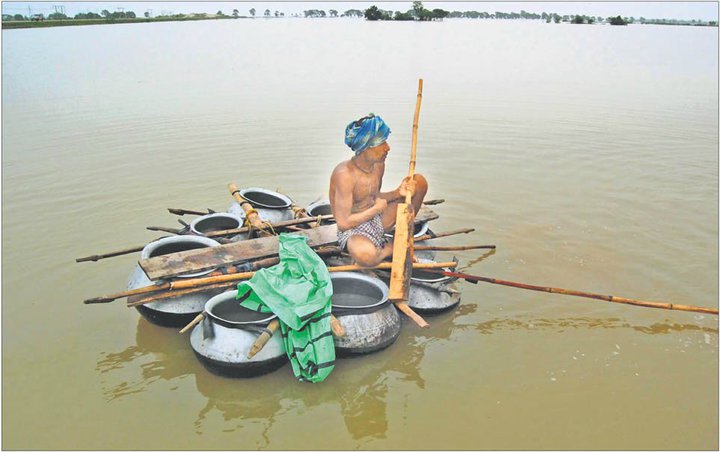
I posted possibility thinking blog yesterday and one of my friends, Amol, responded to one of the photo I posted on Facebook earlier. The context of the image and the image is as follows – Necessity is mother of inventionThis was a photo in Mid-day (a newspaper in Mumbai) sometime in 2007/08/09. I do not own the copyright for the picture.
Posting this photo for sensitizing people about problem in some parts of India…
Caption for this image in Mid-day was – Father of Invention.
Response of my friend to this (possibility thinking) is
I see few good things in it…
1. It supports “go green” concept as this boat is not made of wood – saving trees..
2. It shows next generation boat where one or two holes wont drown it – multiple air sockets help it float…at the same time, it has option for expansion due to open ends…
3. I see unity – multiple pots r helping together to keep this guy float
4. I see alternative way of selling veg/fish/flowers, etc. which can be carried out in these pots as permissible – fun way of shopping for me!
5. At the end of the day, u can bring home some fresh water… 😉
If he can do this without education, he can do ++ with education….
Today, after a long time I was watching Television, the channel was Fox History and program – building the ultimate: roller coaster. This program was a story of development of roller coasters, a very good and informative program. What struck to me was one development which was taken from the world war II German defense system. This system was a breakthrough in material for the wheel of the coaster. I started wondering, how these roller coaster designers took one thing (about 20 years old) from one place to different place and with some success. My take from this is – we can learn from anywhere; only basic need is willingness to learn and being open to possibilities. I heard some author earlier used a term – ‘possibility thinking’. This concept has been reinforced often to me. I have worked on TRIZ– the theory of inventive problem solving – and have worked on application of TRIZ (a very engineering based problem solving method) to social sector innovation and medical science etc. The concept of TRIZ is similar and very structured.
Possibility thinking Let me give one analogy – a glass is half-full. An optimist says – the glass is half full, a pessimist says – the glass is half empty and the possibility thinker says there is room for more water in the glass. Going one step further – what if the glass is not there? Some would say – Glass IS (many possibilities). In my opinion this is possibility thinking; when you say Glass IS, you open opportunities to think more and more about what can be? The challenge is to switch back and forth from structured to more creative thinking.
Coming back to the point of learning, the idea I want to reinforce is – we can learn from anywhere; only basic need is willingness to learn and being open to possibilities. The idea of this blog – Business to the Buddha was similar concept.
References –
1. Fox history schedule – http://www.foxhistory.com/Schedule/Daily.aspx
2. Glass half full – http://www.zazzle.com/glass_half_full_23_poster-228602679415734701
My professor, Professor Tomas Lopez often wraps his lessons in simple and interesting ways. His one of the lessons was very simple, profound and meaningful. That lesson was defining meditation (not literally though) for the corporate leaders, for the young generation and for the affluent golfers. The lesson was so disguised that prima-facie it looked as it is a lesson on golf (or marketing). However, the profound meaning was for everyday and the soul. In simple words he said – do not force yourself for doing things, let the things happen through you. Trust this message is clear.
Let me give you the verbatim statement – “you know what, marketing is like playing golf, you have to swing naturally”. In other words – chances are the harder you try the miserably you fail. So, do not force, let the things happen naturally. ‘The harder you try the miserably you fail’, I heard/read it somewhere… you know where!
First thing first, why this title to the blog? Does Business and the Buddha sound ok together? Is there any connection? Let me explain origin of this thought and why I see there is relation between business and the Buddha.
I was reading a book – old path white clouds, walking in the footsteps of Buddha – by Thich Nhat Hanh. There were many lessons of Buddhism in the book. One which stuck to me very profoundly was – interdependent co-arising. My interpretation of the concept in layman’s terms is – we all grow when we help each other to grow whether it is our subordinates or our competitors.
“When Ferrari and Honda run on the racing track competing for the first spot, they are not eying at the first spot, they are racing to offer best product to their customers.” The Buddha’s teaching on ‘Dependent co-arising’ teaches me this. “Each one of us is a rung of a ladder to the other and vice versa, hence for self development and moving higher up, one’s ladder should be strong enough, even one’s competitors.” I believe this will be the extension of P&G’s present approach of Connect & Develop in future; working on various fronts with the competitors such as IPR – strategically innovating – besides others.
What I feel is as we evolve as humans further, such philosophical concepts will come in our main stream without our conscious knowledge. We studied a case in our marketing course recently, launch of Z3 (BMW car) with the New James Bond movie Golden Eye. This was again a case of interdependent co-arising. How many knew about this?
Effectively, the title of business to Buddha looked apt to me. The other reason for the same was – these two seemingly different concepts encompass almost everything on which I would possibly write on the blogs. Therefore, I selected the title with its caption – Everything from earthly and unearthly. The blog would be my thoughts from physical to metaphysical all. I trust I will be able to keep pace with life and still take time to write some or the other things on the blog.