Tag: system

  • Syādvāda – The Doctrine of Postulation


    I had written about this earlier, however thought to revisit the same again. What is the meaning of system when it is not solving the required purpose? Let us take the same example again from my previous post Lost in translation. What is the meaning of grammar (System) if the language (Following the system) is not able to communicate the message using the grammer?

    To make my point further clear, let me take recent developments in India. In case of Anna Hazare, the Government was shouting about the SYSTEM in place, “THE SUPREME PARLIAMENTARY PROCESS” and therefore was not relenting to the rightful issue of sentiments of the common man of India. What is the use of such process which is not listening to the voices of people, and we call it DEMOCRACY! At the same time, Supreme court of India has kept death sentences (ruled in favor of High Court) for Killer of Mr Rajiv Gandhi and Afzal Guru (involved in parliament attack of 2003), let me repeat – Supreme Court of India. Yet for many years they are in jails of India. Now, the system of respecting the Supreme Court is not followed. What kind of SYSTEMS we are talking about?

    A man/woman – actually killer in some sense – is in jail not receiving the fruits of his/her crime, why because we can do away with some systems selectively to suit our benefits. At the same time a man (Anna) – who is fighting for a cause – is given rule-book and all sorts of stories of systems, stating what he is doing is not in favor of democracy. What nonsense! Are not these systems making us handicap rather than helping us? Is the system making us feel – in India, you can get away with murders too?

    Reiterating this from my earlier blog – …I am not arguing against systems. I am just trying to say that one has to answer the question – why at first place we designed systems?

    1. to facilitate operations of society (in case of religion, culture and laws)
    2. to facilitate operations of work (in case of businesses).

    Inputs from Prof Mankad on need of system –
    3. to facilitate understanding of the present and formulating vision for the future (in case of education)
    4. to facilitate orderly day to day living for people, ensure fairness in dealings, security and openness (in case of governance, transparency and judiciousness). At times, systems are inadequate too.

    And therefore my stand is no spiritual teacher advocated “create a religion in my name” …and do business on the same. They just showed the path, I recall Mahavir (one of the messengers of Jainism) used ‘Syādvāda’. What I understand about ‘Syādvāda’* is – this is true and that is also true. Everything is based on relativity. Systems are correct if they solve the basic purpose, if they do not – better to change them. Everything of 12th century (or Before Christ) may not be relevant today better abolish some of them, right? So, relevance is important and thus the doctrine of postulation… systems are correct but in context, be it democracy of India. Mahavir said that 500 years BC (Before Christ), we are still not listening/learning, are we?

    More on Syādvāda in future blogs.

    *Note – it is purely my understanding and please do your research for references

  • The line of understanding


    I heard a story that a person was ready to change his religion because of the strange rituals followed in time of demise of someone in the family. The question to ask at such times is – Are we meant for systems or systems are meant for us?

    A mobile operator and a credit card company did the same with me. I always paid bills on time, at times in advance! Yes, I paid 1/3rd of my credit limit in advance. The problem with them was they did not listen to my problems because of an error in their system! Yes, ‘paralysis of system dependency’ – I would call it – could result in loss of business. I have also heard and witnessed in some cases – not invented here! and cannot work in this setup, type of comments. The reason for such limited thinking is our dependencies and self imposed limitations. I recall one of my senior facing similar situation, told to the client – are tum karo to sahi, bad me dekhenge kya problem hai. (You just do it we will analyze if there is any problem). He could say this with confidence because he knew what works, what is going to work and importantly he was not the part of the system.

    I am not arguing against systems. I am just trying to say that one has to answer the question – why at first place we designed systems? Answer is to

    1. facilitate operations of society (in case of religion, culture and laws)
    2. facilitate operations of work (in case of businesses).

    We resist change – because we have become inured to our system. See what is happening in case of banking reforms in USA. The situation is dire, yet reforms seem to be a tough nut to crack.

    How long are we going to depend on systems and follow the system till death even if systems are not supporting our cause? Were systems made for making our life miserable? Well, I am not asking to rebel against systems, what I am giving a thought to is – why not critically look at why we are doing what we are doing and question our assumptions. These questions and issues if not addressed correctly create rebellion such as hippie movement.

    What I could see is – There has to be two lines drawn, one between system and understanding its short comings and the other is understanding and rebelling against the system. I would call that line ‘the line of understanding’. More on this in future when I take information age Vs other ages.

    I know this all seems a very weird connection, starting with religion, talking about my personal experience, challenge of a consulting assignment and then banking reforms and lastly to hippie movement! The reason I found is – in the end we all are human being, and everything connects somewhere. The need is to learning to see (oops its a title of a book on LEAN, which I have not read yet) and yes questioning assumptions.

  • Double dip!!


    “There seems to be high likelihood of double dip!” When we heard our professor of macroeconomics Prof Mankad say that we could not believe it. I recently thought to plot some charts and realized that human sentiments are also equally responsible for this. The following is a graph, here we see an increase in the center yet once the peak is achieved there is a drop and no gain. Some call it correction. Well, frankly speaking these are my semester-wise undergrad scores.

    When I had a quick look at the graph I said – ok! I did ok initially, and then my performance dropped, it hurts I improved myself and went down back somewhat. Alas! My undergraduate was over therefore I could not extrapolate things. Yet, if you sem one to two movement there seemed some similarity.
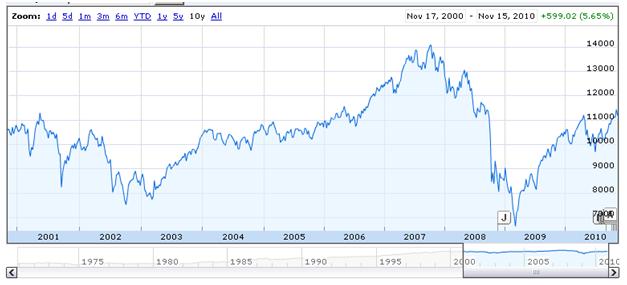
    I tried relating it to the last 10-years NYSE performance. There were phenomenal similarities. I took 10 year performance because it seemed to me that post DOTCOM bubble burst would be a good point to start from, and some other logics. See sentiments are again at work.

    Then I thought about the statement of Prof Mankad, double dip, what about that? There could be a possibility of double dip, why, how and when? Yesterday I was reading Financial Times front page news – Ireland resists bail-out pressure, and viola I got a hint. If nothing is done at this time perhaps the other bottom is not far.
    I recalled another part of macroeconomics class. “Essentially all banks are bankrupt.” Though for self satisfaction we may call them BANKS, on which we bank. Nonetheless banks are sitting eternally on a time bomb ready to explode any time. The bomb of Debt!
    If Ireland does not accept the support from EU perhaps we all would be doomed to see the second dip. The situation is a double edged sword – the world needs an enhanced banking system yet what I read somewhere “if you actually tried to manage according to the regulatory measurements, your bank would fail.” At such times I resort to TRIZ – the theory of inventive problem solving. I would comment on the SYSTEMS in general and TRIZ in next posts.