Tag: Religion and Spirituality

  • Education, religion and spirituality

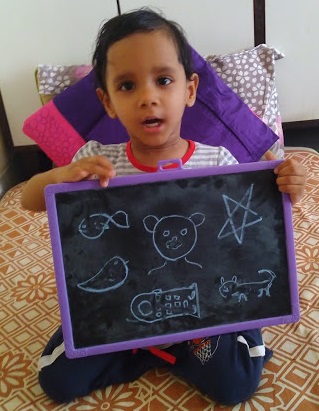
    Adviti showing sketch

    Adviti is attending school now, this started off with thoughts on education, religion, and spirituality. She is three years and we opted for online schooling finally. We avoided it initially, but the Chinese virus (Covid-19) gave us no option of formal school for her. It has been only two weeks. This time around the questions were more than just why do we educate kids? and also the race we start with our kid’s schooling.

    During our primary education, we read this story in our syllabus. This is apt for our life in general and I take a parallel from this story in religion and spirituality as well. Let me first narrate the story to you.

    Hunter and the parrots

    A jungle was famous for its species of parrots. One day a hunter crossed by this jungle. He was mighty impressed with these different types and colors of parrots. The hunter put his net and no wonder he could catch a lot of parrots. He sold those in the market and made a lot of money. He started visiting this jungle often.

    Brighter-day

    A sage lived in this jungle too. He observed that the number of parrots was drastically reducing. Sage being sage, compassionate, and friendly to every animal of the jungle, started teaching these parrots.

    The sage taught these parrots –

    The hunter comes, spreads his net,
    puts some grains, we should avoid this trap

    The exact words we learnt in the Hindi version was 

    शिकारी आता है. जाल फैलता है.
    दाना डालता है. हमें जाल में नहीं फ़सना चाहिए।

    The parrots learned it quickly. They started singing it all the time. When the hunter came he was taken aback. He was fearful now he won’t get these parrots. With a heavy heart, he put his net again. To his surprise, all the parrots were in the net and singing the same song

    The hunter comes, spreads his net,
    puts some grains, we should avoid this trap

    With immense pleasure, he took his prized possession. This time he had value-added parrots – parrots who spoke language!

    When the hunter crossed sage’s hut, sage was smiling. He saw all the parrots singing the song inside the trap that they had to avoid.

    The moral of the story

    We must learn instead of rote memorization. we must learn instead so that conceptual learning can be applied in many walks of life.

    Additionally, there are chances that someone says one thing but does another. We must learn two things – first, we must walk the talk, and second, identify people who do not walk the talk and be cautious.

    Education

    When Adiviti sits for her school sessions, I sit with her. Initially, I was frustrated (at times now too) with her slow response. She knows the things but does not respond, at times she does not understand – because she predominantly understands Marathi and Hindi and not English. She does not follow instructions.

    We learn a lot of very basic and important things in our schools. How much do we apply in our life? Be it learning instead of rote method or the basics – do not steal, do not tell lie, etc.

    Religion

    Another thought triggered in my mind. We learn almost all the ten commandments of Abrahamic religions in School, isn’t it? Most of the religion teach such basic things in our life. If this is the only lesson of religion our school or syllabus of school education is no less than a religious book. In fact, in this case, the schools and education are much more than many of the religions of the world.

    Though I know I have made this comparison on a very high level. In whatever case, what more the religions teach? Follow what is taught, in some cases do not use your brain. Do not question the authority, isn’t it?

    Religions that do not allow questioning is far lesser than school education. At least school education allows asking questions!

    I am a born Hindu (a Lingayat), I have questioned almost everyone and everything religious since childhood. When I was unconvinced I stopped going to temples. When I started understanding few things about Hinduism and started reading few scriptures, I realized many scriptures are dialogs. On the battlefield, Arjun asked questions, Janaka asked questions to Ashtavakra, and Vashisth and Rama discussed multiple things. When someone wrote Upnishad no one asked to believe those by force.

    The Buddha or Mahavir (and other Tirthankaras of Jainism) also gave the point of view without forcing others to accept those as gospel truth.

    Spirituality

    I have written on religion vs spirituality earlier. In that blog, I had given an analogy between religion and spirituality to sex and love. Since now I am looking at education, I created another analogy between education and learning to religion and spirituality. You can learn without formal education. I have heard of a past CM of Maharashtra – Vasant Dada Patil He was educated to only 4th grade. However, he was the harbinger of the robust canal and irrigation system of Maharashtra.

    If we look at multiple definitions of spirituality what best comes to my mind is – “search for meaning in life”. I can connect to the Indic religion (Buddhism, Jainism, and Hinduism) to a large extent. Spirituality is beyond any geography, religious rituals, and believing in a single book alone. Spirituality includes every living being – I can write more on that however that is for some other day.

    In fact, if I take the freedom to extrapolate the story, the hunter (शिकारी) is our false sense of self, net (जाल) greed, lust, ego etc and the grains – bait – (दाना) is our false sense of satisfaction or pleasure. We should not get in the net (जाल), here WE is the SELF.

    Education, religion, and spirituality

    What I have observed is that education and religion are like parrots in the cage. They know what they are saying but they do not understand the meaning of what they are saying. It is with many people and religions worldwide. In fact just because of that either we see terrorism or atheism in the world. People have either lost trust in religion or they are so faithful that they see killing those who do not comply with the point of view of the killer.

    At the same time, learning and spirituality are conceptualizing, synthesizing, and questioning, and exploring. Learning involves a sense of experience similar to spirituality. Look at religion you would get a lot of people who can reiterate books word by word without knowing and experiencing. This is what differentiates religion and spirituality.

    I saw a tweet from Elon Musk once – “I hate when people confuse education with intelligence, you can have a bachelor’s degree and still be an idiot.”

    Education, intelligence Elon Musk tweet

    The corollary, in this case, is – one can be known for religion and religious knowledge without actually being a spiritual master. Whereas Spiritual masters many times are against the dogmas and are more practical and clear about what they say, do, and mean.

    Adviti’s schooling is a learning experience for me. I have to get off the showjumping thing we have observed. I have to let her learn at her own pace. What matters is how intelligent she becomes with the education not how much she scores in school. What is more important is she becomes a virtuous person who walks the talk – not like the parrots who are in the cage reiterating the lesson –

    The hunter comes, spreads his net,
    puts some grains, we should avoid this trap

    The exact words we learnt in the Hindi version was 

    शिकारी आता है. जाल फैलता है.
    दाना डालता है. हमें जाल में नहीं फ़सना चाहिए।

  • Clinging to wealth


    prayer of frogThere have been many Messiah, and many have learnt to have peaceful life because of them. There are many who have learnt violence, the lessons were given and listeners have learnt what “they wanted” to learn. It is up to you what you learn.
    The invention of this story is not to hurt any religious sentiments. Here goes the story.

    A wealthy farmer burst into his home one day and cried out in an anguished voice, “Rebecca, there is a terrible story in town—the Messiah is here!”

    “What’s so terrible in that?” asked his wife. “I think it’s great. What are you so upset about?”

    “What am I so upset about?” the man exclaimed. “After all these years of sweat and toil we have finally found prosperity. We have a thousand head of cattle; our barns are full of grain and our trees laden with fruit. Now we will have to give it all away and follow him.”

    “Calm down,” said his wife consolingly. “The Lord our God is good. He knows how much we Jews have always had to suffer. We had a Pharaoh, a Haman, a Hitler—always somebody. But our dear God found a way to deal with them all, didn’t He? Just have faith, my dear husband. He will find a way to deal with the Messiah too.”

    Source – Prayer of the Frog Vol I and Vol II by Father .

  • Neeraj in Kabir’s style


    Gopaldas Neeraj is an Indian poet. He wrote many poems, some I studied in my course work may be. I remember his Bollywood songs such as O meri sharmilee (from the movie Sharmilee) and Phoolon ke rang se, dil ki kalam se (from the movie Prem Pujari) etc. Read more poems here, and one of his poetry book.

    The most I like (rather love) is below – Neeraj ka Kabirana andaz. This poem I copied in a diary in 1998, found that diary when I was relocating recently. The poem title in English can be Neeraj in the style of Kabir. Kabir is (was) a sufi saint in India in 1500’s. Kabir wrote many things (called Doha) and tried uniting Hindu’s and Muslims (against their religious “blind belief system” to an awakened self). Here goes Neeraj (trying to translate in English – bold part below – for readers of other than Hindi readers). This translation is line by line translation. In some places a line should be read after the next line e.g. Line Number N+1 should be read before line number N.

    नीरज का कबीराना अंदाज़

    दिल के काबे मे नमाज़ पड़ (Dil ke kabe me namaz pad – pray in your heart)
    यहाँ वहाँ भरमाना छोड़ (Yahan vahan bharmana chhod – do not shout everywhere)
    सांस सांस तेरी अज़ान है (Sans sans teri azan hai – every breath is a call for prayer)
    सुबह शाम चिल्लाना छोड़ (Subhah sham chillana chod – do not shout day and night)

    उसका नूर ना मंदिर में है (Uska noor na mandir me hai – HIS glory is neither in temple)
    उसकी ज्योति ना मस्जिद मे (uski jyoti na masjid me – nor HIS glory is in any mosque)
    जिस मोती को ढूंड रहा तू (jis moti ko dhund raha tu – the pearl you’re searching for)
    वो है दिल के समंदर मे (vo hai dil ke samandar me – is within the sea of yourself)
    भीतर गोता मार बाहरी (bhitar gota mar bahari – jump Within O! worldly person)
    ये सब खोज खजाना छोड़ (ye sab khoj khajana chhod – do not search outside)

    जो कुछ बोले है पैगंबर (Jo kuch bole hai paigambar – whatever Paigambar said)
    वही कहा सब संतों ने (vahi kaha sab santon ne – same is said by other saints too)
    लेकिन उसकी मानी बदले (lekin uski mani badle – but the meanings have been changed)
    सारे भ्रष्ट महंतों ने (sare bhrast mahanton ne – by all the corrupt religious representatives)
    पंडित मुल्ला सब झूठे है (pandit mulla sab jhute hai – Pandit, Mulla all are liers)
    इनसे हाथ मिलना छोड़ (inse hath milana chhod – leave them, dont follow them)

    खुदा खलक से अलग नही है (Khuda khalak se alag nahi hai – God is not separate from creation)
    इसमे ही वो समाया है (isme hi vo samaya hai – God is within the creation)
    जैसे तुझमे ही पौषिदा (jaise tujhme hi poshida – as your own body)
    तेरा अपना साया है (tera apna saya hai – has its shadow)
    दुनिया से मत दूर भाग (dunia se mat dur bhag – do not run away from the world)
    बस मन की दौड़ लगाना छोड़ (bas man ki daud lagana chhod – stop running within your mind)

    पूजा पाठ नमाज़ जप (puja paath namaz jap – worship, Namaaz, chant everything)
    सब छलना और दिखावा है (sab chhalana aur dikhava hai – are show-off & cheating)
    दिल है तेरा साफ तो (dil hai tera saf to – if you heart is pure)
    तेरा घर ही काशी काबा है (tera ghar hi kashi kaba hai – your home itself is Kashi & Kaba)
    मकड़ जाल है ये सब जग के (makad jaal hai ye sab jag ke – this all is a cob-web)
    इनका ताना बना छोड़ (inka tana bana chhod – leave these framework)

    तू ही तो संसारी है रे (tu hi to sansari hai re – you are the worldly)
    और तू ही संसार भी है (aur tu hi sansar bhi hai – you are the world)
    कैदी तू ही, जैल भी तू ही, (kaidi tu hi, jail bhi tu hi – you are the jailer, you are the jailed)
    तू ही पहरेदार भी है(tu hi paharedar bhi hai – and you are the sentinel/guard)
    तीन गुनो वाली रस्सी मे (teen guno vali rassi me – a knot with these three attributes)
    अब तो गाँठ लगाना छोड़ (ab to gaandh lagana chhod – do not knot this rope)

    Specially in this I like the last bit (I would not want to write that in English, as the translation seem to lose the meaning –

    …दुनिया से मत दूर भाग
    बस मन की दौड़ लगाना छोड़…

    …कैदी तू ही, जैल भी तू ही,
    तू ही पहरेदार भी है…

    Whole world is created by our mind – we are the jailer, sentinel and jailed…

    Kabir Good read

  • Yoga – Secular or not?


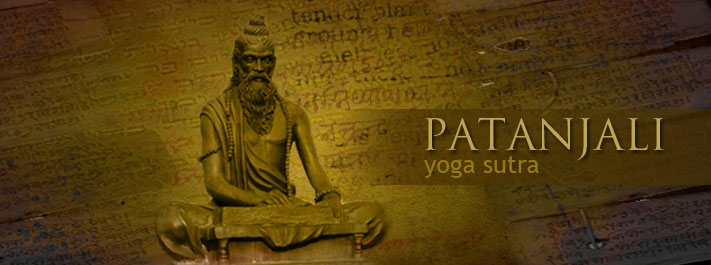
    Patanjali Yoga Sutras
    Source – Art of Living website

    It takes a lot of time for courts to offer a judgement, there are argument and counter-arguments. Logic and intuition fails if you do not have proof. That’s why Indian courts take 20 years even for high profile cases (e.g. Mumbai bomb blast), small cases are either solved out of court or not at all during the life time of an accused / plaintiff. Galileo died and hundreds of years later (in 1992) Churches exonerated him of the heresy – of saying Earth if not flat. People do not think logically and thus recently I have been bothered by fanatics on Twitter (follow me on Twitter @krdpravin). So, I feel petty on some things. Well, today I want to write about whether Yoga is secular or not?

    Disclaimer – I am discussing Yoga as Patanjali Yoga Sutra I am not an “authority on Yoga”.

    There was a case filed in California- “Yoga can not be taught in schools as Yoga is not secular”. Effectively the contention was Yoga is actually Hindu religion. California Judge rejected this claim.  Yet there is little more discussion needed on this.

    Think – is breathing secular or not? In yoga Patanjali has talked about Pranayams – breathing exercise. Is remembering (concentrating, meditating on) any God or whether Jesus or other prophet related to only “Hinduism”? Yoga talks about meditating on deity too. Is speaking truth not secular? I can list few more food for thoughts, however let me instead brief on Patanjali Yoga Sutra. Patanjali was a sage, he existed before Christ and had written Yoga Sutras. The sutras have eight limbs –

    1. Yama – 5 abstinence – non-violence, truth, non-covetousness, abstinence and non-possessiveness.

    In today’s world we need all these virtues, very importantly non-covetousness, non-possessiveness. Financial crisis is result of covetousness

    2. Niyama – 5 observances – cleanliness, contentment, austerity, reading scriptures, surrender to god.

    Here one may argue – reading scripture is religious. Did Patanjali say do not read Bible? Even in Surrender to God it is not mentioned that the God has to be only HINDU God!

    3. Asana – Discipline of the body and body posture.

    Largely – people all over the world (include many Indians and Hindus) think Yoga means Asana. Asana is just 12.5% (e.g. 1 part of 8 fold path of Patanjali) of what Patanjali said about yoga. Also, can you say that whatever games played in Olympics are religion? In this context – Hinduism? No! right?

    4. Pranayam – Control of breath

    Common we call breath and this would be idiotic to call breathing non-secular.

    5. Pratyahar – withdrawal of senses from their external objects.

    Well, many of us would not understand this. This is not talked in many religions – this helps in being non-covetous, non-possessive and being content. This is where I think Yoga is far more evolved and different than any Western religion. Though Yoga is not a religion.

    6. Dharana – concentration of the Chitta upon a physical object (say a photograph of Jesus, a frivolous example – Computer mouse).  Take an example of Rosary (a bead) and remembering any mantra / God. Use of bead is common in Islam too. Who says Dharana is about only one religion? It can be followed by any person whether following a religion or not.

    7. Dhyan – Meditation. It is largely professed by Indian religions e.g. Jainism, Hinduism and Buddhism. So, meditation is also not specific to only Hinduism. Additionally if someone prays with complete devotion that can become meditation.

    8 Samadhi – oneness with the object of meditation.

    Yoga is a very evolved science, of course developed and practiced more than 2000 years ago. But yes Yoga is science, there is no religious seal on it. My Indian and Hindu friends may argue against me saying – it is Hindu practice with various arguments. Foreigners may argue on same lines and state Yoga is religion.

    Well, I am of the opinion – religion is very personal matter and not a group matter. So, if I follow yoga practice (which I do not) I may say Yoga is my religion. But otherwise yoga is a way of life beyond and above all the so call religions of the world – which effectively are cause of troubles, war (include terrorism), fundamentalism and superiority complexes. And yes, Yoga is above the courts and laws too.

    Most importantly – Now do you follow what religious fundamentalism is? I am putting Yoga above everything which is what happens when fanaticism creeps in making a suicide bombers. I did the same in above para (by stating Yoga is above all).

    Yet please remember – 1st step of Yoga has first abstinence – non-violence. This includes not having superiority complex also.

    Image source – http://www.artofliving.org/patanjali-yogasutra

    One of the Authority on Yoga is – Sri Sri Ravishankar (Guruji)

  • Miracles of life – are we sleeping?


    As usual, this story again comes from – ‘The prayer of the Frog’ by Father Anthony de Mello, S.J. The book has small stories and worth reading one at a time, sleep over the story and think what we can improve in our life?

    A man took his new hunting dog out on a trial hunt. He shot a duck that fell into the lake. The dog walked over the water, picked the duck up and brought it to his master.

    The man was flabbergasted! He shot another duck. Once again, while he rubbed his eyes in disbelief, the dog walked over the water and retrieved the duck.

    Hardly daring to believe what he had seen, he called his neighbor for a shoot the following day. Once again, each time he or his neighbor hit a bird the dog would walk over the water and bring the bird in. The man said nothing. Neither did his neighbor. Finally, unable to contain himself any longer, he blurted out, “Did you notice anything strange about that dog?”
    The neighbor rubbed his chin pensively. “Yes,” he finally said. “Come to think of it, I did! The son of a **** can’t swim!

    It isn’t as if life is not full of miracles. It’s more than that: it is miraculous, and anyone who stops taking it for granted will see it at once.

    At times I think the life itself is a miracle, we take it for granted. Naxals are killing, Terrorist are killing, in fact people are dying on pilgrimages to add to the trouble people are leaving ethics and morals to earn few bucks here and there (eventually we would leave everything here). I wonder if they would realize some time – life is a miracle live it, don’t kill anyone and be peaceful with what you have.

    Related blog – Don’t be empathetic

  • The circle, conflicts and avoiding conflicts


    Perform an experiment – a simple 2-minute experiment. Take a blank sheet of paper and a pen. At the center of the page, put a dot. What is it? A dot nothing else right? Now draw a big circle with the dot as the center of the circle. Now what is the dot? It is center of the circle, right? Everything on the page is around it “now”.

    The dot was nothing when there was no circular periphery. The dot was meaningless in itself. The periphery gave it a very powerful definition. It became the center of the existence e.g. the periphery. Now for a moment if you remove the dot (the center of the periphery), the periphery losses its definition. The periphery would not remain a circle without the dot “center”. This is interdependent co-arising in one sense for the center and the circle.

    Visualize the page you took is the universe and the dot represents you. We think that “I am” the center of the universe. This is the case with many of us – if not all. We are self centered. Everything is around me and everything should happen as per my desire. But there are more dots on the page with each one having its periphery, these periphery intersect which causes conflict. How to avoid the conflicts? I see there are three possible ways to avoid it –

    When I was searching for an image for this blog I found this image

    1. reduce the periphery such that only you remain in that periphery
    2. increase the periphery such that everything falls under it without intersection
    3. Make your periphery someone (only one) else with “full devotion”

    In Indian philosophical context first two could be path of meditation and third is path of devotion (Bhakti). Do you know any other? Please share.

    Image source – http://www.astronomyforum.net/blogs/astroval/106-where-center-universe.html

    A different perspective on dot – http://phataktejas.wordpress.com/2012/02/15/dot-hain-to-hot-hain/

  • Incentive to cheat – Problem with Democracy


    I read a book – Games Indians Play by Mr Raghunathan a Professor in IIM-A and CEO of GMR group. I have written on this book earlier too – Individually smart collectively dumb. The problems with Indian – supposedly sharp – minds is given below in story format.

    This story is from a book – ‘The prayer of the Frog’ by Father Anthony de Mello, S.J. This book has very interesting stories on religion, spirituality and human relations etc. The story precisely explains how we – Indians – think and act.

    A great festival was to be held in a village and each villager was asked to contribute by pouring a bottle of wine into a giant barrel.

    When the banquet began and the barrel was tapped what came out of it was water. One of the villagers had had this thought: “If I pour a bottle of water in that giant barrel, no one will notice the difference.” But it hadn’t occurred to him that everyone else in the village might have the same thought.

    This happens in Indian political system. Everyone thinks that yes there is corruption, but I am paid 100/- let me vote this corrupt politician. Others would not vote him… similar to the story above. Every poor person gets an incentive to cheat – that cheating is a responsibility of politician – development Vs one time benefit to voter – 100 rupee note or a quarter of alcohol etc.

    The interesting part is we Indians more complex yet cheat always. We think in two fashion. 1. the way story suggests above and 2. why should I do it when everyone else is cheating?

    Option two suggests that every Indian knows what others are going to do and thinks why should not I do the same?

  • Border-less world


    Let us imagine, a border-less world. A world where

    Source - http://praditaastarina.files.wordpress.com/2011/08/170580815_bbdabc8038.jpg
    Border-less world

    1. people can move from one place to the other without Visas
    2. goods and services can be bought and sold without import/export duties
    3. education is free (at least basic education)
    4. people would be free to do what they want to do (not taking law in their hand though)

    I believe both the leading economic “-isms” and many spiritual/religious “-isms” have been trying to do that for years.

    The economic “-ism” are capitalism and socialism. Socialists want this by making a world a single big society where everyone is working for the society. Capitalists are trying to do it through Washington Consensus and IMF. Until now the results have been failure. Russia failed, China becoming a capitalist USA (being protectionist) walking on the way to become more socialistic. Seems There could be a middle path where both these -isms are together.

    Religious groups “-ism” are Christianity, Islam, Buddhism, Hinduism etc. Christianity wants the world to be Christan, Islam talks about Universal brotherhood. I am not sure about the other two asking people to convert to their religion though. However, Hinduism talks about Vasidhev Kutumbakam. Vasidhev Kutumbakam means one world family. But the idea all over the world is unity and unifying the world in different ways.

    All this is failing because – the ulterior motives are money or fan following (I mean increasing number of followers of the religion).  Since both they ways seem not working, what if we turn to something else, no politician, no economist and no religious group to lead. People leading the people’s movement!

    Take the following case – Social media for social service, crowd sourcing based funding (crowd funding) and initiatives such as Janlokpal (India), Occupy Wall Street (USA), Jasmin revolution (Tunisia) and Tahrir square (Egypt) etc. If people are empowered yet are asked not to encroach on others freedom. What if we really become an educated world, without politics, without divisions, without borders.

    This may happen if we remove ego and greed from our society!

    Image Source – http://praditaastarina.files.wordpress.com/2011/08/170580815_bbdabc8038.jpg (Apologies for delayed update, it was updated in the image description but not visible on view)

  • 33 – Understanding change and change in understanding


    33 Understanding change and change in understanding is a book by Richard Saul Wurman. You know TED conferences? He created that. I want to write a lot of blogs (perhaps one for each page from the book).

    Professor Mankad gave this book to me, when I requested him for opinions on few of my blogs. The book is very interesting, I will read it again before giving back to him. Today I am referring to a chapter of the book – I am a zoo episode.

    The protagonist is astound at the arrogance of man. The author writes – “… they are just so proud of themselves in all their various religious books, the Bible, the Koran, the Book of the Dead, the Bhagavad Gita and many, many more.

    In every one of these tomes it was man this man that man, and besides the fact that it was men and women, the arrogance of thinking of ourselves as a single species just amazed the Commissioner…”

    “Bacteria, the Commissioner knew, subdivide and reproduce, in effect multiplying by division. The human body… …has many trillions of cells and 90% are bacteria!…”

    “I am a zoo, the commissioner said, Because that is what I am. It would be only religious arrogance to see myself as a single species.”

    I wonder if the author wanted to say zoo in terms of our thoughts too. We have so many so diverse thought that we are a zoo and a jungle within our mind too.

    We are much more than what we think we are. I was recently talking to my father and he suggested – “we are made of various tissues, tissues are made of cells and molecules and atoms and particles. Now each particle is in effect an energy packet. So we eventually are indestructible in that sense.”

    What we need to remember is – understanding the change helps in change in understanding!

  • Death!


    Is death the ultimate truth? I asked this question to myself a couple of times during last weeks. I wrote a tribute to Dadaji on his birthday as he passed away in Jan 2012. I met with Rajgopaul uncleji recently; his father also expired recently so did my maternal uncle.

    I learnt a great deal from my uncle. He was very active and hardworking. The most critical lesson to learn from him was – working with complete responsibility, commitment and without much of expectations. I saw his this ethic resulting in fruition always. He did few businesses and was very successful. He also inculcated these ethics in my cousins. A hundred bows to my uncle. I cannot forget him and his subtle and effective teachings without teaching those extrinsically to us.

    My uncle’s death made me think very seriously about death – “Is death the ultimate truth?”. I have heard that our cells die every second and thus in a couple of months we are completely a new person. It is true that physically we change. In fact the reality is – the day we are born we start dying. (I think Osho said that). So physically, I am not the same Pravin who started writing these blogs about 2 years back. The one who used to write earlier and the one who is writing today is different. Yet, there is still a connection, I personally know that I am the same Pravin who used to blog, is blogging and hopefully keep on blogging at “business2buddha @ wordpress”.

    The question to ask is – what is that which does not change even if physically we change a lot? “That something” which does not change keeps us the same, perhaps it does not die. So with death does it die too? I believe the concept of Soul or Atman in Hindi, has evolved from the same question.

    I wonder if death is the ultimate truth, but I believe that there is something which defines an individual – something beyond the physical being.

    Books I read on Related topics –

    Same Soul Many Bodies

    Many Lives, Many Masters

    Only Love Is Real